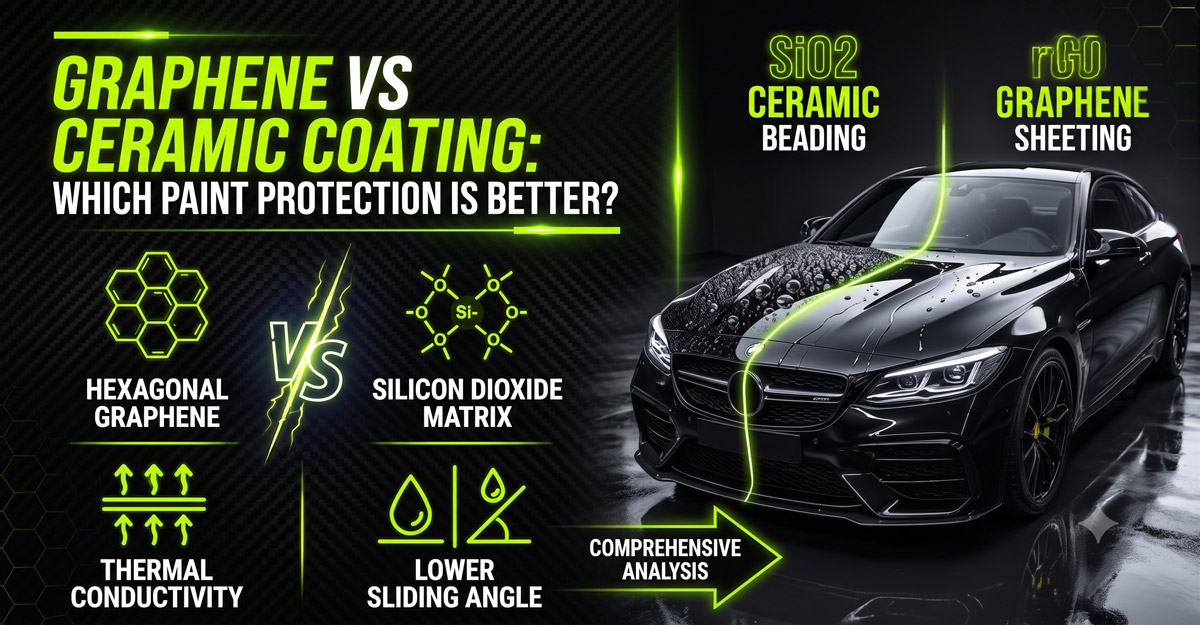
Protecting your vehicle paint from environmental fallout, ultraviolet degradation, harsh road salts, and chemical contaminants is a primary priority for vehicle owners. For years, silicon dioxide based ceramic coatings represented the gold standard in long lasting surface protection. They offered unprecedented gloss, hydrophobic water repelling action, and multi year defense that rendered traditional carnauba waxes and synthetic sealants obsolete.
The detailing industry has evolved with the introduction of graphene infused coatings. Marketed as a revolutionary breakthrough, graphene coatings promise higher thermal resistance, reduced water spotting, anti static dust repulsion, and extended operational lifespan.
Is graphene coating truly superior to traditional ceramic coating, or is it an incremental refinement wrapped in clever marketing? This comprehensive analysis breaks down the chemical formulations, real world performance metrics, thermal dynamics, application nuances, and cost structures of both options to help you choose the ideal protection for your vehicle.
Chemistry Breakdown: SiO2 Ceramic vs Graphene Oxide Coatings
Understanding the practical differences between these two protective barriers requires examining their core chemical architecture. Neither product functions as a liquid metal shield, and both rely on advanced polymer science to bond with clear coat finishes.
Surface Coating Matrix Comparison
Comparing molecular bond structures, heat distribution, and hydrophobic behaviors.
Ceramic Coating Matrix
SiO2 Network- Structure: Hard, glass-like rigid surface network
- Thermal Profile: Retains ambient heat under direct sunlight
- Water Behavior: High surface energy traps standing water beads
Graphene Coating Matrix
SiO2 + rGO Lattice- Structure: Hexagonal carbon lattice dispersed within SiO2 resin
- Thermal Profile: Conducts heat across surface to disperse hot spots
- Water Behavior: Low sliding angle causes droplets to roll off rapidly
The Science of Silicon Dioxide (SiO2)
Traditional ceramic coatings are formulated using silicon dioxide nanoparticles suspended in a clear liquid carrier solvent. When applied to vehicle paint, these solvents evaporate, allowing the silicon dioxide molecules to crosslink with the microscopic pores of your clear coat.
This process forms a crystal clear, glass like ceramic resin layer measuring roughly one to two microns in thickness. The resulting matrix creates a rigid barrier that resists chemical attacks from bird droppings, bug splatter, and acid rain while producing an intense wet look shine.
Understanding Reduced Graphene Oxide (rGO) Infusion
A common misconception in the automotive industry is that graphene coatings consist of pure, single layer carbon sheets. Pure graphene is an ultra thin, highly conductive honeycomb lattice of carbon atoms that is difficult to suspend in liquid form for automotive application.
Commercial graphene coatings are liquid silicon dioxide or siloxane matrices infused with reduced graphene oxide molecules. The ceramic base acts as the binder that adheres to the clear coat, while the graphene oxide flakes act as a high performance additive. This hybrid formulation enhances the structural flexibility, slickness, and thermal conductivity of the traditional ceramic base.
Heat Dissipation and Water Spot Prevention Mechanisms
Water spots represent one of the most frustrating challenges for vehicle owners living in regions with hard water or frequent rainfall followed by intense sunlight.
Thermal & Water Droplet Dynamics
How surface heat dissipation directly impacts water spot formation under direct sunlight.
Ceramic Coating Profile
High Spotting RiskGraphene Coating Profile
Low Spotting RiskWhy Ceramic Coatings Suffer From Water Spot Etching
Ceramic coatings are naturally insulating materials that retain thermal energy. When a vehicle coated with traditional ceramic sits under direct sunlight, the surface temperature of the dark panels can spike dramatically.
Raindrops containing dissolved minerals such as calcium and magnesium sit on top of the hydrophobic surface as tall, round beads. The intense heat beneath the bead accelerates water evaporation. As the water evaporates quickly, it bakes the concentrated mineral deposits directly into the ceramic coating and underlying clear coat, creating deep mineral etchings that require aggressive machine polishing to correct.
How Thermal Conductivity Solves Mineral Etching
Graphene possesses extraordinary thermal conductivity, transferring heat significantly faster than copper or silicon dioxide. When reduced graphene oxide is integrated into a ceramic coating, it helps distribute thermal energy horizontally across the entire panel rather than trapping heat directly beneath standing water droplets.
By lowering the localized surface temperature of the panel in direct sunlight, graphene coatings slow down the rate of water evaporation. This extended evaporation window gives standing water droplets time to roll off the vehicle naturally while driving or during light breezes, drastically reducing the formation of stubborn hard water spots.
Hydrophobicity, Contact Angle, and Roll Off Angle Comparison
While both coatings provide hydrophobic water repelling properties, their performance under real world conditions differs based on two critical fluid dynamics metrics: contact angle and sliding angle.
Hydrophobic Performance Metrics
The water contact angle measures the angle formed where a water droplet meets the coated surface. A higher contact angle creates rounder, tighter water beads. Traditional ceramic coatings achieve impressive contact angles between 105 degrees and 112 degrees. Graphene coatings push this metric further, reaching contact angles between 115 degrees and 125 degrees.
The sliding angle or roll off angle dictates how steep a panel must be tilted before a water droplet rolls off under the influence of gravity. Graphene coatings feature a lower sliding angle compared to traditional ceramics. Water droplets begin moving off horizontal surfaces at tilt angles as low as 8 to 12 degrees, whereas traditional ceramic coatings require angles of 18 to 25 degrees. This low sliding angle creates an effective self cleaning mechanism during normal rain showers.
Technical Performance Specifications
To help you compare these technologies, the table below highlights the key physical, chemical, and operational attributes of premium ceramic and graphene formulations.
| Performance Feature | Ceramic Coating (SiO2) | Graphene Coating (SiO2 + rGO) |
|---|---|---|
| Core Chemistry | Silicon Dioxide (SiO2) Polymer | SiO2 infused with Reduced Graphene Oxide |
| Realistic Longevity | 2 to 5 Years | 5 to 7+ Years |
| Water Spot Resistance | Moderate (Prone to mineral baking) | Exceptional (High heat conductivity) |
| Slickness & Tactile Feel | Very High (Glass like hardness) | Ultra High (Smooth, silky feel) |
| Dust & Pollen Repulsion | Standard Static Retention | Anti Static Conductivity Properties |
| Visual Finish Character | Deep, wet look, candy like gloss | Rich, dark, reflective depth |
| Application Difficulty | Moderate (Requires careful leveling) | Moderate to High (Slightly darker tint) |
| Average Professional Cost | $800 to $1,800 | $1,200 to $2,500+ |
Durability, Scratch Resistance, and Chemical Tolerance
Vehicle owners often inquire whether liquid coatings can protect paintwork against stone chips, deep scratches, or harsh automated wash brushes. Clarifying the structural durability limits of both liquid barriers is vital.
Pencil Hardness Standards: 9H vs 10H Claims
The detailing industry relies on the pencil hardness scale, ranging from 1H up to 10H, to rate coating hardness. Standard ceramic coatings generally achieve a verified 9H rating, meaning they withstand scratching from a 9H graphite pencil applied at a forty five degree angle under specific pressure.
Graphene coatings are frequently advertised with 10H hardness claims due to the structural strength of carbon atoms. In practical terms, neither ceramic nor graphene coatings will stop high velocity road debris, rocks, or aggressive keying. They do provide outstanding resistance against fine micro marring, washing swirl marks, towel scratches, and light vegetation brushes.
Resistance to Chemical Acids and Alkalis
Chemical Tolerance Range (pH Scale)
Comparison of resistance against harsh acidic washes, bug removers, and caustic alkaline degreasers.
Ceramic Coating
pH 2 to pH 12 RangeGraphene Coating
pH 1 to pH 14 RangeVehicle paint encounters a wide range of chemical contaminants, from harsh alkaline degreasers and touchless car wash detergents to highly acidic bird droppings, bug splatter, and industrial fallout.
Ceramic coatings offer robust protection against pH ranges between 2 and 12. Graphene coatings extend this operational envelope, providing tolerance against pH ranges from 1 to 14. This high chemical inertia ensures that aggressive degreasers or road salts will not strip or degrade the protective layer during routine winter wash cycles.
Paint Preparation and Application Process Demystified
Regardless of whether you choose a ceramic or graphene coating, the application process demands meticulous surface preparation. The liquid coating will permanently lock in any existing defects, swirl marks, or contaminants present on the clear coat.
Surface Preparation & Application
Chemical Decontamination
Chemical CleanIron remover & tar solvent breakdown embedded metallic particles and road grime without touching the paint.
Mechanical Decontamination
Clay BarClay bar treatment pulls above-surface bonded contaminants out of the clear coat pores for a glass-smooth surface.
Paint Correction
Machine PolishMulti-stage machine polishing levels clear coat defects, eliminates swirl marks, and maximizes gloss depth.
IPA Surface Panel Wipe Down
SterilizeIsopropyl alcohol (IPA) wipe strips remaining polish oils and lubricants to leave bare, sterile paint for bonding.
Precision Coating Application & Buffing
Final SealApply liquid coating evenly in cross-hatch passes, monitor flash time, and buff level using plush microfiber towels.
Surface Decontamination and Correction Requirements
Before opening a bottle of ceramic or graphene coating, you must perform a multi step decontamination and paint correction procedure:
- Chemical Decontamination: Wash the vehicle thoroughly with a high pH strip shampoo, followed by an iron fallout remover to dissolve embedded brake dust and industrial particulates.
- Mechanical Clay Bar Treatment: Glide a detailing clay bar over the wet paint using dedicated clay lubricant to pull out deeply bonded grit.
- Paint Correction: Execute a single or multi stage machine polish to eliminate swirl marks, scratches, and oxidation. The paint must be as close to defect free as possible.
- Panel Wipe Eraser: Wipe down every panel using an isopropyl alcohol solution or dedicated panel prep spray to strip away lingering polishing oils and waxes, leaving a bare clear coat surface.
Leveling, Flash Times, and Environmental Curing Factors
Applying either coating involves crisscross crosshatching motions using a microfiber applicator pad. Once applied to a section, the coating solvent begins to evaporate, a phenomenon known as flashing.
Flash Time Observation Workflow
The crucial 1-to-3 minute window between applying liquid coating and leveling high spots.
Apply Liquid Layer
Suede Microfiber & Applicator Block
Apply coating in overlapping cross-hatch passes across a 2×2 ft panel section.
Observe Rainbowing
Sweating & Oil-Slick Effect
Watch for the liquid solvent to flash, creating an oil-slick rainbow appearance or small beads.
Buff & Level Surface
Dual Microfiber Towel Wipe
Wipe away residue with Towel 1, then buff to a crystal-clear mirror shine with Towel 2.
During flashing, the coating exhibits an oily, rainbow like haze on the panel surface. The installer must level and buff the coating using clean microfiber towels within a specific window of time:
- Flash Detection: Wait for the rainbow effect to appear, which typically takes between one and three minutes depending on ambient temperature and humidity.
- First Wipe: Use a low pile microfiber towel to gently level the high spots and spread the remaining product evenly.
- Second Buff: Follow immediately with a plush microfiber towel to buff the panel to a high gloss sheen.
Graphene coatings often feature a slightly darker tint during application, making it easier to spot high spots on light colored vehicles under proper detailing lights. Initial curing requires keeping the car completely dry for twenty four hours, while full chemical curing takes seven to fourteen days.
Cost Analysis and Value Retention for Vehicle Owners
Evaluating paint protection options requires balancing upfront investment against expected operational lifespan and vehicle maintenance requirements.
Estimated Cost vs Longevity Breakdown
DIY Ceramic Kit
$60 – $120
Lifespan: 2 – 3 Years
Cost/Year: ~$30
Pro Ceramic Install
$800 – $1,500
Lifespan: 3 – 5 Years
Cost/Year: ~$250
Pro Graphene Install
$1,200 – $2,500
Lifespan: 5 – 7+ Years
Cost/Year: ~$240
The primary driver of professional coating costs is not the liquid inside the bottle, but rather the labor hours required for multi stage paint correction. A professional detailer may spend anywhere from eight to twenty hours preparing the vehicle surface prior to coating installation.
For vehicle owners who plan to sell or trade in their car within two or three years, a traditional ceramic coating or a high quality DIY kit offers an exceptional return on investment. Conversely, long term vehicle owners, exotic car collectors, or owners living in harsh sun belts gain significant economic value from graphene coatings due to their extended durability and reduced maintenance overhead.
Top Recommended Protection Solutions in Today’s Market
Selecting the right product depends on your detailing expertise, budget, and desired longevity. Below are leading options across different application tiers.
Premium DIY Graphene Options
- Adam’s Advanced Graphene Ceramic Coating: Known for its integration of UV tracer technology, this product allows installers to shine a blacklight flashlight over the vehicle to ensure even coverage and spot un-leveled high spots. It boasts a rated durability of up to nine years with proper maintenance.
- Ethos Graphene Matrix Coating: Utilizing reduced graphene oxide combined with siloxane polymers, Ethos offers a slick, anti static surface that repels road dust and pollen. It is favored by DIY enthusiasts for its forgiving wipe on wipe off application process.
Established Ceramic Standard Bearers
- Gtechniq Crystal Serum Light: A consumer version of Gtechniq famous professional coating, offering 9H structural hardness, impressive gloss, and up to five years of durable protection against environmental fallout.
- CarPro Cquartz UK 3.0: Specifically formulated to perform exceptionally well in cold or humid climates, this high content SiO2 ceramic coating provides a rich, candy like gloss finish with exceptional chemical resistance.
Buyer Decision Matrix: Which Surface Protection Fits Your Needs?
To finalize your decision, review the scenario matching matrix below to determine which coating technology aligns with your specific ownership habits, environment, and budget.
Buyer Decision Matrix
Match your vehicle’s paint color, parking environment, and ownership goals to the ideal coating technology.
Choose Ceramic Coating If:
Budget & Light Paint- You operate under a strict detailing budget.
- Your vehicle paint is light silver, white, or light gray.
- Your vehicle is garage-kept overnight and sheltered at work.
- You intend to sell or trade in the vehicle within 3 years.
Choose Graphene Coating If:
Hot Climates & Dark Paint- You live in a hot climate with intense sun exposure.
- Your vehicle features dark blue, burgundy, or black paintwork.
- The car is parked outdoors and exposed to frequent rain showers.
- You want maximum self-cleaning action and water spot resistance.
- You plan to keep the vehicle long-term (5+ years).
Choose Ceramic Coating If:
- You want a cost effective, proven protection method with a track record spanning over a decade.
- Your vehicle is painted in lighter shades where minor mineral spotting or subtle gloss differences are difficult to see visually.
- Your vehicle spends most of its life parked inside a climate controlled garage, away from intense ultraviolet radiation and tree sap.
Choose Graphene Coating If:
- Your vehicle features dark or black paint that easily absorbs solar heat and highlights water spots.
- You live in regions characterized by sudden summer rainstorms followed by scorching heat waves.
- You desire the ultimate in slickness, anti static dust repulsion, and the longest available service life from a single detailing installation.
Summary and Maintenance Best Practices
Neither ceramic nor graphene coating is completely maintenance free. Both technologies require proper wash techniques to maintain their hydrophobic performance over time. To preserve your investment:
- Use a pH neutral automotive shampoo free from added waxes or gloss enhancers.
- Practice the two bucket wash method with grit guards to prevent wash marring.
- Apply a ceramic or graphene maintenance topper spray every three to six months to rejuvenate the top layer hydrophobicity.
- Remove bird droppings and insect splatter promptly using a soft microfiber cloth and quick detailer spray.
By matching the coating technology to your climate, paint color, and ownership goals, you can keep your vehicle finish looking showroom fresh for years to come.
Next Step: Ready to Transform Your Vehicle Paintwork?
Ready to protect your vehicle with professional grade paint protection? [Schedule a Paint Protection Consultation] with our certified master detailers today. Our team will inspect your clear coat thickness, recommend the ideal coating package for your budget, and deliver a flawless, high gloss finish that lasts for years.