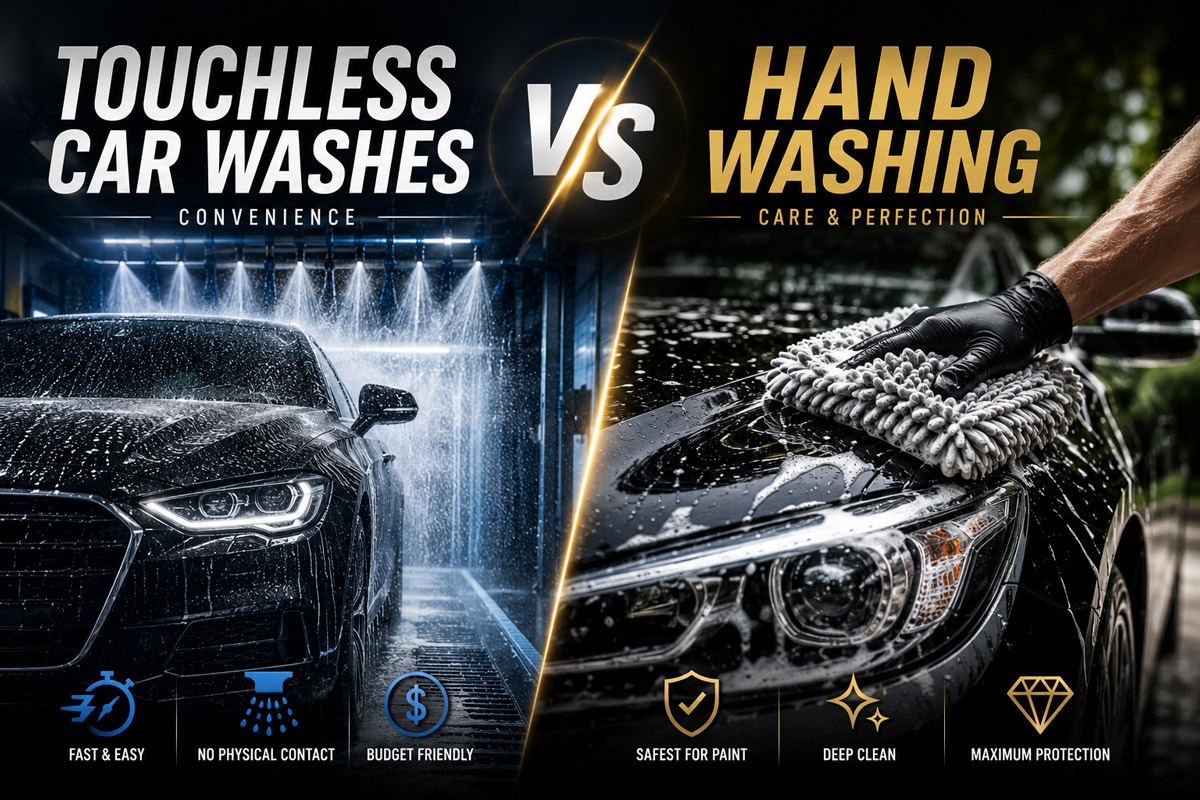
Maintaining the exterior beauty and financial equity of a vehicle requires consistent care, yet vehicle owners frequently face a fundamental dilemma: touchless car washes vs hand washing. Every automobile comes finished with a multi layer paint system consisting of an e coat primer, a color base coat, and an outer clear coat that measures merely 100 to 150 microns in thickness. This razor thin clear coat shields your vehicle against oxidation, ultraviolet rays, and environmental contamination. However, improper cleaning techniques can permanently ruin this protective shield through severe scratching, chemical haze, or protective coating degradation.
Automotive enthusiasts and daily commuters alike often wonder whether automated convenience outweighs physical detailing precision. While automated touch free bays promise quick zero contact cleaning in less than ten minutes, manual hand washing relies on targeted mechanical agitation to lift stubborn traffic film. This comprehensive article delves deep into the engineering, chemistry, cost structures, and paint safety factors of both cleaning methodologies to help you make an informed decision for your vehicle.
Understanding Touchless Car Washes: Technology, Chemistry, and Mechanics
Touchless car washes represent a major technological evolution over legacy automated car washes that used heavy nylon brushes or hanging felt strips. Friction car washes gained notoriety for creating micro scratches, deep paint gouges, and spiderweb swirl marks across clear coats because their spinning brushes trapped sand and grit from previous vehicles. Touchless bays eliminated physical brushes entirely, relying instead on high pressure water jets combined with specialized chemical pre washes to clean the vehicle surface.
In a modern touchless bay, automated arches equipped with oscillating high pressure nozzles move around your stationary car. These nozzles blast water at pressures ranging between 1000 and 1500 pounds per square inch (PSI). Because water alone cannot loosen oily road contaminants, touchless wash systems use a multi stage chemical cleaning process. First, an acidic pre soak is applied to break up mineral deposits, road salts, and inorganic dirt. Next, a high alkaline detergent application breaks down organic grease, oils, and environmental grime before a final high pressure rinse clears the loosened debris.
The Advantages of Touchless Washing for Quick Vehicle Maintenance
Touchless washing systems deliver distinct benefits for drivers prioritizing convenience and baseline cleanliness:
- Zero Mechanical Paint Contact: The primary benefit of touchless car washing is the total absence of physical contact. Without brushes, mops, or wash mitts rubbing against your clear coat, the risk of creating mechanical friction scratches and ugly swirl marks is exceptionally low.
- Unmatched Speed and Convenience: A standard touchless cycle takes between five and eight minutes from start to finish. Drivers can remain inside their air conditioned cabin while the automated arch performs the entire pre soak, wash, undercarriage flush, and blow dry cycle.
- Budget Friendly Maintenance Cleaning: Touchless washes offer an economical solution for routine cleaning, typically costing between 10and15 per session. This makes them ideal for frequent maintenance washes between comprehensive detailing treatments.
- Comprehensive Undercarriage Rinsing: Most automated touchless bays include underbody spray manifolds that fire upward pressurized water jets as your vehicle enters the bay. This effectively flushes away corrosive winter de icing chemicals, magnesium chloride, and accumulated mud from hard to reach suspension components and subframes.
The Downsides of Touchless Systems and Hidden Chemical Risks
Despite zero mechanical contact, touchless car washes suffer from significant technical limitations and hidden paint risks:
- Incomplete Traffic Film Removal: High pressure water jets alone cannot overcome the electrostatic bond that binds microscopic traffic film to vehicle paint. Traffic film consists of atmospheric soot, unburned exhaust polymers, tire dust, and road grease. Without physical friction agitation, touchless washes leave behind a subtle, oily film that becomes visible once the vehicle dries.
- Highly Aggressive Detergent Chemistry: Because touchless systems lack brushes to agitate dirt, they rely heavily on aggressive cleaning chemicals. Touchless washes frequently utilize dual stage chemical cycles featuring low pH acids followed by strong high pH alkaline detergents reaching pH levels between 11 and 13.
- Stripping of Waxes, Sealants, and Coatings: Frequent exposure to harsh alkaline detergents rapidly degrades traditional Carnauba waxes, synthetic polymer sealants, and even lower grade ceramic spray coatings. Repeated touchless washing strips paint protectants, leaving the clear coat vulnerable to environmental oxidation.
- Ineffective Spot Contaminant Cleanout: Embedded contaminants such as baked on bug splatter, dried tree sap, industrial fallout, and acidic bird droppings require targeted mechanical lubrication to dissolve. Touchless water jets rarely dislodge these stubborn contaminants, leaving them to etch deep into the clear coat.
- Water Spotting and Mineral Etching: Automated overhead blowers rarely dry a vehicle completely. Droplets of hard recycled wash water remain trapped in body panel seams, side mirror housings, and rear light assemblies. As sunlight evaporates these droplets, concentrated mineral deposits like calcium and magnesium etch into the paint surface.
Decoding Hand Washing: Precision Detailing, Technique, and Protection
Hand washing remains the gold standard technique among professional auto detailers and vehicle collectors. Unlike automated systems, hand washing combines physical friction, visual inspection, high lubrication automotive shampoos, and human precision to sanitize every inch of a vehicle safely.
When performed correctly, hand washing utilizes soft microfiber wash mitts that safely glide across paint surfaces. The mechanical agitation of microfiber fibers lifts bonded road grime while the automotive shampoo encapsulates abrasive dirt particles in lubricating suds. This prevents abrasive dust from dragging across the soft clear coat, preserving maximum gloss and clarity.
The Benefits of Hand Washing for Showroom Grade Paint Finishes
Hand washing offers several superior advantages for car owners seeking immaculate paint perfection:
- Superior Detailed Cleaning Results: Hand washing provides meticulous cleaning capability. A human detailer can agitate dirt around emblems, lower rocker panels, wheel wells, door jamb crevices, and complex grill geometries that automated jets miss completely.
- Preservation of Protective Wax and Ceramic Coatings: Hand washing allows you to use gentle, pH neutral car shampoos formulated to cleanse paint without stripping protective layers. Quality auto soaps preserve Carnauba wax, synthetic sealants, paint protection film, and professional ceramic coatings for months or years.
- Targeted Stain and Contaminant Removal: Hand washing enables immediate spot treatment. Detailers can apply specialized bug removers or iron decontaminants directly to stubborn tar, sap, or industrial fallout, safely dissolving contaminants before they etch the paint.
- Maximum Paint Depth and Optical Clarity: Regular gentle hand washes combined with proper drying techniques preserve clear coat gloss. Free from chemical hazing and mineral water spots, hand washed paint retains deep reflections and vibrant color saturation.
The Drawbacks and Risks of Improper Hand Wash Techniques
While hand washing delivers unmatched cleaning quality, it presents notable challenges and potential risks:
- Substantial Time and Effort Investment: Properly hand washing a vehicle requires significant time, typically ranging from 45 minutes for a basic wash to over two hours for a thorough detail including wheels, tires, and trim.
- High Risk of Human Error Swirl Marks: Improper hand washing is the leading cause of clear coat swirl marks. Using a single bucket, dropping wash mitts on dirty ground, using harsh household dish soaps, or drying with rough bath towels will drag grit across the paint, causing severe scratches.
- Physical Energy and Equipment Expense: Hand washing demands physical exertion and initial financial investment in quality gear, including two dedicated buckets, grit guards, microfiber mitts, drying towels, wheel brushes, and specialized automotive shampoos.
Touchless Car Washes vs Hand Washing: Head to Head Feature Comparison
To evaluate both methods objectively, the following interactive table breaks down key operational parameters, costs, safety factors, and performance metrics.
Visual Performance Comparison Chart
The following visual graph compares touchless car washes versus hand washing across core performance dimensions on a scale from 0 to 100.
Paint Protection Compatibility: Waxes, Sealants, and Ceramic Coatings
Understanding how washing methods interact with paint protection products is vital for preserving your financial investment in detailing treatments.
Impact on Carnauba Waxes and Polymer Sealants
Natural Carnauba wax offers warm visual depth but low chemical resistance. A single pass through a touchless wash using aggressive high pH alkaline detergents can dissolve Carnauba wax entirely. Synthetic polymer sealants offer higher durability but still degrade rapidly under frequent touchless chemical exposure. Conversely, gentle hand washing with pH neutral shampoo preserves wax layers for up to three months and polymer sealants for six to twelve months.
Impact on Ceramic Coatings and Paint Protection Film
Professional ceramic coatings rely on silicon dioxide (SiO2) or titanium dioxide (TiO2) chemical bonds that offer high chemical tolerance between pH 2 and pH 12. While quality ceramic coatings resist touchless chemicals better than wax, routine high alkaline pre washes slowly degrade the coating hydrophobic top layer over time, reducing water beading capabilities.
For vehicles equipped with Paint Protection Film (PPF), touchless washes pose a physical edge lifting risk. Concentrated 1500 PSI water jets aimed directly at film seams or relief cuts can force water beneath the clear polyurethane layer, causing permanent bubbling or peeling. Hand washing around PPF seams ensures safe cleaning without film damage.
The Science of Traffic Film and Why Touchless Washes Leave Residue
Car owners often notice a dull, grey film on their paint immediately after a touchless car wash. This phenomenon stems from the chemical physics of road film.
Road traffic film is a complex composite structure composed of:
- Inorganic road dust, pulverized silica, and concrete grit
- Organic engine oil soot, unburned fuel vapors, and asphalt bitumen
- Electrostatic polymer charges binding the dust particles directly to the clear coat
High pressure water jets hit the vehicle surface at an angle, stripping loose sand and surface mud. However, water pressure alone cannot break the electrostatic bond holding fine traffic film against the clear coat. Breaking this bond requires either physical friction (microfiber contact wash) or surfactants that encapsulate the oily film. Because touchless washes cannot safely utilize mechanical friction, microscopic traffic film remains on the paint surface, leaving a thin haze once dried.
How to Hand Wash Your Car Without Causing Swirl Marks: The Two Bucket Method
If you choose hand washing, executing the two bucket method is critical to ensure zero paint scratching. This technique isolates removed dirt from your fresh cleaning solution.
Essential Equipment Checklist
- Two 5 gallon buckets
- Two bucket grit guard inserts
- One high quality microfiber wash mitt
- One dedicated wheel and tire brush
- Premium pH neutral automotive shampoo
- One large plush microfiber drying towel or electric leaf blower
Step by Step Two Bucket Washing Execution
- Prepare the Buckets: Fill Bucket One with clean water and insert a grit guard. Fill Bucket Two with clean water, add recommended auto shampoo quantity, and insert a grit guard.
- Rinse the Vehicle: Thoroughly rinse the entire car with clean hose water or a pressure washer set to low pressure (under 1200 PSI) to remove loose surface dirt.
- Clean Wheels and Tires First: Always wash wheels and tires before body paint using dedicated wheel brushes and separate buckets. This prevents sharp brake dust particles from contaminating your body wash mitt.
- Dip and Suds: Submerge your microfiber mitt into Bucket Two (Soap Bucket) to load it with rich lubricating suds.
- Wash Top Down: Wash the vehicle in straight, overlapping lines starting from the roof, moving down to windows, hood, trunk, and upper door panels. Leave dirty lower rocker panels for last. Never wash in circular motions.
- Rinse Mitt Frequently: After completing each panel, submerge the dirty wash mitt deep into Bucket One (Rinse Bucket). Scrub the mitt against the bottom grit guard to release trapped dirt particles beneath the guard.
- Wring out and Reload: Squeeze out excess water from the clean mitt, then dip back into Bucket Two (Soap Bucket) for fresh soapy solution before tackling the next panel.
- Final Rinse and Gentle Dry: Rinse the entire vehicle with a gentle stream of clean water. Dry immediately using a plush microfiber drying towel mixed with a quick detailer spray lubricant, or use a filtered air blower to eliminate water spot formation in body panel crevices.
The Hybrid Wash Strategy: Balancing Convenience and Paint Longevity
Car owners do not need to choose touchless or hand washing exclusively. Implementing a hybrid vehicle maintenance strategy offers the perfect balance between speed, paint preservation, and budget management.
Recommended Seasonal Routine
- Spring and Summer Care: Perform routine hand washes every two weeks using pH neutral shampoo to remove bug splatter, pollen, and tree sap while refreshing wax or sealant layers.
- Winter Maintenance: Utilize touchless car washes every one to two weeks during cold winter months specifically to flush corrosive road salt, slush, and liquid de icers from underbody chassis components without exposing yourself to sub zero temperatures.
- Bi Annual Deep Restoration: Schedule a comprehensive hand wash, clay bar paint decontamination, and fresh wax or ceramic boost application every six months in early spring and late autumn.
Which Vehicle Cleaning Method Wins?
The ultimate choice between touchless car washes vs hand washing depends entirely on your vehicle type, paint condition, free time, and maintenance objectives.
Choose Touchless Car Washes If:
- You are short on time and require a complete rinse in under ten minutes.
- You need frequent undercarriage salt flushing during harsh winter seasons.
- You drive a daily commuter vehicle where minor baseline cleanliness is prioritized over flawless show car gloss.
- You prefer low cost routine maintenance cleans.
Choose Hand Washing If:
- You own a luxury, classic, or sports car with custom or delicate clear coat finishes.
- Your vehicle features expensive Carnauba wax, synthetic sealants, PPF, or ceramic coatings that demand pH neutral care.
- You demand flawless, swirl free, showroom grade paint depth and reflectivity.
- You enjoy hands on car care and have 45 to 60 minutes to dedicate to detailing.
Conclusion: Mastering Your Vehicle Care Routine
Both touchless car washes and hand washing play valuable roles in modern vehicle care. Touchless washes provide unparalleled speed, low cost, and vital underbody protection against winter road salt corrosion without the severe scratch risks of old fashioned brush washes. Meanwhile, proper hand washing using the two bucket method remains the undisputed king of detailing precision, offering complete traffic film removal, wax preservation, and swirl free clear coat longevity. By understanding the chemical and mechanical dynamics of both options, you can combine these methods into a tailored maintenance workflow that protects your vehicle aesthetic brilliance and long term resale equity.
Next Step: Elevate Your Paint Protection Routine
Ready to achieve showroom grade clarity and safeguard your car paint against environmental damage? Explore our detailed guides on paint decontamination, ceramic coating maintenance, and master detailing techniques. Subscribe to our auto care newsletter today for expert paint care tips, product reviews, and step by step maintenance checklists delivered straight to your inbox.