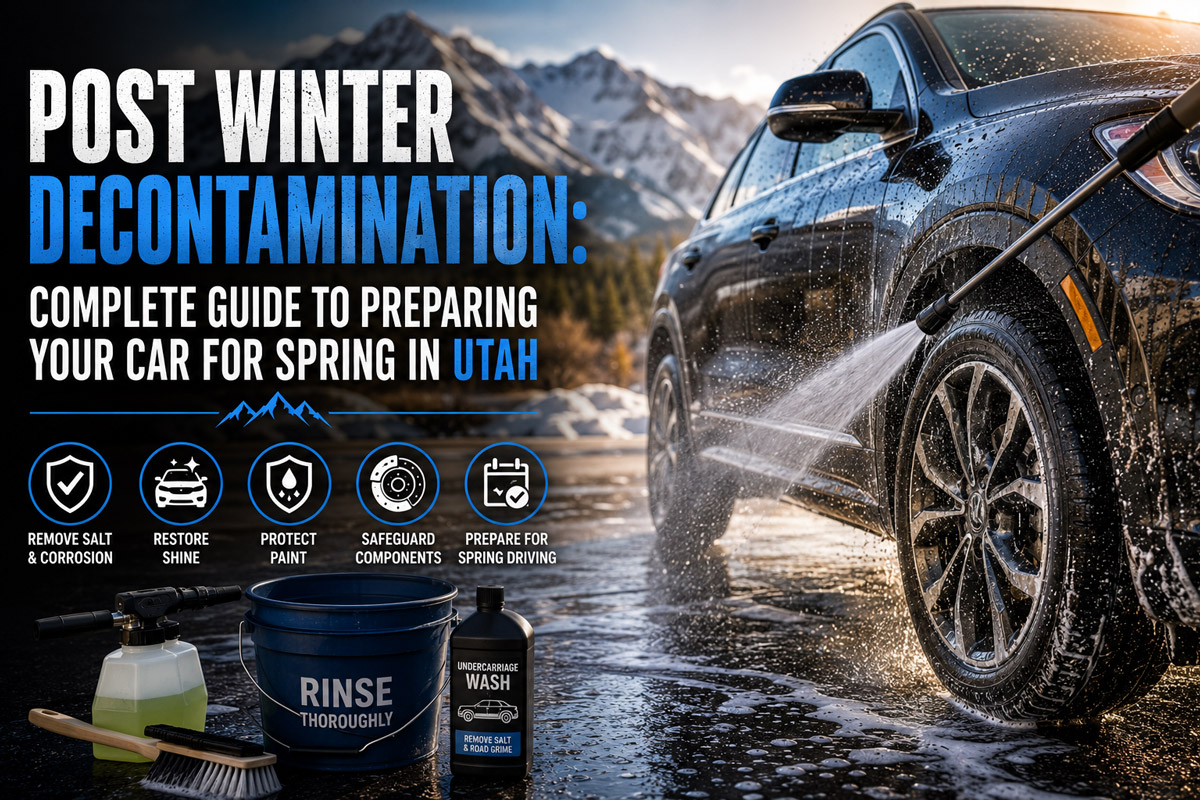
Winter in Utah delivers world class powder to the Wasatch Mountains, but it leaves behind a destructive chemical legacy on your vehicle. Driving along Interstate 15, State Route 92, or through the snow covered canyons of Salt Lake and Utah County forces your car to endure months of relentless chemical exposure. The Utah Department of Transportation relies heavily on liquid magnesium chloride brine, heavy rock salt, and abrasive volcanic sand to melt mountain ice and keep roadways open.
While these winter road treatments keep drivers safe during snowstorms, they create a silent corrosion crisis for your vehicle. As winter gives way to warmer spring temperatures, those trapped chemical residues undergo an accelerated chemical reaction. Salt and magnesium chloride that sat inactive during sub freezing weather suddenly combine with moisture and heat, accelerating oxidation across your clear coat, suspension components, brake lines, and lower body panels.
A standard drive through automatic car wash might rinse away surface dust, but it cannot dissolve bonded chemical fallout or reach deep inside undercarriage crevices. Achieving true vehicle restoration requires a rigorous post winter decontamination strategy. This comprehensive guide breaks down the science of Utah winter road chemicals, provides a step by step 6 step deep cleaning process, and gives you the exact blueprint needed to safeguard your car value for spring.
The Chemistry of Utah Winter Roads: Why Standard Car Washes Fail
To understand why your car requires specialized spring decontamination, you must first understand the aggressive chemical composition of Utah winter road treatments.
Magnesium Chloride vs Traditional Rock Salt Dynamics
Unlike basic sodium chloride rock salt used in milder climates, the Utah Department of Transportation relies heavily on liquid magnesium chloride solutions. Magnesium chloride is selected because it effectively lowers the freezing point of water down to zero degrees Fahrenheit, making it ideal for freezing temperatures in Utah County and Salt Lake Valley.
However, magnesium chloride possesses a property known as hygroscopy. This means the compound actively pulls moisture out of the surrounding air, even long after the roads have dried. When sprayed onto wet highways, this liquid brine atomizes into a fine mist that coats every exposed surface of your vehicle. It penetrates deep into frame rails, body seams, electrical connectors, and wheel arches. Because it continually draws moisture from the atmosphere, it remains in an active chemical state far longer than traditional rock salt.
Chemical Corrosion Lifecycle
How road salt and seasonal shifts accelerate structural vehicle damage
Winter Highway Driving
Liquid Magnesium Chloride & Brine Spray coat undercarriage and body panels.
Deep Penetration
Salt solution settles deep into frame rails, suspension joints, micro-scratches, and paint pores.
Spring Temperature Rise
Trapped moisture, oxygen, and rising ambient heat trigger rapid electrochemical oxidation.
Clear Coat & Rust Decay
Visible outcome: pitting paint, flaking underbody metal, and crusty interior floorboard corrosion.
Why Spring Temperature Spikes Accelerate Undercarriage Oxidation
Chemical reactions double in speed for every ten degree Celsius increase in temperature. During cold Utah winter months, corrosion moves at a relatively slow pace because low temperatures suppress chemical activity.
When spring arrives in Utah, bringing daytime temperatures up into the fifties, sixties, and seventies, that trapped magnesium chloride residue acts like an accelerator for rust. Combined with frequent spring rain showers, the trapped salt creates an ideal electrolyte solution, triggering rapid galvanic corrosion on steel suspensions, aluminum subframes, and unprotected sheet metal.
Vehicle Cleaning Method Comparison
Evaluating wash techniques for contaminant removal, rust defense, and paint safety
| Cleaning Method | Target Contaminants Handled | Undercarriage & Rust Prevention | Clear Coat Safety |
|---|---|---|---|
| Drive-Through Brush Wash | Surface dirt, fresh dust only | Minimal / None Recirculates dirty water | High Risk Abrasive swirl marks & scratches |
| Standard Touchless Tunnel | Loose mud and top layer film | Low Efficiency Low pressure misses frame rails | Safe from Brushes Leaves bonded iron & tar |
| Full Chemical & Mechanical Decontamination | Magnesium chloride, embedded iron fallout, road tar, carpet salt rings | Complete Flush Cleans frame, brake lines, pinch welds | Maximum Safety Restores smooth finish & applies defense |
Complete 6 Step Post Winter Decontamination Process for Utah Cars
Restoring a vehicle after a long Utah winter requires a deliberate multi step workflow. Moving in the correct sequence ensures that heavy abrasive particles are safely removed before fine paint smoothing and sealant application take place.
Step 1: High Pressure Undercarriage Flush and Wheel Well Cleansing
The underbody of your car is the frontline victim of Utah road brines. High pressure washing beneath the vehicle must be your very first action.
- Target Areas: Frame rails, brake line channels, mud flap backing plates, sway bar links, coil springs, and inner pinch welds.
- Required Tools: High pressure washer equipped with an underbody water broom or a forty degree angled pressure wand attachment.
- The Process:
- Position your vehicle on a flat driveway out of direct sunlight.
- Connect your pressure wand or rolling undercarriage water broom beneath the bumper.
- Flush each section systematically, working from the front axle to the rear bumper. Continue flushing until the runoff water transitions from murky brown to crystal clear.
- Turn your attention to the wheel wells. Plastic wheel liner covers trap damp sand and salt behind their lips. Spray directly into the arch apex and behind the fender liners to clear out accumulated winter mud sludge.
Step 2: High pH Strip Pre Wash and Scratch Free Two Bucket Contact Wash
Standard car soaps designed for weekly washing have neutral pH formulas created to preserve existing waxes. However, after winter, your goal is to strip off contaminated road oils, traffic film, and degraded wax layers.
- Target Contaminants: Oily winter road spray, heavy traffic film, grease, and loose surface grime.
- Recommended Chemicals: Alkaline high pH snow foam or dedicated traffic film remover soap.
- The Process:
- Apply an alkaline strip foam using a foam cannon connected to your pressure washer. Allow the dense foam to dwell on dry paint for four to five minutes. This dwell time allows active surfactants to break the chemical bond of oily road grime without requiring scrubbing.
- Thoroughly rinse the vehicle from the top roof panels down to the rocker panels.
- Prepare two wash buckets equipped with grit guard inserts. Fill bucket one with warm water and fresh car wash shampoo. Fill bucket two with clean rinse water.
- Using a plush microfiber wash mitt, clean one panel at a time using straight, overlapping passes. Never use circular rubbing motions. Dunk and swirl your mitt in the rinse bucket after every panel to drop trapped grit before dipping back into the soapy wash bucket.
Step 3: Chemical Iron Decontamination for Embedded Metallic Particles
Even after a thorough hand wash, your paint clear coat will still harbor invisible microscopic contaminants. Tiny metallic specks from snowplow blades, vehicle brake rotors, and industrial road dust embed directly into the softened clear coat during winter driving. Left untreated, these iron particles rust and expand inside the paint, creating permanent pitting spots.
- Target Contaminants: Embedded iron brake dust, metallic road fallout, and iron oxide specks.
- Recommended Product: pH balanced chemical iron remover containing active sodium thioglycolate.
- The Process:
- Ensure the paint surface is cool to the touch and shaded.
- Spray the chemical iron remover generously across all painted surfaces, glass, and alloy wheels.
- Observe the chemical reaction over three to five minutes. As the product encounters embedded ferrous metal particles, it dissolves them into a water soluble complex, turning a vivid purple color.
- Rinse the entire vehicle thoroughly with high pressure water before the product dries. Pay close attention to body seams, door handles, gas caps, and emblem badging to clear away all purple residue.
Step 4: Mechanical Clay Bar Treatment for Stubborn Tar and Road Film
While chemical iron removers dissolve metallic debris, non metallic contaminants like road tar, asphalt spots, tree sap, and hardened mineral crust require physical extraction.
- Target Contaminants: Road tar droplets, sap, bugs, and non iron bonded roughness.
- Recommended Tools: Fine or medium grade synthetic clay towel, traditional clay bar, and specialized clay lubricant spray.
- The Process:
- Mist a generous layer of clay lubricant onto a two foot by two foot panel section.
- Lightly glide the clay bar or synthetic clay towel back and forth across the lubricated surface using minimal down pressure. You will initially feel and hear friction as the clay grabs embedded particles.
- Continue gliding until the surface feels completely silent and smooth as glass under the towel.
- Wipe away residual lubricant with a clean microfiber towel and inspect your work. Run your hand inside a thin plastic sandwich bag over the paint panel. The plastic amplifies any remaining microscopic roughness, confirming whether the clear coat is perfectly decontaminated.
Step 5: Clear Coat Inspection, Rock Chip Touch Up, and Barrier Protection
Now that your paint is surgically clean, it is vulnerable to external threats. Utah spring brings intense high altitude ultraviolet rays, heavy tree pollen, and alkaline dust storms blown across the Salt Lake flats.
- Target Goal: Seal clear coat pores, repair winter gravel damage, and establish a long lasting protective shield.
- Protection Options: Carnauba wax, synthetic polymer sealant, or ceramic coating spray boosters.
- The Process:
- Inspect the front fascia, hood, and rocker panels for gravel rock chips caused by winter road sanders. Carefully clean each chip cavity with isopropyl alcohol and dab exact matching touch up paint using a micro applicator brush to seal bare metal against future rust.
- Select your defense layer based on durability needs. While traditional carnauba wax provides a warm gloss, synthetic polymer sealants and ceramic coating boosters provide far superior resistance against high temperatures and spring rain acidity in Utah.
- Apply your chosen protection evenly over painted panels, headlight lenses, and trim moldings according to product instructions. Buff away haze with a clean, high GSM microfiber towel.
Step 6: Deep Interior Salt Extraction and Windshield Haze Stripping
Winter road salt does not remain outside your car. Passengers track wet calcium chloride and sodium chloride slush onto carpet mats with every entry, leaving stubborn white crusty rings as the water evaporates. Furthermore, running your vehicle heater all winter causes interior plastic off gassing, forming an oily film over interior glass.
- Target Goal: Dissolve rock hard carpet salt deposits and eliminate interior glass glare haze.
- Required Tools: Hot water extractor or wet dry vacuum, stiff carpet brush, acidic salt neutralizing carpet shampoo, and dedicated glass cleaner.
- The Process:
- Remove all rubber and fabric floor mats from the cabin. Wash rubber mats with an all purpose cleaner and high pressure water.
- Spray an acidic salt neutralizing cleaner onto white carpet crust spots. The acidic formula breaks down alkaline calcium chloride bonds that standard interior cleaners cannot dissolve.
- Allow the solution to dwell for three minutes, then agitate the carpet fibers vigorously with a stiff nylon brush to break up the salt crystals.
- Extract the loosened liquid using a hot water extractor or wet dry shop vacuum. Repeat until the carpet pile is soft, clean, and original in color.
- Clean all interior glass panels using a waffle weave microfiber towel and alcohol based glass cleaner. Wipe in vertical strokes on the inside and horizontal strokes on the outside so you can immediately pinpoint and remove any remaining streak locations.
Visual Process Lifecycle and Chemical pH Effectiveness Chart
Executing post winter decontamination requires using products across the pH spectrum to break down specific organic, metallic, and mineral compounds safely.
Decontamination pH Spectrum & Process Efficacy
Step-by-step chemical breakdown and contaminant removal efficiency
Steps 1 & 2: High pH Alkaline Pre-Wash
Target: Traffic Film & Oily Dirt Removal
Step 3: Neutral Iron Chemical Dissolution
Target: Embedded Iron & Brake Dust Extraction
Step 4: Mechanical Clay Bar Abrasion
Target: Road Tar & Surface Roughness Elimination
Step 6: Low pH Acidic Carpet Salt Neutralizer
Target: Calcium Chloride Salt Ring Neutralization
Environmental Challenges Unique to Utah County and Wasatch Front Drivers
Utah drivers encounter environmental conditions distinct from almost any other region in North America. Understanding these local factors explains why routine car care routines fall short in Utah.
Utah Environmental Threat Matrix
Regional climate factors and their specific impacts on vehicle finishes
| Environmental Factor | Primary Threat Area | Severe Consequences |
|---|---|---|
| High Elevation UV | Hood, Roof, Clear Coat | Accelerated Fading & Oxidation |
| Great Salt Lake Dust | Exposed Metal & Paint | Alkaline Chemical Corrosion |
| Wasatch Canyon Gravel | Front Bumper, Rockers | Deep Chips Down to Metal |
| Spring Oak & Pine Pollen | Hydrophobic Sealants | Sticky Etching & Clear Spotting |
High Altitude Ultraviolet Radiation Impact
Salt Lake City sits at over four thousand four hundred feet above sea level, while surrounding bench communities in Utah County like Alpine, Sandy, and Park City range from five thousand to seven thousand feet. At these higher elevations, the atmosphere is thinner, allowing up to thirty percent more raw ultraviolet radiation to strike your vehicle surface.
When UV rays interact with winter road chemicals left trapped on clear coats, the combination causes rapid thermal degradation of clear coat polymers, resulting in premature peeling and permanent paint cloudiness.
Great Salt Lake Alkaline Dust Storms
Spring weather along the Wasatch Front frequently triggers powerful windstorms that sweep over dry lakebeds and alkaline flats. These storms carry fine dust particles rich in active minerals and salts. If your vehicle paint possesses embedded winter road grime, these windborne alkaline particles bind directly to the rough surface, exacerbating clear coat erosion.
DIY Decontamination vs Professional Detailing Services in Utah
Deciding whether to perform post winter decontamination yourself or hire a professional auto detailing shop in Utah County depends on your available equipment, budget, and free time.
DIY vs. Professional Auto Decontamination
Evaluating equipment, chemical costs, effort, and depth of service
| Evaluation Factor | DIY Home Decontamination | Professional Utah Auto Detailer |
|---|---|---|
| Equipment Required | Pressure washer, water broom, two buckets, foam cannon, extractor | Commercial hot water extractors, lift hoists, paint meters, polishers |
| Chemical Investment | $100 – $200 Initial chemical purchase | Included Part of full-service package |
| Time Commitment | 4 to 6 Hours Intensive manual labor | Half/Full Day Vehicle drop-off service |
| Undercarriage Reach | Limited to ground-level pressure wands & creepers | Full hydraulic lift access for precision underbody cleaning |
| Paint Defect Correction | Basic manual claying & hand sealant application | Machine paint correction polishing & ceramic coating installation |
For car enthusiasts who enjoy hands on vehicle care, performing a DIY spring decontamination is an extremely rewarding weekend project. However, if your car features heavy underbody salt accumulation or deep white carpet stains, partnering with a specialized auto detailer along the Wasatch Front ensures every hidden pocket of corrosion is completely neutralized.
Frequently Asked Questions About Utah Spring Car Care
How often should I perform post winter decontamination in Utah?
Post winter decontamination should be performed once every year in early spring, typically between late March and early May when snowfall subsides and Utah Department of Transportation plows cease brining highways.
Will dish soap remove road salt from my car paint?
While household dish soap will strip old wax, it contains high salt content and harsh degreasers that dry out rubber door seals and accelerate clear coat dullness. Always use dedicated automotive strip soaps formulated for paint safety.
Can magnesium chloride cause my brake lines to fail?
Yes. Magnesium chloride is highly corrosive to steel brake lines and fuel lines. Over multiple Utah winters, unchecked salt buildup leads to pitting rust, causing structural thinning and eventual hydraulic brake line leaks. Thorough undercarriage flushing is essential to prevent this safety hazard.
Is iron remover safe for ceramic coated cars?
Yes. Quality pH balanced iron removers are completely safe for vehicles protected by professional ceramic coatings or paint protection film. In fact, iron decontamination is a recommended maintenance step to unclog ceramic coating pores and restore hydrophobic water beading properties.
How do I get hard white salt rings out of auto carpet without an extractor?
If you do not own a hot water extractor, mix equal parts warm water and white vinegar in a spray bottle. Spray the crusty salt ring generously, allow the acid to dissolve the mineral crystals for five minutes, scrub with a stiff nylon brush, and blot repeatedly with dry microfiber towels until clean.
Conclusion: Safeguard Your Vehicle Investment with Proper Spring Care
Vehicles in Utah represent significant financial investments that face some of the harshest seasonal road conditions in the nation. Allowing winter road salt, magnesium chloride brine, and embedded metal fallout to remain on your paint and underbody throughout spring and summer guarantees premature rust, dull clear coat paint, and diminished resale value.
By executing a systematic post winter decontamination routine, including an undercarriage flush, strip foam wash, chemical iron removal, clay bar extraction, protective sealing, and interior carpet salt stripping, you effectively stop corrosion in its tracks. Preparing your vehicle for spring ensures that your car, truck, or SUV looks stunning while standing fully protected against the challenging climate along the Wasatch Front.
Next Step: Protect Your Car for the Season Ahead
Ready to give your vehicle the complete post winter reset it deserves? Take action today to protect your finish and undercarriage:
- DIY Enthusiasts: Gather your pressure washer attachments, chemical iron remover, synthetic clay towel, and premium paint sealant to execute this 6 step checklist this weekend.
- Professional Detailing: If you prefer expert care, schedule a comprehensive spring decontamination detail with a certified Utah auto detailing specialist along the Wasatch Front. Be sure to request a specialized undercarriage pressure flush and acidic interior carpet extraction.