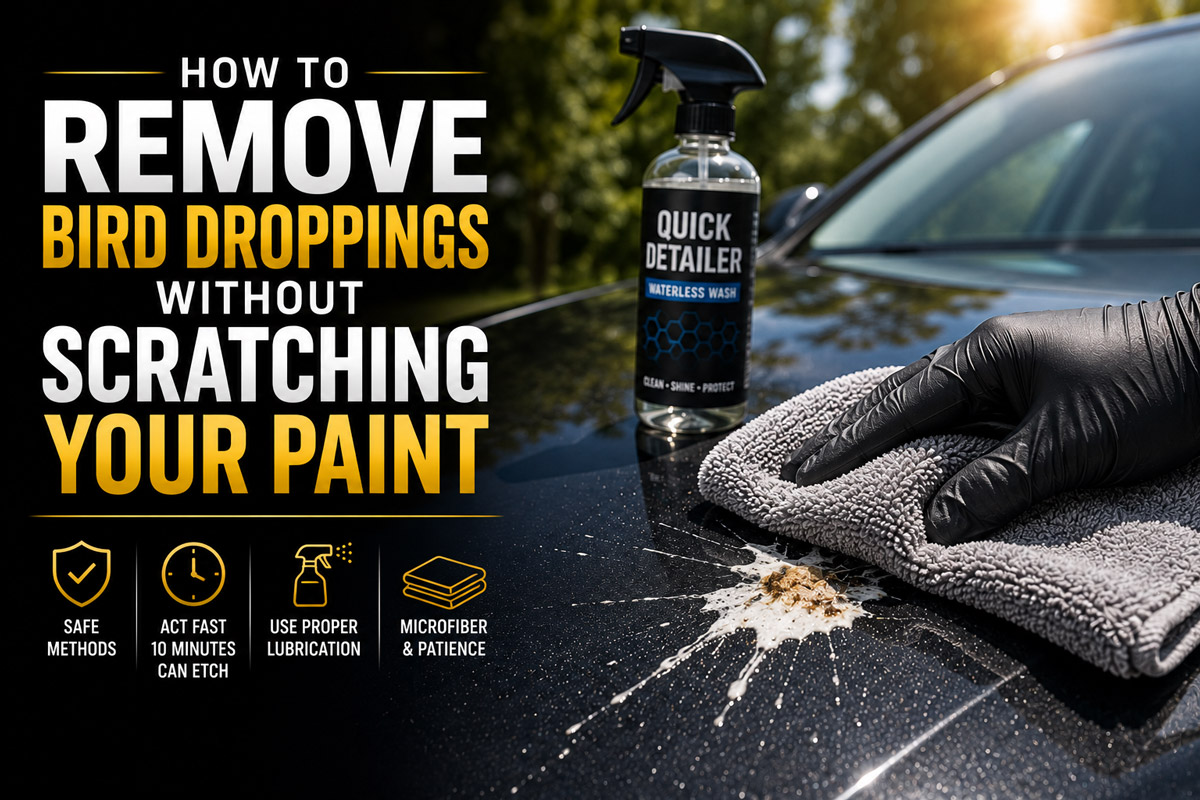
The safest way to remove bird droppings without scratching automotive paint is through chemical saturation and vertical lifting. Never scrub dry droppings, as they contain abrasive sand and uric acid. Spray the dropping heavily with quick detailer, let a soaked microfiber towel dwell for three minutes, and pinch the debris upward.
At a Glance:
- Fresh bird droppings can begin etching a clear coat in just 10 minutes under 100°F (38°C) direct sunlight.
- The maximum safe window to remove a dropping before permanent clear coat wrinkling occurs is exactly 24 hours.
- Bird droppings possess a highly acidic pH level between 3.5 and 4.5 due to concentrated uric acid, which rapidly degrades carnauba waxes.
- Hot water between 120°F and 140°F effectively dissolves hardened droppings when automotive detail sprays are unavailable.
- Rubbing a matte paint finish to remove droppings creates a permanent glossy spot requiring a full panel repaint.
Why Do Bird Droppings Damage Car Paint?
Bird droppings damage automotive paint through a combination of chemical acidity and thermal shock. Bird feces contain highly concentrated uric acid, which naturally sits at a pH level between 3.5 and 4.5. This acid aggressively attacks the top layer of automotive clear coat, weakening its structural integrity within hours.
Beyond chemical acidity, thermal expansion plays a critical role in paint damage. When automotive metal panels heat up under direct sunlight, the clear coat expands. Simultaneously, the bird dropping resting on the surface dries, hardens, and contracts. As the ambient temperature drops at night, the car’s clear coat cools and contracts tightly around the hardened uric acid deposit. This cooling cycle effectively molds the clear coat into a wrinkled, etched shape that mirrors the footprint of the dropping. The presence of abrasive undigested seeds and gravel within the dropping further guarantees physical micro-scratches if the deposit is wiped while dry.
How Does a Bird’s Diet Affect Paint Etching Severity?
The severity of paint etching caused by a bird dropping directly correlates with the bird’s recent diet. Birds that consume high quantities of dark berries excrete droppings with intense natural dyes and highly concentrated fruit acids. These berry-rich droppings not only eat through the clear coat faster but also leave behind deep purple or red pigment stains that are notoriously difficult to extract from light-colored paints.
Conversely, birds that consume marine life or scavenge human food waste produce droppings with exceptionally high concentrations of calcium and abrasive grit. Seagull droppings, for example, are heavily laden with crushed shells and sand. Removing seagull droppings poses a massive physical scratch risk to the clear coat, prioritizing the need for heavy chemical lubrication over pure acid neutralization. Identifying the visual texture of the dropping dictates whether the primary risk is chemical etching (smooth, colorful droppings) or physical scratching (chalky, gritty droppings).
How Long Does It Take for Bird Poop to Etch Paint?
Fresh bird droppings can start etching automotive clear coat in as little as 10 minutes when exposed to direct, hot sunlight at temperatures of 100°F (38°C) or higher. Heat drastically accelerates the chemical reaction between the uric acid and the porous clear coat matrix.
Under moderate temperatures or shaded conditions, vehicle owners generally have a maximum window of 24 hours to remove a dropping before permanent chemical etching or clear coat wrinkling becomes highly likely. If the dropping lands on an unprotected paint surface—meaning no wax, synthetic sealant, or ceramic coating is present—this timeline compresses further. Once the 24-hour mark passes, the uric acid has typically penetrated deep enough into the clear coat that standard chemical removal will leave behind a dull, faded, or visibly wrinkled ghost mark requiring mechanical correction.
What is the Safest Liquid to Dissolve Bird Droppings?
The safest liquid to dissolve bird droppings on automotive paint is a dedicated waterless wash or a high-lubricity quick detailer spray. These specialized automotive chemicals contain advanced surfactants that encapsulate dirt particles and break down uric acid without stripping the underlying wax or sealant.
If dedicated automotive chemicals are unavailable, a 1:1 mixture of isopropyl alcohol (IPA) and distilled water acts as a highly effective substitute. The alcohol cuts through the organic proteins in the dropping rapidly. However, IPA mixtures will strip traditional carnauba waxes and polymer sealants, requiring the user to reapply paint protection to that specific area after cleaning. In emergency situations with no chemicals available, plain hot water heated between 120°F and 140°F (49°C to 60°C) is the safest natural solvent. The heat softens the hardened organic matter effectively, though water lacks the slick lubrication found in detailing sprays.
What Type of Microfiber Towel is Safest for Clear Coats?
The safest microfiber towel for removing bird droppings from an automotive clear coat is an edgeless, high-pile towel with a density of at least 400 GSM (Grams per Square Meter). High-pile microfiber towels feature longer fibers that draw the sharp grit, seeds, and sand found in bird droppings deep into the towel, pulling them away from the flat surface of the paint.
Using flat-weave or low-GSM towels (like standard yellow multipack towels found in hardware stores) is dangerous for paint correction. Low-pile towels keep the abrasive grit trapped directly between the towel surface and the clear coat, acting essentially as liquid sandpaper. Furthermore, edgeless towels are preferred because stitched nylon borders can introduce micro-marring when pressure is applied. Towels used for bird dropping removal should be washed immediately in hot water using a dedicated microfiber detergent to prevent the acidic residue from degrading the towel’s fibers.
How Do You Remove Dried Bird Poop Without Scrubbing?
To safely remove a dried, hardened bird dropping without scrubbing, vehicle owners must rely on chemical dwell time and vertical lifting. The standard removal process requires isolating the dropping and breaking down its hardened shell before any physical contact is made.
- Saturate: Spray the hardened dropping heavily with a dedicated quick detailer, waterless wash, or hot water.
- Dwell: Fold a clean microfiber towel twice, soak it in the cleaning liquid, and place it directly over the dropping. Leave the wet towel sitting on the paint for 2 to 3 minutes. This traps moisture and softens the debris.
- Lift: Instead of wiping horizontally, pinch the edges of the microfiber towel together, lifting the softened dropping vertically off the paint.
- Neutralize: Gently wipe the surrounding area with a fresh, clean section of the towel and apply one final mist of detailer to neutralize any microscopic acidic residue left behind.
Can You Use WD-40 or Baking Soda for Bird Droppings?
Vehicle owners can safely use WD-40 to remove bird droppings, but baking soda should never be applied to automotive paint. WD-40 effectively breaks down organic matter, dissolves hardened sap, and is completely safe for modern catalyzed clear coats. However, WD-40 leaves behind a thick, oily residue that attracts dust and completely compromises ceramic coatings, requiring the user to wash the area immediately with automotive shampoo.
Baking soda, conversely, is highly abrasive. While baking soda effectively neutralizes the acidity of the bird dropping, its granular structure acts as an aggressive scouring powder. Rubbing a baking soda paste into automotive paint will inflict severe, localized clear coat scratches that often require heavy machine compounding to remove. Detailers should always prioritize liquid chemical neutralizers over dry abrasive powders.
Is Hand Sanitizer Safe for Cleaning Automotive Paint?
Hand sanitizer is not safe for routine cleaning of automotive paint. While hand sanitizer contains alcohol that can break down the organic matter in a bird dropping, it is formulated with glycerin, aloe vera, and artificial fragrances designed to moisturize human skin.
When applied to a hot car panel, the alcohol in the hand sanitizer evaporates instantly, leaving behind a sticky, baked-on glycerin residue that smears across the clear coat. Furthermore, prolonged exposure to high-concentration rubbing alcohol gels can cause modern clear coats to swell or soften temporarily, making them highly susceptible to scratching when wiped. If a driver must use an alcohol-based emergency cleaner, liquid isopropyl alcohol diluted with water is vastly superior to gel-based hand sanitizers.
How Do You Clean Bird Poop Off Matte Car Paint?
To clean bird droppings off matte or satin car paint, owners must strictly use dedicated matte paint cleansers and avoid all standard quick detailers, waxes, or heavy friction. Standard automotive detail sprays contain gloss-enhancing polymers and carnauba wax derivatives that will permanently alter the flat finish of a matte vehicle.
Because matte finishes cannot be polished, any friction applied to the surface is a critical error. Rubbing a dried bird dropping on a matte clear coat will shave down the microscopic peaks and valleys that create the flat look, resulting in a permanent, shiny bald spot. If a dropping lands on a matte finish, saturate it heavily with a product like Dr. Beasley’s Matte Paint Cleanser, allow it to dwell for 5 minutes, and gently blot the area dry. If the paint etches, the only remedy is a full panel repaint.
How Should You Treat Droppings on a Fresh Ceramic Coating?
If a bird dropping lands on a ceramic coating that was applied less than 7 days ago, owners must stick strictly to pH-neutral car shampoo and warm water. A newly applied ceramic coating requires a minimum curing window (often 7 to 14 days) to fully cross-link and harden into a quartz-like protective layer.
Introducing harsh chemicals, such as isopropyl alcohol mixtures or heavy-duty bug and tar removers, during this curing phase can permanently degrade the soft coating, causing it to haze or fail prematurely. Soak the dropping with warm water, gently lift it away with a soft microfiber, and wash the panel with a dedicated ceramic maintenance shampoo. Avoid applying any physical pressure to the soft, curing silica surface.
What is the Best Way to Clean a Convertible Soft Top?
The best way to clean a bird dropping from a fabric or vinyl convertible soft top is to let the dropping dry completely before vacuuming away the loose crust. Applying detail sprays or water to a fresh dropping on a fabric roof will liquefy the acidic matter, driving the stain deeper into the woven canvas fibers.
Once the dropping is entirely dry, break the crust with a plastic scraper and use a shop vacuum to extract the organic dust. Next, spray the remaining stain with a dedicated convertible top cleaner (such as RaggTopp or 303 Fabric Cleaner). Agitate the cleaner gently using a soft-bristled horsehair brush in a circular motion, ensuring the bristles lift the stain out of the weave rather than pushing it down. Rinse the area thoroughly with low-pressure water to flush the remaining acid out of the fabric.
How Can You Fix Paint Etched by Bird Droppings?
If a dull, wrinkled, or faded mark remains after a bird dropping is removed, the clear coat has been chemically etched and requires physical or thermal correction. Standard detailing sprays will not fix etching.
- The Heat Gun Method (Minor Etching): Gently heat the affected area with a heat gun or hair dryer set to medium heat, keeping the nozzle 6 inches away from the paint. Modern automotive clear coats possess “self-healing” elastomeric properties; applying heat allows the clear coat to expand and level out shallow, microscopic wrinkling.
- Dual-Action Polishing (Moderate Etching): If thermal expansion fails, the etched clear coat must be leveled. Use a dual-action orbital polisher equipped with a foam finishing pad and a fine finishing compound to safely shave off a few microns of the damaged clear coat, restoring the gloss.
- Wet Sanding (Severe Etching): If the uric acid has burned deep into the clear coat layer, the area requires professional wet sanding using 2500 to 3000 grit automotive sandpaper. This aggressive leveling must be followed by a multi-stage machine compound and polish to restore optical clarity.
Do Ceramic Coatings Prevent Bird Poop Damage Completely?
Ceramic coatings do not make automotive paint completely immune to bird poop damage. A ceramic coating acts strictly as a sacrificial barrier; it absorbs the initial chemical attack so the factory clear coat does not.
While carnauba wax might succumb to uric acid in a matter of hours, a high-quality 9H ceramic coating buys the vehicle owner significantly more time—often extending the safe removal window from minutes to several days. However, highly concentrated uric acid left baking under a hot sun will eventually burn through the silica dioxide layer of any ceramic coating if completely neglected. Coatings make the cleanup process effortless by providing a non-stick surface, but they do not eliminate the need for prompt maintenance.
The Bottom Line
Safely removing bird droppings without scratching automotive paint demands chemical lubrication and strict avoidance of horizontal wiping. Using dedicated detail sprays and the towel-pinch method ensures abrasive grit is lifted safely away from the clear coat rather than dragged across it. While ceramic coatings provide a vital buffer, time and heat are the ultimate enemies of clear coat integrity. Drivers must address acidic droppings within 24 hours to prevent permanent etching, utilizing heat or dual-action polishing only if the uric acid has already compromised the paint surface.