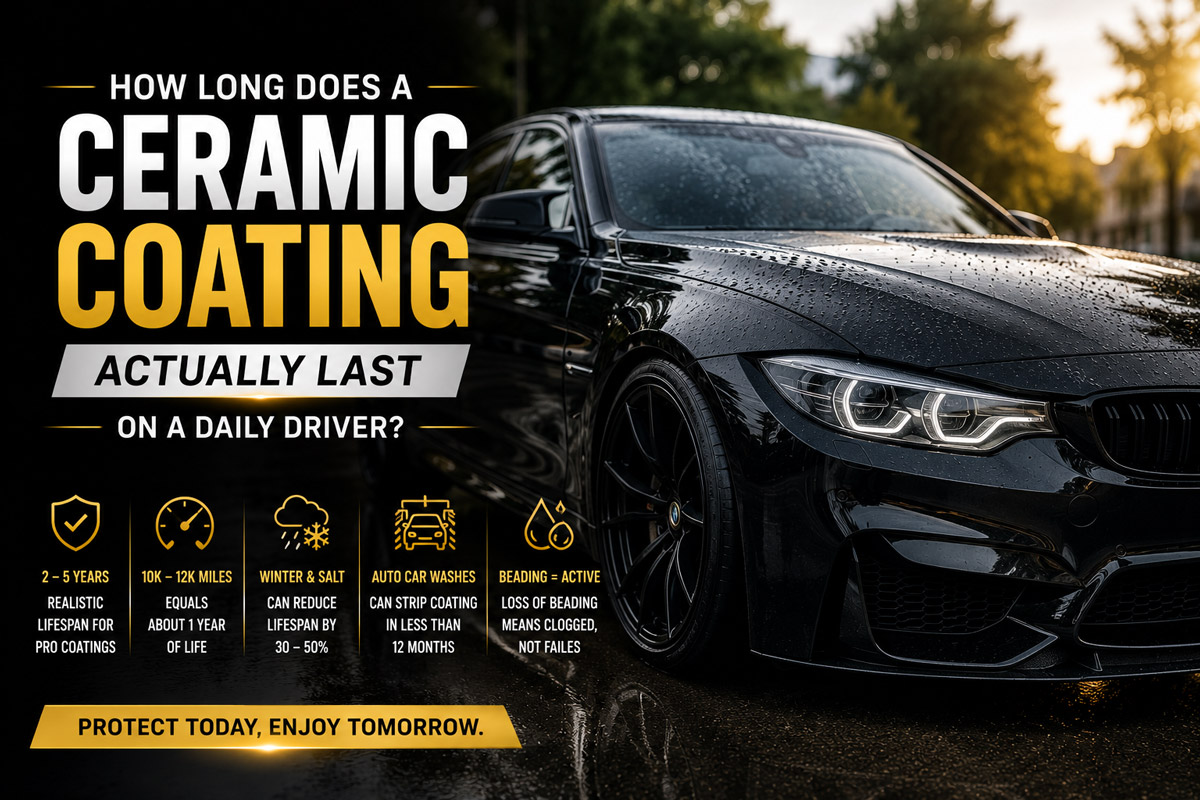
On a daily driver, a professional-grade ceramic coating realistically lasts 2 to 5 years, while consumer-grade spray coatings last 3 to 12 months. Longevity heavily depends on annual mileage, environmental exposure, and maintenance habits. A coating remains active as long as the surface continuously sheds dirt and vigorously beads water.
At a Glance: Ceramic Coating Realities
- A 5-year advertised professional coating typically survives 2 to 5 years under real-world daily driving conditions.
- One year of advertised ceramic coating life equates to roughly 10,000 to 12,000 miles of active driving.
- Frequent automatic tunnel car washes physically abrade and strip a ceramic coating within 12 months.
- Winter road salt exposure reduces the lifespan of any vehicle coating by 30 to 50 percent.
- A sudden loss of water beading usually means the ceramic coating is clogged with minerals, not permanently failed.
What is the Real-World Lifespan of Professional vs. Consumer Coatings?
Professional-grade ceramic coatings last 2 to 5 years, consumer-grade quartz bottles last 1.5 to 2.5 years, and spray coatings last 2 to 6 months on a daily-driven vehicle. The timeline printed on the bottle represents durability potential in ideal, laboratory-like conditions, not real-world commuting.
Professional coatings (like Gyeon or Ceramic Pro) require intensive paint correction and cure into a thick, concentrated silicon dioxide (SiO2) or silicon carbide (SiC) layer. Consumer glass bottles (like CQuartz UK) offer similar chemistry but are diluted for easier, slower-curing application, sacrificing some longevity. Spray coatings and detail sprays are highly diluted toppers; they provide excellent short-term gloss and hydrophobics but burn off quickly under UV and chemical exposure.
Ceramic Coating Lifespan Comparison
| Product Type | Advertised Lifespan | Real-World Daily Driver Lifespan |
|---|---|---|
| Professional Grade (Installer Only) | 5 Years to “Lifetime” | 2 to 5 Years |
| Consumer Glass/Quartz Bottle | 2 to 3 Years | 1.5 to 2.5 Years |
| Spray Ceramic Coating | 6 to 12 Months | 2 to 6 Months |
| Ceramic Detail Spray (Topper) | 1 to 3 Months | 2 to 4 Weeks |
How Does Annual Mileage Impact Ceramic Coating Longevity?
Annual mileage reduces ceramic coating longevity at a rate of roughly one year of advertised life per 10,000 to 12,000 miles driven. Time is a poor metric for coating durability; physical friction and chemical exposure dictate the true degradation rate.
A daily driver commuting 25,000 miles a year will burn through a “5-year” professional coating in approximately two years. Every mile driven exposes the vehicle’s front clip and lower rocker panels to microscopic impacts from road grit, brake dust, and exhaust fallout. High-mileage drivers must rely heavily on ceramic booster sprays applied every 1 to 2 months. These boosters create a sacrificial layer, taking the physical abuse so the expensive base coating underneath remains intact.
How Much Does Parking Outside Reduce Ceramic Coating Durability?
Parking a vehicle outside 24/7 reduces the expected lifespan of a ceramic coating by at least 20 percent compared to a garage-kept car. Constant exposure to ultraviolet (UV) radiation and thermal cycling causes microscopic fractures in the protective layer.
When a vehicle sits in the sun, the painted metal expands. When the sun sets, the metal contracts. This daily thermal expansion, combined with acidic bird droppings, tree sap, and hard water sprinkler overspray, stresses the structural integrity of the SiO2 matrix. A coating rated for 3 years on a garaged vehicle will typically show signs of failure at the 2.5-year mark if the vehicle is exclusively street-parked.
Does Winter Road Salt Destroy Ceramic Coatings Prematurely?
Winter road salt and brine mixtures destroy ceramic coatings prematurely, typically reducing the coating’s expected lifespan by 30 to 50 percent. Vehicles driven daily in the “Salt Belt” (the Midwest, Northeast, and Canada) subject their paint to extreme chemical abrasion.
Salt is highly abrasive and chemically harsh. When a driver travels on salted roads, the tires kick a slurry of calcium chloride and magnesium chloride onto the paint. If this brine is allowed to dry, it etches into the pores of the coating. A premium 5-year ceramic coating will often degrade completely after three hard winters unless the owner performs weekly touchless undercarriage and body washes to neutralize the salt accumulation.
Do Automatic Tunnel Car Washes Ruin Ceramic Coatings?
Automatic tunnel car washes ruin ceramic coatings rapidly, often completely stripping a professional-grade application in under 12 months. The abrasive spinning brushes used in these facilities act like high-speed sandpaper against the vehicle’s clear coat.
While ceramic coatings are harder than factory clear coat, they are not impervious to heavy mechanical abrasion. Furthermore, automated car washes use highly aggressive, alkaline-based degreasers to break down road grime quickly. The combination of stiff nylon brushes and extreme pH chemicals physically wears down the coating layer while simultaneously dulling its high-gloss finish. Touchless car washes are safer, but their heavy reliance on harsh chemicals will still degrade a coating faster than hand washing.
How Long Do Ceramic Coatings Last on Wheels and Exhausts?
Ceramic coatings applied to wheels, brake calipers, and exhaust tips generally last 1 to 2 years, significantly less than coatings applied to painted body panels. Extreme heat cycling and direct bombardment by metallic brake dust accelerate the coating’s degradation.
Brake rotors can reach temperatures exceeding 400°F (200°C) during heavy commuting. This intense heat transfers to the wheels, stressing the coating. High-temperature specific wheel coatings (often utilizing silazane chemistry rather than standard siloxanes) are required for these areas. Even with specialized formulas, the constant friction from hot iron particles shearing off the brake pads will eventually compromise the hydrophobic layer, requiring reapplication much sooner than the rest of the vehicle.
What Maintenance Routine Extends Ceramic Coating Life?
To extend the life of a ceramic coating, owners must perform a two-bucket hand wash every two weeks using a pH-neutral ceramic soap, followed by a dedicated chemical decontamination wash every 6 to 12 months.
The bi-weekly hand wash removes loose dirt without inflicting swirl marks. However, the critical step is the biannual decontamination wash. This involves spraying an iron-removing chemical to dissolve embedded brake dust, followed by a mild acidic water-spot remover to dissolve mineral calcium. Finally, applying a silica-based ceramic booster spray every few months acts as a sacrificial barrier, artificially extending the life of the base layer indefinitely by ensuring the cheap topper takes the environmental damage.
Do You Still Need to Wash a Ceramic-Coated Car?
Drivers absolutely still need to wash a ceramic-coated car, usually every one to two weeks. Ceramic coatings are not self-cleaning magic fields; they are simply low surface energy barriers that make washing significantly faster and easier.
On a daily driver, oily road grime, exhaust soot, and rubber particles form a sticky “traffic film” on the lower half of the vehicle. Heavy rain will rinse off light pollen and surface dust, but rain cannot break the bond of traffic film. A contact hand wash is required to remove this film. The primary benefit of the coating is that dirt releases effortlessly, meaning a wash that used to take an hour can be completed in 15 minutes without aggressive scrubbing.
Can You Apply Traditional Carnauba Wax Over a Ceramic Coating?
Traditional carnauba wax should never be applied over a ceramic coating. Carnauba wax is structurally “stickier” than a ceramic surface and will immediately mask the coating’s superior water-beading and self-cleaning properties.
Ceramic coatings repel water and dirt due to their high contact angle and low surface tension. Carnauba wax attracts dust, pollen, and environmental fallout. By applying wax over a coating, the owner is effectively downgrading the paint’s performance to that of a 1990s-era sealant. To add gloss or protection to a coated car, always use a dedicated silica-based (SiO2) detail spray designed to chemically bond with the underlying ceramic matrix.
Why Did the Ceramic Coating Stop Beading Water After 6 Months?
When a ceramic coating stops beading water after 6 months, the coating has not failed; it is clogged with microscopic contaminants. Road film, iron deposits, and tree sap build up on top of the coating, masking its hydrophobic properties.
Many drivers mistakenly believe they need to polish the car and reapply a new coating when water starts pooling flat on the hood. The correct fix is a chemical decontamination wash. Using a dedicated iron-fallout remover and a mineral-deposit remover will unclog the microscopic pores of the ceramic layer. In 90 percent of cases, this simple chemical cleaning restores aggressive water beading immediately without the need for reapplication.
How Can You Tell When a Ceramic Coating Has Completely Worn Off?
A ceramic coating has completely worn off when water sits completely flat on the paint, the surface feels physically “grabby” during washing, and a thorough chemical decontamination wash fails to restore any water beading.
When the coating is actively protecting the car, water will form tight, tall, spherical beads that race off the panel. As the coating thins through abrasion, the beads become flat and irregular. When the coating is dead, the water sheets slowly and pools. If an owner applies an iron remover and a water-spot remover, washes the car thoroughly, and the water still refuses to bead, the SiO2 layer has fully degraded back to the bare factory clear coat.
Can You Patch a Ceramic Coating if One Panel Fails Early?
A professional installer can easily patch a ceramic coating on a single panel if it fails early or if the vehicle requires bodywork after an accident. The entire car does not need to be stripped and re-coated.
If a daily driver’s front bumper takes excessive abuse from road salt and stops repelling water, the detailer will isolate that specific panel. They will use a machine polisher to abrade away any remaining degraded coating, correct the clear coat, and apply a fresh layer of ceramic to that bumper alone. Because ceramic coatings cure completely clear, the patched panel will blend seamlessly with the rest of the vehicle.
Do Ceramic Coatings Prevent Scratches on a Daily Driver?
Ceramic coatings do not prevent scratches, rock chips, parking lot door dings, or key marks on a daily driver. While they are measurably harder than factory clear coat, they are micro-thin and offer zero structural impact resistance.
The primary physical protection a ceramic coating offers is resistance to fine “wash marring”—the microscopic swirl marks caused by dragging a wash mitt across the paint. The coating provides a highly lubricated surface, allowing dirt to slide off without scratching the clear coat underneath. For actual impact protection against highway rock chips or deep scratches, a vehicle requires Paint Protection Film (PPF), which is a thick, self-healing polyurethane wrap.
Is a Ceramic Coating Worth the Cost for a Commuter Vehicle?
A ceramic coating is highly worth the cost for a commuter vehicle strictly for the time saved in maintenance and the preservation of the vehicle’s resale value. The upfront cost pays dividends in reduced detailing labor over a 3 to 5 year ownership period.
Daily drivers suffer the worst environmental abuse. A coating ensures that brake dust, bug splatter, and bird droppings do not permanently etch into the clear coat. While the coating itself adds little direct book value to a trade-in, it preserves the factory paint immaculately. When the vehicle is sold five years later, the paint will look significantly glossier and newer than a non-coated equivalent, routinely commanding a higher resale price on the used market.
The Bottom Line
A professional ceramic coating will reliably protect a daily driver for 2 to 5 years, provided the vehicle is kept out of automated tunnel washes and receives proper decontamination maintenance. Longevity is dictated by mileage and chemical exposure, meaning vehicles in snowy, salt-heavy regions will see drastically reduced lifespans. Ultimately, if the paint feels slick and beads water tightly after a thorough chemical cleaning, the coating is still actively protecting your investment.