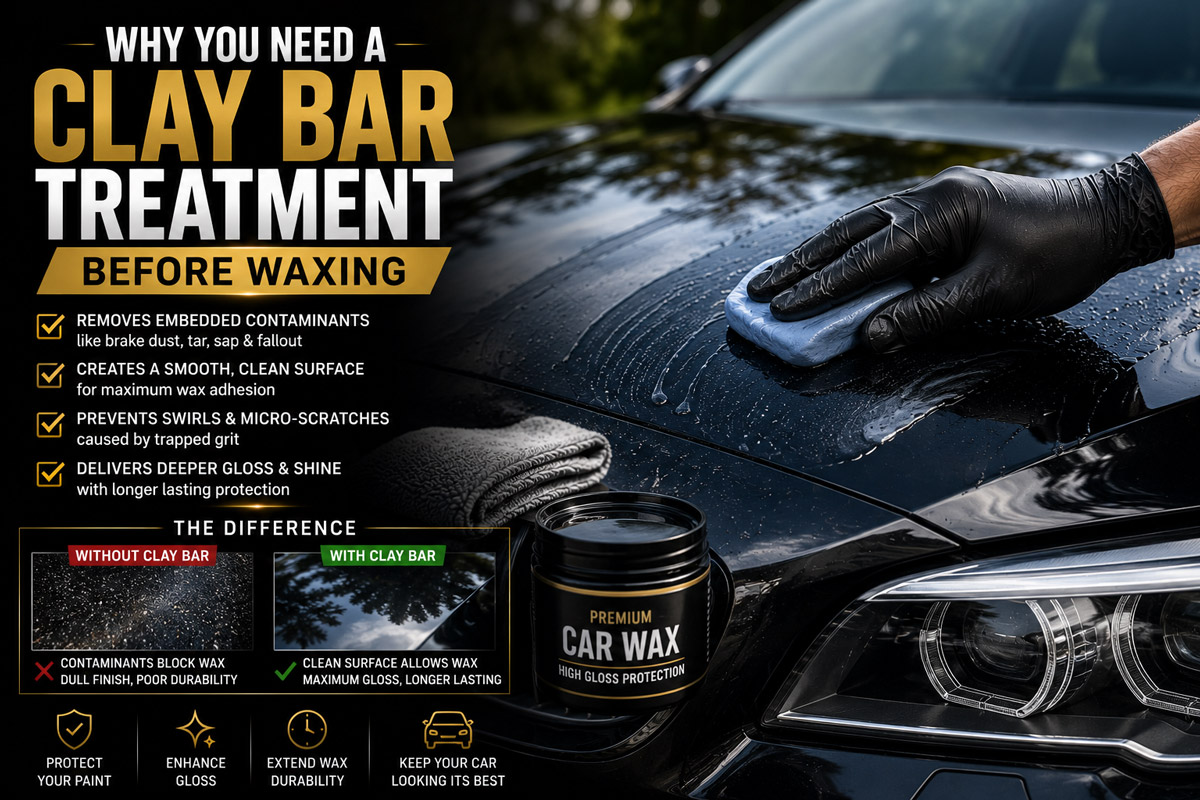
Applying car wax without a prior clay bar treatment traps microscopic environmental contaminants against the clear coat. A clay bar removes embedded brake dust, industrial fallout, and road tar that standard washing leaves behind, ensuring the wax bonds directly to bare paint for maximum durability, adhesion, and gloss.
At a Glance:
- Detailing clay extracts bonded abrasives from the microscopically porous clear coat.
- Wax applied over contaminated paint will fail prematurely due to poor adhesion.
- Rubbing a wax applicator over embedded grit causes micro-scratches and swirl marks.
- Clean, clayed paint reflects light evenly to create a deeper, mirror-like shine.
- The plastic baggie test determines instantly if a vehicle’s paint requires claying.
What Does a Clay Bar Remove From Car Paint?
Detailing clay removes environmental contaminants that physically embed themselves into the porous structure of modern clear coats. Standard car wash shampoos are formulated to remove loose dirt and grease, but they lack the mechanical shearing force required to dislodge bonded particles.
A standard clay bar treatment effectively extracts the following contaminants:
- Brake Dust: Jagged metallic particles that oxidize and create rust blooms on light-colored paint.
- Industrial Fallout: Airborne iron particles and factory emissions that settle on horizontal panels.
- Tree Sap: Hardened organic resins that bond aggressively to the clear coat.
- Road Tar: Sticky petroleum-based compounds kicked up from freshly paved roads.
- Paint Overspray: Stray airborne paint droplets from nearby construction or auto body work.
What Happens If You Wax Without Claying First?
Skipping the clay bar stage locks abrasive particles beneath the wax layer and drastically increases the risk of scratching the paint. When you apply wax over a contaminated surface, the foam or microfiber applicator pad catches the microscopic grit embedded in the clear coat.
As you rub the wax into the paint, you inadvertently drag these jagged particles across the surface. This action creates thousands of tiny, circular micro-scratches known as swirl marks. Furthermore, because the wax is sitting on top of a layer of dirt rather than bare paint, the protective barrier will break down in a matter of weeks rather than months.
How Does Claying Improve Car Wax Durability?
Claying improves wax durability by creating a pristine, bare clear coat that allows the protective polymers to adhere uniformly to the paint. Car wax requires surface tension and direct contact with the clear coat to cure properly.
When automotive paint is covered in microscopic grit, the wax bonds to the dirt instead of the vehicle. Because this layer of contamination is weakly bonded to the car, it washes away during the next rainstorm or maintenance wash, taking your freshly applied wax with it. A clayed surface ensures optimal cross-linking of the wax polymers, extending the lifespan of a standard carnauba wax from four weeks to up to three months.
How Does a Clay Bar Increase Paint Gloss?
A clay bar increases gloss by shearing off microscopic bumps on the paint surface, allowing light to reflect perfectly evenly. Automotive clear coat is essentially a specialized plastic; when it is perfectly smooth, it acts like a mirror.
Embedded contaminants scatter incoming light in multiple directions, which makes the vehicle’s finish look dull, cloudy, or heavily oxidized. By extracting these particles, detailing clay restores the ultra-smooth topography of the clear coat. This smooth surface maximizes light refraction and creates the deep, wet-looking shine that detailers strive for.
How to Test if Your Car Needs a Clay Bar
You can test if your car needs a clay bar by performing the “baggie test” on a freshly washed and dried panel. Yes, you need a thin, standard plastic sandwich bag to accurately gauge the condition of your clear coat.
- Wash and thoroughly dry the vehicle to remove all loose dirt.
- Place your hand inside a clean, thin plastic sandwich bag.
- Gently glide your plastic-covered fingertips across the hood or lower door panels.
- If the paint feels rough, gritty, or sounds like sandpaper, the vehicle requires a clay bar treatment.
- If the paint glides completely smooth like glass, you can skip claying and apply your wax or sealant immediately.
How Often Should You Use a Clay Bar?
Most daily-driven vehicles require a clay bar treatment one to two times per year. You should only clay the paint when it is absolutely necessary prior to applying a fresh coat of wax or paint sealant.
The frequency depends heavily on your vehicle’s environment. A car parked outside near a railway, airport, or heavy industrial zone may accumulate iron fallout rapidly, requiring a clay treatment every four to six months. Conversely, a garage-kept vehicle driven only on weekends might pass the baggie test for up to two years. Never clay a car weekly or monthly, as the repeated friction will unnecessarily degrade the clear coat over time.
Do Brand New Cars Need Claying Before Waxing?
Yes, brand new cars almost always need a clay bar treatment before their first coat of wax. Despite being newly manufactured, a new vehicle has endured a highly contaminated journey before arriving at the dealership.
New cars are transported via open-air freight trains and diesel trucks, exposing the fresh clear coat to massive amounts of rail dust, brake dust, and industrial fallout. Furthermore, vehicles often sit in holding lots near shipping ports for weeks. Performing the baggie test on a vehicle straight off the showroom floor will typically reveal a highly contaminated, rough surface that desperately needs claying.
Will a Clay Bar Remove Existing Wax or Sealants?
Yes, a medium or heavy-grade clay bar will strip away existing carnauba waxes and significantly degrade synthetic paint sealants. Detailing clay works through mechanical abrasion; it shears off anything sitting above the flat surface of the clear coat.
Because car wax forms a sacrificial layer on top of the paint, the friction of the clay bar combined with the surfactants in the clay lubricant will remove this protection. This is why claying must always be followed by the application of a fresh wax, sealant, or ceramic coating to reseal the newly exposed, bare clear coat.
What is the Difference Between Clay and Polish?
Detailing clay removes surface contamination, while paint polish removes a microscopic layer of the actual clear coat to eliminate scratches. They are distinct steps in the detailing process that solve completely different problems.
Clay Bar Treatment vs Paint Polishing
| Feature | Clay Bar Treatment | Paint Polishing |
|---|---|---|
| Primary Purpose | Removes bonded dirt above the surface. | Removes scratches below the surface. |
| Mechanism | Mechanical shearing and extraction. | Liquid abrasives leveling the clear coat. |
| Effect on Clear Coat | Does not remove paint thickness. | Removes 1–2 microns of clear coat. |
| Order of Operation | Step 1 (Prep phase) | Step 2 (Correction phase) |
What Type of Clay Lubricant is Best?
The best clay lubricant is a dedicated, synthetic quick detailer spray designed specifically for automotive clay. These formulas provide high lubricity, ensuring the clay block glides effortlessly over the paint without snagging or marring the clear coat.
Avoid using dish soap or highly concentrated all-purpose cleaners as lubricants. Dish detergents leave behind heavy surfactant films and can actually cause synthetic clay bars to disintegrate rapidly. If you are on a budget, a highly diluted solution of pH-neutral car wash shampoo (about 1 ounce of soap to 16 ounces of water) is a safe and effective alternative to dedicated detailing sprays.
Can Clay Bars Cause Swirl Marks on Clear Coats?
Yes, clay bars can cause minor swirl marks or surface marring if used incorrectly, which is why lubrication is critical. Detailing clay is an abrasive tool; if you rub it on dry paint or fail to fold the clay to expose a clean side, you will scratch the vehicle.
To prevent marring, always work in small 2-foot by 2-foot sections and drench the panel in clay lubricant. As the clay picks up iron and tar, it becomes dirty. You must continuously stretch and fold the clay inward upon itself to ensure you are only rubbing clean clay against the clear coat. Using a fine-grade clay rather than a heavy-duty grade also minimizes the risk of micro-marring.
Should You Wash the Car Again After Claying?
Yes, washing the car a second time after claying is highly recommended to remove residual clay lubricant and loose debris. Clay lubricants often contain polymers or heavy surfactants that can interfere with the bonding process of your car wax.
By performing a quick maintenance wash and drying the vehicle thoroughly, you guarantee the clear coat is 100% bare. If a secondary wash is too time-consuming, you can alternatively wipe down all clayed panels with a diluted isopropyl alcohol (IPA) panel prep spray. This will dissolve any leftover lubricant streaks and leave a pristine surface for waxing.
Can You Reuse a Dropped Clay Bar?
No, you must immediately throw away a clay bar if it touches the ground. Detailing clay is highly highly adhesive and will instantly pick up sand, rocks, and abrasive dirt from the driveway or garage floor.
Because clay is designed to grab and hold onto particles, you cannot wash or pick the dirt out of it. If you attempt to use a dropped clay bar on your vehicle, you are essentially rubbing sandpaper over your clear coat, which will cause deep, catastrophic scratches that require heavy machine compounding to fix. Always cut your new clay bar into smaller pieces so that if you drop one, you have backup pieces ready to use.
The Bottom Line
A clay bar treatment is a non-negotiable preparation step for any vehicle that fails the baggie test prior to waxing. It physically extracts bonded brake dust, tar, and fallout that washing leaves behind, ensuring your car wax bonds to bare paint rather than a layer of microscopic dirt. Failing to clay a contaminated car will result in severely reduced wax durability, a cloudy finish, and the high probability of scratching the paint during the waxing process. By properly lubricating and folding the clay, you ensure a glass-smooth clear coat ready for maximum protection.