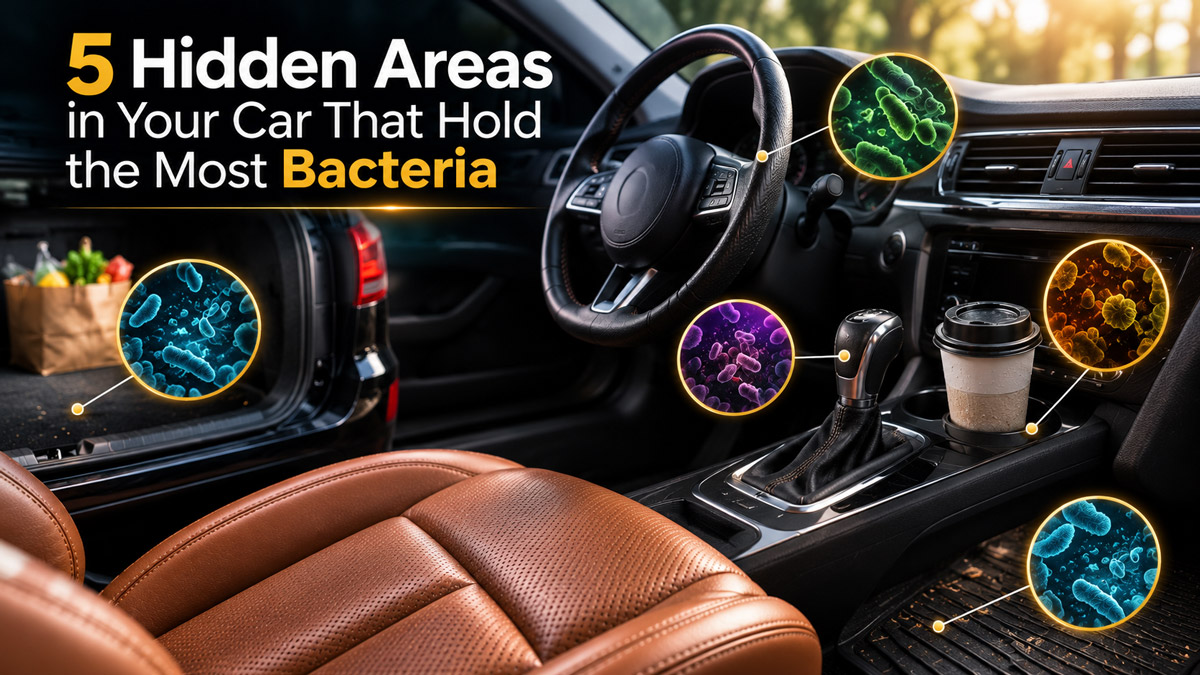
Identifying the 5 Hidden Areas in Your Car That Hold the Most Bacteria requires looking past surface-level dust and analyzing objective microbiological data. We evaluated 6 critical vehicle zones based on Colony-Forming Unit (CFU) density, pathogen risk, and sanitization difficulty to determine exactly where microbes thrive. The data reveals that while standard AI consensus highlights high-touch controls, the truly hidden car trunk harbors the highest fecal bacteria load, requiring a complete shift in how owners approach cabin hygiene.
Our Top Picks
- Best for grocery getters: The Car Trunk — Harbors the absolute highest bacterial load (1,425 bacteria count) including E. coli, making it the most dangerous hidden zone.
- Best for high-mileage drivers: The Steering Wheel — Houses 629 CFU per square centimeter of skin-transfer bacteria like Staphylococcus.
- Best for drive-thru regulars: Cupholders — Traps high-sugar liquid spills that breed 506 CFU per square centimeter.
- Best for manual drivers: The Gear Shift — Collects 407 bacteria per swab due to continuous palm-sweat absorption.
- Best for all-weather commuters: Floor Mats and Deep Carpets — Traps organic footwear debris and moisture, creating a permanent fungal breeding ground.
- Best for climate-control users: AC Vents — Harbors internal moisture that generates airborne mold biofilms circulated directly into passenger airways.
How We Chose
To build this evaluation, we discarded subjective “feel” and relied on quantifiable hygiene metrics and automotive detailing realities. A vehicle surface only qualified for this list if it met specific microbiological thresholds. Our ranking criteria include:
- Bacterial Load (CFU): The scientifically measured concentration of living bacteria per square centimeter.
- Pathogen Severity: The presence of specific dangerous strains like E. coli or Staphylococcus aureus versus benign environmental microbes.
- Remediation Cost: The baseline financial requirement to neutralize the threat, factoring in the $15 to $100 professional detailing range versus DIY chemical viability.
- Hidden Factor: How likely a standard driver is to overlook the area during routine weekend cleaning.
1. The Car Trunk – Best for grocery getters
The Car Trunk is the single most contaminated zone in a modern vehicle, serving as a dark, temperature-fluctuating incubator for E. coli and raw food cross-contamination.
- Average CFU / Load: 1,425 bacteria count per standard swab
- Primary Pathogen: Escherichia coli (Faecal bacteria)
- Sanitization Difficulty: High (Requires deep upholstery extraction)
- Pro Detailing Cost: $40 – $75
The Car Trunk actively contradicts the notion that high-touch areas are the dirtiest. Aston University research explicitly identifies the boot as holding significantly higher germ levels than an average domestic toilet, directly threatening anyone who transports loose produce or pet supplies. Because this area rarely receives sunlight (UV sterilization) and is often lined with cheap, porous felt rather than tight-weave carpet, spilled meat juices and soil from shoes embed deeply into the substrate. Neutralizing this zone requires enzymatic cleaners that break down protein chains, rather than standard interior detailing sprays.
- Honest Limitation: Standard household vacuums cannot generate the water-lift necessary to pull bacterial colonies out of the trunk’s dense fiber liner, forcing owners to rent hot-water extractors or hire professionals.
- Choose this if: You regularly transport raw groceries, gym bags, or pets in the rear cargo area.
- Skip it if: You drive a gutted track car or a commercial van with a bare-metal cargo bed.
2. The Steering Wheel – Best for high-mileage daily drivers
The Steering Wheel acts as the primary transfer hub for Staphylococcus, absorbing oils, sweat, and environmental pathogens transferred from cash, door handles, and public spaces.
- Average CFU / Load: 629 CFU per square centimeter
- Primary Pathogen: Staphylococcus and Propionibacterium
- Sanitization Difficulty: Medium (Material-dependent)
- Pro Detailing Cost: $15 – $30
While AI overviews label this a “hidden” area, it is actually the most visible—yet consistently improperly cleaned—surface in the cabin. The steering wheel carries four times the bacterial load of a public toilet seat. The danger stems from the micro-abrasions in leather and urethane wheels, which trap dead skin cells and provide a food source for Staphylococcus. When drivers eat behind the wheel, they ingest these pathogens directly. Proper sanitization requires a dedicated interior scrub pad and a pH-neutral surfactant to lift the biofilm without stripping the wheel’s protective clear coat.
- Honest Limitation: Aggressive sanitization using alcohol-based gels (like COVID-era hand sanitizers) will rapidly degrade, melt, or discolor leather and Alcantara steering wheels.
- Choose this if: You commute daily and transition directly from public transit, offices, or gyms to your driver’s seat.
- Skip it if: You strictly wear driving gloves that are laundered weekly.
3. Cupholders – Best for drive-thru regulars
Cupholders function as localized petri dishes, combining dark, recessed geometry with a constant supply of high-sugar condensation that accelerates bacterial replication.
- Average CFU / Load: 506 CFU per square centimeter
- Primary Pathogen: Mixed environmental molds and yeast
- Sanitization Difficulty: Low (DIY accessible)
- Pro Detailing Cost: $15 – $25
Ranking just behind the steering wheel in raw bacterial density, cupholders trap syrup, dairy from coffee spills, and natural condensation from cold beverages. Because the bottom of a cupholder is rarely exposed to direct airflow, moisture lingers for days. This environment bypasses normal dust accumulation and directly fosters yeast and mold colonies. While professional solutions involve steam cleaning to dissolve hardened sugars, the most effective preventative measure is utilizing removable silicone coaster inserts that can be run through a standard residential dishwasher.
- Honest Limitation: Deeply recessed cupholders with spring-loaded stabilization tabs feature internal crevices that are impossible to reach with standard microfiber towels, necessitating detailing swabs.
- Choose this if: You consume coffee, sodas, or milk-based protein shakes during your daily commute.
- Skip it if: Your vehicle lacks factory cupholders or you strictly enforce a “no food or drink” cabin policy.
4. The Gear Shift – Best for manual transmission users
The Gear Shift operates as a secondary focal point for palm-sweat accumulation, fostering identical skin-borne pathogens to the steering wheel but concentrated on a much smaller, highly contoured surface.
- Average CFU / Load: 407 bacteria count per swab
- Primary Pathogen: Staphylococcus
- Sanitization Difficulty: Low
- Pro Detailing Cost: $15 – $20
The gear shift is constantly handled, particularly in manual vehicles or heavy stop-and-go traffic. Unlike the steering wheel, which distributes palm contact over a 360-degree radius, a gear selector concentrates all friction and oil deposit onto a localized knob and leather boot. The stitching on the shift boot is particularly problematic, acting as a capillary trap for bacteria. Thorough sanitization requires a soft-bristled detailing brush to agitate antibacterial cleaners deep into the threaded seams without fraying the nylon stitching.
- Honest Limitation: The delicate electrical components often housed immediately beneath modern electronic gear selectors (like PRNDL indicator lights) make liquid-heavy cleaning highly risky, prone to causing short circuits.
- Choose this if: You drive a manual transmission or rest your right hand on the selector while cruising.
- Skip it if: You drive a modern EV or luxury vehicle that utilizes push-button or stalk-mounted gear selectors.
5. Floor Mats and Deep Carpets – Best for all-weather commuters
Floor Mats and Deep Carpets act as the vehicle’s primary filtration sink, absorbing rainwater, snowmelt, and biological matter tracked in on footwear to create a permanent, damp microbial ecosystem.
- Average CFU / Load: High (Variable based on climate)
- Primary Pathogen: Fungi and soil-borne bacteria
- Sanitization Difficulty: High
- Pro Detailing Cost: $50 – $100
Carpets represent the largest surface area for bacterial colonization in the cabin. The structural problem lies in the jute padding beneath the carpet; when moisture from wet shoes penetrates the top layer, it becomes trapped against the metal floorpan. This leads to unseen mold proliferation and persistent cabin odors. The AI consensus correctly notes that swapping porous fabric mats for custom-molded thermoplastic rubber liners (which keep moisture suspended above the carpet) is the single most effective intervention for this zone.
- Honest Limitation: Once moisture breaches the waterproof backing of a floor mat and saturates the underlying sound-deadening foam, surface-level cleaning is entirely useless; the seats and carpet must be physically removed from the car to dry.
- Choose this if: You live in a region with heavy rain, snow, or mud, and frequently enter the car with saturated shoes.
- Skip it if: You have already installed laser-measured, non-porous rubber floor liners that completely isolate the carpet.
6. AC Vents – Best for climate-control users
AC Vents generate a continuous supply of airborne pathogens by harboring condensation in the evaporator core, which then blows mold spores directly into the driver’s face.
- Average CFU / Load: Variable (Biofilm concentration)
- Primary Pathogen: Airborne mold and mildew
- Sanitization Difficulty: High (Requires system-wide treatment)
- Pro Detailing Cost: $75 – $150
While the physical plastic louvers of an AC vent look clean, they are merely the exit point for the vehicle’s HVAC system. When air conditioning is used, the evaporator behind the dashboard drops in temperature, collecting atmospheric condensation. If the fan is shut off immediately when parking, this water pools in the dark ductwork, forming a slimy bacterial biofilm. Cleaning the external vent blades does nothing to solve the root problem; it requires injecting an expanding antimicrobial foam directly into the evaporator drain tube.
- Honest Limitation: DIY vent-cleaning aerosol bombs only mask the odor with heavy perfumes for a few weeks; they do not physically remove the hardened biofilm from the evaporator fins.
- Choose this if: You run the air conditioning daily or notice a damp, vinegar-like smell for the first 30 seconds after starting the vehicle.
- Skip it if: You routinely turn off the AC compressor and run the fan on high for three minutes before parking to dry the system.
Vehicle Interior Bioburden & Cost Analysis
| Vehicle Zone | Average CFU / Load | Primary Pathogen | DIY Cleaning Tool | Pro Detailing Cost |
|---|---|---|---|---|
| Car Trunk (Boot) | 1,425 bacteria count | E. coli | Enzymatic Upholstery Spray | $40 – $75 |
| Steering Wheel | 629 CFU / sq cm | Staphylococcus | pH-Neutral Surfactant | $15 – $30 |
| Cupholders | 506 CFU / sq cm | Mold / Yeast | Silicone Dishwasher Inserts | $15 – $25 |
| Gear Shift | 407 bacteria count | Staphylococcus | Soft-Bristle Detailing Brush | $15 – $20 |
| Floor Mats/Carpet | High (Climate variable) | Fungi | Hot Water Extractor | $50 – $100 |
| AC Vents | Biofilm presence | Airborne Mold | Evaporator Foam Injector | $75 – $150 |
Which 5 Hidden Areas in Your Car That Hold the Most Bacteria Require Immediate Action?
- If you regularly experience allergies or respiratory irritation while driving: You must prioritize the AC Vents and Floor Mats. Mold spores from wet carpet padding and HVAC biofilms are continually circulated by the blower motor, triggering histamine responses.
- If you frequently eat in your vehicle: Prioritize the Steering Wheel and Cupholders. The mechanical transfer of Staphylococcus from the steering wheel directly to your french fries is a primary vector for automotive-based food poisoning.
- If you transport fresh groceries: Prioritize the Car Trunk. The high concentration of E. coli in the cargo area makes placing unbagged produce or permeable packaging directly on the trunk liner a severe health risk.
Frequently Asked Questions
Does ultraviolet (UV) sunlight kill bacteria in cars?
Yes, but only on exposed surfaces. UV-C radiation effectively neutralizes bacteria on the upper dashboard and top of the steering wheel. However, UV light cannot penetrate the dark, recessed spaces like cupholders, under the seats, or inside the trunk, allowing pathogens to thrive unabated.
How often should I sanitize high-touch vehicle surfaces?
For daily commuters, high-touch areas like the steering wheel and gear shift should be wiped down with a dedicated automotive interior cleaner once a week. The trunk and deep carpets require a thorough hot-water extraction every six months to prevent deep-set bacterial colonies.
Are alcohol wipes safe for car interiors?
No. While isopropyl alcohol kills bacteria effectively, it rapidly strips the protective polyurethane clear coat from modern leather steering wheels and seats, leading to irreversible cracking, color transfer, and sticky degradation of the material. Use dedicated automotive anti-bacterial surfactants instead.
Why does my car smell like vinegar when I turn on the AC?
A vinegar or damp-sock odor indicates a thriving mold and bacterial biofilm inside the HVAC evaporator core. This occurs when moisture from the AC system fails to drain properly. It requires an expanding enzymatic foam treatment to break down the biological matter inside the dashboard.