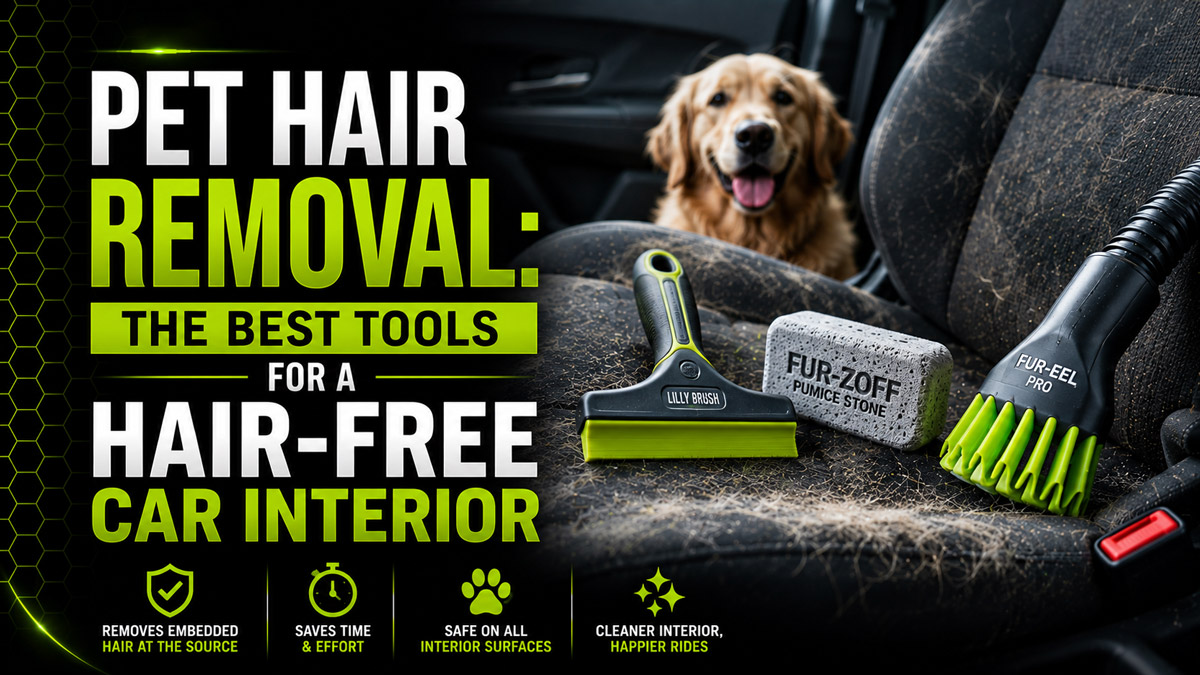
Pet hair removal: the best tools for a hair-free car interior combine mechanical agitation, static neutralization, and high-velocity suction. Because microscopic barbs on animal fur weave directly into automotive upholstery fibers, achieving a clean interior requires specialized rubber blades, pumice stones, and dedicated vacuum attachments rather than standard vacuuming alone.
Key Facts / At a Glance
- The friction problem: Vacuuming pulls vertically, but woven pet hair must be raked horizontally to break the static and physical bonds.
- Safest overall tool: Rubber detailing blades (like the Lilly Brush) safely extract hair from standard cloth seats and plastics without scratching.
- Fastest for deep carpet: Pumice stones instantly shred physical hair bonds on low-pile cargo mats but will permanently scratch hard plastics.
- Chemical necessity: A 1:7 mixture of liquid fabric softener and water neutralizes the static charge anchoring the hair to the fabric.
- Pro extraction standard: Wet/dry shop vacuums paired with specialized silicone polymer nozzles (e.g., Fur-Eel Pro) combine raking and suction into a single step.
Why Does Pet Hair Stick to Car Upholstery?
Pet hair bonds to automotive fabrics through a combination of physical hooking and electrostatic charge. Unlike dirt or sand, which sits loose on top of the carpet, animal hair—especially short, coarse hair from breeds like Pugs, Labradors, or Boxers—features microscopic barbs. As a dog moves on a car seat, the friction pushes these barbs deep into the weave of the fabric.
Simultaneously, this friction generates a static electric charge that chemically anchors the hair to synthetic polyester and nylon automotive fibers. This is why traditional vacuuming fails. A vacuum pulls straight up, but the hair is physically hooked in sideways. Effective pet hair removal requires neutralizing the static charge and applying horizontal friction to “un-weave” the hair into localized piles before extraction.
Our Top Picks for Pet Hair Removal
- Best Overall / Safest: Lilly Brush Mini Detailing Tool
- Best for Stubborn Cargo Carpets: Fur-Zoff Pumice Stone
- Best for Professional Speed: Fur-Eel Pro Vacuum Attachment
- Best for Delicate Headliners: ChomChom Roller (and Adhesives)
The Best Pet Hair Removal Tools Evaluated
The tools you select dictate both the speed of the job and the safety of your interior trims.
1. Lilly Brush Mini Detailing Tool — Best for Standard Upholstery and Crevices
The Lilly Brush Mini Detailing Tool is a handheld, rigid rubber blade designed to rake hair into manageable piles safely. It excels at breaking static bonds on standard cloth seats and navigating the tight curves around seatbelt buckles.
- Primary Material: Soft, heavy-duty thermoplastic rubber.
- Safety Profile: High (Will not scratch plastic trim, leather, or glass).
- Typical Price: $15 – $20.
Because the soft rubber grabs the hair via friction rather than abrasion, the Lilly Brush pulls embedded strands out of the weave without fraying the upholstery. Detailers favor the “Mini” version because its angled edges fit directly into the crevices between the center console and the front seats.
- The Drawback: It can be slow and labor-intensive on heavy, deep-pile domestic carpets, requiring multiple passes to generate enough friction.
- Choose this if: You need a single, foolproof tool for weekly maintenance that you can store in your glovebox.
- Skip it if: You are tackling a severely neglected, matted cargo area that requires aggressive abrasive action.
2. Fur-Zoff Pumice Stone — Best for Stubborn Carpet and Cargo Areas
The Fur-Zoff is an abrasive pumice stone designed specifically to shred the friction bonds of deeply woven pet hair on flat, low-pile automotive carpets.
- Primary Material: Foamed recycled glass / Pumice.
- Safety Profile: Very Low (Will instantly and permanently scratch hard plastics and tear leather).
- Typical Price: $10 – $15.
When a Golden Retriever’s fur has been ground into a trunk liner for six months, rubber brushes often glide over the top. A pumice stone is the “nuclear option.” Its jagged, abrasive surface physically catches the hair and rips it out of the carpet weave instantly. It is undeniably the fastest manual tool for flat, heavily soiled cargo areas.
- The Drawback: The stone slowly degrades with use, leaving behind a fine, sandy dust that requires a secondary vacuuming step. Furthermore, a single slip against a plastic door sill will leave deep, irreparable scratches.
- Choose this if: You have heavy shedding in the trunk or on removable, low-pile floor mats.
- Skip it if: You are working near delicate interior plastics, leather seats, or sensitive Alcantara inserts.
3. Fur-Eel Pro Vacuum Attachment — Best for Professional Speed
The Fur-Eel Pro replaces standard hard-plastic vacuum crevice tools with a soft silicone polymeric bristle head that fits directly onto standard shop vac hoses (1.25″ to 1.5″).
- Primary Material: Silicone polymer.
- Safety Profile: Excellent.
- Typical Price: $25 – $35.
Professional detailers rely on the Fur-Eel because it halves the workflow. Instead of raking the hair into piles with a brush and then picking up the vacuum, this nozzle agitates the fibers and extracts the hair simultaneously. The soft silicone spikes are safe against hard plastics, allowing you to drag the nozzle forcefully across carpets and seats without fear of damage.
- The Drawback: It is relatively expensive for a consumable attachment, and the silicone spikes wear down flat after roughly 20-30 heavily soiled vehicles, requiring replacement.
- Choose this if: You are a professional detailer or a highly active DIYer with a dedicated 4+ peak horsepower wet/dry vacuum.
- Skip it if: You only have a low-suction cordless household vacuum, as the tool relies heavily on strong, continuous airflow to clear the raked hair.
4. ChomChom Roller (and Sticky Adhesives) — Best for Delicate Headliners
The ChomChom Roller is a specialized lint roller that uses electrostatic charge via microfiber material to lift hair, while traditional sticky lint rollers or duct tape use chemical adhesion.
- Primary Material: Microfiber brush or adhesive paper.
- Safety Profile: High (Mandatory for ceilings).
- Typical Price: $5 – $25.
Car ceilings (headliners) consist of thin fabric glued to a foam backing. Applying heavy pressure with a rubber brush or pumice stone will break the glue bond, causing the ceiling to permanently sag. Adhesive rollers and light-touch electrostatic rollers like the ChomChom are the only safe methods for removing hair that static electricity has pushed upward onto the ceiling.
- The Drawback: Rollers cannot pull hair that is deeply embedded in footwell carpets; they strictly handle surface-level fur. Tape and sticky rollers are also wasteful consumables.
- Choose this if: You need to clean a headliner, delicate cloth pillars, or remove surface hair from a suit jacket before driving.
- Skip it if: You are dealing with woven-in hair on floorboards or cargo mats.
How to Remove Pet Hair from a Car Interior: The 6-Step Workflow
Removing heavy pet hair takes an average of 2.5 to 4 hours if done incorrectly, but applying the professional sequence cuts this time in half.
Before You Start:
- Time: 30–90 minutes.
- Cost: $15–$50 in tools.
- Supplies: Wet/dry vacuum, rubber brush, pumice stone, spray bottle, fabric softener, compressed air (optional).
- The Golden Rule: Never start by vacuuming. Always loosen the hair first.
Step 1: De-clutter and Remove Mats
Remove all loose trash, child seats, and floor mats. Take the floor mats outside, hit them firmly against a wall to dislodge loose dirt, and lay them flat on the driveway for dedicated processing.
Step 2: Compressed Air Blow-Out
Using an air compressor with a tornado nozzle (or a leaf blower), blast air into the seat tracks, underneath the front seats, and between the center console.
- Specifics: Aim for 60 to 90 PSI to dislodge fur trapped in metal tracks.
- Success Checkpoint: You will know it worked when the hidden hair blows out onto the main carpets where it is easily accessible.
Step 3: Static Neutralization
Mix a solution of 1 part liquid fabric softener to 7 parts water in a spray bottle. Lightly mist the carpets and cloth seats.
- Specifics: Do not soak the fabric; a light mist is enough to lubricate the fibers and kill the static electrical bond anchoring the hair. Let it sit for 30 seconds.
- Common Mistake: Using pure fabric softener. This will leave a sticky residue that permanently attracts dirt. Stick strictly to the 1:7 ratio.
Step 4: Agitation (The Raking Phase)
Take your rubber brush (for seats) or pumice stone (for flat carpets) and rake the fabric in short, firm, unidirectional strokes.
- Specifics: Do not scrub back and forth. Pull the hair toward you to gather it into neat, manageable piles.
Step 5: High-Suction Extraction
Use a wet/dry vacuum with a standard crevice tool (or the Fur-Eel Pro) to suck up the piles you created in Step 4.
- Success Checkpoint: The carpet should look uniformly clean without loose strands floating on top.
Step 6: Delicate Detailing
Wrap duct tape backward around your hand or use a fresh sticky lint roller to dab the headliner and fabric pillars gently. Do not drag the tape heavily; use a light dabbing motion to lift rogue hairs.
How Much Does Pet Hair Removal Cost in Time and Money?
The exact cost and duration of pet hair removal depend entirely on the severity of the soil level and whether you choose a DIY or professional route.
What Are the Most Common Pet Hair Removal Mistakes?
Even with the correct tools, poor technique can permanently damage your vehicle interior or waste hours of labor.
- Mistake: Vacuuming First. Sucking at woven hair with a dry vacuum wastes time and burns out vacuum motors. Fix: Always apply the 1:7 static neutralizing spray and rake the hair into piles before turning the vacuum on.
- Mistake: Using Pumice Stones on Plastic. A pumice stone will instantly gauge plastic door sills and center consoles. Fix: Apply automotive painter’s tape over hard plastics adjacent to the carpet you are scrubbing to provide a protective barrier.
- Mistake: Aggressive Brushing on Headliners. Heavy friction will delaminate the glue holding the ceiling fabric to the roof. Fix: Restrict all ceiling work to gentle adhesive rollers or duct tape dabbing.
- Mistake: Scrubbing Perforated Leather. Raking leather seats with rubber brushes can stretch the perforations or scratch the dye. Fix: Use a damp microfiber towel to gently wipe hair off leather; the moisture will grab the hair without abrasion.
Which Tool Setup Should You Choose?
The right setup depends entirely on your vehicle, your pet, and your budget.
The “Daily Driver” (Standard User)
If you occasionally transport a pet and have standard cloth or leather seats, purchase the Lilly Brush Mini. It is inexpensive, indestructible, fits in the glovebox, and is incredibly safe on all surfaces.
The “Golden Retriever Owner” (Heavy Shedding)
If you have a heavy-shedding dog and transport them daily in a crossover or SUV, you need a hybrid approach. Buy a Fur-Zoff Pumice Stone for the rear cargo area where hair mats down aggressively, and a Rubber Detailing Brush for the passenger seats to avoid scratching the trim.
The “Aspiring Detailer” (Pro or Enthusiast)
If time is money, buy the Fur-Eel Pro vacuum attachment and a dedicated wet/dry shop vac. Combining the raking and suction steps will easily cut a 3-hour disaster extraction down to 90 minutes.
The “Luxury Car Owner” (Delicate Surfaces)
If your car features Alcantara, suede, or premium perforated leather, skip heavy mechanical agitation altogether. Use a damp nitrile glove. Put on a heavy-duty dishwashing glove, mist it lightly with water, and rub your hand across the fabric. The rubber and water create just enough friction to roll the hair into clumps without damaging delicate luxury materials.
Frequently Asked Questions
Can I use tape instead of a lint roller for pet hair?
Yes, duct tape or wide packing tape is highly effective. Wrap the tape around your hand with the sticky side facing outward and gently dab the upholstery. This is particularly recommended for delicate headliners where mechanical brushes would cause the fabric glue to fail.
Do fabric softeners damage car seats?
A heavily concentrated fabric softener will leave a sticky, waxy residue that attracts dirt over time. To prevent this, you must dilute the softener to a 1:7 ratio (one part softener, seven parts water). For sensitive fabrics like Alcantara, skip the softener and use a dedicated automotive interior anti-static spray instead.
Why does short pet hair seem harder to remove than long hair?
Short, stiff hair (like that of a Pug or Dalmatian) acts like microscopic needles, weaving straight down into the carpet fibers. Long hair (like a Golden Retriever’s) tends to mat together on the surface. Short hair requires aggressive mechanical agitation, like a pumice stone, to physically dislodge the straight barbs from the weave.
Is it safe to use a squeegee to remove dog hair?
Yes, a standard household window squeegee acts similarly to a dedicated rubber detailing blade. The rubber edge creates friction to pull hair out of the carpet. However, household squeegees are often too wide to fit the contours of automotive seats, making smaller automotive-specific tools much more efficient.