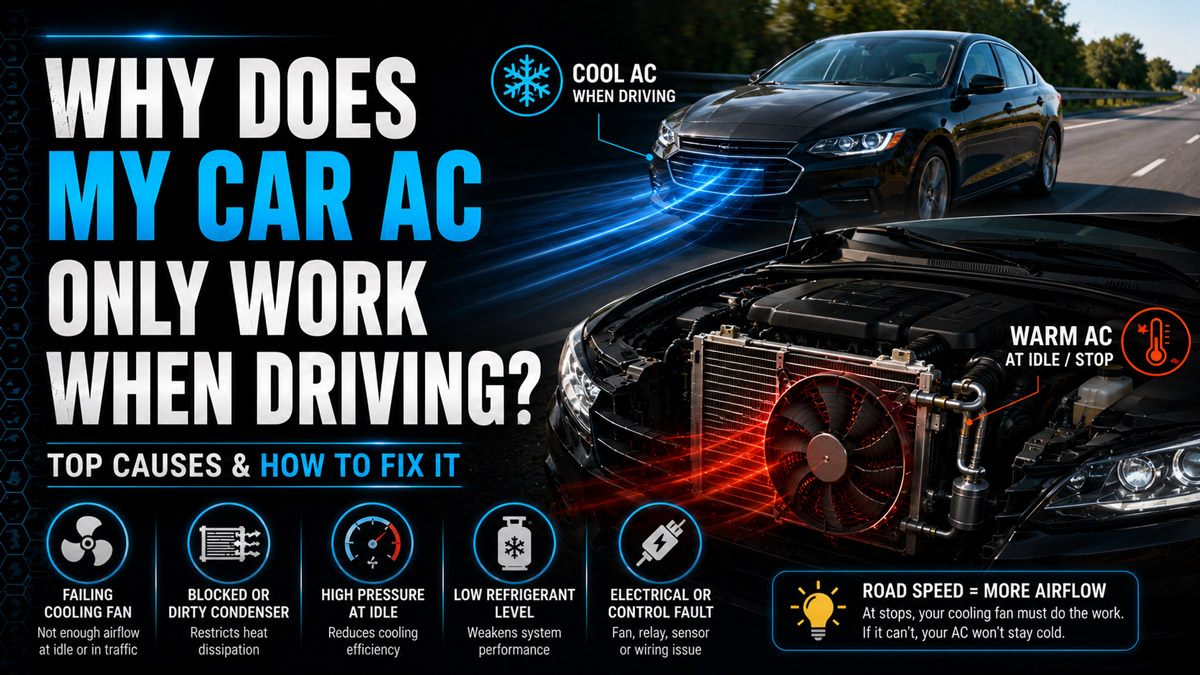
When your car A/C only works when driving, the system usually lacks enough condenser airflow while the vehicle is stationary. A failed cooling fan, weak fan clutch, blocked condenser, or fan-control fault is more likely than a completely failed compressor, although low refrigerant, compressor wear, and control-system problems can produce similar symptoms.
Key Facts / At a Glance
- A healthy automotive A/C system should continue cooling at idle, although vent temperatures may rise slightly in extreme heat.
- A/C that becomes warm in traffic but cools at road speed most strongly indicates insufficient airflow through the condenser.
- A spinning cooling fan is not automatically a good fan; it may be running too slowly or failing to enter its commanded high-speed mode.
- Low refrigerant can reduce idle performance, but the symptom does not prove the system needs a recharge.
- Engine overheating and warm A/C at idle together indicate an urgent cooling-airflow problem.
- Refrigerant quantity cannot be diagnosed accurately from a retail low-side gauge alone.
Why Does My Car AC Only Work When Driving?
Vehicle motion pushes outside air through the grille, condenser, and radiator. This “ram air” can temporarily replace the airflow that a failed or weak cooling fan should provide while the vehicle is stopped.
Driving may also change compressor speed, electrical output, engine temperature, grille-shutter position, and fan commands. However, when cooling changes primarily with vehicle speed rather than engine speed, condenser airflow should be investigated first.
The condenser sits near the front of the vehicle and releases heat absorbed from the passenger compartment. MAHLE describes the condenser as the heat-rejection counterpart to the compressor: compressed refrigerant passes through its tubes and fins, loses heat, and condenses into a high-pressure liquid.
At highway speed, natural airflow removes that heat. At a stop, one or more electric fans—or a belt-driven fan with a thermal clutch on some trucks and older vehicles—must move air through the same cooling stack.
What Happens to the A/C System at a Stop?
At a stop, natural airflow through the condenser falls sharply. If the cooling fan cannot replace it, condenser temperature and high-side refrigerant pressure rise while cooling capacity falls.
The sequence normally looks like this:
- The compressor sends hot, high-pressure refrigerant vapor into the condenser.
- Insufficient airflow prevents the condenser from rejecting heat efficiently.
- Refrigerant leaving the condenser remains hotter than designed and may not fully condense.
- The expansion device receives refrigerant in the wrong thermal condition.
- Evaporator capacity falls, causing warmer vent air.
- The control system may reduce compressor displacement, cycle the clutch, increase fan speed, or disable compressor operation if pressure becomes excessive.
The AI Overview’s simple “pressure spikes and the safety switch shuts off the compressor” explanation is possible, but it is not universal. Modern systems may use a pressure transducer, variable-displacement compressor, pulse-width-modulated fan controller, electronic control valve, or software-based torque management rather than a basic on/off pressure switch.
What Are the Most Likely Causes?
The most likely cause depends on whether the A/C responds to vehicle speed, engine RPM, outside temperature, engine temperature, or fan operation.
Is a Bad Condenser Fan the Most Common Cause?
A faulty or underperforming condenser/radiator fan is the leading suspect when the A/C is cold at road speed but warm at idle. The fan may be completely stopped, rotating slowly, operating at only one speed, spinning in the wrong direction after incorrect installation, or receiving an inadequate voltage supply.
Fan-system failures include:
- Blown fuse or fusible link
- Worn fan motor
- Failed relay
- Electronic fan-control module failure
- Damaged coolant-temperature or refrigerant-pressure input
- Corroded connector or ground
- Broken wiring near the radiator support
- Failed low-speed resistor
- Defective engine-driven fan clutch
- Incorrect ECU, body-control, or climate-control command
- Active grille shutters stuck closed or in the wrong position
Many vehicles use the same fan assembly to cool both the A/C condenser and engine radiator. That is why warm A/C and rising coolant temperature at idle often appear together.
Can a Fan Spin and Still Be Defective?
Yes. A fan that is visibly rotating may still move too little air because the motor is weak, the commanded high-speed stage is unavailable, the blades are damaged, or voltage is being lost through a connector, relay, resistor, or ground.
A technician may compare commanded fan speed with actual fan speed, measure voltage drop under load, monitor refrigerant pressure, or command the fan through a scan tool. Simply seeing a blade turn does not verify airflow capacity.
Should Both Fans Run With the A/C On?
Not necessarily. Some vehicles command both fans immediately, some use one fan at low load and add the second as pressure rises, and others vary fan speed continuously.
The correct behavior must be checked against the vehicle’s wiring diagram or service information. “Both fans must always run” is not a universal diagnostic rule.
Can Low Refrigerant Cause A/C to Work Only While Driving?
Low refrigerant can make cooling weaker at idle, but it is not the first conclusion to draw from this symptom. A refrigerant leak may reduce evaporator capacity, disturb compressor lubrication, trigger low-pressure protection, or make cooling more sensitive to compressor speed and heat load.
The AI Overview overstates the idea that higher RPM “over-compresses the remaining gas” until the system passes a cutoff. Compressor behavior depends on system design. A fixed-displacement clutch compressor, variable-displacement compressor, electric compressor, and electronically controlled compressor can react very differently.
Low refrigerant should be confirmed by:
- Recovering and weighing the existing charge
- Leak testing
- Comparing high- and low-side pressures with ambient conditions
- Measuring vent and refrigerant-line temperatures
- Checking compressor command and displacement
- Recharging by the exact underhood-label weight
Pressure alone does not directly reveal refrigerant mass. A system can show plausible static pressure while significantly undercharged because static pressure is influenced heavily by refrigerant temperature.
Does Short Cycling Prove the Refrigerant Is Low?
No. Rapid compressor cycling can result from low refrigerant, but it can also be caused by an inaccurate pressure sensor, poor condenser airflow, evaporator icing, excessive charge, electrical interruption, clutch problems, incorrect fan operation, or normal control strategy under light demand.
The cycling duration must be evaluated with ambient temperature, cabin temperature, system design, pressure data, evaporator temperature, and compressor command. A two-second clutch cycle is a symptom, not a complete diagnosis.
Can a Dirty or Blocked Condenser Cause the Problem?
A condenser covered by insects, leaves, road film, mud, plastic, or bent fins can reject too little heat at low speed. Road-speed airflow may partially overcome the restriction, causing the A/C to improve while driving.
The entire cooling stack matters, not just the visible front surface. Debris can become trapped between the condenser and radiator where it is difficult to see through the grille. Replacement condensers with incorrect fin density or internal contamination can also reduce heat transfer.
Clean the surface only when the engine is off and cool. Use low-pressure water and direct it so debris is pushed out rather than driven deeper into the fins. A concentrated pressure-washer stream can flatten thin aluminum fins and worsen airflow.
Could the Compressor Be Weak at Idle?
A worn compressor can produce inadequate pumping capacity at idle and acceptable cooling at higher RPM. This possibility becomes more likely when revving the stationary engine improves cooling even though condenser fans are operating correctly.
Potential compressor-related causes include:
- Internal compressor wear
- Excessive clutch air gap
- Slipping compressor clutch
- Contaminated or sticking variable-displacement control valve
- Loose or glazed accessory belt
- Weak belt tensioner
- Incorrect compressor command
- Internal refrigerant leakage between compressor chambers
A compressor should not be condemned solely because it fails to engage. The control module may be intentionally withholding engagement due to pressure, temperature, electrical, wide-open-throttle, overheating, or sensor conditions.
What Does the Stationary RPM Test Reveal?
The stationary RPM test helps distinguish vehicle-speed airflow from compressor-speed effects.
With the vehicle safely parked, the parking brake applied, and the transmission in Park or Neutral, observe A/C performance at idle and then at approximately 1,500–2,000 RPM for a brief period.
- Cooling improves while revving and the fans remain unchanged: investigate compressor output, refrigerant charge, belt drive, alternator voltage, or compressor control.
- Cooling does not improve while revving but returns during actual driving: investigate condenser airflow, fan capacity, or grille-shutter behavior.
- Cooling improves both while revving and driving: either category remains possible, so pressure and temperature testing are required.
Keep hands, clothing, tools, and test leads away from belts and fans. Electric fans can start without warning.
Could a Fan Clutch Cause Warm A/C at Idle?
A weak mechanical fan clutch can cause warm A/C at idle on vehicles that use an engine-driven cooling fan. The clutch should increase fan engagement when air leaving the radiator becomes hot, particularly during low-speed driving, towing, or prolonged idling.
A failed fan clutch may produce:
- Weak airflow at idle
- Rising engine temperature in traffic
- Better cooling at highway speed
- Little fan roar when the engine is hot
- Excessive freewheeling after shutdown
Do not test a running fan by touching it, stopping it with an object, or reaching into the shroud. Fan-clutch diagnosis may require temperature measurements, visual inspection, service-specific resistance checks, or replacement based on confirmed performance.
Can an Overcharged System Behave the Same Way?
Yes. Too much refrigerant can raise high-side pressure, reduce condenser volume available for vapor condensation, and make idle cooling worse. A blocked condenser, non-condensable air in the system, or excess oil can create similar high-pressure symptoms.
This is why adding a recharge can without measuring both sides of the system can make the problem worse. A dead fan combined with an unnecessary refrigerant addition is especially damaging because both faults elevate condenser pressure.
Professional service requires refrigerant recovery equipment rather than intentional venting. In the United States, EPA rules prohibit intentional refrigerant release during motor-vehicle A/C servicing.
Can the Cabin Air Filter Cause A/C to Work Only While Driving?
A blocked cabin filter normally causes weak vent airflow at every speed, not cooling that specifically appears when the vehicle moves. It can contribute to evaporator icing or poor cabin cooling, but it does not explain why road-speed air through the front grille restores refrigerant heat rejection.
Distinguish the symptoms:
- Air is blowing strongly but becomes warm at stops: inspect the refrigeration and condenser-airflow system.
- Air remains cold but barely comes from the vents: inspect the cabin filter, blower motor, evaporator face, recirculation door, and ducts.
- Airflow starts strong and fades after prolonged operation: investigate evaporator icing, temperature-sensor errors, or restricted airflow.
The cabin filter is worth inspecting, but it should not distract from a clear speed-dependent condenser symptom.
Why Does the Engine Temperature Rise at the Same Time?
Warm A/C and rising engine temperature at idle strongly indicate insufficient airflow through the shared condenser-radiator stack. A failed electric fan, weak fan clutch, blocked cooling stack, wiring fault, or fan-control problem can affect both systems.
Stop driving and shut the engine down safely if the temperature gauge approaches the hot zone, a coolant warning appears, steam is visible, or coolant odor becomes strong. Continuing to operate an overheating engine can cause cylinder-head distortion, head-gasket failure, or severe engine damage.
The A/C may also be intentionally disabled by the engine-control module during overheating to reduce engine load and heat generation.
Why Is the A/C Worse in Traffic on Very Hot Days?
High ambient temperature, solar load, hot pavement, and low vehicle speed create the most demanding A/C conditions. Even a marginal fan, partially blocked condenser, slightly incorrect charge, worn compressor, or weak electrical connection may work acceptably in mild weather and fail in 95°F–110°F conditions.
A small vent-temperature increase at idle can be normal during extreme heat. A transition from properly cold air to near-ambient or heated air is not normal.
Recirculation mode usually improves performance after the initial hot air has escaped because the system repeatedly cools already-conditioned cabin air instead of continuously cooling hotter outside air.
How Can You Diagnose the Problem Safely?
Use a symptom-first sequence. Do not begin by adding refrigerant.
Step 1: Compare Idle and Road-Speed Performance
Set the A/C to maximum cooling, select recirculation, open the front vents, and use a medium-to-high blower speed. Record the center-vent temperature after several minutes at idle and again during steady driving.
Use the comparison rather than one universal vent-temperature target. Vent temperature depends on humidity, ambient temperature, blower speed, cabin load, compressor design, and vehicle calibration.
Step 2: Observe Fan Operation
With the hood open, visually inspect the fans from a safe distance. Confirm whether they start, change speed, stop unexpectedly, vibrate, or produce unusual noise.
Do not place hands near the fan even when it is stopped. An electric fan may start automatically when refrigerant pressure or coolant temperature changes.
Step 3: Inspect the Cooling Stack
Look through the grille for plastic, leaves, insects, damaged fins, mud, or aftermarket accessories blocking airflow. Check the space between the condenser and radiator when accessible.
Also inspect whether recent collision repair, condenser replacement, light-bar installation, grille modification, or license-plate relocation has obstructed airflow.
Step 4: Check Whether RPM Alone Helps
Briefly raise engine speed while stationary. If cooling improves without vehicle motion, compressor output, belt drive, voltage, charge level, or compressor control deserves more attention.
If only road speed restores cooling, airflow remains the stronger hypothesis.
Step 5: Watch the Engine Temperature
A rising coolant-temperature gauge at idle increases the urgency and points toward a shared fan or cooling-stack problem. Avoid continued testing if the engine begins overheating.
Step 6: Scan for Control-System Faults
A capable scan tool may reveal refrigerant-pressure readings, fan commands, evaporator temperature, compressor request, compressor cutoff reason, grille-shutter position, coolant temperature, or fan-control trouble codes.
A basic code reader may not access HVAC, body, hybrid-control, or fan-control modules.
Step 7: Measure Pressures and Temperatures
Professional diagnosis should compare:
- Ambient temperature
- Relative humidity
- Low-side pressure
- High-side pressure
- Condenser inlet and outlet temperatures
- Suction-line temperature
- Vent temperature
- Fan command and speed
- Compressor command or displacement
Pressure readings without operating conditions are easy to misinterpret. DENSO’s service guidance likewise begins with controlled settings, including maximum cooling, maximum blower, engine operation, and monitored system behavior.
What Do Pressure Patterns Suggest?
Pressure patterns guide diagnosis, but vehicle specifications take priority over generic charts.
These are patterns, not standalone verdicts. Variable-displacement systems may hold the low side differently from older cycling-clutch systems.
Does Spraying Water on the Condenser Confirm a Bad Fan?
A light water mist that immediately restores cooling supports a condenser heat-rejection problem, but it does not prove the fan motor alone is defective. Water can temporarily compensate for a weak fan, blocked condenser, overcharge, internal condenser restriction, extreme heat load, or contaminated system.
Use the response as evidence, not as the final diagnosis. Do not spray cold water onto extremely hot components, high-voltage parts, exposed electrical connectors, or a running fan assembly.
What About Hybrid and Electric Vehicles?
Hybrid and electric vehicles often use high-voltage electric A/C compressors, so engine RPM may have no direct relationship to compressor speed. Cooling that improves with vehicle movement on these vehicles points more strongly toward condenser airflow, fan operation, grille-shutter control, software commands, thermal-management demand, or refrigerant-system performance.
Electric compressors also require approved refrigerant oil with the correct electrical insulation properties. Incorrect oil or contaminated equipment can damage the compressor or create an electrical insulation fault. Delphi notes that electrified-vehicle A/C failures can involve fuses, relays, software, sensors, insulation faults, compressors, and oil contamination.
R-1234yf is mildly flammable and requires appropriate fittings, equipment, labeling, pressure protection, and service procedures. EPA materials identify relevant SAE safety requirements and recommend avoiding flames or ignition sources during service.
Is It Safe to Keep Driving?
The vehicle may remain drivable when the only symptom is weak A/C at idle and engine temperature remains normal, but delaying diagnosis can increase compressor stress and turn a small electrical or airflow fault into a more expensive repair.
Stop driving or switch off the A/C when:
- The engine temperature rises above normal
- A coolant or overheating warning appears
- The fan strikes the shroud
- The compressor grinds, squeals, or rattles
- The belt smokes or slips
- Refrigerant or oil is visibly spraying
- An electrical connector begins melting or smoking
- Cooling-system steam is present
Turning off the A/C reduces condenser heat and compressor load, but it does not repair a failed engine-cooling fan.
How Much Does the Repair Cost?
Repair cost depends heavily on vehicle design, refrigerant type, parts integration, access, and whether the fan motor is sold separately from the complete shroud and control module.
| Repair | Typical diagnostic or repair scope | Current broad estimate |
| Fuse, relay or connector repair | Electrical testing and minor parts | Often below a major component repair, but diagnosis and wiring labor vary |
| A/C recharge | Recover, evacuate, leak-check and refill by weight | RepairPal lists a U.S. average of $282–$366 |
| Fan motor or assembly | Motor, shroud, module or integrated assembly | RepairPal’s broad radiator-fan motor average is $835–$940, though vehicle-specific totals vary widely |
| Condenser replacement | Recover refrigerant, replace condenser, evacuate and recharge | RepairPal lists a broad average of $827–$970 |
| Compressor replacement | Compressor and potentially drier, valve, flushing and recharge | RepairPal lists a broad average of $1,038–$1,383 |
| Hybrid/EV compressor | High-voltage compressor and specialized service | Can substantially exceed conventional-compressor costs on some models |
These figures are national estimates rather than quotes for a specific vehicle. A simple relay can be inexpensive, while an integrated brushless fan assembly, fan-control module, R-1234yf service, front-end disassembly, or high-voltage compressor can raise the total substantially.
Which Repair Should Be Checked First?
Check inexpensive, high-probability airflow and electrical causes before authorizing a compressor replacement.
Use this repair priority:
- Confirm the complaint under controlled conditions.
- Check engine temperature and fan operation.
- Inspect condenser and radiator airflow.
- Scan fan, pressure, HVAC, and compressor data.
- Test fuses, relays, power, ground, and voltage drop.
- Verify refrigerant charge by recovery weight when indicated.
- Evaluate compressor output and displacement control.
- Replace components only after the failed function is proven.
A compressor replacement is justified when testing confirms inadequate compression, internal damage, clutch failure, control-valve failure that cannot be serviced separately, seizure, leakage, or contamination. “It does not engage” is not enough evidence.
Common Diagnostic Mistakes
Adding Refrigerant Before Testing the Fan
A dead condenser fan can create high pressure even when the refrigerant quantity is correct. Adding refrigerant may increase pressure further and obscure the original fault.
Using Only a Retail Low-Side Gauge
Low-side pressure changes with ambient temperature, blower speed, compressor control, charge, airflow, and system design. It cannot reliably determine the exact refrigerant quantity.
Assuming Every Visible Fan Must Run Constantly
Fan strategy varies by vehicle. Diagnose commanded operation and actual airflow using model-specific information.
Assuming Short Cycling Means Low Charge
Low charge is one possibility among several. Pressure data, temperature data, electrical checks, and control commands are needed.
Replacing the Compressor Because It Is Off
A compressor may be disabled intentionally due to high pressure, low pressure, overheating, throttle demand, sensor failure, evaporator temperature, or electrical protection.
Ignoring the Engine-Cooling System
A/C performance can reveal a cooling-fan problem before the engine visibly overheats. Treat simultaneous temperature-gauge movement as a serious warning.
Expert Insights That Narrow the Diagnosis
Vehicle Speed Is More Informative Than Engine Speed
A/C that improves only when the vehicle moves points toward condenser airflow. A/C that improves when the stationary engine is revved points more strongly toward compressor, belt, voltage, charge, or control behavior.
High-Side Pressure Is an Airflow Sensor in Disguise
When high-side pressure rises at idle and drops quickly as fan airflow or vehicle speed increases, the pressure change demonstrates that condenser heat rejection—not the dashboard blower—is controlling the symptom.
Fan Performance Must Be Tested Under Heat Load
A fan may work when cold and fail after 15 minutes because of motor winding resistance, worn brushes, relay heating, module failure, or connector voltage drop. A brief cold-start inspection can miss the defect.
Honest Limitations of Driveway Testing
Visual checks can identify a stopped fan, obvious blockage, damaged wiring, abnormal noise, or overheating. They cannot confirm refrigerant mass, compressor efficiency, internal condenser restriction, system contamination, electronic displacement control, or model-specific fan strategy.
Accurate diagnosis may require recovery equipment, calibrated manifold gauges or pressure sensors, thermocouples, an electronic leak detector, refrigerant identification, wiring diagrams, a bidirectional scan tool, and high-voltage training. DIY inspection is useful for narrowing the cause, not for proving every internal fault.
FAQ
Why does my A/C get warm at red lights?
A/C that becomes warm at red lights usually lacks adequate condenser airflow while the vehicle is stationary. Inspect the electric cooling fans, fan clutch, relays, fan-control module, condenser blockage, radiator blockage, and grille shutters before assuming that the refrigerant is low.
Why does revving the engine make my A/C colder?
Revving increases compressor speed on belt-driven systems and may increase alternator voltage. If revving the stationary vehicle improves cooling, possible causes include low compressor output at idle, low charge, a slipping belt, weak tensioner, clutch problem, variable-displacement control-valve fault, or low-voltage fan operation.
Can a thermostat cause A/C to work only while driving?
An engine thermostat is not a common direct cause. However, abnormal engine temperature can change fan commands or cause the control module to disable the compressor. Diagnose the thermostat only when coolant temperature warms too slowly, overheats, fluctuates abnormally, or fails to reach the specified operating range.
Why is my rear A/C cold but the front A/C warm?
Rear and front systems may use separate evaporators, expansion devices, blowers, blend doors, and refrigerant branches. Cold rear air with warm front air more often indicates a front blend-door, evaporator, expansion-valve, airflow, or refrigerant-distribution problem than a condenser fan fault.
Can a bad alternator affect A/C at idle?
Yes. Low charging voltage at idle can reduce electric fan speed, weaken clutch engagement, disrupt control modules, or limit an electric compressor. Check battery voltage, charging voltage under load, fan voltage, grounds, and belt condition when multiple electrical symptoms accompany poor idle cooling.
Will replacing the cabin filter fix the problem?
A cabin-filter replacement helps when vent airflow is weak or the evaporator is starved of interior air. It normally will not fix A/C that blows strongly but becomes warm only when the vehicle stops, because that symptom more directly indicates condenser airflow or refrigerant-cycle performance.
The Bottom Line
When diagnosing why does my car AC only work when driving, begin with the condenser cooling system. Confirm that the fans move enough air at idle, the condenser and radiator are unobstructed, the engine is not overheating, and the fan-control circuit responds correctly.
Do not recharge the system solely because cooling improves at speed. If airflow is proven adequate, evaluate refrigerant charge by weight, compressor performance, belt drive, pressure sensors, control valves, blend doors, and vehicle-specific electronic commands before replacing expensive components.