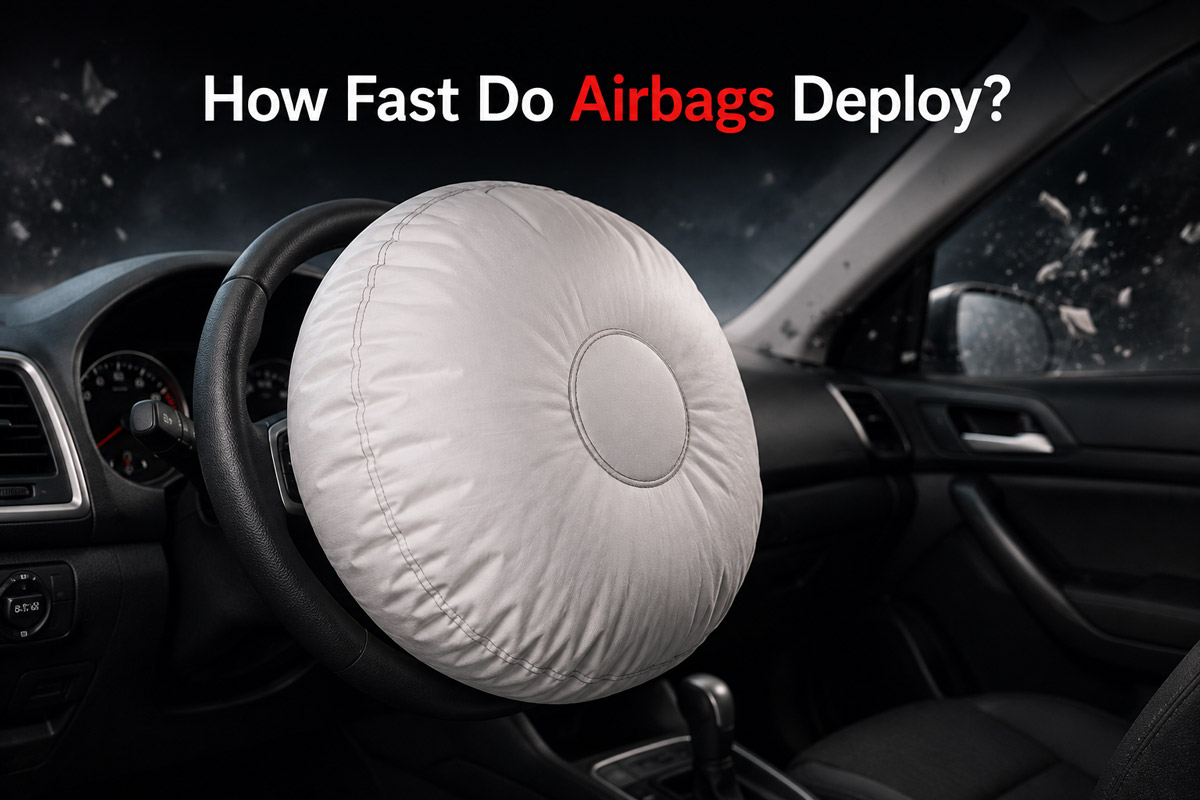
Airbags typically deploy and inflate within approximately 20 to 50 milliseconds, or 0.02 to 0.05 seconds, after a qualifying crash begins. A modern frontal airbag may be fully inflated in about 30 milliseconds, while side-impact systems may require an even faster deployment decision because occupants have less protective space beside them.
Key Facts at a Glance
- A modern airbag can be fully inflated approximately 30 milliseconds after a qualifying impact begins.
- Side-impact airbag controllers may have less than 5 milliseconds to decide whether deployment is necessary.
- Airbags are supplemental restraints designed to work with seat belts, not replace them.
- Airbags do not deploy according to one universal vehicle-speed threshold.
- A deployed airbag cannot be repacked and reused; the affected restraint components require replacement and inspection.
- Children under 13 should normally ride properly restrained in the rear seat.
How Fast Do Airbags Deploy After Impact?
A frontal airbag generally reaches full inflation within about 20–50 milliseconds after the crash sequence begins. Bosch reports that a modern control algorithm can interpret crash data in approximately 10 milliseconds and have the airbag fully inflated within approximately 30 milliseconds.
For perspective:
The exact timeline varies by vehicle, impact direction, airbag location, crash pulse, sensor architecture, and manufacturer calibration. “Thirty milliseconds” is therefore a useful technical example, not a universal specification for every airbag in every vehicle.
What Happens During Those Milliseconds?
Airbag deployment is a coordinated electronic and pyrotechnic process rather than a bag simply “popping” open. The restraint controller must recognize a crash, determine its severity and direction, select the appropriate devices, ignite the inflator, and place the cushion between the occupant and the vehicle interior before harmful contact occurs.
A representative frontal deployment sequence looks like this:
- 0 milliseconds: Impact begins.
The vehicle structure starts deforming and crash sensors begin recording acceleration changes. - 0–10 milliseconds: The controller analyzes the crash pulse.
The airbag control unit compares sensor signals with calibrated deployment criteria. It distinguishes a severe crash from braking, potholes, curb strikes, door slams, and other non-deployment events. - Approximately 10–20 milliseconds: Restraints are triggered.
The controller may fire seat-belt pretensioners, one or more airbag inflator stages, or both. - Approximately 20–40 milliseconds: The cushion expands.
Gas produced or released by the inflator fills the folded fabric cushion. The airbag breaks through engineered seams in the steering wheel, dashboard, seat, door, or headliner. - Approximately 40–100 milliseconds: The occupant loads the cushion.
The occupant’s head, chest, torso, or knees contact the deployed restraint as crash energy continues moving the body. - After contact: Gas vents from the cushion.
Calibrated vent holes allow the airbag to soften and absorb energy instead of acting like a rigid balloon.
The stages overlap. A belt pretensioner may activate before the airbag reaches full size, and a multi-stage inflator may use different firing intervals depending on the crash and occupant conditions.
How Fast Does an Airbag Come Out?
The leading surface of a deploying airbag is often described as moving at 100–200 mph or more, but that figure needs context. It represents the rapid motion of the expanding cushion during a fraction of a second; it is not a single standardized “airbag speed” that remains constant throughout deployment.
Airbag motion changes continuously as:
- The folded cushion opens.
- Internal pressure rises.
- Fabric panels unfold in different directions.
- The bag encounters the occupant or interior surfaces.
- Gas begins escaping through vents.
The practical safety lesson is more important than the headline velocity: an occupant positioned against the steering wheel, dashboard, door, or seat-mounted airbag can be struck while the cushion is still forcefully unfolding. NHTSA warns that direct contact with an airbag at the beginning of deployment can cause serious or fatal injury.
Why Must an Airbag Inflate So Quickly?
An airbag must inflate before the occupant’s head or torso reaches a hard interior surface. During a crash, the vehicle may stop or change speed abruptly, but an unrestrained occupant continues moving because of inertia.
The restraint system manages that motion in stages:
- The crumple zone extends the vehicle’s deceleration period.
- The seat belt limits occupant travel.
- The pretensioner removes belt slack.
- The load limiter controls belt force on the chest.
- The airbag spreads impact forces across a larger area.
- The airbag vents as the occupant presses into it.
An airbag that deploys too late may inflate after the occupant has already reached the steering wheel or dashboard. An airbag that deploys unnecessarily or too aggressively can create avoidable injury risk. The controller therefore needs both speed and accurate crash classification.
How Does the Car Decide to Deploy an Airbag?
The airbag control unit deploys a restraint only when sensor data and programmed crash criteria indicate that the device is likely to provide protection. The controller does not respond to vehicle speed alone.
Depending on the vehicle, the system may evaluate:
- Longitudinal and lateral acceleration
- Pressure changes inside door cavities
- Vehicle rotation and rollover rate
- Crash-pulse shape and duration
- Impact direction
- Occupant-seat status
- Passenger weight classification
- Seat position
- Seat-belt buckle status
- Pretensioner activation strategy
- Previous or simultaneous sensor signals
- Electrical health of the SRS circuit
Bosch describes modern controllers that use acceleration, pressure, and yaw-rate information to identify the accident type and severity before selecting airbags and belt tensioners.
Why are multiple sensors necessary?
Multiple sensors help prevent both missed deployments and false deployments. A central acceleration sensor can measure overall vehicle motion, while a door pressure sensor can detect rapid deformation close to a side impact.
Bosch states that side-impact pressure sensing can require a deployment decision in less than five milliseconds because the side of a passenger compartment has much less crush space than the front.
At What Crash Speed Do Airbags Deploy?
There is no single crash speed that guarantees airbag deployment. Frontal airbags are generally calibrated for moderate-to-severe frontal or near-frontal crashes, but deployment depends on the severity and shape of the deceleration pulse rather than the speedometer reading immediately before impact. NHTSA also notes that airbags may sometimes deploy in a crash considered minor.
Statements such as “airbags deploy at 10–16 mph” usually refer to simplified barrier-impact equivalence under particular test conditions. They should not be interpreted as a universal on-road trigger.
A 20 mph collision may produce very different restraint decisions depending on whether the vehicle hits:
- A rigid concrete barrier
- The rear of a moving vehicle
- A deformable object
- A narrow pole
- A glancing surface
- A taller vehicle that overrides the bumper
- A soft embankment
A lower-speed rigid-barrier impact can produce a sharper deceleration pulse than a faster collision in which both vehicles deform and continue moving.
Do Airbags Deploy Immediately When a Car Is Hit?
Airbags deploy only after the restraint controller has gathered enough evidence to identify a qualifying crash. The delay is measured in milliseconds, but it is intentional and necessary.
The controller must avoid firing during events such as:
- Hard braking
- A pothole strike
- Driving over a curb
- A minor parking collision
- A door being slammed
- Towing or loading shocks
- Hammering near a sensor during repair work
Modern systems analyze the direction, magnitude, duration, and pattern of sensor signals rather than reacting to one isolated jolt.
Are Side Airbags Faster Than Front Airbags?
Side airbags often require a faster firing decision than frontal airbags because there may be only a door and a small interior gap between the occupant and the striking object. NHTSA states that side-impact airbags inflate even more quickly because less protective space is available.
The comparison is not simply “side airbags inflate at X mph while front airbags inflate at Y mph.” Timing depends on the individual system:
Curtain airbags designed for rollover protection may remain inflated longer than a frontal cushion because they may need to protect occupants during multiple vehicle rotations.
Do All Airbags Deploy at the Same Time?
No. The restraint controller deploys only the devices judged useful for the detected crash. A frontal collision may activate frontal airbags and pretensioners without deploying every side curtain, while a side impact may activate only the airbags on the struck side.
Possible deployment combinations include:
- Driver frontal airbag only
- Driver and passenger frontal airbags
- One inflator stage instead of two
- Front pretensioners without frontal airbags
- Struck-side torso and curtain airbags
- Curtain airbags during rollover
- Knee airbags with frontal restraints
- Center airbag during a far-side impact
Some passenger airbags are suppressed when the occupant-classification system detects an empty seat, a small occupant, or certain child-restraint conditions. The exact logic is vehicle-specific and should be confirmed in the owner’s manual.
What Is a Dual-Stage Airbag?
A dual-stage airbag has two controllable inflator outputs that allow the restraint system to adjust inflation performance. The controller may fire one stage, both stages close together, or both stages with a calibrated delay.
The decision may reflect:
- Crash severity
- Seat-belt use
- Occupant size classification
- Seat position
- Impact direction
- Manufacturer-specific restraint strategy
A dual-stage system does not necessarily mean the bag inflates “halfway” during a mild crash. The two stages alter gas generation and pressure development, while cushion shape, venting, belt performance, and occupant position also influence the result.
Do Airbags Use Compressed Air?
Most automotive airbags do not operate like refillable compressed-air balloons. An electrical igniter activates a pyrotechnic or hybrid inflator that rapidly generates or releases gas into the cushion.
Older descriptions frequently state that all airbags use sodium azide to produce nitrogen. That is historically important but incomplete for modern vehicles. Manufacturers have used different propellant chemistries and hybrid inflators containing stored gas, so the exact chemical process varies by inflator design.
The visible material released after deployment may include:
- Fine residue from the inflator
- Lubricants used when packing the cushion
- Dust from interior trim
- Smoke-like aerosols
- Small fabric particles
The cloud can resemble smoke, but it does not automatically mean the vehicle is on fire. Occupants should still exit safely and check for actual fire, leaking fuel, battery damage, or electrical hazards.
How Do Seat Belts Affect Airbag Deployment?
Seat belts position occupants so airbags can protect them as designed. An airbag alone cannot reliably control the pelvis, prevent ejection, or keep an occupant from reaching the cushion too early.
NHTSA states that airbags are supplemental restraints and that seat belts remain the primary line of defense. Unbelted occupants may be thrown into a rapidly expanding airbag with enough force to cause serious injury or death.
Seat-belt status may also affect:
- Pretensioner activation
- Airbag inflator staging
- Deployment thresholds
- Occupant movement before cushion contact
The exact control strategy varies by model. Wearing a belt is necessary even when a vehicle has many airbags.
How Far Should You Sit From an Airbag?
Drivers should sit as far from the steering-wheel airbag as practical while maintaining full control of the pedals and steering wheel. A commonly used safety target is approximately 10 inches or 25 centimeters between the breastbone and the steering-wheel cover.
Safe positioning includes:
- Keep the seatback relatively upright.
- Move the seat rearward while retaining comfortable pedal reach.
- Tilt the steering wheel toward the chest rather than the face.
- Hold the wheel at approximately the 9-and-3 positions.
- Wear the lap belt low across the hips.
- Place the shoulder belt across the chest.
- Never lean over the steering wheel while driving.
Short drivers should first use normal seat and steering-wheel adjustments. Pedal extensions should be professionally selected and installed when standard adjustments cannot provide safe control and adequate airbag clearance.
Why Is Sitting Too Close Dangerous?
Sitting too close places the occupant inside the airbag’s deployment zone before the cushion has finished unfolding. The greatest risk occurs during the opening phase, not after the bag has inflated and begun venting.
Out-of-position risks include:
- Chest or facial injury near the steering wheel
- Arm injury when crossing the wheel
- Head injury while leaning toward the dashboard
- Torso injury beside a seat-mounted side airbag
- Leg injury when feet rest on the dashboard
- Neck and spinal loading in a heavily reclined seat
An airbag is designed to receive a belted occupant moving into an already formed cushion. It is not designed to push an occupant backward from direct contact with the module cover.
Can Airbags Deploy Without a Seat Belt?
Yes. Many vehicles can deploy airbags even when an occupant is unbelted, although belt status may change the restraint strategy. Airbags are not normally disabled merely because the seat belt is unfastened.
Being unbelted makes airbag contact more dangerous because the occupant can move too far forward before or during deployment. NHTSA warns that airbags cannot substitute for seat belts and may seriously injure an unrestrained occupant.
Why Might an Airbag Not Deploy in a Crash?
An airbag may correctly remain undeployed when the controller determines that deployment would not improve protection. Visible vehicle damage alone does not prove that an airbag should have fired.
Common explanations include:
- The crash pulse was below the calibrated threshold.
- The impact direction did not match that airbag’s protection zone.
- The object absorbed or redirected much of the collision energy.
- The impact occurred outside the main sensor path.
- The passenger seat was empty or the airbag was suppressed.
- Another restraint, such as a pretensioner, was selected instead.
- The vehicle experienced a later secondary impact after electrical damage.
- An SRS fault prevented normal operation.
A side airbag on the opposite side of the impact may remain undeployed, and frontal airbags may not deploy in many rear impacts, low-speed crashes, or rollovers without a significant frontal component.
Can severe damage occur without deployment?
Yes. Body panels can sustain expensive damage while the passenger compartment experiences a crash pulse below the deployment criteria. Conversely, an airbag may deploy in a collision that leaves relatively modest exterior damage if the deceleration is sharp enough.
Airbag deployment should therefore not be used as a direct measure of repair cost or crash severity.
What Does an Airbag Warning Light Mean?
An illuminated SRS or airbag warning light means the restraint controller has detected a fault or has not completed its normal self-check. Depending on the fault, one airbag, several restraints, or the entire supplemental restraint system may be unavailable.
Common causes include:
- Damaged wiring beneath a seat
- A failing steering-wheel clock spring
- Low system voltage
- A weak backup power supply
- Water-damaged floor sensors or connectors
- Passenger-occupancy sensor faults
- Previous crash data stored in the control unit
- Improperly installed seats or interior electronics
- Disconnected pretensioners
- Faulty inflator circuits
A standard engine-code reader may communicate only with the powertrain module and may not read manufacturer-specific SRS codes. Diagnosis normally requires a scan tool with airbag-module access plus electrical testing based on the manufacturer’s service information.
Do not probe an inflator circuit with an ordinary test light or apply external voltage to it. Pyrotechnic restraint circuits require model-specific handling procedures.
Can an Airbag Accidentally Deploy During Repair?
Accidental deployment is uncommon when manufacturer procedures are followed, but improper electrical testing, damaged wiring, static discharge, module mishandling, or powered work on an SRS circuit can create serious risk.
Before servicing an airbag-related component, technicians generally:
- Turn the ignition off.
- Disconnect the battery according to the service procedure.
- Wait the specified capacitor-discharge period.
- Identify yellow or specially marked SRS connectors.
- Avoid resistance or voltage tests prohibited by the manufacturer.
- Carry an airbag module with the trim cover facing away from the body.
- Store the module with the deployment side facing upward.
The required waiting period is not universally 15 minutes. Some manufacturers specify much shorter or longer procedures, so the service manual for the exact model is the controlling source.
What Should You Do After Airbags Deploy?
After deployment, stop the vehicle safely, turn off the ignition, exit when conditions permit, and contact emergency services if anyone may be injured. Airbag deployment indicates that the vehicle experienced a crash serious enough to trigger part of the restraint system, even when occupants initially feel well.
Post-crash priorities include:
- Check for fire, smoke, leaking fuel, and electrical hazards.
- Avoid touching damaged high-voltage components in an EV or hybrid.
- Seek medical assessment for pain, breathing problems, burns, hearing changes, dizziness, or loss of consciousness.
- Do not drive with obstructed controls or deployed restraints.
- Arrange towing and a complete collision inspection.
- Photograph the interior and exterior before repairs.
- Preserve diagnostic information when crash reconstruction may be necessary.
Airbag noise can cause temporary ringing, and inflator residue may irritate the skin, eyes, or lungs. Wash exposed skin, move to fresh air, and seek medical care for persistent symptoms.
Can a Deployed Airbag Be Reused?
No. An airbag module is a single-use pyrotechnic device and must be replaced after deployment. NHTSA advises replacing deployed airbags promptly at an authorized repair facility before the vehicle is returned to service.
A proper repair may involve more than installing a new cushion. Depending on the vehicle and crash, technicians may need to inspect or replace:
- Deployed airbag modules
- Seat-belt pretensioners
- Seat-belt retractors
- Crash sensors
- Occupant-classification sensors
- Steering-wheel clock spring
- Dashboard or steering-wheel trim
- Headliner and pillar trim
- Damaged wiring harnesses
- Airbag control module
- Seats containing side airbags
- Battery disconnect devices
The control module may require replacement, manufacturer-approved reset procedures, calibration, coding, or post-repair scanning.
How Much Does Airbag Replacement Cost?
Airbag-system repair commonly costs from roughly $1,000 to several thousand dollars, but a single universal range is unreliable. Cost depends on the number and type of deployed restraints, interior damage, parts availability, calibration requirements, labor rates, and vehicle design.
A crash that deploys two frontal airbags may also damage:
- The dashboard
- Steering-wheel components
- Front seat belts
- Pretensioners
- Sensors
- The restraint control module
- Windshield or interior trim
A multi-airbag event in a luxury or late-model vehicle can exceed broad online estimates. Repair decisions should be based on a written component-level estimate, not the price of one airbag module.
NHTSA has also warned consumers about dangerous substandard replacement inflators. Used-car buyers should verify that post-crash repairs used traceable, approved components rather than counterfeit or improvised replacements.
What Are the Most Dangerous Airbag Mistakes?
The most dangerous airbag mistakes place an occupant or object directly in the deployment path.
Avoid these errors:
- Driving without a seat belt: The occupant can reach the cushion too early.
- Placing feet on the dashboard: A passenger airbag can force the legs toward the face or upper body.
- Installing a rear-facing child seat before an active frontal airbag: Deployment can strike the rear of the child restraint.
- Allowing children under 13 to ride in front unnecessarily: NHTSA recommends the rear seat for this age group.
- Attaching objects to an airbag cover: Phone holders, ornaments, badges, and dashboard accessories can become projectiles.
- Using an incompatible seat cover: A cover may obstruct a seat-mounted side airbag’s tear seam.
- Resting against the door: The occupant may be too close to a torso airbag.
- Ignoring the SRS warning light: A stored fault may prevent expected restraint operation.
- Installing salvaged or counterfeit parts: The replacement may deploy incorrectly or rupture.
- Assuming the airbag replaces the belt: The two systems are engineered to work together.
Expert Insights About Airbag Deployment
The fastest airbag is not automatically the safest
Airbag performance depends on correct timing, pressure, cushion geometry, venting, and occupant position. A restraint that deploys earlier or more forcefully than necessary can be less protective for a small or out-of-position occupant.
Exterior damage does not predict deployment reliably
Crash sensing is based primarily on the vehicle’s deceleration and deformation pattern. A visually dramatic sideswipe may not require frontal airbags, while a rigid narrow-object impact can trigger restraints despite less widespread body damage.
Airbag replacement is a system repair
Replacing only the visible cushion can leave fired pretensioners, stored crash data, damaged wiring, uncalibrated occupant sensors, or counterfeit inflators in the vehicle. A complete restraint-system scan and documented inspection are essential after deployment.
Limitations of Airbag Protection
Airbags cannot prevent every injury and are not designed to make every seating position safe. They provide limited protection when occupants are unbelted, lying down, extremely close to a module, outside the normal seating position, or involved in a crash outside the device’s intended direction.
Airbags also cannot fully prevent:
- Ejection through an open window or roof
- Injury from severe compartment intrusion
- Multiple-impact trauma
- Fire or submersion hazards
- Injuries caused by loose cargo
- Neck loading from poor seating posture
- Harm from an improperly installed child restraint
The best protection comes from a structurally sound vehicle, correctly worn seat belts, appropriate child restraints, proper seating position, functional airbags, and safe driving.
Frequently Asked Questions
Are airbags faster than a blink?
Yes. A modern frontal airbag may be fully inflated in approximately 30 milliseconds, while a human blink commonly takes considerably longer. NHTSA describes airbag inflation as occurring in less than 1/20 of a second, or under 50 milliseconds.
How loud is an airbag deployment?
Airbag deployment creates a sudden, extremely loud impulse that may cause temporary ringing or reduced hearing. The exact sound level depends on the inflator, cabin volume, number of airbags, window position, and measurement location. Persistent hearing loss, pain, drainage, or dizziness after a crash requires medical evaluation.
Does an airbag hurt when it deploys?
An airbag can cause abrasions, bruising, burns, chest soreness, or facial injury, particularly when an occupant is too close, unbelted, or out of position. These injuries may still be less severe than the head or chest trauma the restraint was designed to prevent in a qualifying crash.
Can an airbag deploy when the car is parked?
An airbag can deploy in a parked vehicle if another vehicle or object creates a qualifying crash pulse. Normal parking bumps should not trigger the system. Unintended deployment without a meaningful impact is abnormal and should prompt investigation of crash damage, wiring, control modules, repairs, and applicable recalls.
Will every airbag deploy during a rollover?
No. Rollover-capable curtain airbags deploy only when the vehicle’s sensors and control logic identify a qualifying rollover or side-impact condition. Frontal, knee, and torso airbags may remain undeployed unless the event also meets their individual activation criteria.
Can airbags deploy twice in one accident?
A specific airbag module can deploy only once, but different modules may deploy at different moments during a multi-impact crash. After the first module fires, it cannot reinflate. Other unused restraints may remain available briefly if the electrical system and control unit continue functioning as designed.
The Bottom Line
So, how fast do airbags deploy? A qualifying airbag typically inflates in approximately 20–50 milliseconds, with some modern frontal systems reaching full inflation around 30 milliseconds and side-impact controllers making firing decisions in under five milliseconds.
The number alone does not explain airbag safety. Deployment depends on crash direction, deceleration pattern, occupant status, restraint design, and precise coordination with the seat belt. Proper seating, adequate distance, correct child-restraint placement, and a functional SRS system determine whether that millisecond response protects the occupant as intended.