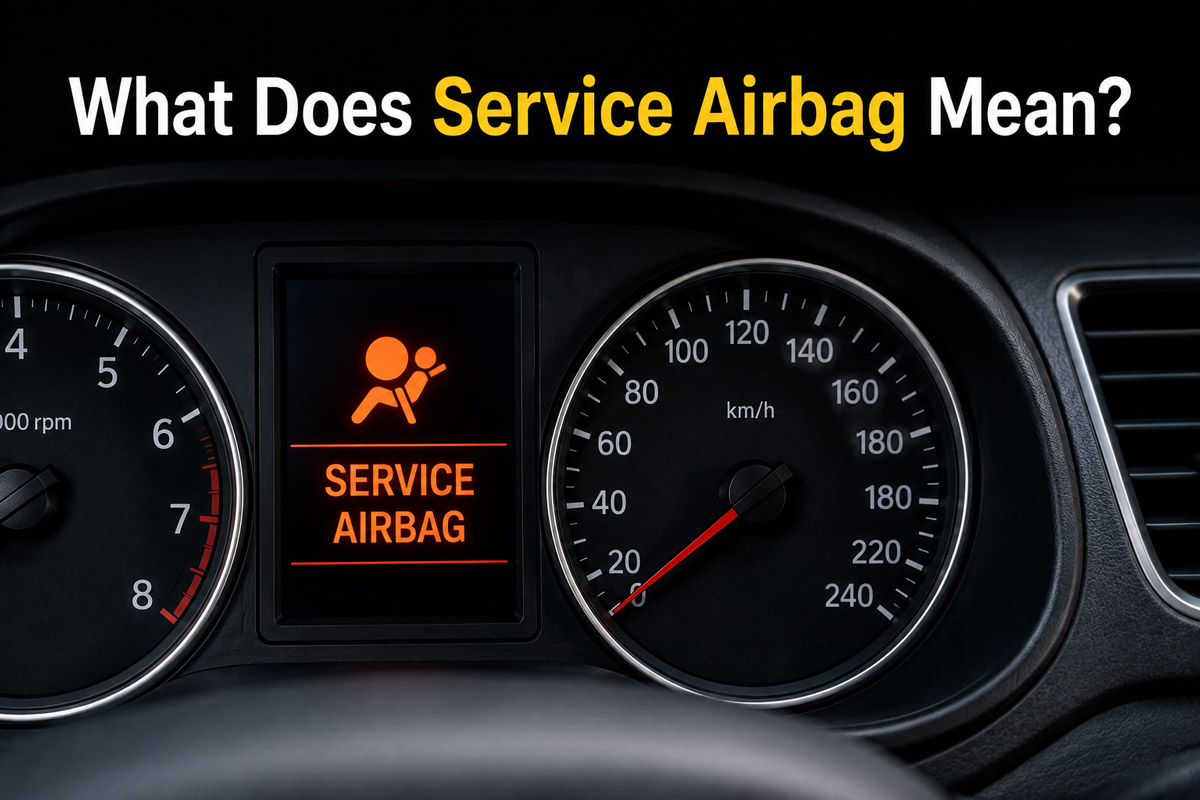
A Service Airbag message means the vehicle’s Supplemental Restraint System has detected a fault that could prevent one or more airbags or seat-belt pretensioners from working correctly. The vehicle may still run normally, but you cannot assume that its full crash-protection system will operate until the fault is diagnosed and repaired.
Key Facts at a Glance
- A Service Airbag message identifies a safety-system malfunction, not routine maintenance.
- One failed circuit may disable only the affected restraint device, or the fault may compromise several parts of the system.
- A basic engine-code reader usually cannot access airbag diagnostic trouble codes.
- Disconnecting the battery may temporarily remove power, but it does not repair an SRS fault.
- The passenger-airbag “OFF” indicator is not automatically a Service Airbag warning.
- Professional diagnosis should be arranged as soon as practical because airbag availability cannot be guaranteed.
What Does “Service Airbag” Mean on a Dashboard?
“Service Airbag” means the restraint control module has detected an electrical, electronic or mechanical condition outside its acceptable operating range. Depending on the manufacturer, the same condition may display as Service SRS, Airbag Fault, Restraint System Malfunction, Supplemental Restraint System Fault or an illuminated airbag symbol.
The word service does not mean that the airbags need scheduled maintenance. It is an instruction to diagnose the system because the control module cannot confirm that every monitored restraint component is ready for a collision.
Manufacturers describe an airbag light that remains on, flashes or fails to illuminate during startup as evidence of a possible restraint-system malfunction. Ford, for example, warns that the system may be disabled, while Toyota identifies its SRS lamp as a malfunction warning.
A crucial distinction is that the warning does not always prove that every airbag is disabled. The module may isolate an affected circuit, suppress a particular airbag or place a larger portion of the system into a fault strategy. Because the owner cannot determine the remaining protection from the dashboard message alone, the safe assumption is that the intended restraint coverage is unavailable.
How Does the Supplemental Restraint System Work?
The Supplemental Restraint System combines airbags, seat-belt devices, sensors, wiring and a dedicated control module to reduce occupant movement during certain crashes. It supplements properly worn seat belts; it does not replace them.
A typical system contains:
- A restraint or airbag control module
- Front, side and rollover sensors
- Driver and passenger frontal airbags
- Side-torso and curtain airbags
- Seat-belt pretensioners and buckle switches
- Passenger occupant-classification sensors
- Steering-wheel clockspring circuits
- Yellow-coded connectors and wiring
- Backup electrical energy storage
- Warning lamps, messages and audible alerts
The restraint control module continuously monitors electrical continuity, voltage, resistance and communication with other modules. During a qualifying collision, it evaluates impact direction, severity, seat occupancy, seat-belt status and other vehicle-specific inputs before commanding the appropriate inflators and pretensioners.
Airbags are designed to work with seat belts, which remain the occupants’ primary restraint. NHTSA reports that frontal airbags have saved more than 50,000 lives over approximately three decades, but emphasizes that seat belts remain the first line of defense.
What Happens During the Startup Self-Test?
The airbag warning lamp normally illuminates briefly when the ignition is switched on and then turns off after the module completes its self-test. Exact timing varies by model, but a brief startup light is normally expected.
The system needs attention when the lamp:
- Never illuminates during startup
- Remains illuminated after startup
- Begins flashing
- Returns while driving
- Appears with a Service Airbag message
- Is replaced by a repeated warning tone
Some vehicles produce a backup chime if the instrument-panel airbag light itself is faulty. Ford documentation, for example, describes repeated warning tones when either the restraint system or its readiness lamp has a fault.
Does the Warning Mean the Airbags Are Off?
A Service Airbag warning means that at least part of the SRS cannot be verified as operational. It does not establish, without diagnostic data, whether all airbags are disabled, one restraint circuit is suppressed or the system has entered another manufacturer-specific fault strategy.
The airbag module is designed to avoid unintended deployment while preserving protection where its programming permits. The precise response depends on the fault code, vehicle architecture and manufacturer calibration.
Examples include:
- A driver-airbag circuit fault may affect the steering-wheel airbag.
- An occupant sensor fault may suppress the front passenger airbag.
- A seat-belt pretensioner fault may affect only one seating position.
- A module power or communication failure may affect multiple restraint devices.
- Stored crash data may prevent normal operation after airbags have deployed.
The practical conclusion is the same: do not treat the vehicle as having complete airbag protection while the warning is active.
Service Airbag vs. Passenger Airbag Off
A Service Airbag message indicates a diagnosed malfunction, while a Passenger Airbag Off indicator may represent normal system operation. The passenger indicator can illuminate when the seat is empty, when a lightweight occupant is detected or when the occupant-classification system determines that deployment should be suppressed.
Federal requirements include a passenger-airbag status telltale that indicates when the passenger airbag has been deactivated under defined conditions. Therefore, an “OFF” lamp by itself is not equivalent to an SRS malfunction warning.
What Causes a Service Airbag Warning?
The most common causes are damaged wiring, poor connector contact, a failed clockspring, occupant-detection faults, low system voltage, sensor failures or a component that deployed during an earlier collision. The stored SRS code—not the dashboard wording—identifies the circuit requiring diagnosis.
Loose or Damaged Under-Seat Wiring
Front-seat movement can pull, pinch or loosen wiring for side airbags, buckle switches, pretensioners and occupant sensors. The fault may appear after:
- Sliding the seat fully forward or backward
- Vacuuming beneath the seat
- Storing objects under the seat
- Removing a seat for cleaning
- Installing seat covers or audio equipment
- Allowing water to enter the cabin
A connector that looks attached can still have poor terminal tension, corrosion or a partially backed-out pin. Repeatedly unplugging and reconnecting an SRS connector is not a proper substitute for checking the manufacturer’s terminal and wiring specifications.
Failed Steering-Wheel Clockspring
A clockspring is a wound electrical ribbon assembly that maintains circuits between the rotating steering wheel and the stationary steering column. Wear, internal breakage or incorrect centering can interrupt the driver-airbag circuit.
A clockspring becomes more likely when the airbag warning appears with:
- A nonworking horn
- Intermittent steering-wheel buttons
- Cruise-control faults
- Steering-angle sensor codes
- A warning that changes as the wheel turns
Not every steering-wheel electrical problem proves that the clockspring has failed. Wiring, control switches and steering-column modules must still be tested before replacement.
Passenger Occupant-Sensor Fault
The passenger occupant-classification system estimates whether the seat is empty and whether the passenger airbag should be enabled. Depending on the vehicle, it may use pressure sensors, strain gauges, seat-position information and a dedicated classification module.
Faults may follow:
- Liquid spilled onto the seat
- Heavy objects placed on the cushion
- Electronics or cables resting on the seat
- Seat removal without recalibration
- Cushion or upholstery replacement
- Sensor-mat damage
- Incorrect zero-point calibration
Some vehicles require an occupant-classification calibration after seat repairs. Clearing the code without completing the required calibration may cause the warning to return.
Seat-Belt Buckle or Pretensioner Failure
Seat-belt pretensioners use a rapid pyrotechnic or mechanical action to remove belt slack during specified crashes. The SRS module monitors the pretensioner circuit and may also monitor buckle-switch status.
A warning can result from:
- High resistance in the pretensioner circuit
- A deployed pretensioner
- Damaged buckle wiring
- Contaminated connectors
- Seat-track damage
- A buckle switch that reports an implausible state
A pretensioner that deployed during a collision normally requires replacement according to the manufacturer’s repair instructions.
Impact or Rollover Sensor Fault
Crash sensors provide acceleration, pressure or rollover data to the restraint module. Their design and location vary substantially; they may be mounted near the front structure, doors, pillars, floor or central control module.
A sensor-related code does not automatically mean the sensor itself is defective. The actual cause may be:
- Connector corrosion
- Harness damage
- Water intrusion
- Incorrect mounting
- Structural damage
- Module communication loss
- A sensor with the wrong part number
Replacing a sensor solely because its name appears in a diagnostic code is a common misdiagnosis. Many codes identify the circuit in which the fault was detected rather than proving which component caused it.
Low Battery Voltage or Charging Problems
Low voltage can produce SRS codes when the module loses stable power during starting, battery failure, jump-starting or charging-system problems. The warning may first appear after the battery has gone flat or been replaced.
However, a new battery does not automatically clear every code. The technician must determine whether the code is:
- Historical and no longer present
- Current because voltage remains low
- Caused by a poor ground or power connection
- Unrelated to the battery event
System voltage should be stabilized before diagnosing resistance or communication faults.
Collision Damage or Stored Crash Data
A vehicle that has deployed an airbag or pretensioner requires more than replacing the visible airbag cushion. Depending on manufacturer procedures, repairs may include the control module, sensors, wiring, steering components, seat belts, dashboard panels, headliner, seats and occupant-sensing calibration.
A warning after a used-car purchase may indicate:
- Unrepaired crash damage
- A deployed component left in place
- Incorrect replacement parts
- A module containing stored crash data
- Resistors installed to imitate airbag circuits
- A removed or concealed warning lamp
NHTSA has warned about dangerous substandard replacement inflators found in previously crashed vehicles. Traceable, approved components and documentation are therefore important in any post-collision repair.
Water Intrusion and Corrosion
Water can reach restraint wiring or modules through a leaking windshield, clogged sunroof drain, flood damage, wet carpeting or an improperly sealed body repair. Corrosion can create intermittent resistance that changes with humidity, temperature or seat movement.
Water-related SRS faults should be treated as a root-cause problem. Replacing a corroded connector without stopping the leak usually produces a repeat failure.
Software, Communication or Module Faults
Modern restraint modules exchange information with body, seat, powertrain and occupant-classification modules through the vehicle network. A communication code may originate from:
- A module losing power
- Network wiring damage
- Incorrect software
- Incomplete programming
- A replaced module that was not configured
- An internal control-module fault
A module should not be condemned until its power, ground, network and related circuits have been checked.
Can You Drive With a Service Airbag Warning?
A vehicle may remain mechanically drivable with a Service Airbag warning, but its intended occupant protection cannot be guaranteed. Driving should be limited until the fault is diagnosed, especially when the vehicle regularly carries passengers or travels at highway speeds.
The warning usually does not mean that an airbag will deploy spontaneously while driving. The more common concern is that an airbag or pretensioner may fail to operate correctly during a crash.
Use the following decision guide:
Stop Driving and Arrange Towing When
- The warning appeared after a collision.
- An airbag or pretensioner has deployed.
- Wiring is visibly damaged or exposed.
- The cabin has significant flood or water damage.
- The vehicle has a current manufacturer “Do Not Drive” recall.
- A technician has identified an unsafe replacement inflator.
- The steering wheel, seat or dashboard has been improperly reassembled.
Drive Only as Necessary to Obtain Service When
- The warning appeared without collision damage.
- The vehicle otherwise steers, brakes and operates normally.
- No SRS wiring has been disturbed or exposed.
- The owner’s manual does not give a stricter instruction.
All occupants should continue wearing seat belts correctly. Seat belts remain essential even when the airbags are working and become even more important when supplemental protection is uncertain.
How Is a Service Airbag Fault Diagnosed?
A proper diagnosis begins by retrieving codes from the restraint module with a scanner that supports the specific vehicle’s SRS system. The code is then followed through the manufacturer’s test procedure instead of being treated as an automatic instruction to replace a named component.
1. Confirm the Warning Behavior
Switch the ignition on and observe whether the airbag lamp illuminates, turns off, flashes or remains on. Record every message and note whether the warning changes when moving a seat, fastening a belt or turning the steering wheel.
2. Check Recalls and Service Information
Search the vehicle identification number for open safety recalls. A recall defect can exist whether or not the warning lamp is illuminated, and an illuminated lamp can also be unrelated to a recall.
The correct service information should match the exact year, make, model, restraint configuration and production date.
3. Scan the SRS Module
Use a scan tool that can communicate with the restraint control module. An ordinary reader that retrieves only powertrain “P” codes is insufficient.
“OBD-II scanner” is often used imprecisely. OBD-II standardizes the diagnostic connector and emissions-related access; it does not guarantee that every scanner can read manufacturer-specific airbag modules.
The scan should identify:
- Current or active codes
- Stored or history codes
- Intermittent codes
- Module communication faults
- Deployment records
- Relevant live data
- Calibration or programming requirements
4. Stabilize Battery Voltage
Check battery condition, charging voltage, grounds and module power supplies before testing sensitive circuits. Low or unstable voltage can create misleading communication and resistance codes.
A battery maintainer may be required during prolonged scanning, programming or calibration.
5. Inspect the Referenced Circuit
Follow the factory diagnostic tree for the exact code. Inspection may involve connectors, wire routing, terminal tension, power, ground, network integrity or approved simulator tools.
The technician should determine whether the fault is located in:
- The restraint device
- The wiring or connector
- A related sensor or module
- The restraint control module
- The vehicle’s power or communication network
6. Repair the Root Cause
Repair may involve securing a connector, replacing damaged wiring, installing a new clockspring, replacing a sensor, repairing water intrusion, replacing a pretensioner or programming a control module.
SRS wiring repairs must follow manufacturer-approved methods. Generic crimping, soldering or resistance changes can alter circuit behavior and may not be permitted.
7. Clear Codes and Perform a Verification Test
After the repair, clear the codes using the scan tool and complete any required calibration or programming. Cycle the ignition, verify the startup self-test and rescan the module.
A successful repair normally produces:
- A normal warning-lamp self-test
- No returning current codes
- Correct occupant-status data
- Successful calibrations
- No warning during a road test or seat movement
Can a Basic Code Reader Diagnose the Warning?
Most inexpensive engine-code readers cannot diagnose a Service Airbag warning because they access only emissions and powertrain data. The scanner must explicitly support SRS or restraint-system communication for the vehicle being tested.
Scanner capability varies by brand, model and software subscription. A device advertised as “SRS capable” may support some vehicles but not every module function, such as occupant calibration, module setup or deployment-data access.
For a one-time warning, paying for a professional scan may cost less than buying a capable tool. A DIY owner who maintains several vehicles should verify coverage using the scanner manufacturer’s vehicle-compatibility list before purchasing.
Will Disconnecting the Battery Reset the Airbag Light?
Disconnecting the battery usually does not permanently reset a Service Airbag warning because the module stores diagnostic codes in nonvolatile memory. Even if the warning temporarily disappears, it will return when the system detects the unresolved fault.
Battery disconnection can also erase other settings or create new problems involving:
- Window initialization
- Steering-angle calibration
- Radio security
- Idle adaptation
- Occupant-sensor calibration
- Electronic parking systems
- Module communication
The frequently repeated instruction to disconnect the battery for “30 minutes” is not universal. Backup-energy discharge times and disabling procedures vary by manufacturer and model. The correct waiting period and connector sequence must come from the applicable service manual.
Is It Safe to Test Airbag Wiring With a Multimeter?
Do not probe an airbag inflator or pretensioner squib circuit with a standard test method unless the manufacturer’s procedure explicitly authorizes the equipment and connection points. Applying current to a pyrotechnic circuit or damaging a terminal can create a deployment hazard or a new fault.
A trained technician may use a digital multimeter on approved portions of the system, such as power supplies, grounds or disconnected harness sections. The danger is not that every multimeter use instantly deploys an airbag; the danger is testing the wrong circuit, using the wrong mode or bypassing the manufacturer’s safety procedure.
Important precautions include:
- Disable the system exactly as specified by the manufacturer.
- Keep your body out of the deployment path.
- Never use a test light on a pyrotechnic circuit.
- Never measure resistance directly across an inflator.
- Use approved load tools or simulators where required.
- Do not place a removed airbag face-down.
- Protect connectors from static electricity and contamination.
How Much Does Service Airbag Repair Cost?
A Service Airbag diagnosis typically costs $100–$250, while the complete repair may range from under $200 for a connector problem to several thousand dollars for post-collision restoration. Vehicle design, parts availability, programming and interior disassembly create substantial price variation.
These are broad U.S. repair-market estimates, not fixed prices. Luxury vehicles, curtain-airbag replacement, dashboard removal, seat upholstery work and restricted parts distribution can push costs well above the listed ranges.
Why Can the Diagnostic Fee Be Expensive?
The scan itself may take only minutes, but diagnosis includes interpreting the code, accessing connectors, disabling the SRS, testing the circuit safely and reassembling interior components. A code such as “high resistance in driver airbag circuit” does not prove whether the cause is the airbag, clockspring, connector, wiring or module.
Paying for diagnosis reduces the risk of replacing expensive components that are not defective.
How Long Does an Airbag Repair Take?
A straightforward connector, buckle or sensor repair may take one to three hours. A clockspring repair often requires several hours, while seat-sensor work, module programming or collision restoration may require one or more days.
Parts availability can extend the total calendar time. Certain restraint components must be ordered by vehicle identification number, and some replacements require manufacturer programming or occupant-classification calibration before the vehicle can be returned to service.
Can You Clear the Warning Without Repairing It?
A scanner may clear a stored code, but the Service Airbag warning will return when the module detects the same active fault. Clearing the message is a verification step after repair, not a repair by itself.
Avoid attempts to conceal the warning by:
- Removing the instrument-panel bulb
- Covering the indicator
- Installing resistors to imitate airbags
- Coding out restraint devices
- Clearing the light immediately before selling the vehicle
- Disconnecting the module
These actions can hide a serious safety defect from occupants, inspectors and future buyers.
What Should You Check Before Visiting a Repair Shop?
An owner can gather useful information without opening or probing SRS circuits. Record the circumstances surrounding the warning and inspect only areas that can be viewed safely.
Note whether the warning began after:
- A dead battery or jump-start
- Interior detailing
- Moving a front seat
- Installing an accessory
- Seat or upholstery work
- Steering-column repair
- A pothole or minor collision
- Water entering the cabin
- Windshield replacement
- Body or paint repair
Also record whether the horn, steering controls, seat-belt indicator or passenger-airbag status changed at the same time. These symptom combinations can shorten diagnostic time.
Do not disconnect yellow connectors, remove airbags or reach beneath powered seats without the appropriate procedure.
Common Diagnostic Mistakes
Replacing the Component Named in the Code
An SRS code usually identifies the circuit or condition where the module detected a fault. It does not always prove that the named airbag, sensor or pretensioner is defective.
Practitioner rule: Test the wiring and connectors before condemning the most expensive component.
Treating Every Warning as a Loose Seat Connector
Under-seat wiring is common, but assuming it is always responsible can overlook crash damage, water intrusion, low voltage or a failed steering-column circuit.
Practitioner rule: Read the code before moving connectors or replacing parts.
Moving Connectors With the System Powered
Disconnecting restraint connectors without following the disabling procedure can set additional codes, damage terminals or expose the technician to deployment risk.
Practitioner rule: The battery-disconnection procedure is vehicle-specific, not universal.
Installing the Wrong Sensor or Module
Restraint components may look identical while carrying different calibrations or part numbers. An incompatible sensor can create persistent codes or incorrect crash-response behavior.
Practitioner rule: Match restraint parts by VIN and manufacturer documentation, not appearance.
Ignoring the Source of Water Damage
Cleaning corrosion without repairing the windshield, sunroof, body seam or drain leak produces recurring faults.
Practitioner rule: Correct the environmental cause before replacing electronics.
Should You Repair the System Yourself?
DIY repair is appropriate only when the person has model-specific service information, an SRS-capable scanner, safe electrical-testing knowledge and the correct replacement procedures. Airbag systems are poor candidates for trial-and-error diagnosis because they contain pyrotechnic devices and tightly monitored circuits.
Reasonable owner-level tasks include:
- Recording warning behavior
- Checking for recalls
- Testing the 12-volt battery
- Reviewing recent repair history
- Looking for visible water intrusion
- Confirming scanner compatibility
Professional service is preferable for:
- Airbag or pretensioner circuits
- Seat occupancy sensors
- Clocksprings
- Stored crash data
- Deployed restraints
- Module programming
- Corroded connectors
- Post-collision inspection
An honest limitation is that a scan code alone cannot establish whether a vehicle is safe. Physical circuit testing, repair-history review and sometimes trim removal are necessary before the system’s readiness can be confirmed.
What Should Used-Car Buyers Do?
A used vehicle with a Service Airbag message should receive a restraint-system inspection before purchase. The warning may represent a small wiring problem, but it can also reveal incomplete collision repairs, deployed pretensioners, missing airbags or unsafe replacement inflators.
Ask the seller for:
- Collision-repair invoices
- Airbag and seat-belt part numbers
- Restraint-module programming records
- Calibration documentation
- Before-and-after repair photographs
- A current SRS scan report
- Recall-completion records
Do not accept “the light only needs resetting” without diagnostic evidence. The cost difference between a connector repair and restoring several deployed restraints can be thousands of dollars.
Expert Insights That Change the Diagnosis
Intermittent Warnings Are Still Real Faults
A warning that disappears after moving the seat or restarting the vehicle usually indicates an intermittent circuit, not a harmless software glitch. Vibration, temperature and connector movement can make a marginal electrical connection pass one self-test and fail the next.
A New Battery Can Reveal an Existing Problem
Owners sometimes assume a battery replacement caused the airbag failure. In practice, voltage loss may expose a weak circuit, reset module communication or simply coincide with a preexisting intermittent fault.
No Warning Light Does Not Guarantee Safe Airbags
A vehicle can contain a recalled, counterfeit or improperly installed inflator without illuminating the SRS warning. NHTSA has issued “Do Not Drive” warnings for certain unrepaired airbag recalls, demonstrating why VIN-based recall checks remain necessary even when the dashboard appears normal.
What to Do When “Service Airbag” Appears
Follow this sequence:
- Keep every occupant properly belted.
- Avoid disturbing seats, yellow wiring or airbag trim.
- Record when the warning appeared and any related symptoms.
- Check the vehicle identification number for open recalls.
- Arrange an SRS-capable diagnostic scan promptly.
- Authorize testing of the coded circuit, not automatic parts replacement.
- Complete any required programming or calibration.
- Confirm that the warning passes its startup test and no active codes return.
Frequently Asked Questions
Is Service Airbag the Same as an Airbag Recall?
No. A Service Airbag warning reports a fault detected by the vehicle, while a recall identifies a safety defect covered by a manufacturer campaign. A recalled component may not trigger a warning, and an illuminated warning may be caused by an unrelated wiring, sensor, voltage or module problem.
Can a Weak Battery Cause the Service Airbag Message?
Yes. Low voltage during starting, jump-starting or battery failure can store SRS voltage and communication codes. However, the warning should still be scanned because it may remain active due to a poor ground, charging problem or unrelated restraint fault rather than the battery itself.
Why Does the Airbag Light Come and Go?
An intermittent warning commonly indicates a loose terminal, damaged wire, failing clockspring, moisture-related corrosion or voltage instability. The light may disappear when vibration or temperature temporarily restores electrical contact, but the underlying fault can return during a crash when dependable circuit continuity matters most.
Will the Car Pass Inspection With the Airbag Light On?
Inspection rules vary by jurisdiction. Some programs fail a vehicle for an illuminated SRS lamp, a missing startup self-test or evidence of warning-light tampering, while others do not inspect airbags directly. Regardless of inspection rules, the warning indicates that full restraint protection cannot be confirmed.
Can Seat Covers Cause an Airbag Warning?
Yes. Incorrect seat covers can interfere with seat-mounted side-airbag deployment seams or occupant-classification sensors. Removing seats, pulling wiring or placing heavy materials over the cushion may also trigger codes. Use only covers approved for the vehicle’s seat-airbag and occupancy-sensing design.
Does the Airbag System Need Routine Servicing?
Most modern systems do not require routine airbag replacement solely because of age unless the manufacturer specifies an inspection or replacement interval. A Service Airbag message is therefore a fault warning rather than a normal maintenance reminder. Follow the exact maintenance instructions in the vehicle’s owner’s manual.
The Bottom Line
What does Service Airbag mean? It means the vehicle has detected a problem within its Supplemental Restraint System and cannot guarantee that every airbag, pretensioner or related safety device will function as designed. The car may continue to operate, but the warning requires an SRS-capable scan, circuit-specific diagnosis and verification after repair—not merely a battery reset or code clearing.