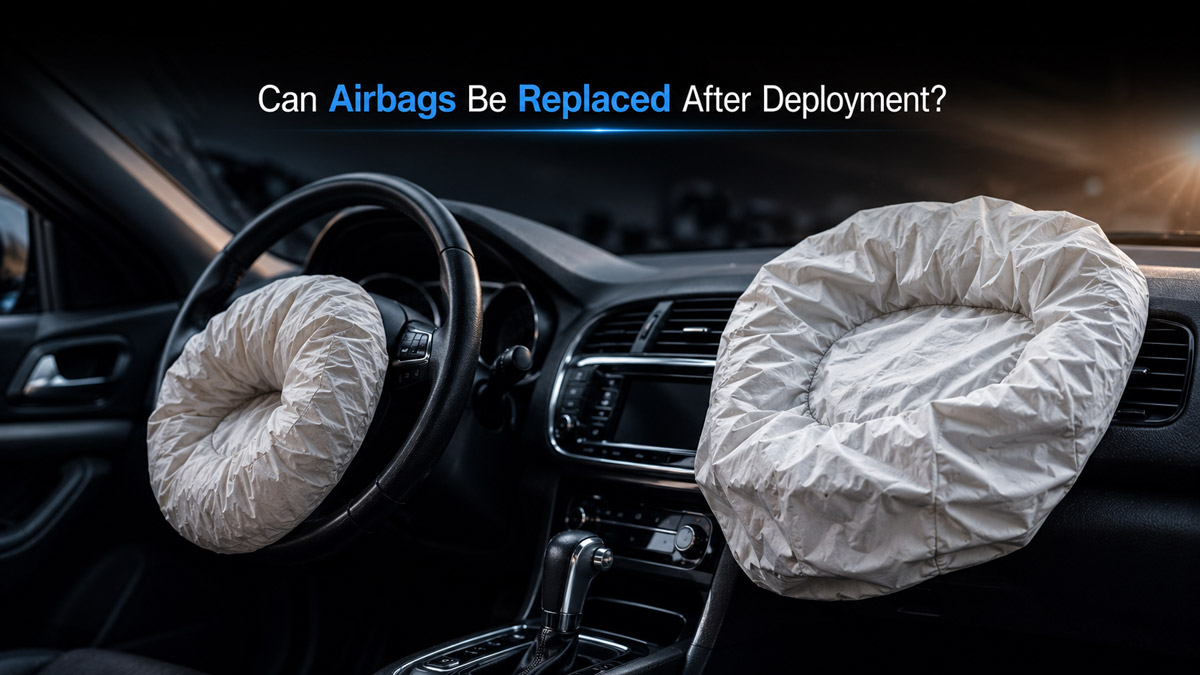
Deployed airbags can and must be completely replaced by certified automotive technicians. Because automotive airbags are single-use safety devices triggered by a chemical explosion, they cannot be repaired, sewn shut, or repacked. The entire Supplemental Restraint System (SRS) module requires a full replacement to restore vehicle safety functionality.
At a Glance
- Airbags operate as strictly single-use devices that demand complete module replacement after any deployment.
- Average replacement costs range from $1,000 to $2,000 per individual airbag, excluding secondary system components.
- A complete SRS restoration requires replacing seatbelt pretensioners, crash sensors, and the central control module alongside the bags.
- Auto insurance covers airbag replacement under comprehensive or collision policies, provided the total repair cost does not exceed the vehicle’s value.
- Advanced weight sensors in modern vehicles prevent passenger-side airbags from deploying if the seat remains empty or holds a lightweight child.
- Driving a vehicle with deployed airbags poses severe safety risks, eliminates secondary crash protection, and violates vehicle safety inspection laws in many jurisdictions.
Can Airbags Be Repaired or Repacked?
Airbags can never be repaired, repacked, or stuffed back into their modules after deployment. The mechanism that inflates an airbag relies on a highly controlled chemical explosion, typically utilizing sodium azide or guanidine nitrate, which burns rapidly to produce nitrogen gas. Once this chemical propellant is spent, the inflator mechanism is permanently destroyed.
Attempting to fold a deployed airbag back into the steering wheel or dashboard compromises the entire safety system. The intense heat of the chemical reaction often singes or weakens the nylon fabric of the bag itself, rendering it prone to rupturing if a secondary impact were to occur. Furthermore, the plastic covers designed to split open along engineered fault lines during a crash cannot be glued or taped back together without altering the precise resistance required for a future deployment. Automotive safety standards mandate that the entire housing, inflator, and folded nylon bag be discarded and replaced with a factory-new unit.
What Other Components Need Replacement Alongside the Airbag?
A proper airbag replacement requires installing a new SRS control module, updated crash sensors, and a replacement clock spring, depending on the severity of the collision. The airbag itself is just the final physical output of a complex, interconnected electronic network.
The SRS Control Module (the central computer) permanently records “hard crash data” the moment an airbag deploys. Manufacturers design these modules to lock up after a deployment to prevent corrupted data from misfiring the system later. While specialized services claim to flash and reset these modules, most original equipment manufacturers (OEMs) strictly require installing a brand-new control module, which typically adds $400 to $1,200 to the repair bill.
Additionally, the mechanic must replace the specific frame-mounted crash sensors that triggered the event. If the driver-side airbag deployed, the steering wheel’s clock spring—the coiled ribbon cable connecting the steering wheel electronics to the steering column—frequently melts or snaps from the extreme heat and electrical current of the deployment and requires immediate replacement.
Do Seatbelts Always Need Replacing When Airbags Deploy?
Yes, seatbelts almost always require full replacement following an airbag deployment because they operate on the same explosive circuit. Modern seatbelts utilize a mechanism called a pretensioner, which fires a small pyrotechnic charge milliseconds before the airbag deploys. This charge rapidly retracts the seatbelt webbing to pull the occupant tightly against the seat, maximizing the airbag’s effectiveness.
Once a seatbelt pretensioner fires, the locking mechanism is permanently fused. The seatbelt will either remain locked solid, preventing anyone from buckling it, or hang completely slack, offering zero restraint. Furthermore, the immense physical force of an adult body pulling against the seatbelt during a severe collision physically stretches the woven nylon webbing. This stretching is an intentional energy-absorbing design feature, but it permanently compromises the belt’s tensile strength. Replacing seatbelt assemblies typically costs between $150 and $450 per seat.
How Much Does Airbag Replacement Cost?
Replacing a single airbag costs between $1,000 and $2,000 on average, while a full multi-bag system restoration typically spans $3,000 to $6,000. The final price depends heavily on the vehicle’s make, model, and the secondary interior damage caused by the deployment.
A driver-side airbag generally costs between $1,000 and $2,470 because it requires replacing the central horn pad and sometimes the entire steering wheel assembly. Passenger-side airbags present a more expensive challenge; they explode directly upward or outward through the dashboard. Replacing a passenger airbag often requires purchasing an entirely new dashboard panel, pushing the localized repair cost closer to $2,000 or more.
Side curtain and knee airbags are comparatively cheaper, ranging from $500 to $1,500 per unit. However, luxury vehicles from manufacturers like Mercedes-Benz, Audi, or Porsche command premium parts pricing, where a full interior SRS restoration can easily exceed $10,000.
How Long Does It Take a Mechanic to Replace an Airbag?
A professional mechanic typically takes 2 to 5 hours to replace a single steering-wheel airbag, seatbelt pretensioners, and reset the SRS module. However, complex multi-bag deployments can keep a vehicle in the shop for several days due to extensive interior teardowns.
Driver-side replacements proceed relatively quickly because the steering column provides direct access to the module. In contrast, replacing a passenger-side airbag requires a technician to completely dismantle the vehicle’s dashboard, disconnect the HVAC routing, and remove the infotainment screens to access the mounting brackets. This labor-intensive process easily demands 8 to 12 hours of specialized labor. Side curtain airbags require removing the vehicle’s headliner, interior pillar trim, and sometimes the sunroof assembly, pushing labor times into the 6 to 10 hour range.
Who is Qualified to Replace an Airbag System?
Only certified collision repair technicians or dealership service centers possess the qualifications, training, and specialized diagnostic software required to replace an airbag system safely. Airbag restoration is strictly off-limits for DIY mechanics or standard oil-change technicians.
The primary barrier to independent repair involves proprietary manufacturer coding. On premium brands like BMW and Audi, a mechanic cannot simply bolt a new airbag into the steering column. The vehicle’s central computer requires proprietary coding blocks to sync the serial numbers of the new modules to the vehicle’s main network. Without this software handshake, the system remains disabled.
Furthermore, handling explosive pyrotechnic devices requires strict safety protocols. An untrained individual generating a small static electric shock while handling an airbag connector can accidentally trigger a localized deployment, resulting in severe physical injury.
Does Insurance Cover Airbag Replacement?
Auto insurance covers airbag replacement if the driver carries collision or comprehensive coverage and the deployment stems from a covered event. Standard liability-only policies will never cover airbag repairs for the policyholder’s own vehicle.
When an insured driver hits a tree or another vehicle, the collision policy pays for the exterior bodywork and the complete interior SRS overhaul, minus the driver’s deductible. If the airbags deploy due to an unavoidable animal strike or severe vandalism, comprehensive coverage handles the bill. Insurance adjusters require the repair facility to use OEM (Original Equipment Manufacturer) parts for airbag restorations, ensuring the vehicle meets factory safety standards before returning to the road.
Does a Deployed Airbag Total a Car?
A deployed airbag frequently totals older or high-mileage cars because the comprehensive repair cost exceeds 60% to 75% of the vehicle’s actual cash value. Insurance companies declare an economic total loss when repairing a vehicle stops making financial sense, regardless of whether the frame remains structurally sound.
For example, if a 2012 Honda Civic valued at $6,000 suffers a front-end collision that deploys both front airbags, the SRS repair alone could cost $4,000. When combined with the cost of a new bumper, hood, and radiator, the repair estimate easily surpasses the vehicle’s market value. In contrast, if a brand-new $60,000 SUV deploys its airbags in a similar crash, the insurance company will authorize the $8,000 repair because the vehicle retains immense residual value.
Can You Drive a Car With Deployed Airbags?
No, driving a vehicle with deployed airbags is highly dangerous, severely compromises passenger protection, and often violates local vehicle inspection laws. Once an airbag deploys, the vehicle no longer provides its intended safety measures for subsequent impacts.
From a practical standpoint, deployed airbags physically obstruct the cabin. A deflated driver-side bag hangs directly over the steering wheel, interfering with steering maneuvers and blocking the instrument cluster. Passenger and side-curtain airbags obscure the driver’s peripheral vision and blind spots.
Legally, vehicles with deployed airbags fail mandatory state safety inspections. Furthermore, if a driver operates a vehicle with deployed airbags and gets into a secondary accident, their auto insurance provider may deny any medical injury claims, citing the driver’s intentional negligence in operating an unsafe, structurally compromised vehicle.
Will Airbags Deploy if the Seat is Empty?
Modern vehicles will not deploy the passenger-side airbag if the seat is empty, thanks to advanced Occupant Classification Systems (OCS) built directly into the seat cushion. This technology saves owners thousands of dollars in unnecessary dashboard repairs during a collision.
The OCS utilizes sophisticated weight sensors and electronic pressure mats to determine the mass of the object occupying the passenger seat. If the sensors detect no weight, or a weight under a specific threshold (typically under 65 pounds), the vehicle’s central computer deliberately disables the passenger airbag. This mechanism serves a dual purpose: it prevents the explosive deployment from injuring a small child or infant in a car seat, and it prevents the costly destruction of the dashboard when the driver is commuting alone.
Are Aftermarket or Used Airbags Safe to Install?
Installing aftermarket, counterfeit, or salvaged airbags is highly dangerous due to the extreme risk of deployment failure, unregulated chemical explosives, and deadly shrapnel. Automotive safety experts and the National Highway Traffic Safety Administration (NHTSA) strictly prohibit the use of non-OEM airbags.
The counterfeit airbag market represents a massive safety hazard. Shady online vendors frequently sell cheap knock-off modules manufactured overseas that bypass rigorous crash testing. When triggered, these counterfeit units often fail to inflate, inflate too slowly, or worst of all, shatter their cheap metal housings, spraying deadly metal shrapnel into the driver’s face and chest.
Salvaged airbags pulled from junkyard vehicles present a different risk. Even if they are genuine OEM parts, buyers cannot verify if the donor vehicle suffered flood damage, severe humidity exposure, or electrical faults that may have compromised the chemical propellant inside the module.
What Happens if I Ignore an Illuminated Airbag (SRS) Warning Light?
Ignoring an illuminated SRS warning light means the vehicle’s central computer has actively disabled the entire airbag system, guaranteeing the airbags will not deploy in a crash. The SRS light is not a mere suggestion; it is a critical system failure notification.
When a driver turns the ignition key, the vehicle runs a rapid diagnostic check on every crash sensor, seatbelt pretensioner, and airbag module. If the computer detects abnormal electrical resistance, a broken clock spring, or a faulty seat weight sensor, it illuminates the red or amber airbag icon on the dashboard. Because the computer cannot guarantee the system will fire at the exact millisecond required for safety, it completely shuts down the firing circuit to prevent an accidental, unprompted deployment while driving.
Can I Reset the Airbag Light Myself?
No, vehicle owners cannot reset a hard crash code or an airbag warning light themselves using standard, inexpensive OBD-II diagnostic scanners. The SRS system operates on a specialized, heavily encrypted electronic network separate from basic engine emissions codes.
While a $20 Bluetooth scanner can clear a temporary “Check Engine” light caused by a loose gas cap, it cannot communicate with the SRS control module. If the airbag light illuminates due to a temporary glitch (like a loose wire under the passenger seat), a mechanic with a professional $2,000+ bi-directional scan tool must read the code, fix the physical wiring issue, and command the module to turn off the light. If the light remains on because of an actual deployment, the module’s hard crash data cannot be erased; the module itself must be removed and replaced.
Do Unused Airbags Expire?
Modern unused airbags do not expire and are engineered to last the entire operational lifetime of the vehicle without requiring routine maintenance or replacement. The automotive industry has vastly improved the chemical stability of airbag propellants over the last three decades.
In the 1990s, early owner’s manuals often recommended having airbag systems inspected or replaced after 10 to 15 years, primarily out of an abundance of caution regarding the degradation of the sodium azide propellant. However, field data and extensive testing by organizations like the Society of Motor Manufacturers and Traders (SMMT) have proven that modern sealed inflators remain completely viable and explosive even after 20 or 30 years. Today, as long as the vehicle’s self-diagnostic SRS light turns on briefly at startup and then turns off, the unused airbags remain fully functional.
How Do I Know if Airbags Were Replaced Properly on a Used Car?
Buyers can verify proper airbag replacement on a used car by inspecting the dashboard for mismatched textures, checking the SRS light sequence during ignition, and paying for a professional electronic diagnostic scan. Unscrupulous rebuilders often cut corners on salvage-title vehicles to maximize profit.
First, observe the SRS warning light. When you turn the key to the “ON” position without starting the engine, the airbag light should illuminate for about six seconds and then shut off. If the light never comes on, a shady seller likely placed electrical tape over the bulb or wired it to the check engine light to mask a missing airbag.
Second, press firmly on the center of the steering wheel and the passenger dashboard. A properly installed airbag module feels solid. If the cover feels hollow, soft, or yields easily to pressure, the compartment may be empty. Always demand a pre-purchase inspection where a mechanic uses a high-end scan tool to verify that the SRS module is actively communicating with every individual airbag.
The Bottom Line
Airbags are strictly single-use pyrotechnic safety devices that must be completely replaced by certified professionals after any deployment. Restoring the system correctly involves far more than just replacing the fabric bag; it requires new seatbelt pretensioners, crash sensors, and a factory-new central control module to guarantee passenger safety. While insurance covers this expensive procedure under comprehensive or collision policies, the sheer cost of a complete SRS overhaul frequently renders older vehicles an economic total loss.