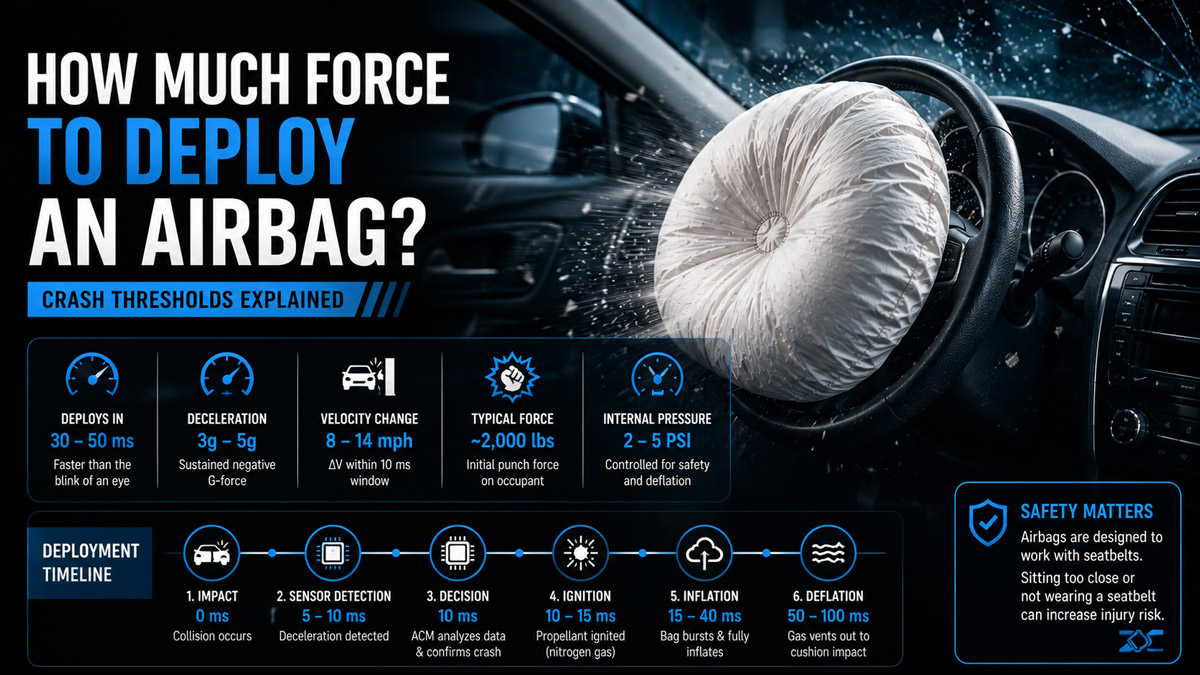
To deploy an airbag, a vehicle’s crash sensors must detect a sustained deceleration of 3g to 5g and a change in velocity ($\Delta V$) of 8 to 14 mph within a 10-millisecond window. The Airbag Control Module evaluates this negative G-force rather than raw vehicle speed to determine if the impact severity requires a supplemental restraint system.
Key Facts / At a Glance
- Airbag Control Modules (ACMs) require a consecutive acceleration spike below $-1.0\text{g}$ to $-2.0\text{g}$ to wake up the system.
- Frontal airbags deploy at an 8 to 14 mph velocity change for unbelted occupants, and 16+ mph for belted occupants hitting a rigid barrier.
- The chemical ignition phase expands nitrogen gas at speeds up to 200 mph (320 km/h).
- Occupants positioned in the immediate expansion zone experience approximately 2,000 pounds (8.9 kN) of initial punch force.
- The entire deployment sequence, from initial bumper impact to full cushion inflation, occurs in under 50 milliseconds.
What Physical Forces Trigger Airbag Deployment?
Airbag deployment requires specific deceleration signatures, not just high vehicle speed. A vehicle traveling 100 mph that gradually brakes to a halt experiences zero deployment because the deceleration is gradual. Conversely, a vehicle traveling 15 mph that strikes a concrete pillar experiences a massive, instantaneous structural stop that triggers the sensors immediately.
Deceleration and Negative G-Force Thresholds
The primary trigger mechanism relies on micro-electromechanical systems (MEMS) accelerometers detecting sustained negative G-force. The Airbag Control Module looks for a 3g to 5g deceleration sustained over a precise millisecond window.
Expert Insight: Modern ACMs use a “moving window integral” algorithm. This algorithm mathematically filters out violent but brief forces—like hitting a deep pothole or striking a curb at high speed—because the severe G-force spike does not last long enough to indicate a life-threatening structural collision.
Change in Velocity ($\Delta V$) Requirements
Velocity change, or $\Delta V$, measures how quickly the vehicle loses speed during the crash event. The system measures this against a Rigid Barrier Equivalent (RBE). Striking a parked car at 30 mph might only generate a $\Delta V$ of 15 mph because the parked car absorbs energy and moves. Striking a concrete wall at 15 mph generates a $\Delta V$ of 15 mph instantly. The system deploys when the $\Delta V$ crosses the 8 to 14 mph threshold within the critical 10 to 50 millisecond window.
How Much Force Does an Airbag Exert on Occupants?
An airbag exerts an estimated 2,000 pounds (8.9 kN) of blunt punch force if an occupant’s body blocks the module during the initial bursting phase. The query “how much force to deploy airbag” often refers to this violent output rather than the crash trigger itself.
Internal Gas Pressure and Expansion Speed
The chemical propellant—typically guanidine nitrate in modern vehicles—burns rapidly to produce harmless nitrogen gas. This gas forces the airbag out of the steering column at speeds reaching 200 mph (320 km/h). Despite this explosive expansion, the internal peak gas pressure is strictly controlled at just 2 to 5 PSI.
The high speed ensures the bag is fully inflated before the occupant’s head snaps forward. The low PSI, combined with engineered rear vent holes, ensures the bag deflates upon contact, acting as a decelerating cushion rather than a hard bouncy balloon.
How Does the Airbag Deployment Timeline Work?
Airbag deployment operates on a strict microsecond timeline where mechanical stress transforms into chemical inflation instantly. The sequence completes before the human brain can process the sound of the crash.
- Impact (0 ms): The vehicle’s bumper and crumple zones strike an object, generating immediate structural slowing.
- Sensor Signal Processing (5–10 ms): MEMS accelerometers register the drop in speed. The system logs a “wake-up” pulse of $-1.0\text{g}$ to $-2.0\text{g}$.
- Deployment Decision (10 ms): The ACM matches the sensor data against pre-programmed crash algorithms. The module dispatches an electrical firing current to the appropriate restraint units.
- Chemical Ignition (10–15 ms): The electrical current heats an igniter wire, triggering a solid propellant pellet to combust into expanding nitrogen gas.
- Bag Burst (15–30 ms): Expanding gas rips through the pre-scored plastic seams on the steering wheel, dashboard, or seat bolsters.
- Full Inflation (30–40 ms): The fabric cushion achieves maximum volume just milliseconds before the occupant’s body is thrown forward.
- Controlled Deflation (50–100 ms): The occupant’s kinetic energy forces the nitrogen gas out through rear vents, safely catching the body and preventing whiplash rebound.
What Are the Specific Crash Thresholds for Deployment?
The Airbag Control Module applies different mathematical conditions depending on the vector of the impact and occupant seatbelt status.
| Parameter | Frontal Airbags | Side / Curtain Airbags |
|---|---|---|
| Deceleration Pulse | 3g to 5g sustained over 10+ ms. | Rapid internal door cavity pressure spike. |
| Velocity Change (ΔV) | 8-14 mph (unbelted), 16+ mph (belted). | 8-12 mph against narrow objects (poles/trees). |
| Initial Wake-Up Threshold | Consecutive spikes of -1.0g to -2.0g. | Immediate lateral G-force deviation. |
| Full Expansion Time | 30 to 50 milliseconds. | 10 to 20 milliseconds (less crush space). |
| Crash Vector Angle | Within 30 degrees of the vehicle center line. | 90-degree lateral impact or severe roll angle. |
Single-Stage vs. Smart Adaptive Airbag Systems
Understanding how much force to deploy an airbag depends heavily on the era and technology level of the vehicle’s restraint network.
Single-Stage Airbags (Pre-2000s)
Single-stage systems deploy using one fixed explosive charge regardless of crash severity or passenger size.
- Mechanism: If the impact crosses the 12 mph $\Delta V$ threshold, the bag fires at 100% capacity.
- Limitations: Deploying with maximum, unforgiving force in low-speed accidents heavily increases the risk of orbital bone fractures or chemical burns for smaller drivers.
Multi-Stage Adaptive Airbags (Modern Standard)
Modern vehicles utilize smart dual-stage inflators governed by an Occupant Classification System (OCS).
- Mechanism: The ACM reads data from seat weight mats, seat track position sensors, and seat belt buckle monitors. In a low-speed crash, the system fires a primary stage for a gentler 70% inflation force. In a catastrophic impact, it fires both stages milliseconds apart for 100% inflation.
- Limitations: Complex capacitive sensing mats are fragile. Spilling a large drink on a passenger seat can short the weight sensor, triggering an SRS fault light that disables the passenger airbag entirely.
Why Do Airbags Fail to Deploy in Severe Crashes?
Airbags do not deploy in every severe accident. The ACM intentionally suppresses deployment in specific edge cases to prevent the airbag from causing more harm than the crash itself.
- Impact Angle Outside the Zone: Frontal airbags will not deploy in a rear-end collision or a severe side-swipe. The crash vector must fall within a 30-degree angle of the vehicle’s front center line.
- Underride Collisions: If a car slides under the rear trailer of a semi-truck, the hood and windshield shear off while the chassis and bumper (where sensors live) experience minimal immediate deceleration.
- Soft Object Impacts: Striking a large animal, a chain-link fence, or thick brush causes massive cosmetic damage, but the deceleration is gradual enough that the 3g-5g sustained threshold is never met.
- Out-of-Position (OOP) Occupants: If the OCS detects a passenger weighs under 65 pounds, or if a driver has the seat pulled dangerously close to the steering wheel, the computer disables the bag to prevent fatal deployment trauma.
Expert Safety Rules and Common Counterfeit Dangers
Supplemental Restraint Systems require occupants to maintain proper biomechanical positioning. Violating clearance rules turns a life-saving device into a localized explosive hazard.
The 10-Inch Clearance Rule: Drivers must maintain exactly 10 inches (25 cm) of space between their breastbone and the center of the steering wheel. Sitting closer places the ribs inside the 2,000-pound primary burst zone.
Avoid Aftermarket Seat Covers: Modern side-impact airbags deploy directly out of the stitched seams of the driver and passenger seats. Wrapping seats in non-approved, tight aftermarket fabric physically blocks the deployment path. The expanding bag will either fail to escape, or it will blow the seat frame apart and fire plastic shrapnel into the cabin.
Never Ignore the SRS Light: If the Airbag or SRS light illuminates on the dashboard, the computer has proactively disabled the entire restraint network due to a fault (often a broken steering wheel clockspring or a severed seat sensor wire). The vehicle will not deploy airbags under any circumstances while this light is active.
What Are the Costs and Timeframes for Airbag Replacement?
Once deployed, airbag systems cannot be repacked or reset. The blown modules, melted wiring connectors, and locked-out control modules must be completely replaced.
- Driver-side steering wheel module: $400 to $800.
- Passenger-side dashboard module: $600 to $1,000 (often requires replacing the entire cosmetic dashboard).
- Side curtain / seat bolsters: $500 to $1,200 per unit.
- Airbag Control Module (ACM): $300 to $600. By federal law, ACMs permanently lock down their crash data retrieval (CDR) memory after a deployment and must be replaced or sent to specialized forensic reset labs.
- Labor Time: A certified technician requires 2 to 5 hours to replace sensors, swap modules, and digitally pair the new ACM to the vehicle’s immobilizer network.
Always demand original equipment manufacturer (OEM) parts. Cheap counterfeit airbags bought online frequently contain substandard sodium azide propellants that either fail to fire or detonate violently enough to shatter the steering column.
Frequently Asked Questions (FAQ)
Can a pothole or speed bump trigger an airbag?
No. While hitting a severe pothole generates a massive momentary G-force spike, the duration is too short. Airbag algorithms require sustained negative acceleration over 10 to 50 milliseconds to verify a structural crash.
Will airbags deploy if the car is turned off?
Generally, no. Airbag control modules require active ignition power to monitor sensors. However, modern vehicles retain capacitor backup power for 1 to 5 minutes after the key is removed to protect occupants if they are struck immediately after parking.
Does hitting the brakes hard deploy the airbags?
No. Maximum emergency braking in a modern sports car generates roughly 1.0g to 1.2g of deceleration. Airbag deployment requires a minimum of 3g to 5g, which is physically impossible to achieve using friction brakes alone; it requires striking a physical object.
Why do airbags smell like smoke after deployment?
The smoke is actually a mixture of harmless nitrogen gas and fine powder lubricants (cornstarch or talcum powder) used to keep the fabric from sticking together in storage. The chemical propellant reaction also produces a mild burning odor similar to a fired bullet casing.
Do airbags expire?
Modern OEM airbags manufactured after the late 1990s use stable solid-state chemicals and glass-sealed igniters designed to last the lifetime of the vehicle. Older vehicles from the 1980s or early 1990s often recommended module inspections every 10 to 15 years.