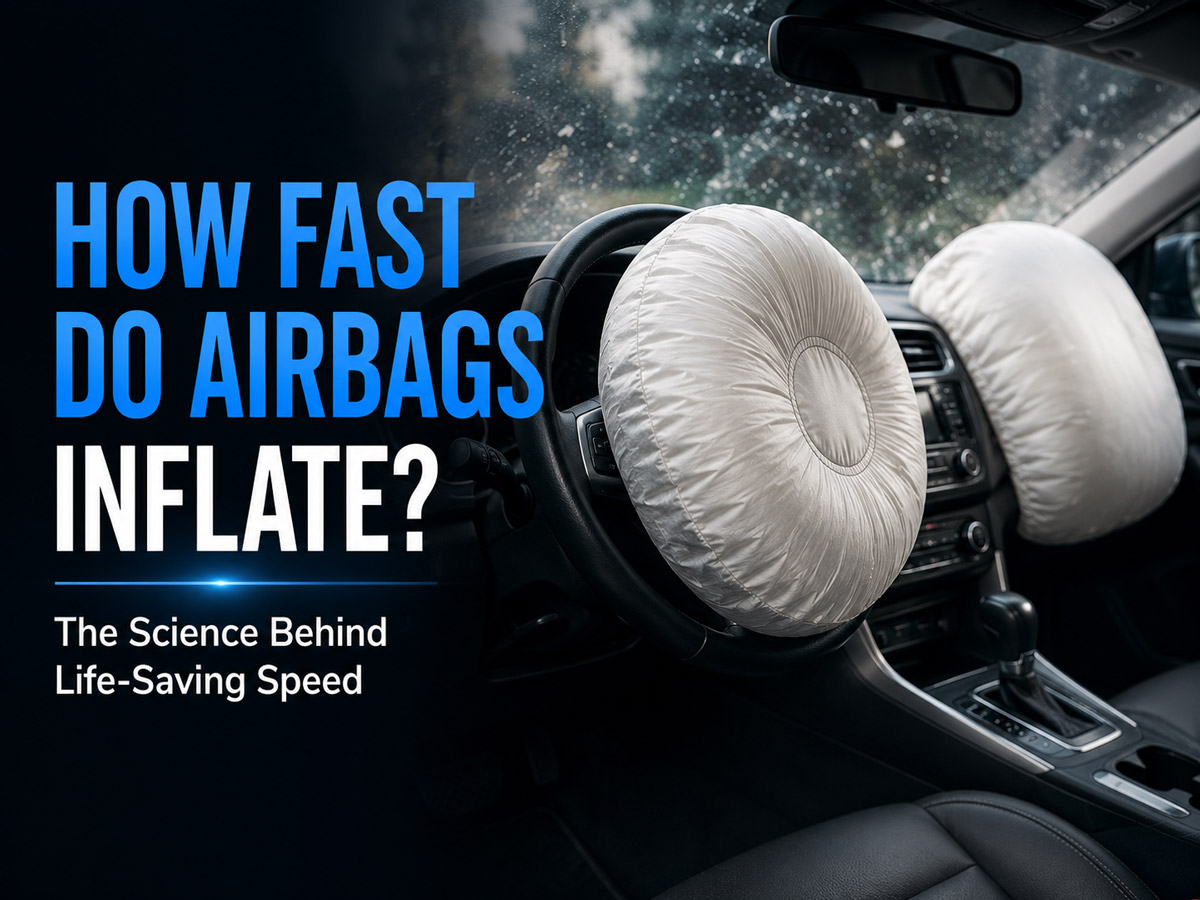
To answer the question of exactly how fast do airbags inflate: a standard automotive airbag deploys in 20 to 40 milliseconds, reaching expansion velocities between 100 and 200 mph (160 to 320 km/h). This rapid inflation process completes in less than half the time it takes for a human eye to blink (100 milliseconds).
Key Facts / At a Glance
- The entire deployment sequence takes under 100 milliseconds from initial impact to post-crash deflation.
- Electronic crash sensors trigger inflation only when detecting a sudden deceleration equivalent to a 10–15 mph barrier impact.
- Modern dual-stage inflators dynamically adjust inflation speed and pressure based on crash severity and occupant weight.
- Older airbags relied on sodium azide ($NaN_3$) for inflation, while modern systems utilize safer guanidine nitrate or compressed argon gas.
- Occupants must maintain a minimum 10-inch (25 cm) clearance from the steering wheel hub to prevent severe inflation-zone injuries.
How Does the Airbag Deployment Process Work?
The airbag deployment process works through a highly synchronized, five-stage sequence triggered by sudden deceleration, completing entirely within 100 milliseconds. An airbag is a Supplemental Restraint System (SRS) designed to work alongside seatbelts; it does not replace them.
1. Collision Detection (0–5 ms)
Electronic crash sensors, including accelerometers and pressure sensors, detect a sudden deceleration exceeding a preset threshold. This threshold is typically a deceleration force of 2 to 3 Gs, equivalent to striking a solid barrier at 10 to 15 mph. In this fraction of a second, the sensors evaluate the impact vector to determine if deployment is necessary.
2. Signal and Ignition (5–10 ms)
The Airbag Control Unit (ACU) processes the sensor data and sends a direct electrical current to the igniter (the squib) housed inside the inflator module. Modern ACUs also evaluate Occupant Classification System (OCS) data—such as passenger weight and seatbelt status—to determine if a dual-stage airbag should fire at partial or full power.
3. Chemical Reaction (10–20 ms)
The electrical signal fires the squib, igniting a solid chemical propellant or rupturing a compressed gas canister. Older inflators burned sodium azide ($NaN_3$) to create nitrogen gas ($N_2$). Because sodium azide is highly toxic and unstable, modern pyrotechnic inflators use safer guanidine nitrate, or bypass chemicals entirely by releasing highly compressed argon gas.
4. Cushion Inflation (20–40 ms)
The rapidly expanding gas bursts through the plastic seams of the steering wheel hub, dashboard, or seat bolster. The fabric cushion inflates at speeds up to 200 mph. Internal fabric tethers shape the airbag as it expands, preventing it from turning into a perfect sphere and ensuring it aligns with the human torso and head.
5. Cushioning and Deflation (40–100+ ms)
The human body contacts the fully inflated airbag exactly as it finishes expanding. As the occupant’s kinetic energy presses into the fabric, the gas immediately escapes through precisely calibrated vent holes in the rear of the bag. This controlled deflation absorbs the impact energy, preventing the occupant from violently rebounding into the seat.
What Are the Different Airbag Inflation Systems?
Automotive manufacturers use three primary airbag inflation systems: pyrotechnic, compressed gas, and hybrid inflators. The choice of inflator dictates both the speed of deployment and the physical footprint required within the vehicle cabin.
| Inflator Type | Inflation Speed | Mechanism | Pros | Cons |
|---|---|---|---|---|
| Pyrotechnic | Fastest (~20 ms) | Ignites solid chemical propellant (guanidine nitrate) to generate nitrogen gas. | Highly compact, lightweight, exceptional shelf-life reliability. | Generates extreme heat; leaves powdery residue in the cabin. |
| Compressed Gas | Moderate (~30-40 ms) | Releases highly pressurized argon or helium gas stored in a cylinder. | Cold deployment eliminates burn risks; no chemical smoke. | Requires bulkier, heavier high-pressure steel storage canisters. |
| Hybrid | Fast (~25-35 ms) | Uses a small pyrotechnic charge to heat and expand stored compressed gas. | Allows adjustable, dual-stage inflation levels; lower peak temperatures. | Most mechanically and electronically complex system. |
Which Types of Airbags Deploy the Fastest?
Frontal airbags deploy the fastest out of all vehicle airbag systems because the physical distance between the occupant’s head and the steering wheel is incredibly short. Different crash vectors require specific airbag locations and tailored deployment characteristics.
Frontal Airbags
Located in the steering wheel hub for the driver and behind the dashboard for the passenger, frontal airbags deploy in 20 to 30 milliseconds. They are engineered strictly for straight head-on or near head-on collisions (within 30 degrees of the vehicle’s centerline) to protect the chest and cranium.
Side-Torso and Side-Curtain Airbags
Side-torso airbags deploy from the outer edges of the seat backrest, while side-curtain airbags deploy from the roof lining above the windows. Because the crumple zone on the side of a vehicle is measured in inches rather than feet, side airbags must react slightly faster—often initiating within 15 milliseconds. Side-curtain airbags also differ by remaining inflated for up to 5 seconds to prevent occupant ejection during multi-second rollover events.
Knee Airbags
Installed in the lower dashboard below the steering column and glove compartment, knee airbags deploy to distribute impact forces across the shins and knees. By preventing the occupant’s lower body from sliding forward under the dashboard (submarining), knee airbags keep the torso properly positioned for the main frontal airbag.
What Are the Most Common Airbag Safety Mistakes?
The most common airbag safety mistakes involve incorrect occupant seating positions that place the human body inside the high-velocity inflation zone. Because airbags deploy at 200 mph, obstructing their path transforms a lifesaving device into a blunt-force hazard.
- Sitting Too Close: Always sit at least 10 inches (25 cm) away from the steering wheel. Sitting closer puts your sternum and face directly in the initial “inflation zone,” risking severe rib fractures or traumatic brain injuries.
- Incorrect Passenger Posture: Never rest your feet on the dashboard. A deploying passenger airbag will force the knees backward into the face and pelvis at 200 mph, causing catastrophic orthopedic injuries.
- Rear-Facing Car Seats: Never place a rear-facing infant seat in the front passenger seat of an active airbag system. The deployment force will strike the rigid back of the child’s seat, transferring fatal acceleration directly into the infant’s neck and spine.
- Buying Counterfeit Airbags: Installing cheap, unbranded replacement airbags purchased from third-party online marketplaces is highly dangerous. Independent testing shows these often fail to deploy, or worse, their inferior metal housings explode into the cabin as shrapnel.
Expert Insight: Many crash survivors panic when they see “smoke” filling the cabin post-deployment, assuming the car is on fire. This white powder is actually benign cornstarch or talcum powder used by the manufacturer to keep the fabric folded and lubricated over decades of storage.
How Much Does Airbag Replacement Cost?
Replacing a deployed airbag costs between $500 and $2,000 per module, plus the cost of replacing corresponding interior trim, sensors, and seatbelts. Airbags cannot be repacked, repaired, or reused under any circumstances; the entire modular unit is functionally destroyed upon deployment.
- Driver-Side Frontal: $500 – $1,000 (Requires 1–2 hours of labor and steering wheel trim replacement).
- Passenger-Side Frontal: $800 – $1,500 (Often requires complete dashboard replacement, adding 2–4 hours of labor).
- Side-Curtain or Seat Airbags: $1,000 – $2,000 per side (Requires seat reupholstering or headliner removal).
- Ancillary Costs: $300 – $600 (Seatbelt pretensioners permanently lock during a crash and must be replaced; the Airbag Control Unit must also be flashed or replaced).
Why Is My SRS Warning Light On?
The Supplemental Restraint System (SRS) warning light illuminates when the Airbag Control Unit detects an electrical or sensor failure, instantly disabling the entire airbag system as a safety precaution. An illuminated SRS light means your airbags will not deploy in a crash.
Common failure points include:
- Faulty Clockspring: The clockspring is a spiral ribbon cable inside the steering wheel that maintains electrical contact as the wheel turns. Constant rotation causes it to fray and break over the years.
- Seat Weight Sensors (OCS): Occupant Classification System sensors under the passenger seat fail due to liquid spills or become miscalibrated from heavy, concentrated objects left on the seat.
- Corroded Connectors: Moisture accumulating under the seats can corrode the highly sensitive yellow airbag wiring harnesses, breaking the continuity the ACU relies upon.
Expert Insight: For used car buyers, the SRS light is your primary diagnostic tool. Turn the ignition to the “ON” position without starting the engine. The SRS light should illuminate for 5 seconds and turn off. If it never lights up at all, a deceptive seller may have removed the dashboard bulb to hide a blown airbag or a broken system.
The Bottom Line
Airbag technology represents one of the fastest mechanical processes in daily human life. Relying on millisecond-level precision, these systems balance extreme kinetic force with chemical thermodynamics to prevent fatal blunt-force trauma. Maintaining a proper seating position and never ignoring dashboard SRS warnings are the two most critical steps in ensuring this system protects rather than harms.
Frequently Asked Questions
Do airbags always deploy in a crash?
No, airbags do not always deploy. The Airbag Control Unit will intentionally suppress deployment in low-speed fender-benders (under 10 mph), pure rear-end collisions, or if the passenger seat weight sensor detects a child or an empty seat.
What happens if an airbag deploys late?
A late deployment is a catastrophic failure. If an airbag deploys even 50 milliseconds too late, the occupant’s head will have already moved forward into the deployment zone. The airbag will strike them at 200 mph while they are moving forward, severely multiplying the impact force.
Can I manually disable my passenger airbag?
Some older trucks and two-seater sports cars feature a manual key-operated switch to disable the passenger airbag to accommodate child seats. In modern passenger vehicles, manual switches are illegal; the vehicle relies entirely on the automated Occupant Classification System (OCS) weight sensors.
Do automotive airbags expire?
Modern airbags manufactured after the late 1990s do not have a defined expiration date; they are designed to outlast the mechanical life of the vehicle. However, early 1990s models required inspection every 10 years to ensure the pyrotechnic chemicals had not degraded from humidity.