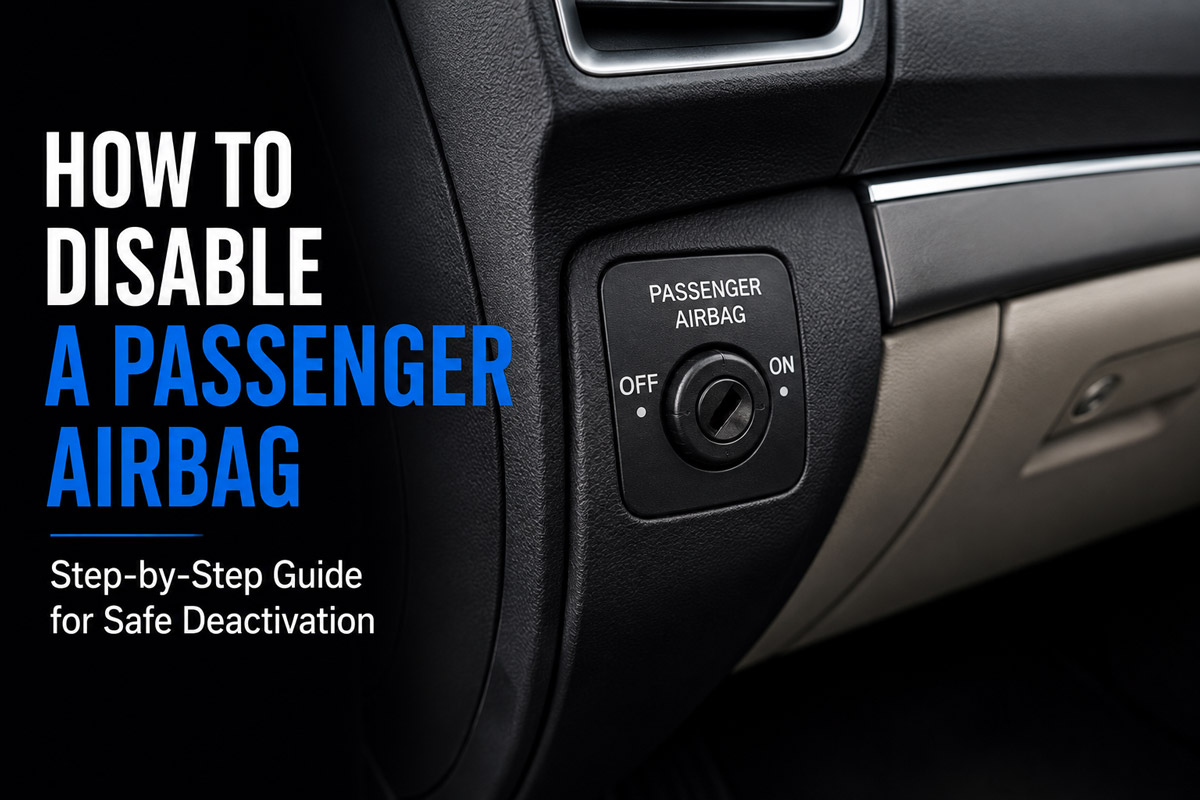
Safely deactivating a passenger airbag requires using a factory key switch, manipulating weight sensors, or installing an NHTSA-approved aftermarket kit. This guide details the exact steps to locate your vehicle’s switch, disconnect battery power, drain SRS capacitors, and verify deactivation. Strict adherence to safety protocols is the single most critical factor for success.
Before You Start
- Time Required: 1–2 minutes (Factory Switch); 60–90 minutes (Aftermarket Kit).
- Difficulty Level: Beginner (Factory Switch); Advanced (Aftermarket Kit).
- Estimated Cost: $0 (Factory Switch); $150–$300 (Kit + Parts).
- Tools & Materials:
- Factory ignition key
- 10mm socket wrench
- Non-conductive plastic trim removal tools
- Digital Multimeter (DMM) set strictly to $V_{\text{DC}}$
- 1 vehicle-specific aftermarket on/off switch kit
- Prerequisites: An official, approved NHTSA waiver letter (Form OMB No. 2127-0051) is legally required in the U.S. before installing an aftermarket shut-off switch.
Method 1: Using a Factory Key Switch
Step 1: Locate the Airbag Switch Slot
Find the dedicated passenger airbag key slot inside your vehicle. Open the passenger-side door and check the side dashboard panel facing the door frame, or open the glovebox and look at the upper interior rim.
- Success Checkpoint: You will see a small circular key slot flanked by “ON” and “OFF” text markings.
- Common Mistake: Confusing the trunk lockout switch inside the glovebox with the airbag switch. Ensure the text explicitly mentions “Airbag” or “SRS”.
Step 2: Turn the Switch to the OFF Position
Insert your factory ignition key into the airbag slot and turn it firmly from the ON position to the OFF position. Remove the key completely from the slot.
- Success Checkpoint: The key slot cylinder remains locked in the “OFF” orientation after the key is removed.
- Common Mistake: Leaving the key in the slot while driving, which can damage the cylinder mechanism over rough terrain.
Step 3: Verify the Dashboard Indicator
Turn the vehicle ignition to the “ON” or “Accessory” position and look at the center console or overhead console.
- Success Checkpoint: The “Passenger Airbag OFF” status light will illuminate in yellow or amber and remain steadily lit.
- Common Mistake: Assuming the system is deactivated just because the key was turned. If the light flashes or fails to illuminate, the switch is faulty.
Method 2: Installing an Aftermarket Retrofit Kit
Step 1: Disconnect the Battery and Drain Capacitors
Park on a level surface, remove the keys from the ignition, and use a 10mm socket wrench to completely detach the negative (-) battery terminal. Wait exactly 15 minutes, then press and hold the brake pedal for 10 seconds to purge any remaining electrical energy.
- Success Checkpoint: The vehicle cabin will be entirely dead—no dome lights, horn, or dashboard chimes will operate.
- Common Mistake: Skipping the 15-minute wait time. SRS backup capacitors store enough energy to deploy an airbag long after the battery is disconnected.
Step 2: Remove Dash Panels and Mount the Switch
Use non-conductive plastic trim tools to pry open the dashboard blanking plates specified in your retrofit kit instructions. Push the aftermarket switch module through the resulting dashboard cutout until it snaps into place.
- Success Checkpoint: The switch module sits completely flush with the dashboard plastic and does not wiggle when pushed.
- Common Mistake: Using metal flathead screwdrivers instead of plastic trim tools, which permanently gouges the soft dashboard plastic.
Step 3: Route and Connect the SRS Wiring Harness
Route the provided plug-and-play wiring harness behind the dashboard directly to the factory SRS junction interface. Align the yellow connectors, push them together until the primary lock clicks, and slide the secondary locking tab (usually red or green) downward to secure it.
- Success Checkpoint: You will hear a distinct “click” and the connector will not pull apart when given a firm tug.
- Common Mistake: Shoving multimeter probes into the yellow SRS harness pins to test continuity; doing so with the meter set to Ohmmeter/Resistance can trigger an accidental deployment via the meter’s internal battery.
Step 4: Reconnect Power and Verify Deactivation
Reconnect the negative (-) battery terminal using your 10mm socket wrench and tighten the nut to exactly 4–6 ft-lbs (5–8 Nm). Turn the ignition to the ON position and confirm the newly installed “Passenger Airbag OFF” indicator illuminates steadily.
- Success Checkpoint: The new cutoff indicator lights up, and the main dashboard SRS/Airbag warning light turns off after its initial 5-second self-check.
- Common Mistake: Over-tightening the battery terminal nut, which stretches the clamp and prevents a solid electrical connection.
Common Mistakes and How to Fix Them
- The “Airbag OFF” Light Does Not Illuminate: The vehicle’s Occupant Classification System (OCS) pressure mat may be overriding the system. Fix: Ensure the passenger seat is 100% empty. Remove backpacks, laptops, or heavy water bottles. Check the OCS fuse in the interior footwell fuse box.
- Main Dashboard SRS Light Flashes After Kit Install: The vehicle computer detects an open circuit or invalid resistance value, usually due to an improperly seated wiring clip. Fix: Disconnect the battery again, wait 15 minutes, unplug the yellow harness, inspect the pins for bending, and reconnect firmly.
- Stripped Battery Terminal Bolt: Overtightening during reconnection prevents the terminal from gripping the battery post securely. Fix: Replace the negative battery terminal clamp entirely; do not attempt to shim it with foil or wire.
- Using the Wrong Multimeter Setting: Accidentally checking circuit resistance on an airbag module. Fix: If you must test wires, ensure the Digital Multimeter is locked to $V_{\text{DC}}$ before the probes touch any metal. If you checked resistance on an active module, step away and consult a professional, as the squib may be compromised.
Variations
Vehicles with Occupant Classification Systems (OCS)
Most vehicles built after 2006 do not use manual key switches. Instead, they feature an OCS weight sensor embedded in the passenger seat cushion. To disable the passenger airbag in an OCS-equipped vehicle, simply keep the total weight on the seat below the factory threshold (typically under 45–65 lbs). The “Passenger Airbag OFF” light will automatically illuminate.
Temporary Fuse Removal
In extreme emergencies where an airbag must be disabled but no switch is available, mechanics can pull the dedicated SRS fuse. Warning: This disables the entire airbag system (driver, side, curtain, and passenger) and leaves the main dashboard warning light permanently illuminated. This is highly discouraged for regular road use.
How Long Does It Take / What Does It Cost
- Factory Key Switch: Takes under 1 minute and costs $0.
- Aftermarket Retrofit Installation: Takes 60 to 90 minutes. The physical switch kit costs between $150 and $300 depending on the vehicle make. If you hire a legally authorized mechanic to perform the installation after obtaining your NHTSA waiver, labor will add $100 to $200.
Frequently Asked Questions
Is it legal to disable my passenger airbag?
In the United States, it is legal to use a factory-installed switch. However, modifying a vehicle to add a switch requires submitting Form OMB No. 2127-0051 to the NHTSA and receiving formal authorization based on specific medical or child-seat necessities.
Will disabling the passenger airbag disable the driver’s airbag?
Using a factory key switch or an approved aftermarket harness strictly isolates the passenger-side module. The driver’s steering wheel airbag and all side curtain airbags will remain fully operational.
Can I just cut the airbag wires?
Never cut, splice, or solder SRS wiring. The system relies on highly specific resistance values (typically around 2.0 to 3.0 ohms) to monitor system health. Cutting wires triggers a hard fault code and disables the entire safety system.
Why does the airbag light stay on when a child seat is installed?
The OCS weight sensor detects the mass of the child seat. Because the weight falls below the adult threshold, the system intentionally deactivates the airbag to prevent deploying it into the back of a rear-facing infant carrier.
Conclusion
Knowing exactly how to disable passenger airbag systems—whether by utilizing a factory key switch, managing an OCS weight sensor, or retrofitting an NHTSA-approved aftermarket kit—ensures you can safely accommodate rear-facing child seats or specific medical exemptions. Always respect the 15-minute capacitor drain protocol during any electrical work, never splice SRS wiring, and visually verify that the dedicated dashboard indicator remains steadily lit before moving the vehicle.