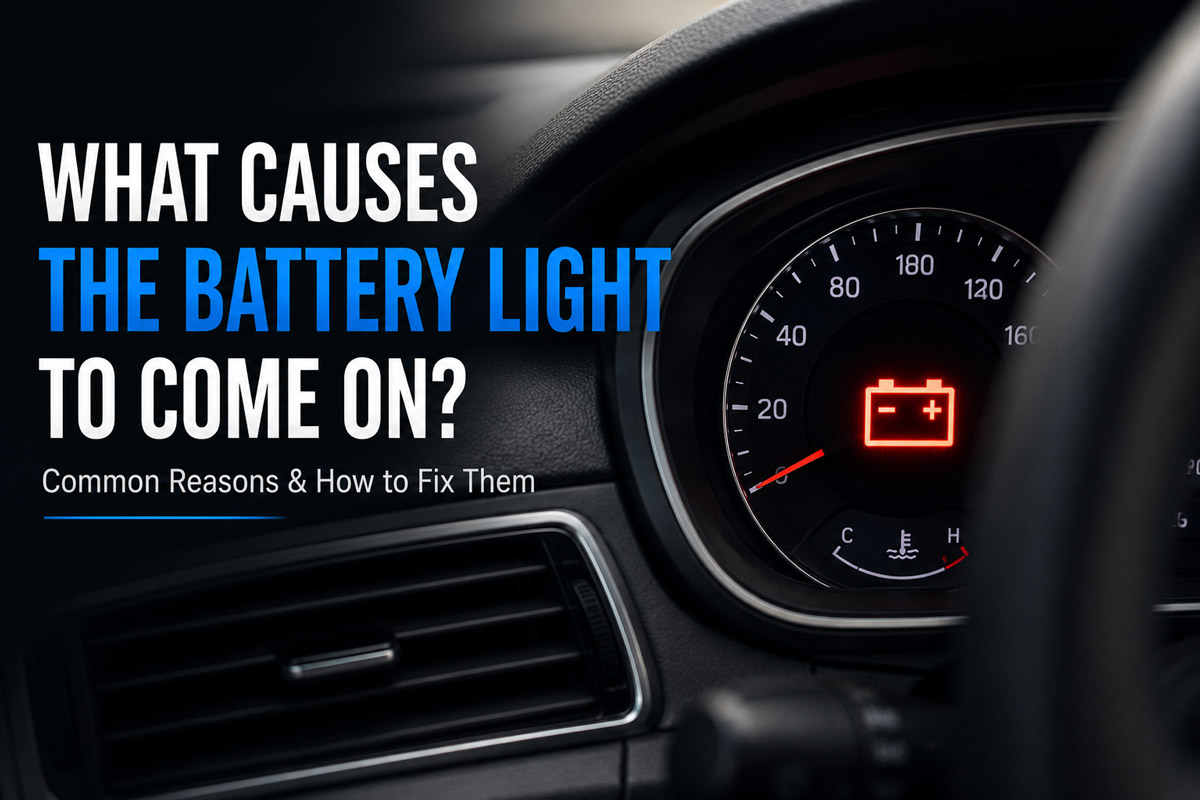
The battery light comes on when the vehicle detects that its charging system is not maintaining electrical power correctly. The most common causes are a failing alternator, defective voltage regulator, broken or slipping drive belt, corroded connection, damaged cable, poor ground, blown fuse, or faulty battery.
Key Facts at a Glance
- The battery symbol usually indicates a charging-system fault, not simply a bad battery.
- A steady light while driving means the vehicle may be operating on stored battery power.
- A broken serpentine belt can stop the alternator and may also cause engine overheating.
- Driving time after the warning appears cannot be predicted accurately.
- Modern smart-charging vehicles may not maintain a constant 13.5–14.5 volts.
- Replacing the battery without testing the entire system may not solve the problem.
What Does the Battery Light Mean?
The battery light means the vehicle has detected abnormal operation in the low-voltage charging system. In most gasoline and diesel vehicles, the alternator is no longer producing enough controlled electricity to power the vehicle and recharge the battery.
The warning may appear as a red battery symbol or as a message such as:
- Check charging system
- Service battery charging system
- Charging system fault
- Electrical system malfunction
- Stop vehicle safely
The light does not automatically mean that the battery itself has failed. A healthy battery will still discharge if the alternator stops replenishing it.
When Is the Battery Light Normal?
The battery light normally comes on briefly when the ignition is switched on before the engine starts. It should turn off shortly after the engine begins running.
Investigate the system when the light:
- Remains on after startup
- Comes on while driving
- Flickers with engine speed
- Appears with dim lights
- Returns during rain or heavy electrical use
- Appears with overheating or steering warnings
How Does the Charging System Work?
The charging system supplies electrical power while the engine runs and restores energy used during starting. Its main components include the alternator, voltage regulator, battery, drive belt, cables, grounds, fuses, sensors, and control modules.
The alternator converts engine rotation into alternating current. Rectifier diodes convert that electricity into direct current, while the voltage regulator controls output according to vehicle demand.
Older battery lights respond directly to a voltage difference between the battery and alternator circuits. Modern vehicles may use the engine computer, battery sensor, alternator control module, or instrument cluster to calculate whether the system is charging correctly.
What Causes the Battery Light to Come On?
A failed alternator is the most common cause, but mechanical, electrical, battery, and computer-related faults can all trigger the warning.
| Cause | Typical symptoms | Failure |
| Alternator failure | Steady light, dim lamps, eventual stall | Brushes, regulator, diodes, windings, or bearings |
| Broken or slipping belt | Sudden warning, squealing, overheating | Alternator pulley stops or slows |
| Weak tensioner | Intermittent warning, belt flutter | Belt cannot maintain proper grip |
| Corroded connection | Flickering light, slow starting | Resistance restricts current flow |
| Damaged charging cable | Low battery voltage while running | Alternator output cannot reach battery |
| Poor ground | Multiple electrical problems | Return-current path has high resistance |
| Blown fuse or fusible link | No charging after repair or jump-start | Main charging circuit is open |
| Defective battery | Slow cranking, repeated discharge | Battery cannot accept or store charge |
| Battery sensor fault | Start-stop disabled, warning after battery work | Incorrect charging data |
| Electrical overload | Light appears with accessories on | Demand exceeds alternator output |
Alternator or Voltage-Regulator Failure
Alternator failure turns on the battery light when the unit cannot produce stable electrical output. Common internal problems include worn brushes, damaged slip rings, failed diodes, defective windings, bad bearings, and regulator failure.
An alternator may not fail completely. It can:
- Stop charging only when hot
- Charge at higher RPM but not at idle
- Work intermittently over bumps
- Produce normal voltage with no load
- Fail when headlights and the blower are switched on
- Overcharge instead of undercharging
A damaged rectifier diode may also create excessive AC ripple. This can cause flickering lights, electronic malfunctions, audio noise, or repeated battery failure even when the voltage reading looks acceptable.
Broken or Slipping Serpentine Belt
A broken or slipping serpentine belt causes the warning because the alternator is no longer rotating fast enough. Belt failure may result from age, oil contamination, coolant contamination, pulley misalignment, weak tension, or a seized accessory.
Possible symptoms include:
- Squealing or chirping
- Burning-rubber smell
- Visible belt damage
- Heavy steering
- Air conditioning stopping
- Rising engine temperature
If the battery light appears with overheating, stop as soon as safely possible. On many engines, the same belt also drives the water pump.
Weak Belt Tensioner or Damaged Pulley
A weak automatic tensioner can allow the belt to slip during acceleration, rain, or high electrical demand. A seized idler pulley, alternator pulley, compressor, or water-pump bearing can create similar symptoms.
Inspect the complete accessory-drive system whenever an alternator fails. Installing a new alternator without correcting a damaged tensioner or pulley can cause another failure.
Loose or Corroded Connections
Loose or corroded connections increase resistance between the alternator, battery, engine, and vehicle body. The alternator may produce electricity normally, but the current cannot reach the battery efficiently.
Check these locations:
- Battery terminals
- Alternator output terminal
- Alternator electrical plug
- Battery cables
- Engine ground strap
- Body ground
- Under-hood fuse box
- Starter power junction
A cable may be corroded internally even when the outside looks normal. Swelling, stiffness, discoloration, melted insulation, or excessive heat can reveal hidden damage.
Blown Fuse or Fusible Link
A blown alternator fuse or fusible link can disconnect the alternator from the battery. This can happen after reversed jumper cables, incorrect battery installation, damaged wiring, or accidental short circuits.
Never bypass a fusible link with ordinary wire. The fuse protects the wiring harness from overheating and fire.
Weak or Damaged Battery
A defective battery can contribute to a charging warning, although a light that appears while driving more commonly points to the alternator or charging circuit.
Battery failure is more likely when the vehicle also has:
- Slow cranking
- Repeated jump-starts
- Battery swelling or leakage
- Sulfur odor
- Rapid voltage loss
- A shorted cell
- Failed capacity or load test
A deeply discharged battery should be charged before testing the alternator. Forcing a new alternator to recharge a severely depleted battery can overheat the alternator.
Smart-Charging or Battery-Sensor Fault
Modern vehicles may use a battery-monitoring sensor to measure current, voltage, temperature, and state of charge. Incorrect sensor information can cause abnormal charging behavior or warning lights.
Problems may follow:
- Battery replacement without registration
- Incorrect AGM or EFB battery installation
- Damaged battery sensor
- Incorrect accessory grounding
- Incompatible replacement alternator
- Lost alternator communication
- Control-module or wiring faults
Why Does the Battery Light Come On While Driving?
The battery light comes on while driving when charging performance drops after startup. Common reasons include alternator overheating, belt slip, vibration-sensitive wiring, excessive electrical load, bearing failure, or an intermittent voltage regulator.
The warning pattern can help narrow the cause.
| Warning pattern | Likely causes |
| Immediately after startup | Broken belt, blown fuse, disconnected alternator |
| Only at idle | Weak alternator, low idle, belt slip, heavy load |
| After 20–40 minutes | Heat-sensitive regulator, diode, wiring, or bearing |
| During rain | Wet or worn belt, weak tensioner, exposed connection |
| Over bumps | Loose cable, connector, or ground |
| With headlights and AC | Marginal alternator or high-resistance cable |
| With overheating | Belt failure or seized accessory |
| After recent repair | Loose connection, wrong part, blown fuse |
Why Does the Battery Light Flicker?
A flickering battery light usually indicates an intermittent fault. Common causes include worn alternator brushes, slipping belts, loose terminals, damaged wiring, weak grounds, or unstable regulator output.
Flickering that changes with engine speed often points to the alternator or belt. Flickering over bumps is more likely to involve a loose cable or connector.
Why Does It Appear Only at Idle?
A battery light that appears only at idle means alternator output is inadequate at low speed or electrical demand is unusually high. Increasing RPM may temporarily turn the light off, but the alternator, belt, tensioner, idle speed, and electrical load still require testing.
Can You Keep Driving With the Battery Light On?
You should drive only far enough to reach a safe stopping place. A charging failure can eventually stall the engine, disable electric power steering, dim the lights, trigger control-module faults, and prevent the engine from restarting.
The often-repeated estimate of 30 to 60 minutes is unreliable. Remaining driving time depends on:
- Battery capacity
- Battery charge level
- Battery age
- Temperature
- Headlight use
- Blower and defroster use
- Electric steering demand
- Fuel-pump and ignition load
- Whether the alternator has completely failed
- Whether the belt also drives the water pump
A weak battery may support the vehicle for only a few minutes. A fully charged battery under light daytime load may last longer.
When Should You Stop Immediately?
Stop the engine as soon as safely possible when the battery light appears with:
- Rising temperature gauge
- Steam or coolant smell
- Heavy steering
- Burning-rubber odor
- Belt noise
- Smoke
- Battery swelling
- Sulfur smell
- Erratic engine operation
- A stop-vehicle warning
These symptoms may indicate belt failure, overheating, electrical damage, or severe overcharging.
Should You Turn Off Accessories?
Turn off nonessential electrical loads such as seat heaters, rear defroster, high-power audio, and accessory chargers. Keep headlights, wipers, demisting, and safety equipment operating when needed.
Do not switch off the engine until you are safely parked because it may not restart.
How Do You Diagnose the Battery Light?
Diagnose the warning by inspecting the belt and connections, testing battery voltage, checking charging output under load, performing voltage-drop tests, and scanning control modules when necessary.
Step 1: Check for Immediate Hazards
Park safely, switch off the engine, and inspect for:
- Missing belt
- Coolant leaks
- Smoke
- Melted wiring
- Loose battery cables
- Swollen battery
- Sulfur odor
- Fluid leaking onto the alternator
Do not continue testing a leaking, smoking, frozen, swollen, or excessively hot battery.
Step 2: Inspect the Belt and Pulleys
Check that the belt is present, correctly routed, and seated in the pulley grooves.
Look for:
- Cracks
- Missing ribs
- Fraying
- Glazing
- Oil contamination
- Coolant contamination
- Pulley wobble
- Belt flutter
- Weak tension
A contaminated belt generally requires leak repair and belt replacement.
Step 3: Inspect Electrical Connections
Check battery terminals, alternator terminals, charging cables, grounds, and fuses for corrosion, looseness, heat damage, or broken wiring.
Never disconnect a battery cable while the engine is running. This outdated test can cause voltage spikes that damage electronic modules.
Step 4: Measure Resting Battery Voltage
With the engine off and the battery rested, a fully charged conventional 12-volt battery typically measures approximately 12.6 to 12.8 volts.
| Voltage | General interpretation |
| 12.6–12.8 V | Near full charge |
| Around 12.4 V | Partially discharged |
| Around 12.2 V | Significantly discharged |
| Around 12.0 V | Heavily discharged |
| Around 10.5 V | Possible shorted cell |
Voltage alone does not measure battery capacity. A weak battery may show normal voltage but fail under load.
Step 5: Measure Running Voltage
Connect the multimeter directly to the battery posts and start the engine. Test at idle and with headlights, blower, and rear defroster operating.
Many conventional systems produce approximately 13.5 to 14.8 volts. However, computer-controlled charging systems may intentionally vary voltage according to battery temperature, charge level, acceleration, and electrical demand.
General findings include:
- Voltage near 12 volts while running may indicate little or no charging.
- Excessively high voltage may indicate regulator failure.
- Voltage that collapses under load may indicate a weak alternator or bad cable.
- Variable voltage may be normal on a smart-charging vehicle.
Always compare results with specifications for the exact vehicle.
Step 6: Test Under Load
A failing alternator may show acceptable voltage until electrical demand increases. Test with normal accessories operating and monitor voltage, alternator current, warning behavior, belt movement, noise, and heat.
An alternator can maintain voltage but still fail to produce sufficient current.
Step 7: Perform Voltage-Drop Tests
Voltage-drop testing identifies resistance in cables and connections while current is flowing.
Measure between:
- Alternator output terminal and battery positive post
- Alternator housing or engine block and battery negative post
Excessive voltage drop indicates resistance in a cable, fuse, junction, terminal, or ground connection.
Step 8: Scan for Fault Codes
Modern vehicles may store alternator, battery sensor, communication, or charging-control codes. Use a scan tool capable of accessing more than basic engine codes.
Useful data can include:
- Desired charging voltage
- Actual voltage
- Alternator command
- Battery current
- Battery temperature
- State of charge
- Communication status
Does the Battery Light Mean You Need a New Battery?
The battery light does not automatically mean the battery needs replacement. The battery should be replaced only after checking its capacity, charge level, age, case condition, terminals, alternator output, cables, and grounds.
Replacing the battery without repairing a failed alternator will cause the new battery to discharge. Replacing the alternator while leaving a damaged battery can overload the new alternator.
Why Is the Light On After Alternator Replacement?
The battery light may remain on after alternator replacement because the original diagnosis was incomplete or the replacement unit is incorrect.
Possible causes include:
- Loose alternator plug
- Disconnected output cable
- Blown charging fuse
- Poor ground
- Incorrect belt routing
- Weak tensioner
- Wrong pulley
- Incorrect alternator
- Defective remanufactured unit
- Battery sensor fault
- Battery registration requirement
- Failed battery
Modern alternators may look physically identical while using different electronic communication systems.
How Much Does Battery-Light Repair Cost?
Battery-light repair may cost less than $50 for terminal cleaning or more than $1,500 for a difficult alternator, battery, belt-drive, or wiring repair.
| Repair | Typical U.S. cost |
| Charging-system diagnosis | $80–$200 |
| Terminal cleaning | $20–$100 |
| Battery cable or ground | $100–$400 |
| Conventional battery | $150–$350 |
| AGM or specialty battery | $250–$500+ |
| Serpentine belt | $100–$250 |
| Belt and tensioner | $250–$650 |
| Alternator replacement | $400–$1,100 |
| Luxury or difficult alternator | $1,200–$3,000+ |
| Fuse or wiring repair | $100–$800+ |
| Battery registration | $50–$200 |
Actual cost depends on vehicle design, labor access, parts quality, and whether related damage is present.
Common Diagnostic Mistakes
Replacing the Battery First
The battery symbol causes many owners to replace the battery without testing the alternator. The new battery may simply discharge again.
Disconnecting a Cable While Running
Removing a battery cable is unsafe on modern vehicles. It can create voltage spikes and damage electronic systems.
Trusting One Voltage Reading
A single unloaded reading may miss diode damage, weak current output, heat-related failure, or cable resistance.
Checking Only Whether the Belt Exists
A present belt may still slip because of contamination, glazing, weak tension, or pulley damage.
Installing a Severely Discharged Battery
A deeply discharged battery can overwork a replacement alternator. Charge and test the battery separately first.
How Are Hybrids and EVs Different?
Many hybrids and electric vehicles do not use a traditional belt-driven alternator. A DC-to-DC converter uses energy from the high-voltage battery to maintain the 12-volt system.
A battery warning in a hybrid or EV may involve:
- The 12-volt battery
- DC-to-DC converter
- High-voltage system
- Converter cooling
- Charging-system fuse
- Control-module communication
The red 12-volt battery symbol does not necessarily mean the main traction battery is low. High-voltage systems should be diagnosed by trained technicians.
The Bottom Line
What causes the battery light to come on is an abnormal charging-system condition, usually involving the alternator, voltage regulator, belt, tensioner, cables, connections, grounds, battery, fuse, or electronic charging controls.
Treat a steady warning while driving as urgent. Reduce unnecessary electrical demand, watch for overheating or belt symptoms, stop safely, and test the entire charging system before replacing parts.
Frequently Asked Questions
Can cold weather cause the battery light?
Cold weather can expose a weak battery, marginal alternator, slipping belt, or corroded connection. Cold temperatures increase starting demand and reduce battery performance, but persistent illumination still indicates a fault that requires testing.
Can rain cause the battery light?
Rain can cause a worn or contaminated belt to slip or expose a damaged electrical connection. The root cause is normally weak belt tension, missing splash protection, poor insulation, or damaged wiring.
Will jump-starting fix the battery light?
A jump-start may start the engine, but it will not repair a failed alternator, broken belt, blown fuse, or damaged cable. The engine may stall again once the available battery energy is depleted.
Can the battery light turn off by itself?
The light may turn off when an intermittent problem temporarily disappears. Heat-sensitive alternators, loose connections, worn brushes, belt slip, and communication faults can return without warning.
Is a red battery light serious?
A red battery light usually indicates an urgent charging-system fault. Continue only far enough to reach a safe stopping place unless the owner’s manual gives different instructions.