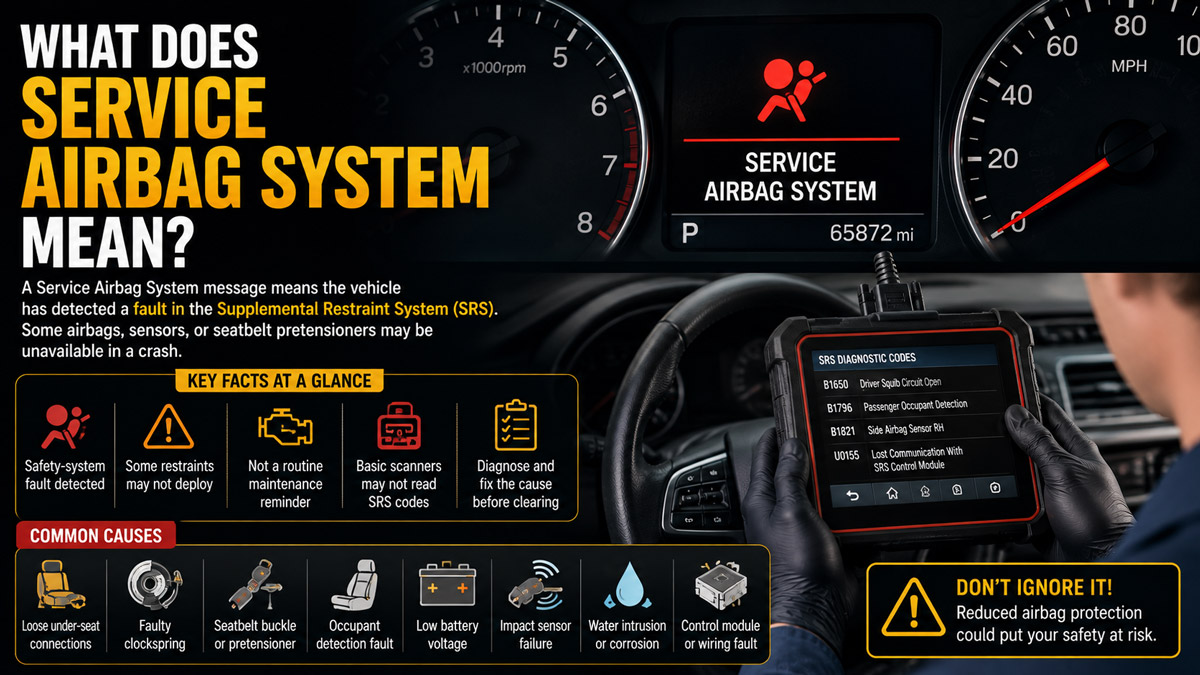
A Service Airbag System message means the vehicle has detected a malfunction in its Supplemental Restraint System, or SRS. Depending on the fault and vehicle design, one or more airbags, seatbelt pretensioners, crash sensors, or passenger-detection functions may be unavailable during a collision.
Key Facts at a Glance
- A Service Airbag System warning identifies a safety-system fault, not a routine maintenance reminder.
- The affected airbag or pretensioner may fail to activate during a qualifying crash.
- A normal SRS light usually illuminates briefly when the vehicle starts and then turns off.
- Basic engine-code scanners often cannot read airbag fault codes.
- Loose under-seat wiring, damaged clocksprings, weak battery voltage, and failed sensors are common causes.
- The correct repair is to diagnose and fix the underlying fault before clearing the stored code.
What Is the Supplemental Restraint System?
The Supplemental Restraint System is the network that controls the vehicle’s airbags and, in many vehicles, the pyrotechnic seatbelt pretensioners. It is called “supplemental” because airbags are designed to work with properly fastened seatbelts rather than replace them.
Depending on the vehicle, the SRS may monitor:
- Driver and passenger frontal airbags
- Side-torso and curtain airbags
- Driver knee airbags
- Seatbelt buckle switches
- Seatbelt pretensioners
- Front and side impact sensors
- Passenger-seat weight sensors
- Seat-position sensors
- Steering-wheel clockspring circuits
- SRS wiring and power supplies
- The airbag control module
Toyota manuals, for example, describe the SRS warning system as monitoring airbags, pretensioners, impact sensors, occupant-classification sensors, wiring, and power sources.
How Does the Airbag System Work?
The SRS control module continually checks the resistance, voltage, communication, and readiness of monitored safety circuits. During a qualifying collision, it evaluates information from impact sensors and other inputs before deciding which restraints should activate.
A simplified sequence is:
- Sensors detect the crash. Accelerometers and impact sensors identify rapid changes in speed and direction.
- The control module evaluates severity. The module considers impact direction, crash intensity, seat occupancy, seatbelt status, and vehicle-specific programming.
- Selected restraints activate. The module may trigger frontal airbags, side airbags, curtain airbags, or seatbelt pretensioners.
- The system stores event information. Deployment and diagnostic data may remain in the module after the collision.
Airbags are not designed to deploy in every crash. Deployment depends on factors such as impact direction, crash severity, sensor location, occupant classification, and the manufacturer’s restraint strategy.
Does the Warning Mean All Airbags Are Disabled?
Not necessarily. A Service Airbag System message confirms that the SRS has detected a problem, but the exact effect depends on the diagnostic code and vehicle design.
For example:
- A passenger-seat classification fault may deactivate the passenger frontal airbag.
- A clockspring circuit fault may affect the driver’s steering-wheel airbag.
- A side-impact sensor fault may affect a side or curtain airbag circuit.
- A control-module or power-supply fault may compromise several restraint functions.
Because the dashboard message does not identify which protection is unavailable, the vehicle should be treated as having reduced crash protection until an SRS-capable scan confirms the fault.
Why Did the Service Airbag System Warning Appear?
The warning appears when the SRS module detects an electrical value, sensor signal, communication message, or stored event that falls outside its programmed limits.
Common Causes and Symptoms
| Possible cause | Typical related symptoms | Usual repair |
| Loose under-seat connector | Warning appeared after moving a seat or storing items underneath | Inspect and secure the connector |
| Damaged clockspring | Airbag light with horn or steering-wheel button problems | Replace and calibrate the clockspring |
| Seatbelt buckle or pretensioner fault | Warning associated with one seat or buckle | Diagnose buckle wiring or replace the assembly |
| Occupant-classification fault | Incorrect AIR BAG ON/OFF status | Diagnose seat sensors and recalibrate |
| Impact-sensor failure | Persistent code for a front or side sensor | Inspect wiring and replace the failed sensor |
| Low battery voltage | Warning appeared after a dead battery or jump-start | Test battery and charging system, then rescan |
| Water intrusion | Multiple SRS communication or circuit codes | Find leak and inspect module and wiring |
| Previous collision data | Warning remains after crash repairs | Replace or professionally service the module as required |
| Damaged wiring | Intermittent warning when the seat or harness moves | Repair according to manufacturer procedures |
| Failed control module | Multiple internal or communication codes | Program and install a compatible replacement |
Can a Weak Battery Trigger the Airbag Warning?
Yes. Low voltage during starting, battery replacement, jump-starting, or charging-system failure can produce temporary or stored SRS voltage codes.
However, installing a new battery does not prove that the warning was caused only by voltage. The system should still be scanned because the light may indicate:
- A low-voltage history code
- A current circuit fault
- A module communication problem
- Damage caused during battery or interior work
A technician should record the codes before erasing them. Clearing the codes first can remove useful diagnostic evidence.
Can Moving the Front Seat Cause the Warning?
Yes. Moving a powered or manual seat can pull, pinch, or disturb wiring underneath it. The harnesses may serve seat-mounted airbags, buckle switches, pretensioners, seat-position sensors, and occupant-classification components.
Items pushed beneath the seat can also strain the connectors. Common examples include water bottles, bags, cleaning equipment, phone chargers, and tools.
Do not repeatedly unplug and reconnect yellow SRS connectors while the battery is connected. A visual inspection is reasonable, but electrical repair should follow the manufacturer’s shutdown and handling procedure.
What Is the Difference Between “Airbag Off” and an SRS Warning?
An AIR BAG OFF indicator may be normal when the passenger seat is empty, occupied by a small passenger, or affected by another condition recognized by the occupant-classification system. A Service Airbag System or SRS warning indicates a detected malfunction.
Passenger classification can also be affected by:
- A passenger’s posture
- Pressure applied to the seatback
- Objects placed on or beneath the seat
- Seat covers or cushions
- A child restraint
- Contact between the front seat and rear-seat occupants or cargo
Toyota documentation shows that a passenger-classification malfunction can illuminate the SRS warning and deactivate the passenger airbag.
Is It Safe to Drive With the Warning On?
The engine may continue running normally, but the vehicle should not be considered fully crash-protected. The warning means at least one monitored restraint function may not perform as designed.
A short, cautious trip directly to a qualified repair facility may be reasonable when:
- The vehicle has not been in a collision.
- No airbag has deployed.
- No wiring is exposed.
- No burning smell, smoke, or water intrusion is present.
- The seatbelts latch and retract normally.
Avoid unnecessary driving and arrange towing when:
- An airbag or pretensioner has deployed.
- The warning appeared after a collision.
- Floodwater or a major leak reached the interior.
- SRS wiring or connectors are visibly damaged.
- Interior repairs disturbed airbags, seats, or the steering column.
- The vehicle has counterfeit, unknown, or improperly installed replacement airbags.
NHTSA warns that substandard replacement inflators may deploy incorrectly, deploy too slowly, fail to deploy, or release dangerous fragments.
How Is a Service Airbag System Fault Diagnosed?
A proper diagnosis begins by reading the SRS module with a scanner that supports the specific vehicle. A generic reader that accesses only emissions-related engine codes may display “no codes” even when the airbag warning is active.
Step 1: Observe the Warning Behavior
Turn the ignition on without immediately starting the engine. The SRS warning should normally illuminate during the self-test and then turn off after several seconds.
A fault may exist when the light:
- Never illuminates
- Remains on
- Flashes repeatedly
- Returns shortly after startup
- Appears with a Service Airbag System message
A warning that fails to illuminate can be as important as one that stays on because it may indicate that the readiness indicator or SRS is unavailable. Toyota advises immediate inspection when the SRS light does not perform its normal startup check.
Step 2: Record Recent Events
Identify what happened shortly before the warning appeared:
- Battery replacement or jump-start
- Seat adjustment
- Interior detailing
- Water leak
- Steering-wheel repair
- Audio or accessory installation
- Minor collision
- Seat removal
- Dashboard repair
The timing often narrows the diagnostic path.
Step 3: Scan the SRS Module
Connect a compatible diagnostic tool and retrieve:
- Current codes
- Stored or history codes
- Code status
- Freeze-frame information, when available
- Module communication status
- Passenger-classification data
Record every code before clearing anything.
Step 4: Follow the Manufacturer’s Test Procedure
An SRS code identifies the circuit or condition the module detected; it does not always identify the failed part.
For example, a “high resistance” airbag-circuit code could result from:
- A loose terminal
- Connector corrosion
- Broken wiring
- An incorrect replacement part
- A damaged clockspring
- A faulty airbag module
Replacing the named airbag without testing the circuit can waste money and leave the fault unresolved.
Step 5: Repair and Verify
After completing the approved repair:
- Reassemble all connectors and trim.
- Restore battery power according to the service procedure.
- Clear the SRS diagnostic codes.
- Cycle the ignition.
- Confirm the warning completes its self-test and turns off.
- Rescan for returning codes.
Can You Reset the Warning Without Repairing It?
A scanner may erase some SRS codes, but clearing the warning is not a repair. An active circuit or component fault will usually cause the message to return during the next self-test.
Some codes may require additional procedures, including:
- Occupant-classification calibration
- Steering-angle or clockspring setup
- Module programming
- Component configuration
- Post-collision module replacement
- Manufacturer-specific initialization
Disconnecting the battery is not a dependable reset method. It may also erase unrelated vehicle settings while leaving the SRS problem unresolved.
How Much Does Service Airbag System Repair Cost?
Diagnosis commonly takes 30 to 90 minutes, but the total price depends on the code, vehicle, part availability, programming requirements, and interior disassembly.
| Service or component | Typical total range |
| SRS diagnostic scan | $75–$200 |
| Connector or minor wiring repair | $75–$300 |
| Seatbelt buckle sensor | $150–$450 |
| Impact sensor | $200–$600 |
| Clockspring | $300–$900 |
| Occupant sensor diagnosis or calibration | $150–$600 |
| Seat-bottom sensor or mat replacement | $500–$1,500+ |
| Airbag control module | $600–$1,800+ |
| Airbag module replacement | $800–$2,500+ each |
| Major post-collision SRS restoration | $2,000–$6,000+ |
These are broad typical ranges rather than quotes. Luxury vehicles, discontinued components, dashboard airbags, seat upholstery work, and vehicle-specific programming can increase the total substantially.
What Should You Never Do to an Airbag Circuit?
Never bypass, simulate, splice, or casually probe an SRS circuit. Airbags and pretensioners contain pyrotechnic devices, and incorrect testing can cause deployment, injury, module damage, or an unsafe false-ready condition.
Avoid these mistakes:
- Installing resistors to turn off the warning
- Covering or removing the warning light
- Using a test light on SRS wiring
- Measuring an inflator directly without an approved procedure
- Cutting yellow airbag wiring
- Installing used parts without confirming compatibility
- Reusing a deployed airbag
- Assuming a code automatically proves a component is defective
NHTSA states that a deployed airbag cannot be reused and should be replaced without delay by an authorized service technician.
When Should You Call a Professional?
Professional diagnosis is the safest choice whenever the repair involves an airbag, pretensioner, steering wheel, seat sensor, control module, deployed restraint, or damaged SRS wiring.
Choose a repair facility that can:
- Scan all SRS modules
- Follow manufacturer wiring diagrams
- Perform occupant-sensor calibration
- Program replacement modules
- Verify part numbers by VIN
- Check for recalls and service bulletins
- Document the codes before and after repair
A general code scan without circuit testing is not enough for an accurate SRS diagnosis.
The Bottom Line
A Service Airbag System warning means the Supplemental Restraint System has detected a malfunction that may prevent one or more airbags or seatbelt pretensioners from working correctly. Read the SRS codes with a compatible scanner, repair the diagnosed fault, complete any required calibration or programming, and verify that the warning passes its startup self-test.
Frequently Asked Questions
Will the airbag deploy when the warning light is on?
The affected restraint may not deploy, but the dashboard warning alone cannot identify which airbags remain operational. Deployment capability depends on the fault code and system design. Until the vehicle is scanned and repaired, assume that its crash protection is reduced.
Can a blown fuse cause a Service Airbag System warning?
Yes. A failed fuse, poor ground, low-voltage supply, or damaged power circuit can prevent the SRS module or one of its components from operating. A blown fuse should not simply be replaced repeatedly; the circuit must be checked for the condition that caused it to fail.
Why does the airbag warning come and go?
An intermittent warning often points to a loose connector, damaged terminal, moving seat harness, clockspring fault, moisture problem, or unstable voltage. Even when the light turns off, a history code may remain stored and help identify the affected circuit.
Will disconnecting the battery clear the airbag light?
Usually not permanently. Disconnecting the battery may temporarily change the warning’s behavior, but stored or active SRS faults normally remain or return. The underlying problem must be diagnosed, repaired, and cleared with compatible equipment.
Does the warning affect the seatbelts?
The ordinary belt webbing and latch may still function, but an SRS fault can affect electrically monitored buckle switches or pyrotechnic pretensioners. The pretensioner rapidly tightens the belt during certain crashes, so its loss can reduce the restraint system’s intended performance.
Can an airbag warning cause a failed vehicle inspection?
It may, depending on the jurisdiction and inspection rules. Even where the warning does not automatically cause an inspection failure, it still indicates a safety-system malfunction that should be repaired rather than hidden or erased.