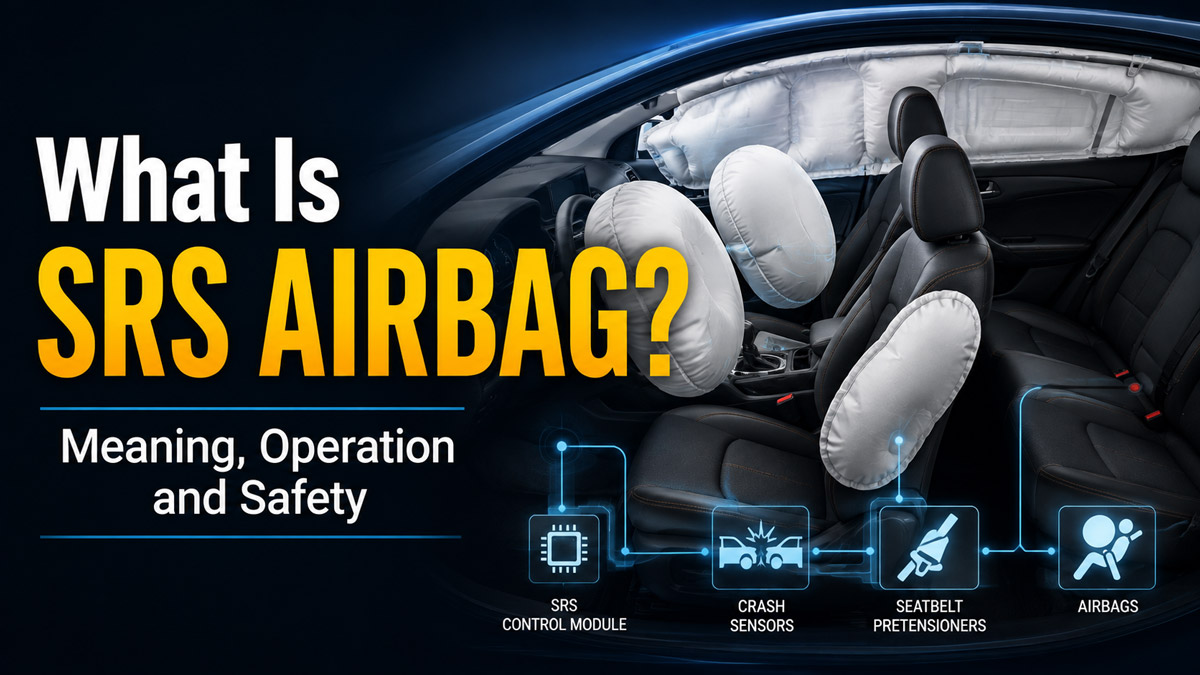
An SRS airbag is part of a vehicle’s Supplemental Restraint System, a coordinated safety network that uses airbags, seat-belt pretensioners, impact sensors and an electronic control module to reduce occupant injuries during certain crashes. The word “supplemental” means airbags assist properly worn seat belts rather than replacing them.
SRS Airbag Key Facts
- SRS stands for Supplemental Restraint System.
- An SRS includes more than airbags; it may also control pretensioners, sensors and passenger-detection equipment.
- Most airbags inflate within approximately 20–50 milliseconds after the system authorizes deployment.
- Airbag deployment depends on crash direction, severity, sensor data and occupant conditions—not vehicle speed alone.
- An illuminated SRS warning light indicates that at least part of the restraint system may not work correctly.
- Airbags are most effective when occupants wear seat belts and sit in the correct position.
What Does SRS Mean in a Car?
SRS means Supplemental Restraint System, the vehicle system designed to supplement the protection provided by three-point seat belts. The name emphasizes that an airbag is a secondary restraint, while the seat belt remains the primary restraint that holds the occupant in position.
Depending on the vehicle, the SRS may include:
- Driver and passenger frontal airbags
- Seat-mounted side airbags
- Roof-mounted curtain airbags
- Knee airbags
- Seat-belt pretensioners
- Seat-belt load limiters
- Front and side impact sensors
- Passenger occupancy sensors
- Seat-position sensors
- Rollover sensors
- An airbag or SRS control module
- Backup electrical energy storage
- Wiring, connectors and diagnostic circuits
Calling the system an “SRS airbag” is common, but technically the airbag is only one component within the broader SRS network.
Why Are Airbags Called Supplemental Restraints?
Airbags are called supplemental restraints because they are engineered to work with seat belts. A seat belt controls the occupant’s overall movement, while an airbag spreads crash forces across a larger area and reduces contact with hard surfaces such as the steering wheel, dashboard, pillars or side glass.
Without a seat belt, an occupant may move too far forward before the airbag is fully inflated. The person can then strike an inflating bag at close range, slide beneath it or be thrown into a position the system was not designed to protect.
The two systems perform different jobs:
- The seat belt restrains the pelvis and torso.
- The pretensioner removes slack from the belt.
- The load limiter manages excessive belt force.
- The airbag cushions the head, chest or side of the body.
- The airbag vents gas to absorb energy as the occupant contacts it.
Airbags therefore cannot compensate for an unfastened or incorrectly positioned seat belt.
How Does an SRS Airbag Work?
An SRS airbag works by detecting crash forces, evaluating the collision electronically and deploying selected restraints within milliseconds. The control module does not simply activate every airbag whenever a vehicle is struck.
1. Sensors Detect Sudden Movement
Accelerometers and impact sensors measure rapid deceleration, acceleration or changes in vehicle rotation. Side-impact and rollover systems may use additional sensors because those events develop differently from frontal collisions.
2. The Control Module Evaluates the Crash
The SRS control module analyzes factors such as:
- Direction of impact
- Rate of deceleration
- Duration of the crash pulse
- Signals from multiple sensors
- Seat-belt use
- Passenger-seat occupancy
- Passenger size or classification
- Seat position
- Rollover movement, when equipped
The module compares this information with programmed deployment criteria.
3. Appropriate Restraints Are Selected
The system may deploy only the devices needed for that particular event. A frontal collision may activate the front airbags and pretensioners, while a severe side impact may activate a side-torso airbag and curtain airbag.
Some modern systems use two-stage inflators. Depending on crash severity and occupant conditions, the module can deploy a lower output, a higher output or staged inflation.
4. The Inflator Produces Gas
When deployment is authorized, the module sends an electrical signal to an igniter inside the selected airbag inflator. The inflator rapidly generates gas that fills the folded fabric cushion.
Older descriptions often identify sodium azide as the universal airbag propellant. Although that chemical was used historically, many modern inflators use different solid propellants or stored-gas designs.
5. The Airbag Inflates and Opens Its Cover
The expanding cushion breaks through a designed seam in the steering-wheel cover, instrument panel, seat or roof trim. Deployment usually occurs within a few hundredths of a second.
The airbag may emerge at an initial speed commonly described as approximately 100–200 mph. That figure describes rapid fabric expansion, not the speed at which a deployed cushion continues travelling through the cabin.
6. The Airbag Deflates Immediately
Vents allow gas to escape as the occupant contacts the cushion. This controlled deflation absorbs energy and prevents the airbag from behaving like a rigid object.
A deployed airbag normally begins deflating almost immediately, which is why it may appear collapsed by the time the vehicle stops moving.
How Fast Does an SRS Airbag Deploy?
An SRS airbag commonly inflates in approximately 20–50 milliseconds, although exact timing varies by airbag type and vehicle design. A human blink generally takes considerably longer, so occupants usually cannot react before deployment occurs.
The complete event includes:
- Crash detection
- Electronic evaluation
- Igniter activation
- Cushion inflation
- Occupant contact
- Controlled deflation
Fast deployment is necessary because occupants continue moving inside the vehicle as soon as the vehicle suddenly slows. Even a delay of a fraction of a second could allow the occupant to reach the steering wheel or dashboard before the cushion is ready.
At What Speed Do SRS Airbags Deploy?
There is no universal vehicle speed that guarantees airbag deployment. The SRS responds primarily to the crash pulse, including how rapidly the vehicle slows, the direction of impact and the amount of energy transferred to the passenger compartment.
A relatively low-speed collision with a rigid object can produce a sharp deceleration. A higher-speed glancing collision may create a different sensor pattern and may not require the same airbags.
Deployment can also vary because of:
- Impact angle
- Object stiffness
- Vehicle structure
- Braking before impact
- Whether the vehicle is moving or stationary
- Sensor placement
- Occupant classification
- Seat-belt status
- Airbag type
A common comparison is an impact equivalent to striking a rigid barrier at approximately 10–15 mph, but that range is only a simplified example. It should not be treated as a guaranteed trigger point for every vehicle.
What Are the Main Types of SRS Airbags?
Different SRS airbags protect different body regions and respond to different collision directions.
| Airbag Type | Typical Location | Main Protection |
| Driver frontal airbag | Steering wheel | Head and chest in frontal crashes |
| Passenger frontal airbag | Dashboard | Front passenger’s head and torso |
| Side-torso airbag | Outer side of seat | Chest and pelvis in side impacts |
| Curtain airbag | Roof rail | Head protection in side impacts and some rollovers |
| Knee airbag | Lower dashboard | Knees and lower body; helps control movement |
| Center airbag | Between front occupants | Reduces occupant-to-occupant contact |
| Seat-belt airbag | Inflatable belt section | Distributes force across the torso |
Not every vehicle contains every type. Equipment varies by model, seating position, market and production year.
What Is the Difference Between SRS Airbags and Seat Belts?
Seat belts provide continuous restraint, while airbags provide temporary cushioning during specific crashes. Neither system offers its full intended protection without the other.
| Feature | Seat Belt | SRS Airbag |
| Function | Holds occupant in position | Cushions selected body areas |
| Availability | Works whenever fastened | Deploys only under programmed conditions |
| Reusability | Usually reusable if undamaged | Must be replaced after deployment |
| Crash coverage | Broad range of events | Selected directions and severity levels |
| Main limitation | Can concentrate force on the body | Can injure occupants who are too close or out of position |
The safest configuration is a properly worn seat belt, a correctly positioned seat and a fully functional SRS.
What Does the SRS Warning Light Mean?
An SRS warning light means the vehicle has detected a fault within the supplemental restraint system. Depending on the design and fault, one component, one deployment circuit or multiple parts of the system may be unavailable.
When the ignition is switched on, the SRS light normally illuminates briefly while the system performs a self-check. It should then turn off.
A problem may exist when the light:
- Remains on
- Flashes repeatedly
- Turns on while driving
- Never illuminates during startup
- Returns after being cleared
- Appears with a “Service Airbag” message
It is too broad to assume that every illuminated light disables every airbag. However, drivers should treat the warning seriously because the system may not deploy the intended restraint during a crash.
What Causes an SRS Airbag Light to Come On?
An SRS light can be triggered by electrical, sensor, wiring, seat-belt or control-module faults.
Common causes include:
Faulty Clock Spring
The steering-wheel clock spring maintains electrical connections while the wheel turns. A broken internal ribbon cable can interrupt the driver airbag, horn or steering-wheel controls.
Under-Seat Connector Problems
Seat movement, loose plugs, damaged wiring or objects stored beneath the seat can disturb side-airbag and pretensioner circuits.
Passenger Occupancy Sensor Faults
The passenger classification system may misread seat occupancy or occupant weight. This can affect whether the passenger airbag is enabled.
Seat-Belt Pretensioner Faults
A failed pretensioner, buckle switch or wiring circuit may illuminate the same warning because these devices are part of the SRS.
Low Battery Voltage
A weak battery, jump-start event or charging-system problem can create voltage-related SRS codes. Replacing the battery may not erase a stored code automatically.
Water or Corrosion Damage
Leaks around doors, windshields, sunroofs or floor areas can corrode connectors and modules beneath the seats or carpet.
Previous Collision Repairs
Deployed airbags, locked pretensioners, damaged sensors or crash data stored in the control module can keep the warning active after an accident.
Can You Drive With the SRS Light On?
A vehicle may continue to run with the SRS light illuminated, but its crash-protection system cannot be assumed to operate correctly. The warning does not normally indicate an engine failure, yet it represents a potentially serious occupant-safety fault.
Driving should be minimized until the system is scanned and diagnosed, especially when:
- The vehicle was recently involved in a collision
- Airbags or pretensioners have deployed
- The light appeared after water entered the cabin
- Wiring has been disturbed beneath a seat
- A passenger airbag status light behaves abnormally
- The steering-wheel horn and buttons also stopped working
A basic engine-code reader may not access SRS faults. Diagnosis generally requires a scan tool that supports the vehicle’s airbag system.
Can You Reset an SRS Airbag Light?
An SRS light should be cleared only after the underlying fault has been repaired. Erasing a code without correcting the cause normally results in the warning returning during the next self-test.
The proper process is:
- Read all SRS diagnostic trouble codes.
- Record code descriptions and status.
- Inspect the relevant circuit or component.
- Repair the confirmed fault.
- Clear the stored code with a compatible scanner.
- Cycle the ignition and repeat the self-test.
- Confirm that no active or pending codes return.
Disconnecting the battery is not a reliable repair. It may fail to clear stored crash or deployment data and can create additional problems in other electronic systems.
Airbag circuits should not be tested with ordinary test lights or unsafe probing methods. Improper testing can damage the module or trigger deployment.
What Happens After an SRS Airbag Deploys?
A deployed SRS requires more than replacing the visible fabric cushion. The complete repair depends on the collision and may include multiple one-time-use components.
Possible replacement or repair items include:
- Deployed airbag modules
- Seat-belt pretensioners
- Seat-belt assemblies
- Impact sensors
- Clock spring
- Steering-wheel trim
- Dashboard panel
- Seat upholstery
- Roof lining
- SRS control module
- Damaged wiring and connectors
- Passenger occupancy components
The control module may store crash information that must be addressed according to the manufacturer’s repair procedures. Structural damage must also be repaired correctly because sensor mounting and body deformation affect future SRS performance.
How Much Does SRS Airbag Repair Cost?
SRS repair costs vary widely because the warning could be caused by a loose connector or by several deployed restraints after a major collision.
Typical repair categories include:
| Repair | Typical Cost Range |
| Diagnostic scan | $75–$200 |
| Wiring or connector repair | $100–$400 |
| Clock spring replacement | $250–$700 |
| Occupancy sensor repair | $300–$1,200 |
| Seat-belt pretensioner replacement | $200–$700 each |
| Individual airbag replacement | $1,000–$3,000 or more |
| Multi-airbag collision repair | $3,000–$10,000+ |
Actual costs depend on the vehicle, component availability, labor rate, dashboard damage and the number of deployed devices. Luxury vehicles and cars with multiple curtain or seat airbags can cost substantially more.
How Should You Sit Safely Near an SRS Airbag?
Drivers should maintain approximately 10 inches between the center of the steering wheel and the breastbone whenever practical. The seat should remain far enough back to reduce deployment injury while still allowing full control of the pedals and steering wheel.
Additional safety rules include:
- Wear the shoulder belt across the chest, not behind the back.
- Keep the lap belt low across the hips.
- Avoid leaning against a door containing a side airbag.
- Never place feet on the dashboard.
- Do not attach objects to an airbag cover.
- Use only seat covers confirmed as compatible with seat-mounted airbags.
- Keep children properly restrained in the rear seat.
- Never install a rear-facing child seat in front of an active frontal airbag.
Pregnant occupants should continue wearing the seat belt, with the lap portion low beneath the abdomen and the shoulder belt across the chest. The seat should be positioned as far from the airbag as practical while maintaining control and comfort.
What Does the Passenger Airbag Off Light Mean?
The passenger airbag “OFF” indicator usually means the occupant classification system has intentionally suppressed the front passenger airbag. This may occur when the seat is empty, occupied by a small person or carrying an object that the system interprets as unsuitable for frontal airbag deployment.
The indicator does not always mean the SRS has failed. However, inspection is needed when:
- The airbag remains off for an average-sized adult
- The light changes when the occupant does not move
- The SRS warning light is also illuminated
- The seat has recently been removed or repaired
- Electronic equipment or heavy objects are placed on the seat
Passengers should sit upright with their back against the seat and feet on the floor so the classification system receives a stable reading.
How Can You Inspect the SRS When Buying a Used Car?
A used-car buyer should observe the SRS light during ignition startup. The light should illuminate during the self-test and then switch off; a light that never appears may indicate a removed bulb, altered cluster or concealed electrical problem.
Also inspect for:
- Mismatched dashboard or steering-wheel covers
- Uneven seams around airbag panels
- Missing airbag labels
- Sagging roof trim near curtain airbags
- Replaced seats or seat upholstery
- Seat belts that do not retract normally
- An illuminated passenger airbag status light
- Accident history
- SRS fault codes
- Non-original wiring beneath the seats
A professional pre-purchase inspection should include an SRS scan. A dashboard without a warning light does not prove that all original safety components are present.
What Are the Limitations of SRS Airbags?
SRS airbags cannot prevent every injury or deploy in every collision. They are designed for specific crash directions, severities, seating positions and occupant conditions.
Airbags may not deploy during:
- Minor impacts
- Certain rear-end collisions
- Low-energy side impacts
- Glancing impacts
- Some underride events
- Collisions where deployment would provide little benefit
Even when the system operates correctly, occupants may experience bruising, abrasions, hearing discomfort or respiratory irritation. These effects are generally less severe than the injuries the restraint is intended to prevent, but airbags should never be viewed as risk-free cushions.
Frequently Asked Questions
Does SRS Mean the Same Thing as an Airbag?
No. An airbag is one component of the Supplemental Restraint System. The complete SRS may include airbags, pretensioners, impact sensors, passenger sensors, wiring and an electronic control module.
Do SRS Airbags Need Routine Replacement?
Modern airbags generally do not have a universal scheduled replacement interval. Owners should follow manufacturer instructions, investigate warning lights promptly and check whether the vehicle has any open safety recalls.
Will an Airbag Deploy If the Battery Is Disconnected?
SRS systems commonly contain backup energy storage that may remain charged briefly after the battery is disconnected. This allows the system to operate during the first moments of a collision that damages battery power. Technicians must follow the manufacturer’s specified waiting period before servicing SRS components.
Can an SRS Airbag Deploy Accidentally?
Unintended deployment is uncommon in an intact, correctly serviced system. Improper electrical testing, damaged wiring, incorrect repairs or unsafe handling of an inflator can create serious risks, which is why SRS service should follow manufacturer procedures.
Is Airbag Dust Dangerous?
The visible residue after deployment may contain talc, cornstarch or by-products from the inflator. It can irritate the eyes, skin or respiratory tract. Occupants should exit safely, seek fresh air and obtain medical attention for breathing difficulty, eye exposure or persistent symptoms.
Can Aftermarket Seat Covers Affect the SRS?
Yes. A non-compatible seat cover can obstruct the deployment seam of a seat-mounted side airbag. Use only covers specifically approved for the vehicle’s seat-airbag design.
The Bottom Line
An SRS airbag is one part of the Supplemental Restraint System, which combines airbags, seat-belt equipment, sensors and electronic controls to reduce injuries in qualifying crashes. The system works most effectively when every occupant wears a seat belt, sits correctly and responds promptly to an illuminated SRS warning light.
Understanding what an SRS airbag is also means recognizing its limitations: it does not replace a seat belt, does not deploy in every collision and should not be repaired through guesswork. Any persistent SRS warning requires diagnosis with a compatible scanner and repair according to the vehicle manufacturer’s procedures.