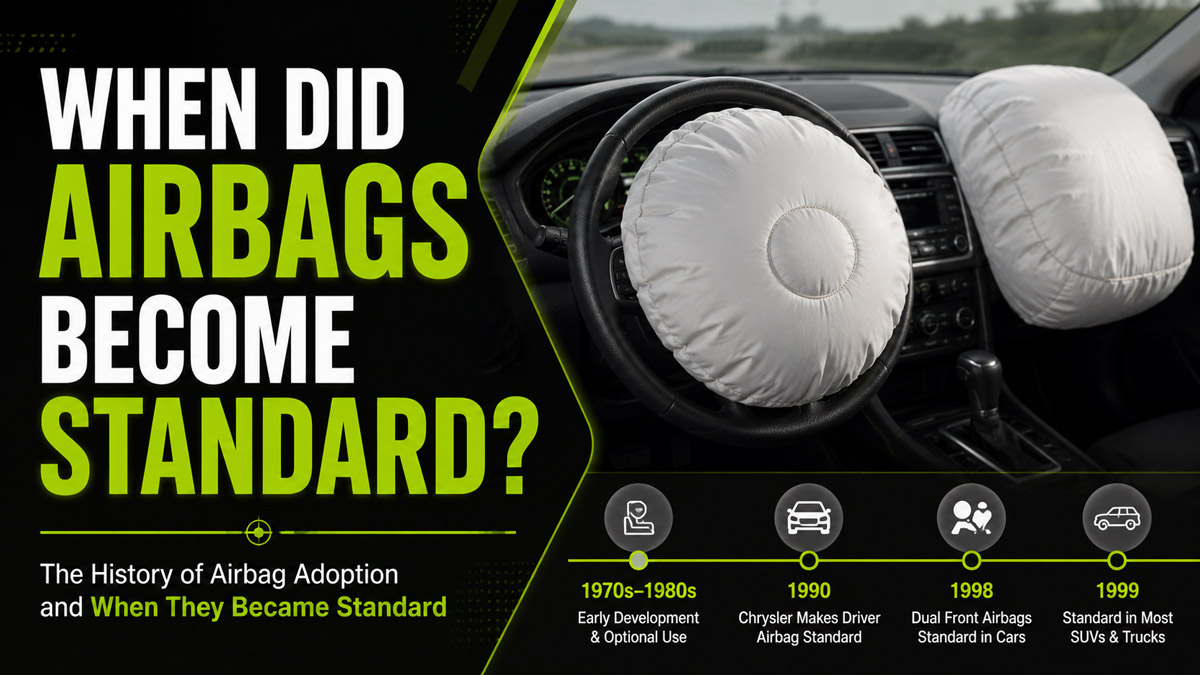
Airbags became standard equipment gradually rather than on one universal date. In the United States, driver and passenger frontal airbags became effectively standard across new passenger cars during the late 1990s, with federal requirements applying to cars by the 1998 model year and to most light trucks, vans, and SUVs by the 1999 model year.
Key Facts at a Glance
- Chrysler made a driver-side airbag standard across its domestic passenger-car lineup for the 1990 model year.
- Dual frontal airbags became standard across new U.S. passenger cars during the late 1990s.
- Most new light trucks, vans, and SUVs followed one model year later than passenger cars.
- Early airbags were available decades before they became standard equipment.
- The original federal requirements primarily concerned frontal airbags, not every modern airbag type.
- Airbags are supplemental restraints and are designed to work with seat belts.
What Does “Standard Airbags” Actually Mean?
An airbag is considered standard equipment when it is included in a vehicle without the buyer having to select or pay for an optional package. A standard airbag may be installed because a manufacturer voluntarily includes it or because safety regulations effectively require the protection it provides.
This distinction matters because airbags passed through several stages:
- Experimental technology
- Limited fleet installation
- Optional equipment
- Standard equipment on selected models
- Standard equipment across a manufacturer’s lineup
- Legally required protection in nearly all new vehicles
Therefore, there is no single date that describes every vehicle, manufacturer, and country.
When Did Airbags Become Standard in U.S. Passenger Cars?
Dual frontal airbags became standard throughout the U.S. passenger-car market by the 1998 model year. Federal occupant-protection rules required new passenger cars to provide automatic crash protection for both front-seat occupants, and manufacturers generally complied by installing driver and passenger airbags.
This means a vehicle sold during calendar year 1997 could already have been labeled a 1998 model and equipped under the newer requirement. Model years often begin several months before the matching calendar year, which explains why different sources may appear to give slightly different dates.
The clearest practical answer is:
New passenger cars sold in the United States had dual frontal airbags as standard equipment by the 1998 model year.
Some vehicles received dual airbags earlier, while certain older models continued with only a driver airbag until their platforms were redesigned or updated.
When Did Airbags Become Standard in SUVs and Pickup Trucks?
Most new light trucks, pickup trucks, vans, and SUVs followed by the 1999 model year. These vehicles were covered on a later schedule than passenger cars under federal occupant-protection requirements.
The practical timeline is:
| Vehicle category | General U.S. standardization point |
| Passenger cars | 1998 model year |
| Light trucks and pickups | 1999 model year |
| Vans | 1999 model year |
| Most SUVs | 1999 model year |
Heavy commercial trucks and specialized vehicles may be governed by different classifications and should not automatically be judged by the passenger-vehicle timeline.
Were Airbags Available Before the 1990s?
Yes. Airbag concepts, patents, and production experiments existed decades before airbags became common standard equipment.
John W. Hetrick in the United States and Walter Linderer in Germany developed early inflatable-restraint concepts during the 1950s. These systems were limited by slow inflation methods and the lack of sufficiently accurate crash sensors.
A major breakthrough came in the late 1960s when engineer Allen Breed developed an electromechanical crash sensor capable of rapidly detecting severe deceleration. This helped make dependable automatic airbag deployment technically practical.
General Motors offered early air-cushion restraint systems in selected vehicles during the 1970s. However, consumer demand was limited, the technology was expensive, and many buyers still viewed airbags as an alternative to seat belts rather than a supplemental restraint.
Which Company First Made Airbags Standard?
Chrysler is widely recognized as the first major U.S. automaker to make a driver-side airbag standard across its domestic passenger-car lineup. This occurred for the 1990 model year.
The milestone did not mean every Chrysler vehicle had both front airbags. Early systems commonly protected only the driver because the steering wheel provided a relatively practical location for the airbag module.
Mercedes-Benz introduced a production driver airbag in the S-Class during the early 1980s, initially as optional equipment paired with a seat-belt pretensioner. Other premium manufacturers also offered airbags before the technology became standard across lower-priced vehicles.
What Was the First Production Car With an Airbag?
The answer depends on how “first” is defined.
The 1973 Oldsmobile Toronado is frequently identified as one of the earliest commercially available passenger vehicles with an airbag system. General Motors also installed air-cushion restraint systems in limited fleet vehicles and selected full-size models during the 1970s.
However, these early installations did not create widespread market adoption. Airbags became commercially successful only after electronic controls improved, deployment systems became more dependable, and safety regulations pushed manufacturers toward broader installation.
Why Did Airbags Take So Long to Become Standard?
Airbags took decades to become standard because early systems faced technical, financial, legal, and behavioral obstacles.
Reliable crash detection was difficult
An airbag must distinguish a serious collision from potholes, curb strikes, hard braking, and minor impacts. A false deployment can cause injury and remove the driver’s visibility and control.
Inflation had to occur within milliseconds
The airbag must inflate before the occupant moves far enough to strike the steering wheel, dashboard, or windshield. Slow compressed-air concepts could not consistently meet this requirement.
Early systems were expensive
Airbag modules, sensors, wiring, control units, dashboard structures, and validation testing added significant manufacturing costs.
Seat-belt use was inconsistent
Manufacturers and regulators debated whether automatic restraints should compensate for low seat-belt use. This contributed to regulatory disputes over airbags, automatic seat belts, and other passive-restraint systems.
Early airbags could injure occupants
First-generation airbags often deployed with substantial force. Small adults, children, unbelted occupants, and drivers sitting too close to the steering wheel faced a greater risk of airbag-related injury.
Modern systems reduce these risks through multi-stage inflators, seat-position sensors, occupant classification systems, improved crash algorithms, and lower-powered deployment when appropriate.
When Were Passenger-Side Airbags Standard?
Passenger-side frontal airbags became standard later than driver airbags. A steering-wheel airbag was easier to package, while a passenger airbag required significant dashboard redesign and a larger deployment area.
During the early and middle 1990s, many vehicles had a standard driver airbag but no passenger airbag. Others offered dual airbags only on selected trims or newer platforms.
By the 1998 model year, new U.S. passenger cars generally included both driver and front-passenger airbags. Light trucks, vans, and SUVs generally reached that point by the 1999 model year.
Did the Law Specifically Require Airbags?
The legal history is more precise than saying that one law simply ordered every automaker to install airbags on one date.
Federal regulations required automatic occupant protection capable of meeting crash-performance standards. Manufacturers previously used solutions such as automatic seat belts, but later legislation and regulatory changes led to dual frontal airbags becoming the normal compliance method for new vehicles.
For buyers, the legal nuance does not change the practical result: new passenger vehicles sold in the United States were expected to include frontal airbag protection by the end of the 1990s.
Did Every Airbag Type Become Standard at the Same Time?
No. Frontal airbags became standard first. Side, curtain, knee, seat-mounted, rear-seat, and front-center airbags followed different development and regulatory paths.
| Airbag type | Typical location | Main protection |
| Driver frontal | Steering wheel | Head and chest in frontal crashes |
| Passenger frontal | Dashboard | Front passenger in frontal crashes |
| Side torso | Seat or door area | Chest and pelvis in side impacts |
| Curtain | Roof rail | Head in side impacts and some rollovers |
| Knee | Lower dashboard | Legs and occupant positioning |
| Front-center | Between front occupants | Far-side impact and occupant contact |
Side-curtain airbags became increasingly common during the 2000s, especially as manufacturers improved side-impact and rollover protection. However, availability varied significantly by trim level and vehicle category before they became widespread.
A late-1990s vehicle may therefore comply with frontal-airbag requirements while having none of the additional airbags expected in a modern vehicle.
When Did Smart Airbags Become Common?
Advanced or “smart” airbags became increasingly common during the 2000s. These systems use additional information to adjust or suppress deployment.
Depending on the vehicle, the airbag control system may evaluate:
- Crash direction and severity
- Seat-belt use
- Passenger weight
- Seat position
- Occupant presence
- Whether a child restraint may be installed
- The rate of vehicle deceleration
Multi-stage inflators can deploy at different levels rather than using the same force in every qualifying collision. Occupant classification systems can also disable the passenger airbag when the seat is empty or occupied by a very small passenger.
These systems improved safety but also made airbag diagnosis more complex. A fault in a seat sensor, wiring connector, clockspring, crash sensor, or control module can illuminate the SRS warning light.
How Do Airbags Work?
An airbag system detects a qualifying crash, activates an inflator, fills a fabric cushion, absorbs occupant energy, and vents almost immediately.
1. Crash sensors detect rapid deceleration
Sensors measure changes in speed and impact forces. The control module compares the data with programmed deployment thresholds.
2. The control module confirms deployment conditions
The airbag control module evaluates crash direction, severity, sensor agreement, seat-belt status, and available occupant information.
3. The inflator activates
An electrical signal activates the inflator. Modern systems use controlled gas-generating materials or stored-gas combinations.
4. The airbag expands
The cushion breaks through a designed cover in the steering wheel, dashboard, seat, or roof rail and inflates in a fraction of a second.
5. The cushion vents
Gas escapes through calibrated openings as the occupant contacts the airbag. The venting process absorbs energy while reducing rebound.
The entire event happens too quickly for an occupant to react after the collision begins.
Do Airbags Replace Seat Belts?
No. Airbags are supplemental restraint systems, meaning they are designed to support seat belts rather than replace them.
A seat belt helps keep the occupant correctly positioned before and during a crash. Proper positioning allows the airbag to contact the head and torso as intended.
An unbelted occupant may move too close to the airbag before it fully inflates, slide underneath it, or be thrown into another part of the vehicle. Seat belts also provide protection in crashes where frontal airbags do not deploy, including many rear impacts, rollovers, and lower-severity collisions.
How Much Safer Are Frontal Airbags?
Frontal airbags substantially reduce the risk of death in serious frontal crashes, especially when occupants also wear seat belts. The exact benefit varies by seating position, crash type, vehicle design, occupant size, and belt use.
Airbags provide their greatest benefit in moderate-to-severe frontal or near-frontal collisions. They may not deploy in minor impacts, many side impacts, most rear impacts, or every rollover because deployment must offer more benefit than risk in the specific crash.
An airbag that does not deploy is therefore not automatically defective. Crash direction and sensor data matter more than visible exterior damage alone.
Are Older Airbags Dangerous?
An older airbag is not automatically unsafe, but age increases the importance of checking warning lights, recall history, water damage, previous collisions, and undocumented repairs.
Used vehicles may have several hidden problems:
- A deployed airbag may have been replaced with a cosmetic cover.
- A warning-light circuit may have been altered to conceal a fault.
- Salvage components may not match the vehicle.
- Water damage may have affected connectors or the control module.
- A recalled inflator may remain installed.
- Crash data may not have been properly repaired or reset.
A functioning SRS light should illuminate briefly when the ignition is switched on and then turn off after the system completes its self-check. A light that never illuminates can be as suspicious as one that remains continuously lit.
How Can You Tell Whether a Used Car Has Working Airbags?
A visual inspection alone cannot confirm that every airbag will work, but several checks can reveal warning signs.
- Turn the ignition on without starting the engine.
- Confirm that the SRS or airbag light illuminates briefly.
- Verify that the light turns off after the self-test.
- Inspect the steering wheel and dashboard for mismatched covers or uneven seams.
- Check the vehicle history for severe crashes or salvage branding.
- Search the VIN for unresolved safety recalls.
- Have a qualified technician scan the SRS module with an airbag-capable diagnostic tool.
A basic engine-code reader may not access the SRS system. The scanner must specifically support airbag, restraint, or body-control diagnostics for the vehicle.
What Safety Rules Apply to Airbags?
Correct seating position greatly reduces the risk of airbag-related injury.
Drivers should maintain approximately 10 inches of space between the center of the chest and the steering-wheel airbag when practical. The seat should remain far enough back for clearance while still allowing full pedal control.
Front passengers should keep their feet on the floor rather than placing them on the dashboard. A deploying passenger airbag can force elevated legs toward the face or body and cause severe hip, leg, and spinal injuries.
Rear-facing child seats should not be placed in front of an active passenger airbag. Children are generally safest when properly restrained in the rear seating area according to their age, height, weight, and the child-seat manufacturer’s instructions.
Were Airbags Standard Everywhere at the Same Time?
No. Airbag laws and adoption dates vary among countries and regions.
Some markets adopted airbags through mandatory crash-performance standards. Others relied initially on consumer demand, insurance testing, or manufacturer competition. Lower-priced vehicles in certain countries continued without airbags long after dual frontal airbags had become routine in the United States and Western Europe.
Vehicle buyers should therefore avoid applying the U.S. 1998–1999 timeline to an imported vehicle without checking its original market, production date, trim level, and local safety requirements.
The Bottom Line
When did airbags become standard? In the United States, dual frontal airbags became standard across new passenger cars by the 1998 model year, while most new light trucks, vans, pickups, and SUVs followed by the 1999 model year.
Airbags had existed for decades before those dates, and manufacturers such as Mercedes-Benz and Chrysler introduced them earlier. However, “available,” “standard on selected models,” and “required across the market” describe different milestones. Modern vehicles also contain side, curtain, knee, and center airbags that were not part of the original universal frontal-airbag timeline.
Frequently Asked Questions
Did cars have airbags in the 1980s?
Yes, but airbags were uncommon and usually limited to selected premium vehicles or specific manufacturers. Mercedes-Benz offered a driver airbag in the S-Class during the early 1980s, while most mass-market vehicles continued without airbags until the late 1980s and 1990s.
Did all 1995 cars have airbags?
No. Many 1995 passenger cars had a driver-side airbag, and an increasing number had dual frontal airbags, but equipment varied by manufacturer, model, body style, trim, and market. Some light trucks and older vehicle platforms still lacked passenger airbags.
Are cars required to have side airbags?
The original federal standardization timeline focused on frontal occupant protection. Side airbags became widespread because of stronger side-impact performance requirements, safety-test results, and manufacturer improvements. The exact regulatory treatment varies by model year, vehicle class, and country.
Can a car legally be driven with the airbag light on?
Rules vary by jurisdiction, but an illuminated airbag light indicates that part or all of the supplemental restraint system may not function correctly. Even when driving is technically permitted, the vehicle may fail a safety inspection and provide reduced crash protection.
Do airbags expire after a certain number of years?
Most modern manufacturers do not specify a routine replacement interval solely because an airbag reaches a particular age. However, owners should follow model-specific maintenance guidance and investigate warning lights, recalls, water intrusion, collision history, damaged wiring, and deteriorated components.
Why did some older cars have automatic seat belts?
Automatic seat belts were one method manufacturers used to satisfy passive-restraint requirements before dual airbags became universal. The belt moved into position when the door closed or ignition was activated, although occupants often still needed to fasten a separate lap belt.