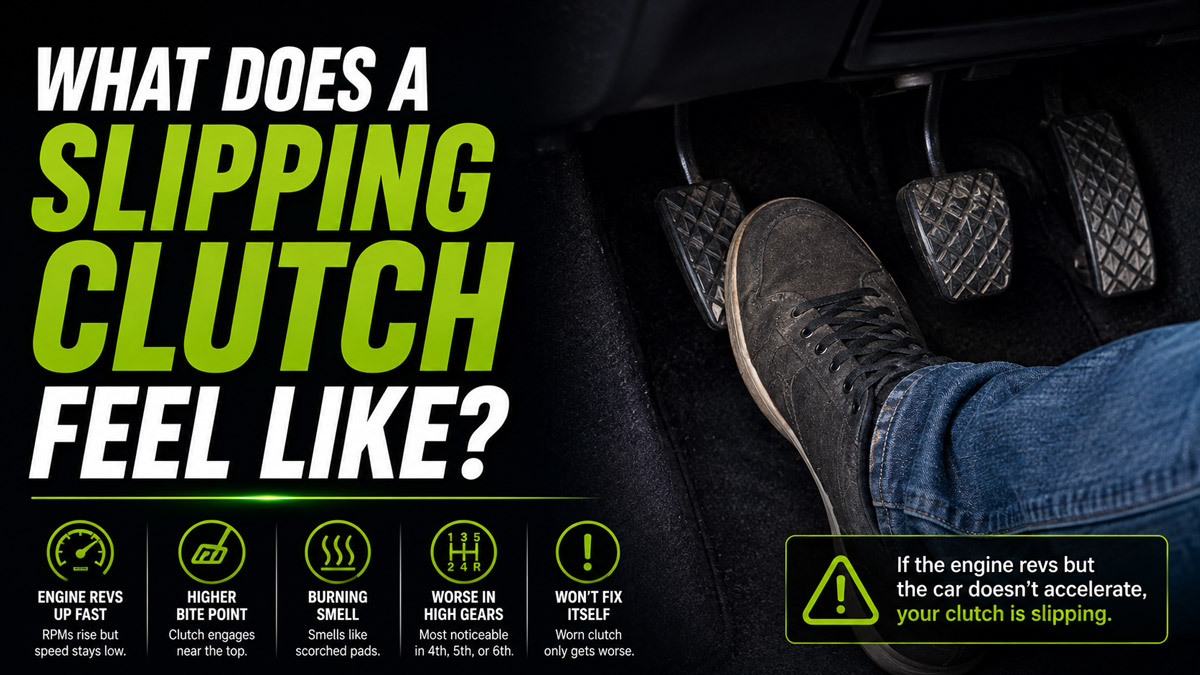
A slipping clutch feels like the engine is revving faster than the car is accelerating. The engine RPMs rise dramatically when the throttle is pressed, but the vehicle speed remains constant or barely increases. This occurs because the friction disc fails to lock completely against the engine’s flywheel.
At a Glance
- Engine RPMs surge abruptly under heavy acceleration without a matching increase in road speed.
- The clutch pedal bite point migrates to the top 10% to 15% of the pedal travel.
- A severe slip generates a pungent, burning odor similar to scorched brake pads or burnt toast.
- Slipping usually manifests first in higher gears (4th, 5th, or 6th) under heavy engine load.
- A slipping manual transmission clutch will never heal or repair itself; the friction material is permanently compromised.
Why Does A Manual Transmission Clutch Slip?
A manual transmission clutch slips because the friction disc loses the ability to transfer 100% of the engine’s rotational energy to the transmission input shaft. In a healthy manual transmission, a heavy pressure plate clamps a fibrous friction disc tightly against the engine’s spinning flywheel. When the driver presses the accelerator, these three components spin in total unison.
As a vehicle accrues mileage, the friction material on the clutch disc naturally wears thinner. Eventually, the pressure plate can no longer apply enough clamping force to overcome the engine’s torque. When the engine produces more torque than the thinned friction material can hold, the flywheel begins spinning faster than the clutch disc. This mechanical disconnect allows the engine to rev freely while the transmission and wheels lag behind.
What Are the Physical Symptoms of a Dying Clutch?
The physical symptoms of a dying clutch include a severe disconnect between engine RPMs and vehicle speed, an altered clutch pedal engagement point, and noticeable changes in drivetrain resistance. Drivers typically first notice that the vehicle hesitates to accelerate when passing on the highway.
Alongside the RPM surge, the physical travel of the clutch pedal changes dramatically. On a healthy transmission, the clutch typically “bites” or engages near the middle of the pedal’s travel. When a clutch disc is near the end of its life, the bite point migrates all the way to the top 10% to 15% of the pedal stroke. The driver must let the pedal almost completely out before the vehicle begins to move forward.
Does a worn clutch smell, and what causes it?
Yes, a slipping clutch emits a distinct, pungent burning odor that smells very similar to burnt toast or scorched brake pads. This foul smell is the direct result of intense friction generating extreme thermal energy.
When the clutch disc fails to lock with the flywheel, the two metal and organic surfaces grind against each other at high speeds. This friction rapidly heats the organic, Kevlar, or ceramic facings of the clutch disc past 500°F (260°C). As the resin and friction material cook, the clutch assembly off-gasses the burning smell into the engine bay, which the climate control system often pulls directly into the passenger cabin.
Does a slipping clutch make a specific noise?
A standard organic slipping clutch does not typically grind, clunk, or whine, but it does cause a highly noticeable acoustic change: the engine pitch rises rapidly and abnormally. Because the engine is briefly disconnected from the weight of the vehicle, the exhaust and engine noise will rev up quickly, exactly as if the driver had shifted into neutral and blipped the throttle.
However, high-performance aftermarket clutches made of ceramic or carbon behave differently. When ceramic clutches slip or fail, they do not transition smoothly. These aggressive materials tend to violently “chatter” or shudder, creating a loud, staccato banging noise as the friction pucks rapidly grab and release the flywheel.
How Do You Test for a Slipping Clutch at Home?
Mechanics rely on a stationary diagnostic procedure known as the “Stall Test” to definitively check a clutch disc’s clamping force. This test forces the clutch to handle maximum load at zero vehicle speed.
- Park the vehicle on a flat, open surface away from traffic or obstacles.
- Fully engage the emergency parking brake.
- Depress the clutch pedal completely and shift the transmission into 4th gear (or 5th gear on a 6-speed transmission).
- Rev the engine slightly to around 2,000 RPM.
- Slowly and smoothly release the clutch pedal completely.
In a healthy vehicle, the engine should stall and die instantly, jerking the car against the parking brake. If the engine takes more than 1.5 to 2 seconds to stall, or if the engine continues running at 600+ RPM with the pedal fully released, the clutch disc is severely worn and slipping.
Are there risks to performing the clutch stall test?
Yes, performing the stall test carries a high risk of damaging a perfectly healthy transmission if executed poorly or repeatedly. Forcing the engine to stall in a high gear places massive strain on the drivetrain.
If a driver performs the stall test multiple times in a row, or rides the pedal for more than three seconds during the test, the friction disc will overheat. This intense heat can “glaze” the organic material on a healthy clutch, turning it into a slick, mirror-like surface. Once a clutch disc is glazed from an abusive stall test, it will begin slipping during normal driving, ruining a previously functional component.
What Mechanical Issues Mimic a Failing Clutch?
Several mechanical anomalies mimic a worn friction disc, causing a clutch to slip even when the disc has 80% or more of its physical thickness remaining. Mechanics must rule these out before dropping a transmission.
- Oil Contamination: A leaking rear main engine seal or a blown transmission input shaft seal can coat the clutch housing in oil. This oil lubricates the friction disc, causing identical slipping symptoms on a physically healthy clutch.
- Hydraulic System Restrictions: A collapsed flexible clutch fluid hose or a faulty clutch master cylinder can hold residual hydraulic pressure in the system. This trapped pressure acts exactly like a driver lightly resting their foot on the pedal, holding the pressure plate slightly open and causing a slip.
- Glazed Friction Materials: Aggressive driving, frequent high-RPM launches, or resting a foot on the clutch pedal while driving will overheat the disc. The heat turns the porous friction material into a hard, glassy surface that cannot grip the flywheel, resulting in permanent slip regardless of material thickness.
Why Does a Clutch Slip Only in Specific Situations?
The clamping force of a pressure plate is a fixed mechanical value, but the torque load placed on the vehicle changes dynamically based on gear ratios, engine output, and thermal conditions.
Why does a clutch slip only in high gears or under boost?
A clutch slips first in high gears (4th, 5th, or 6th) because these overdrive ratios place the maximum mechanical torque load on the transmission input shaft. In 1st gear, torque multiplication makes it incredibly easy for the engine to move the car’s weight. In 5th gear on the highway, the engine is fighting immense aerodynamic drag and long mechanical gearing.
Similarly, turbocharged engines can cause intermittent slip. A clutch might hold perfectly during normal city driving, but the moment the turbocharger spools up and hits peak boost (typically between 2,500 and 3,500 RPM), the engine torque spikes instantly. This sudden surge in power breaks the friction lock, causing the RPMs to shoot up until the driver lifts off the throttle.
Why does a clutch only slip when cold or hot?
A clutch assembly relies on tight mechanical tolerances that are highly sensitive to thermal expansion and contraction.
When a clutch only slips when cold, the friction material on the disc has contracted in the low ambient temperatures. The disc temporarily lacks the thickness required for the pressure plate to clamp it tightly. As the vehicle drives and the assembly warms up, the material expands and regains its grip. Conversely, if a clutch only slips after 20 or 30 minutes of driving, the intense ambient heat of the engine block is warping an old, fatigued pressure plate. As the metal expands and warps, it lifts slightly away from the disc, causing a hot-slip condition.
How does a dual-mass flywheel failure feel different?
A failing dual-mass flywheel (DMF) creates harsh driveline vibrations rather than the smooth, linear RPM surge associated with standard clutch slip. Modern manual vehicles use a DMF to absorb engine vibrations.
When the internal springs of a DMF break down, the two halves of the flywheel lose their synchronization. Instead of the engine smoothly over-revving, the driver will feel a severe, violent shudder through the floorboards and shifter, particularly under heavy load between 1,800 and 2,500 RPM. Many drivers mistake this mechanical bucking for an engine misfire or a fuel delivery issue, completely missing that the transmission side is at fault.
Can A Slipping Clutch Suddenly Fix Itself?
No, a slipping clutch will never fix itself, nor can the friction disc regenerate lost material. Once a clutch begins slipping due to wear or glazing, the condition is permanent and will only accelerate.
If the slipping was caused by a temporary fluid leak—such as oil dripping onto the disc—the situation will actually worsen over time. The extreme heat of the slipping clutch bakes the oil directly into the organic fibers of the disc, permanently ruining the friction surface even if the engine oil leak is completely repaired.
How Long Can You Drive on a Slipping Clutch?
A vehicle with a slipping clutch should only be driven a few miles directly to a repair shop or a safe location. Driving continuously on a slipping clutch is dangerous and mechanically destructive.
Because the clutch acts as the sole power link between the engine and the wheels, a severely slipping clutch can leave a vehicle stranded in an intersection or unable to climb a mild hill. Once the slip begins, the driver has no way to predict exactly when the remaining friction material will disintegrate completely.
What happens if you keep driving with a slipping clutch?
Continuing to drive with a slipping clutch generates immense, unmitigated thermal energy that will completely destroy the surrounding transmission components.
The heat from a constantly slipping disc will permanently warp the heavy metal pressure plate and cause heat-checking (deep micro-cracks) across the surface of the engine’s expensive flywheel. Furthermore, as the friction material disintegrates, the metal rivets holding the disc together will gouge deep grooves into the flywheel. What started as a basic $1,000 friction disc replacement quickly spirals into a $3,000 comprehensive transmission rebuild because the driver refused to stop driving.
Repair Costs and Component Replacement
Repairing a manual transmission requires significant labor, as the mechanic must physically separate the heavy transmission from the engine block to access the clutch assembly.
How much does a clutch replacement cost?
A standard clutch replacement costs between $1,000 and $2,500 for parts and labor. The massive price range depends entirely on the vehicle’s drivetrain layout.
On a standard rear-wheel-drive truck, a mechanic can drop the transmission and replace the clutch in just four hours, keeping labor costs low. On a modern front-wheel-drive or all-wheel-drive vehicle, the mechanic often has to remove the entire front subframe, steering rack, and axles just to reach the clutch, pushing labor times past 10 hours and driving the total bill well over $2,000.
Do you have to replace the flywheel when a clutch slips?
Yes, mechanics almost universally require either replacing or professionally resurfacing the flywheel when installing a new clutch.
Putting a perfectly flat, brand-new clutch disc against a heat-warped or scored flywheel guarantees that the new clutch will slip and shudder immediately. If the vehicle uses a solid single-mass flywheel, a machine shop can usually grind it flat for a small fee. However, if the vehicle utilizes a modern dual-mass flywheel, it cannot be safely machined; it must be completely replaced, which adds $400 to $900 to the final repair bill.
How Can Drivers Prevent Premature Clutch Glazing?
Drivers can prevent premature clutch failure by keeping their left foot entirely off the clutch pedal when not actively shifting gears.
Resting a foot on the pedal—a habit known as “riding the clutch”—applies a few pounds of hydraulic pressure to the release bearing. This slight pressure is enough to partially disengage the pressure plate, causing the disc to slip invisibly and glaze over time. Furthermore, drivers should avoid high-RPM launches, never use the clutch pedal to hold a vehicle stationary on an incline, and practice proper rev-matching when downshifting to minimize friction wear.
The Bottom Line
A slipping clutch feels like a total disconnect between engine speed and vehicle speed, most notably when the RPMs jump wildly in 4th or 5th gear without the car accelerating. A simple home stall test—putting the car in 4th gear, pulling the e-brake, and releasing the pedal to see if the engine dies—can confirm a dead friction disc. Drivers who experience this slip must head directly to a repair shop; ignoring the issue guarantees catastrophic heat damage to the flywheel and pressure plate, multiplying the final repair bill.