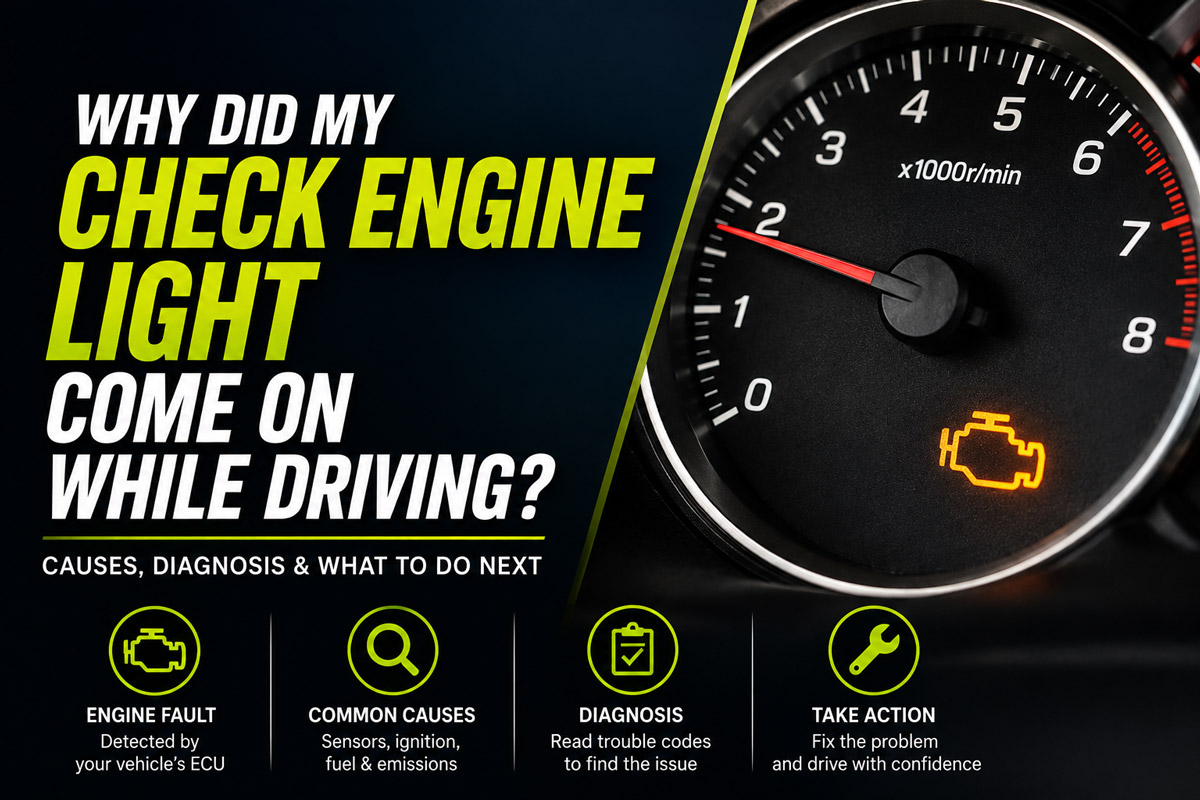
Your check engine light came on while driving because the engine control unit (ECU) detected an anomaly in the emissions, ignition, or fuel delivery systems. When sensor data deviates from factory parameters, the OBD-II system logs a Diagnostic Trouble Code (DTC) and illuminates the dashboard warning light.
Key Facts / At a Glance
- Solid vs. Flashing: A solid light indicates a logged fault that requires diagnosis; a flashing light indicates a severe engine misfire requiring immediate shutdown.
- Standardized Diagnostics: Since 1996, all vehicles use the On-Board Diagnostics II (OBD-II) standard, allowing universal code readers to pull failure data.
- The “Parts Cannon” Fallacy: A fault code identifies a circuit or system operating outside normal parameters, not necessarily the specific mechanical part that failed.
- Temporary Fixes Fail: Clearing a code with a scanner without fixing the underlying mechanical or electrical issue will result in the light returning once the ECU runs its next drive cycle.
- Freeze Frame Data: When the ECU triggers the light, it takes a “snapshot” of all engine metrics (speed, temperature, load) at that exact millisecond to aid in diagnosis.
What Should I Do Immediately When the Light Comes On?
When a check engine light illuminates during transit, your immediate response depends entirely on whether the dashboard indicator is solid or flashing. The Malfunction Indicator Lamp (MIL) is programmed to distinguish between routine maintenance faults and catastrophic engine emergencies.
The Solid Check Engine Light
A solid check engine light means the ECU has verified a non-emergency sensor fault or emissions failure. You can safely continue driving to your destination, provided the vehicle feels and sounds normal. Monitor the engine temperature gauge and oil pressure warning lights; if those remain in the normal range, schedule a diagnostic scan within the next few days.
The Flashing Check Engine Light
A flashing check engine light signifies an active, severe engine misfire that is dumping unburnt fuel directly into the exhaust system. This raw fuel enters the catalytic converter, superheating the honeycomb substrate to temperatures exceeding 1,600°F (870°C). Driving with a flashing light can melt the catalytic converter in less than five minutes, turning a $100 spark plug repair into a $2,500 exhaust replacement. Pull over safely, turn off the engine, and call a tow truck.
How Does the OBD-II Diagnostic System Work?
The On-Board Diagnostics (OBD-II) system functions as the central nervous system of your vehicle. It continuously audits the engine’s mechanical efficiency and chemical emissions through a strict four-step operational sequence.
- Sensor Monitoring: Dozens of sensors constantly stream voltage readings to the ECU, measuring variables like incoming air volume, coolant temperature, and exhaust oxygen density.
- Data Evaluation: The engine computer compares this real-time sensor telemetry against pre-programmed factory maps and EPA emission thresholds.
- Fault Verification: To prevent false alarms from electrical noise, the ECU waits for a sensor reading to fail across a set number of consecutive engine cycles. A temporary glitch becomes a “pending code.” A verified failure becomes a permanent Diagnostic Trouble Code (DTC).
- Dashboard Illumination: Once the code is verified, the ECU commands the instrument cluster to illuminate the check engine light and saves the corresponding alphanumeric DTC into its permanent memory.
What Are the Most Common Causes and Repair Costs?
The cost and time required to fix a check engine light vary dramatically based on the triggered component. Below is a breakdown of the most common failures, their associated DTCs, and current industry-average repair metrics.
| Triggering Component | Common DTCs | Functional Purpose & Failure Symptoms | Est. Repair Cost | Est. Repair Time |
| Loose Gas Cap | P0455, P0442 | Seals the evaporative emissions (EVAP) system. Symptoms: None, light triggers shortly after refueling. | $0 – $30 | 2 minutes |
| Oxygen (O2) Sensor | P0131 to P0175 | Measures unburnt oxygen in exhaust to tune air/fuel ratio. Symptoms: Rough idle, 20% drop in MPG. | $150 – $450 | 1 – 2 hours |
| Mass Airflow Sensor | P0101, P0102 | Measures the exact volume of air entering the intake. Symptoms: Engine stalling, hesitation on acceleration. | $200 – $600 | 1 hour |
| Ignition Coils & Plugs | P0300 to P0312 | Provide the spark that ignites the fuel mixture. Symptoms: Violent shaking, flashing check engine light. | $100 – $500 | 1 – 3 hours |
| Catalytic Converter | P0420, P0430 | Scrub toxic tailpipe gases into safer compounds. Symptoms: Rotten egg (sulfur) smell, failed smog test. | $1,500 – $3,500 | 2 – 4 hours |
How Do You Diagnose the Exact Fault Code?
To extract the specific DTC stored in your vehicle’s memory, you must connect a diagnostic scanner to the 16-pin OBD-II port, typically located under the dashboard on the driver’s side. Automotive professionals and DIY mechanics use three distinct tiers of diagnostic equipment.
Consumer Bluetooth Adapters
Bluetooth OBD-II adapters pair with smartphone applications to provide affordable, real-time diagnostic data.
- Pros: Highly affordable ($20-$50), user-friendly interfaces, capable of displaying live telemetry like coolant temp and RPM.
- Cons: Cheap chipsets often misinterpret manufacturer-specific proprietary codes, leading to misdiagnosis.
Dedicated Handheld Scanners
Standalone handheld scanners are rugged, self-powered devices favored by traditional DIYers and auto parts stores.
- Pros: Plug-and-play simplicity, boots up instantly without pairing, immune to smartphone battery death.
- Cons: Limited to basic emissions and engine codes; most sub-$100 units cannot read ABS (brakes) or SRS (airbag) control modules.
Professional Diagnostic Tablets
Shop-grade diagnostic tablets (e.g., Snap-on, Autel) offer bi-directional control, allowing the mechanic to command vehicle systems rather than just reading them.
- Pros: Unmatched accuracy, can access all vehicle network modules, and allows users to manually actuate solenoids or cooling fans to test circuits.
- Cons: Cost-prohibitive for home mechanics ($1,000–$5,000+), requires software subscription updates, and features a steep learning curve.
What Are the Biggest Diagnostic Mistakes to Avoid?
Inaccurate diagnostics cost vehicle owners thousands of dollars annually in unnecessary parts and labor. Avoid these proven pitfalls when attempting to resolve a dashboard warning.
- Playing the “Parts Cannon”: Assuming the DTC dictates the exact broken part is the most common DIY error. A P0171 “System Too Lean” code means the engine has too much air and not enough fuel; replacing the O2 sensor rarely fixes this, as the actual culprit is usually a cracked vacuum hose or a failing fuel pump.
- Clearing Codes Without Curing the Root Cause: Using a scanner to erase the code turns off the light, but the ECU also resets its internal readiness monitors. Once you drive the car and the ECU runs its self-tests, it will detect the unresolved mechanical fault and illuminate the light again.
- Ignoring Secondary Symptoms: Driving with a solid light is generally safe, but if the vehicle goes into “Limp Mode” (electronically limiting speed to 30 MPH) or the temperature gauge spikes, ignoring the light will result in catastrophic internal engine damage.
Will the Check Engine Light Reset Itself?
A check engine light will turn itself off if the engine control unit verifies that the mechanical anomaly has been corrected over multiple drive cycles. A “drive cycle” is not a simple trip around the block; it is a specific set of parameters (e.g., cold start, idling for 3 minutes, highway driving at 55 MPH for 10 minutes) that forces the ECU to test every emissions component.
If you tighten a loose gas cap, the EVAP system will eventually run its pressure test. Once it detects a sealed system over three consecutive drive cycles, the computer moves the active DTC to the vehicle’s history file and extinguishes the dashboard light.
FAQ
Can low oil cause the check engine light to come on?
Low oil pressure typically triggers the red oil can warning light, not the check engine light. However, if severely low oil causes variable valve timing (VVT) solenoids to fail or induces an engine misfire, the ECU will subsequently trigger the check engine light.
Does a check engine light mean my car will fail emissions?
Yes. In jurisdictions that require OBD-II emissions testing, any active check engine light is an automatic failure. Furthermore, clearing the codes right before the test will also cause a failure, as the ECU’s internal readiness monitors will read “Incomplete.”
Is it safe to drive my car to a mechanic with the light on?
If the light is solid, the engine sounds normal, and the vehicle accelerates smoothly, it is perfectly safe to drive to a repair shop. If the light is flashing, or the car is violently shaking or overheating, you must tow it to prevent terminal engine failure.
Why does my check engine light come on and then go off randomly?
An intermittent check engine light usually indicates a failing electrical connection or an issue hovering right on the edge of the ECU’s threshold. For example, a failing mass airflow sensor might perform adequately on cool days but fail under high-heat conditions, causing the light to cycle on and off.
The Bottom Line: Finding out why your check engine light came on while driving requires pulling the specific DTC, acknowledging whether the light is solid or flashing, and systematically testing the indicated circuit. Never blindly replace parts based solely on a code reader’s generalized output.