A brake inspection is a structured evaluation of the components that slow and hold a vehicle, including friction material, rotors or drums, hydraulics, fluid, parking brake, warning systems, and operating performance. For routine maintenance, a professional basic inspection offers the best value; for symptoms or an unknown vehicle, a full measured diagnostic inspection is the safer choice.
Quick Verdict
For routine maintenance: Choose a professional basic inspection during a tire rotation or scheduled service.
For grinding, pulling, vibration, leaks, or a soft pedal: Choose a full diagnostic inspection immediately.
For used-car purchases: Require a documented inspection with wheel removal and measurements.
For DIY monitoring: Perform visual checks between services, not instead of professional inspection.
For hybrids and EVs: Use a technician who checks corrosion, calipers, fluid, electronics, and regenerative-braking interactions.
Brake Inspection Options Compared
Typical prices vary by location, vehicle, shop type, and whether the inspection fee is credited toward repairs. The ranges below are planning estimates rather than fixed national prices.
| Decision criterion | DIY visual check | Basic shop inspection | Full diagnostic inspection |
|---|---|---|---|
| Typical price | $0, excluding tools | $0–$50 | $75–$180+ |
| Typical time | 5–15 minutes | 15–30 minutes | 45–120 minutes |
| Wheels removed | Usually 0 | 0–2, depending on shop | Usually 2–4 as needed |
| Pad or shoe assessment | Visible outer material only | Visual check or spot measurement | Inner and outer measurements at each inspected wheel |
| Rotor or drum assessment | Visible surface only | Visible scoring, rust and damage | Thickness or diameter checked against specification; runout checked when relevant |
| Fluid assessment | Reservoir level and visible condition | Level, leaks and general condition | Correct fluid type, contamination testing, repair history and service interval |
| Hydraulic inspection | Obvious leaks only | Lift inspection for visible leaks | Hoses, lines, calipers, wheel cylinders, master-cylinder symptoms and component movement |
| Electronic systems | Warning-light observation | Warning-light check; limited scan | ABS, stability control and electronic parking-brake scan when indicated |
| Road test | Driver’s normal observations | Optional or symptom-dependent | Controlled test when safe and diagnostically useful |
| Written measurements | None | Sometimes | Expected |
| Hidden-fault detection | 1/5 | 3/5 | 5/5 |
| Best use | Between-service monitoring | Routine preventive maintenance | Symptoms, purchase decisions and unresolved problems |
The ratings use a five-point scale in which 1/5 means very limited detection and 5/5 means the most complete practical inspection available without destructive disassembly.
What Is a Brake Inspection Supposed to Find?
A proper brake inspection is not merely a pad check. Its purpose is to determine whether the vehicle can stop predictably, whether components are approaching their service limits, and whether one defect is causing abnormal wear elsewhere in the system.
A complete evaluation may cover:
- Disc brake pads and drum brake shoes.
- Rotors, drums and friction surfaces.
- Calipers, slides, pistons and wheel cylinders.
- Flexible hoses and rigid brake lines.
- Brake-fluid level, type and condition.
- Master-cylinder and booster symptoms.
- Parking brake cables, actuators and holding ability.
- ABS and stability-control warnings.
- Pedal travel, firmness, pulsation, pulling and noise.
- Vehicle-specific minimum dimensions and service limits.
Toyota describes brake inspection as part of its multipoint maintenance process for confirming that pad thickness remains at a safe level. AAA similarly recommends checking pads and rotors or drums during tire rotations, traditionally performed about every 5,000–7,500 miles.
Criterion verdict: A full diagnostic inspection finds the widest range of defects because it evaluates the braking system as an interconnected system rather than treating pad thickness as the sole decision.
Which Inspection Finds the Most Safety-Critical Faults?
DIY visual checking
A DIY check can reveal a dashboard warning, a low reservoir, an obvious leak, severe rotor grooves, unusually thin visible pads, burning odors, grinding, squealing, pulling, or changed pedal feel.
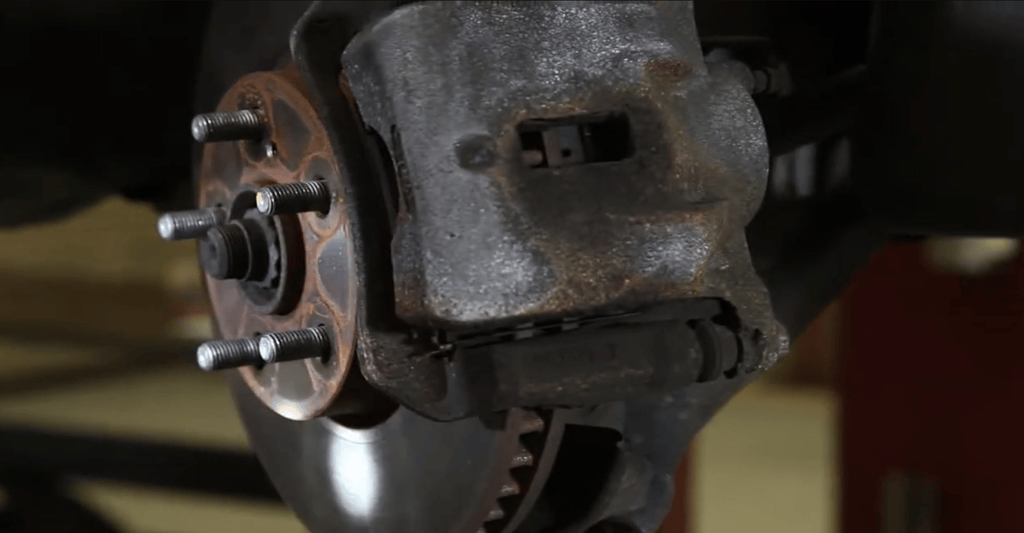
However, the wheel usually blocks the inner pad, caliper piston area, dust boots, most of the hose, and large portions of the rotor. Inner pads can wear differently from outer pads when caliper slides bind or pistons fail to retract.
A visual check also cannot reliably determine whether a rotor remains above its stamped or published minimum thickness.
Basic professional inspection
A basic shop inspection places the vehicle on a lift, giving the technician a much better view of brake hoses, lines, backing plates, calipers, wheel areas and active fluid leaks.
The limitation is inconsistency. “Free brake inspection” can mean anything from looking through the wheel spokes to removing wheels and recording measurements. The customer should ask exactly what is included before treating the result as comprehensive.
Full diagnostic inspection
A full inspection can compare each measured component with the specification for that year, make, model, axle and brake package. It can also trace symptoms that a static visual check may miss, including sticking components, excessive runout, hydraulic imbalance and electronic faults.
NHTSA recall documents illustrate why modern brake diagnosis can extend beyond pads and rotors: certain vehicles use integrated power-brake modules whose failures require system-level diagnosis and component replacement.
Criterion verdict: A full diagnostic inspection wins for safety-critical fault detection because brake problems may originate in hydraulic, mechanical or electronic components that are invisible through the wheel.
How Accurate Are the Measurements?
Brake-pad and shoe thickness
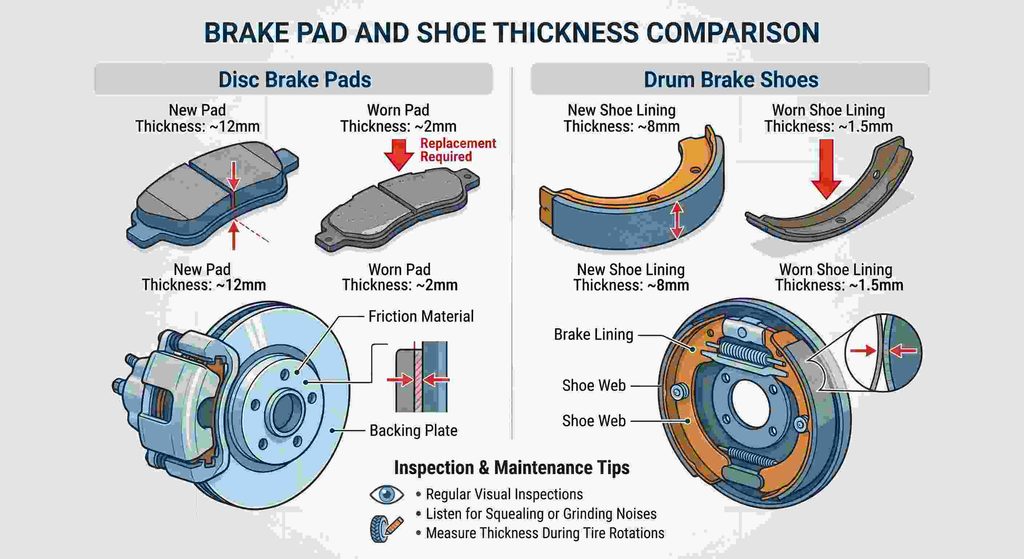
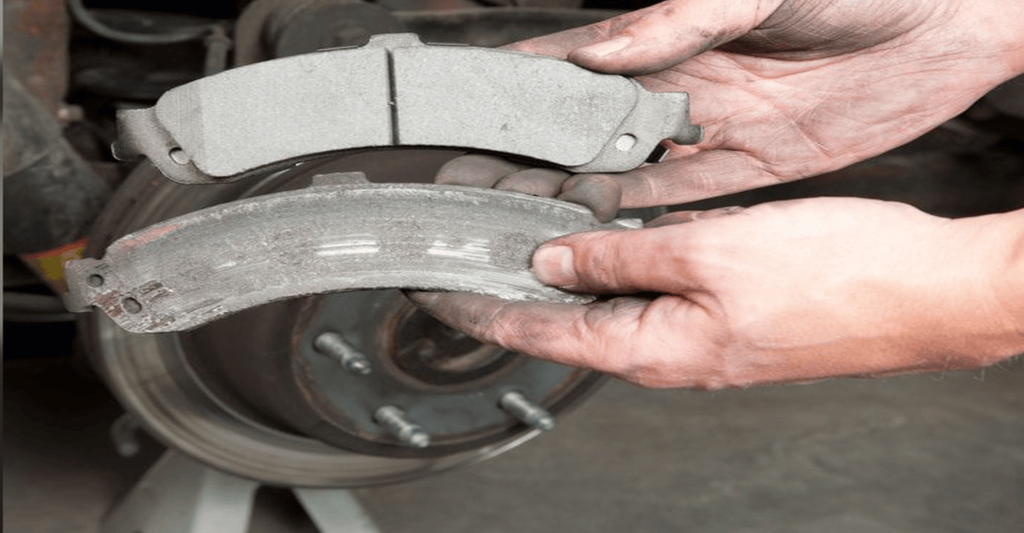
Technicians should measure the remaining friction material—not the steel backing plate—and compare it with manufacturer specifications.
Common service guidance often uses these planning bands:
| Measured friction material | Practical interpretation |
|---|---|
| 6 mm or more | Usually substantial usable material remains |
| 4–5 mm | Monitor and estimate future service timing |
| About 3 mm | Common proactive replacement-planning point |
| 1–2 mm | At or near the published wear limit on many applications |
| Metal contact or no usable lining | Immediate repair required |
These are not universal pass/fail rules. Toyota has published a 1 mm wear limit for certain brake pads and linings, while Ford publishes a 2 mm immediate-replacement point for a particular air-brake application. Vehicle specifications therefore override generic internet charts.
Toyota and AAA consumer guidance sometimes advises considering replacement when visible material is below approximately one-quarter inch, or 6.35 mm. That is an early service recommendation rather than proof that every pad below 6.35 mm has reached its engineering wear limit.
Rotor thickness and runout
Rotor thickness answers whether enough metal remains for safe operation and heat management. Lateral runout measures side-to-side deviation as the rotor turns and may contribute to pedal pulsation or uneven material transfer.
A rotor can appear smooth yet be below minimum thickness. Conversely, a rotor with visible surface marks may remain usable if it satisfies the manufacturer’s dimensional and condition requirements.
Ford specifications demonstrate that minimum rotor thickness is vehicle-specific; one published example lists a 23 mm front-disc minimum. That number must not be copied to another vehicle.
Drum diameter
For drum brakes, the technician may inspect shoe thickness, drum condition, wheel cylinders, hardware, adjusters and inside diameter. An oversized drum may be unsuitable for further machining even when its surface appears repairable.
Criterion verdict: A measured inspection wins for accuracy because generic millimeter thresholds cannot replace year-, model- and brake-package specifications.
How Completely Does Each Option Check Hidden Parts?
DIY observation is strongest for changes the driver can feel or hear. It is weakest for internal and rear-drum components.
A basic lift inspection improves access but may still omit wheel removal. Without removal, the technician may not see:
- The full inner pad.
- Caliper slide condition.
- Piston dust-boot damage.
- Inboard rotor corrosion.
- Drum shoes and hardware.
- Wheel-cylinder seepage.
- Parking-brake mechanisms inside rear rotors.
- Uneven wear across the pad’s leading and trailing edges.
A full inspection does not necessarily require dismantling every component. It requires enough access to explain the symptom, establish component condition, and support the repair recommendation with evidence.
On hybrids and electric vehicles, low friction-brake use can create a different inspection problem. Regenerative braking may reduce pad wear while exposed rotors, calipers or parking-brake parts still corrode or bind. Pad thickness alone may therefore overstate system health.
Criterion verdict: A full inspection wins for hidden-component coverage, especially on rear drum systems, vehicles with uneven wear and low-use friction brakes on hybrids or EVs.
How Should Brake Fluid Be Evaluated?
Fluid level
The fluid should remain within the reservoir markings. A low level can accompany normal pad wear, but a sudden or substantial drop can also indicate leakage. Simply topping up the reservoir without determining why the level fell can hide a developing problem.
Fluid color
Dark fluid may justify further testing or service, but color is not a complete diagnostic method. AAA notes that fresh fluid is generally clear to light-colored and that electronic testers or suitable strips can evaluate moisture, pH or copper-related deterioration more meaningfully.
Moisture percentage
The frequently repeated “flush at 3% moisture” rule is a common tester or workshop convention, not a universal specification for every car and fluid. The correct decision should consider:
- Manufacturer service schedule.
- DOT fluid specification.
- Test instrument and its calibration.
- Moisture, pH or copper test results.
- Fluid contamination.
- Whether the hydraulic system has been opened.
- Vehicle age and operating conditions.
Some general guidance recommends fluid service every two or three years, while more recent AAA commentary describes three to five years as a practical range. Neither interval overrides the vehicle manufacturer’s schedule.
Criterion verdict: A full inspection wins for brake-fluid evaluation because fluid color and a single generic moisture percentage cannot establish the correct service decision for every vehicle.
How Useful Is a Road Test?
A road test can help confirm:
- Pulling during braking.
- Pedal pulsation.
- Excessive pedal travel.
- Delayed engagement.
- Noise under load.
- Brake drag.
- Parking-brake release problems.
- Whether a completed repair addressed the original complaint.
However, “mandatory road test” is too absolute. A technician should not road-test a vehicle that has severe fluid loss, a pedal dropping toward the floor, confirmed metal-to-metal grinding, loose components, or another condition that makes driving unsafe.
Some problems are also speed-, temperature- or load-dependent. A two-minute parking-lot drive may not reproduce highway vibration, brake fade after repeated stops, or a noise that appears only after the brakes warm up.
A useful inspection records the customer’s symptom precisely: speed, pedal pressure, road surface, temperature, turning direction, duration and whether the condition occurs hot or cold.
Criterion verdict: A controlled road test wins for functional diagnosis when the vehicle is safe to drive, but static testing must come first when brake integrity is uncertain.
Which Option Produces the Best Repair Decision?
DIY checking and decision quality
A DIY check answers, “Has something obviously changed?” It rarely answers, “Which component failed, why did it fail, and what must be replaced?”
Its best use is identifying a reason to schedule service sooner.
Basic inspection and decision quality
A basic inspection can support routine maintenance planning when measurements are provided. It is less useful when the recommendation contains no numbers, photographs or specifications.
A statement such as “your brakes are at 20%” is difficult to audit. A stronger report says:
- Left-front inner pad: 3 mm.
- Left-front outer pad: 6 mm.
- Right-front inner pad: 5 mm.
- Rotor minimum: vehicle-specific value.
- Measured rotor thickness: recorded value.
- Caliper slide: restricted on left side.
- Fluid leak: none found.
That evidence explains both the repair and the cause of uneven wear.
Full inspection and decision quality
A documented inspection makes it easier to compare quotes, decline unrelated work, obtain a second opinion, or verify a repair.
The best shops separate findings into:
- Unsafe now.
- Approaching service limit.
- Maintenance recommended by schedule.
- Optional improvement.
- No action required.
Criterion verdict: A documented full inspection wins for repair decisions because measurements and failure causes are more actionable than percentages, adjectives or sales language.
How Do Price and Long-Term Cost Compare?
The DIY check has no labor charge, but it offers limited financial protection if a hidden issue is missed.
A basic inspection may cost nothing when bundled with an oil change, tire rotation or repair estimate. Its value is high when the shop records actual measurements and low when it functions only as a sales lead.
A full diagnostic commonly carries an upfront fee because it uses lift time, wheel removal, measurement tools, scan equipment and road-testing time. Complex electronic, hydraulic or intermittent complaints may cost more than a straightforward mechanical inspection.
The more important cost is the consequence of delay. Continuing to drive after friction material is exhausted can turn a pad-only service into a repair involving rotors, calipers or other damaged components. AAA estimates typical brake-pad replacement at approximately $100–$300 per axle, although vehicle type, labor rates and required companion repairs can increase the total substantially.
Paying for diagnosis can also reduce unnecessary parts replacement. A pulsation blamed on “warped rotors,” for example, may require checking runout, hub condition, wheel-fastener torque and friction-material variation before parts are ordered.
Criterion verdict: A basic professional inspection wins on routine value, while a paid diagnostic wins on total cost when symptoms or uncertain findings create a meaningful risk of misdiagnosis.
Which Should You Choose?
Routine Driver Without Brake Symptoms
Choose a basic professional brake inspection during a tire rotation or scheduled maintenance visit.
Ask for pad measurements at each inspected wheel, rotor or drum observations, leak inspection, fluid condition and parking-brake operation. AAA recommends checking pads and rotors or drums during tire rotations, commonly spaced around 5,000–7,500 miles.
A DIY look between services remains useful, but it should not be the only inspection over the vehicle’s life.
Recommendation: For a symptom-free daily driver, a measured basic shop inspection offers the best balance of cost, access and preventive value.
Driver With Squealing but Normal Pedal Feel
Choose at least a professional inspection, not automatic pad replacement.
Squealing may come from wear indicators, surface rust, glazing, contamination, hardware movement or pad characteristics. Toyota manuals note that wear indicators can produce a warning noise when pads reach their designed warning point.
The technician should identify which wheel produces the noise and measure inner and outer material.
Recommendation: For persistent squealing, choose an inspection that includes wheel removal and measurements if the sound cannot be explained visually.
Driver With Grinding, Pulling or a Soft Pedal
Choose a full diagnostic inspection immediately.
Grinding may indicate exhausted friction material or contact between unintended surfaces. Pulling may involve uneven friction, a sticking caliper, contamination, tire issues or suspension effects. A soft or sinking pedal may indicate air, fluid loss, hydraulic failure or another condition requiring urgent diagnosis.
Do not continue driving merely because the car still stops. If pedal pressure is disappearing, fluid is leaking, or stopping ability is materially reduced, arrange towing rather than a road test.
Recommendation: For grinding, hydraulic symptoms or altered stopping behavior, a full diagnostic inspection is the only appropriate option.
Used-Car Buyer
Choose a documented full brake inspection before purchase.
The report should include pad or shoe measurements, rotor or drum dimensions when warranted, fluid condition, leaks, warning lights, parking-brake operation and a safe road test.
A free visual check cannot reliably establish whether a vehicle needs four pads next year, two rotors now, rear drum service, an ABS repair or hydraulic work.
Recommendation: For a used-car buyer, the inspection fee is justified because brake findings can change the purchase price, repair budget or decision to walk away.
DIY Enthusiast
Use a DIY visual and operational check between professional inspections.
A capable owner can monitor fluid level, warning lights, visible pad material, rotor surfaces, leaks, noises and pedal changes. Accurate wheel-off work requires safe lifting equipment, correct procedures, torque specifications and knowledge of electronic parking-brake or service modes.
Never place any part of the body beneath a vehicle supported only by a jack.
Recommendation: For a DIY enthusiast, visual checking is a monitoring tool; vehicle-specific measurement and hydraulic diagnosis remain professional-inspection tasks unless the owner has the proper equipment and service information.
Hybrid or Electric-Vehicle Owner
Choose a professional inspection that evaluates corrosion and movement, not only remaining pad thickness.
Regenerative braking can reduce friction-material consumption, but low use does not guarantee freely moving calipers or clean rotor surfaces. Electronic parking brakes and brake-by-wire functions may also require model-specific service procedures and scan tools.
Recommendation: For hybrids and EVs, a corrosion- and electronics-aware professional inspection is more useful than a pad-life estimate alone.
Honest Limitations Nobody Explains
A paid inspection is not automatically unbiased
Charging a diagnostic fee compensates the shop for technician time, but it does not guarantee a correct conclusion. A trustworthy inspection still needs written measurements, photographs where helpful, vehicle specifications and a clear explanation of urgency.
Free inspections are not automatically sales traps
A free inspection can be excellent when it is bundled efficiently with tire or maintenance work and produces transparent findings. The price does not determine quality; scope and documentation do.
More disassembly is not always better
A complete inspection does not require unnecessary dismantling. The technician should remove enough components to verify condition without disturbing sealed or correctly operating assemblies without cause.
Pad thickness does not predict exact remaining mileage
Two drivers with 4 mm pads can have very different remaining life. City traffic, towing, hills, vehicle weight, pad compound, caliper condition, regenerative braking and driving style all change the wear rate.
AAA has cited approximately 30,000–40,000 miles as an average brake-life range, but it explicitly notes that driving habits create substantial variation.
Rotor pulsation is not diagnosed by appearance alone
Pedal vibration does not prove that a rotor is visibly “warped.” Diagnosis may require checking rotor runout, thickness variation, hub cleanliness, bearing condition and wheel-fastener torque.
A brake inspection is not a government safety inspection
A repair-shop brake inspection evaluates condition and service needs. A state or national roadworthiness inspection follows the legal rules of its jurisdiction and may use different pass/fail criteria.
The overall winner can still disappoint
A full diagnostic inspection costs more, takes longer and may produce no repair recommendation. That is not wasted money when it rules out dangerous causes or prevents replacing good parts, but it is excessive for every symptom-free oil-change visit.
Honest verdict: The full diagnostic inspection is the most capable option, but the basic measured inspection is the smarter routine choice because most symptom-free drivers do not need 60–120 minutes of diagnosis at every maintenance visit.
What Should a Brake Inspection Report Include?
A useful report should identify:
| Report item | Minimum useful detail |
|---|---|
| Friction material | Millimeters remaining at each relevant inner and outer position |
| Rotors | Visual condition and measurements when near limits or symptoms exist |
| Drums and shoes | Shoe thickness, hardware condition, leakage and drum condition |
| Hydraulics | Leak locations, hose condition and restricted or seized movement |
| Fluid | Level, specified fluid type, test method and result when tested |
| Parking brake | Holding, release and actuator or cable condition |
| Electronics | Warning lights and diagnostic trouble codes when present |
| Road test | Symptom reproduced or not reproduced, with test conditions |
| Urgency | Unsafe now, repair soon, monitor or no action |
| Evidence | Vehicle specification, measurement, photograph or test result |
The inspection should distinguish observed fact from recommended action. “Pad measures 2 mm” is a fact. “Replace both front pads and rotors today” is a recommendation that should be supported by rotor condition, dimensions, axle-pair service practice and the vehicle specification.
Brake Inspection FAQ
Is a brake inspection the same as brake service?
No. A brake inspection evaluates condition and identifies required work. Brake service performs the work, which may include replacing pads, shoes, rotors, drums, hardware or fluid; cleaning and lubricating approved contact points; servicing calipers; or repairing hydraulic and electronic faults. Inspection should occur before parts are authorized unless an obvious emergency failure already establishes the repair.
Can a mechanic inspect brakes without removing the wheels?
Yes, but the result is limited. Looking through wheel openings may reveal visible outer-pad material and rotor condition. It may not expose inner pads, caliper slides, piston boots, inboard corrosion, drum components or uneven wear. Wheel removal is preferable when symptoms exist, measurements differ, access is poor or a purchase decision depends on the findings.
Does 3 mm mean brake pads must be replaced immediately?
Not universally. About 3 mm is a common proactive replacement point, but the actual service limit depends on the vehicle, pad design and manufacturer specification. Published examples range from approximately 1 mm to 2 mm for certain applications. Pads near 3 mm deserve planning and closer monitoring; grinding, damage or abnormal wear can require earlier action.
Is dark brake fluid proof that a flush is required?
No. Dark color can indicate aging or contamination, but color alone does not measure moisture, acidity or copper-related deterioration accurately. The decision should combine manufacturer guidance, fluid type, service history and an appropriate test. AAA identifies electronic testing and suitable test strips as more informative methods than color-only judgment.
How often should brakes be inspected?
A practical routine is to inspect pads and rotors or drums during tire rotations, often every 5,000–7,500 miles, while following the vehicle’s maintenance schedule. Inspection should happen sooner after warning lights, fluid loss, collision damage, prolonged storage, towing, mountain driving, flooding, grinding, pulling, pulsation or a meaningful change in pedal feel.
Should I pay for an inspection when shops offer one free?
Pay when the problem requires wheel removal, precise measurements, hydraulic diagnosis, electronic scanning, an extended road test or written documentation. A free inspection is sufficient for routine screening only when its scope is clearly defined and its findings include measurable evidence. The best value is the least expensive inspection capable of answering the actual safety question.
Final Verdict
A brake inspection is a preventive and diagnostic evaluation of the complete stopping system—not merely a glance at the outer pads.
For a symptom-free vehicle, schedule a basic professional inspection with recorded measurements during routine tire or maintenance service. For grinding, pulling, vibration, a soft pedal, fluid loss, warning lights, uneven wear, an unknown vehicle or a used-car purchase, pay for a full diagnostic and measurement inspection.
A DIY visual check is worthwhile between appointments, but it cannot reliably clear the inner pads, hydraulics, rotor dimensions, rear drums or electronic brake controls. The right inspection is therefore determined by the cost of missing the fault: the higher the symptoms, uncertainty or consequence, the deeper the inspection should be.