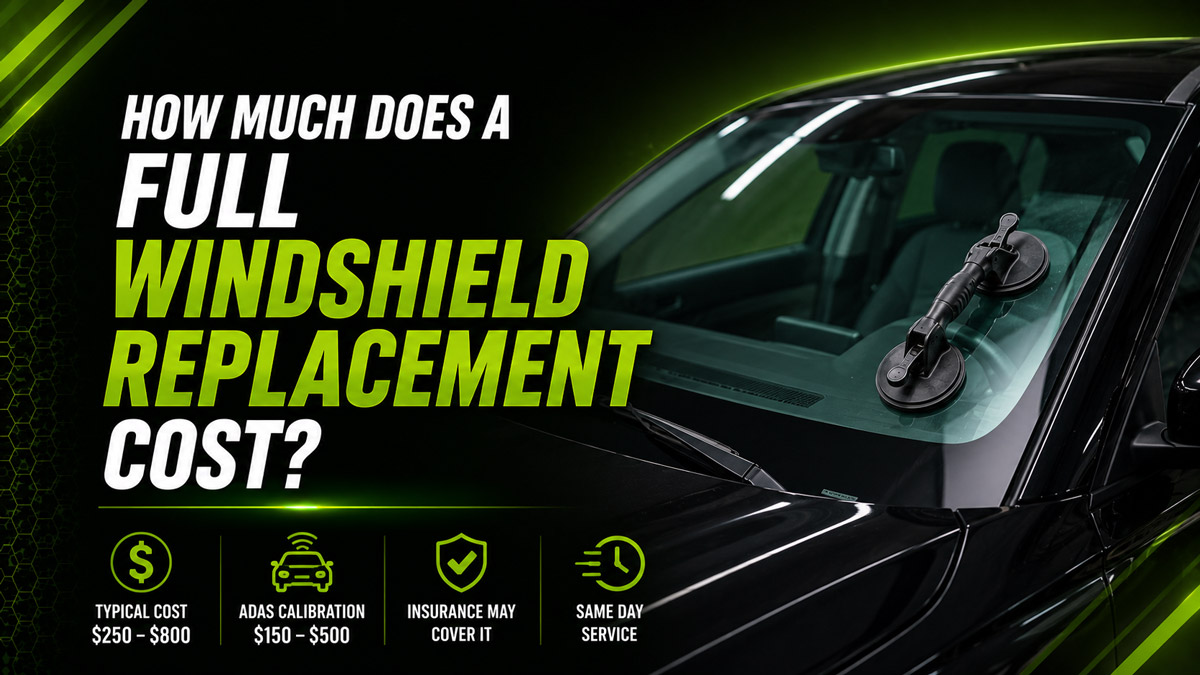
In 2026, a standard full windshield replacement costs between $250 and $800. For modern vehicles equipped with Advanced Driver Assistance Systems (ADAS), the total price increases to $600 to $1,500 due to mandatory camera recalibration requirements. Luxury vehicles, electric models, and windshields featuring a Heads-Up Display typically exceed $1,500.
At a Glance
- Aftermarket glass is 20% to 40% cheaper than original glass, while Original Equipment Manufacturer (OEM) glass costs $100 to $300 more.
- ADAS camera recalibration is a mandatory safety requirement that adds $150 to $500 to the final replacement bill.
- Arizona, Florida, and South Carolina offer or mandate zero-deductible comprehensive insurance coverage for windshield replacements.
- Installing cheaper aftermarket glass on a leased vehicle often violates the lease agreement and results in full OEM replacement penalties.
- Mobile windshield replacement services offer the same warranty and materials as in-shop repairs, often without charging an extra convenience fee.
When should a windshield be replaced instead of repaired?
A windshield must be fully replaced if a crack is longer than six inches, a chip is larger than a quarter, or if any damage sits directly in the driver’s line of sight. Replacement is also mandatory if the damage penetrates both layers of the laminated glass or extends to the windshield’s outer edge.
Repairing glass relies on injecting clear resin into small, contained breaks. Edge cracks compromise the structural integrity of the vehicle’s cabin, as the windshield supports a massive percentage of the roof’s structural weight in a rollover collision. Furthermore, any damage or residual resin near the top center of the glass can distort the view of forward-facing cameras. Modern advanced safety sensors require flawless optical clarity to calculate following distances accurately. Attempting to repair glass in the camera’s view field creates a high risk of emergency braking failure.
What are the separate costs of glass, labor, and calibration?
A complete windshield replacement bill is divided into the glass itself ($200 to $550), installation labor ($100 to $250), and safety system recalibration ($150 to $500). The total cost is heavily weighted by the technology housed within the glass rather than the physical materials.
The glass component fluctuates based on origin and vehicle type. Aftermarket glass represents the lower end of the spectrum, while OEM glass commands a steep premium. Labor charges cover the careful removal of the old glass, application of new urethane sealant, and precise positioning of the new windshield. The most variable cost is the calibration of safety sensors. Because modern windshields act as mounting substrates for LiDAR, rain sensors, and cameras, the post-installation calibration is structurally baked into the replacement process for over 68% of modern vehicles.
How much does ADAS camera recalibration add to the price?
Recalibrating a windshield’s Advanced Driver Assistance Systems (ADAS) adds between $150 and $500 to the total replacement cost. This process aligns the forward-facing cameras with the vehicle’s computer to ensure safety features function flawlessly.
This calibration fee is the single most common hidden charge in the auto glass industry. Static calibration, which involves adjusting sensors against fixed targets in a controlled shop bay, costs $150 to $300. Dynamic calibration requires a technician to drive the vehicle on specific road surfaces to adjust sensors in motion, adding $100 to $200. Dual calibration combines both methods and runs $250 to $450. Always explicitly ask a shop if their quoted price includes recalibration; a budget $299 quote will instantly jump to $600 once this mandatory service is factored in.
What happens if you skip ADAS windshield recalibration?
Skipping ADAS recalibration after a windshield replacement causes safety systems like automatic emergency braking and lane-keep assist to malfunction, disable completely, or trigger false alarms. A camera misaligned by just one millimeter at the windshield translates to a calculation error of over 50 feet at highway speeds.
If the system misjudges distance, the vehicle may brake aggressively for no reason or fail to stop for a stalled car ahead. Most modern vehicle computers will detect the sensor discrepancy and lock out the ADAS features entirely, displaying warning lights on the dashboard. In the event of a collision, skipping a manufacturer-mandated calibration leaves the vehicle owner exposed to immense liability, as the intentional bypassing of a safety system nullifies insurance protections and manufacturer warranties.
Should I choose OEM or aftermarket windshield glass?
You should choose Original Equipment Manufacturer (OEM) glass for leased vehicles, luxury cars, and models with complex ADAS systems, while aftermarket glass is the best financial choice for older, standard vehicles without forward-facing cameras. OEM glass costs $100 to $300 more than aftermarket equivalents.
OEM glass is produced by the exact manufacturer that supplied the vehicle’s original windshield (such as Pilkington or AGC) and features the automaker’s logo. It ensures perfect camera housing alignment, acoustic dampening, and exact factory curvature. Aftermarket glass meets federal safety standards but is reverse-engineered. While it is a structurally safe choice that saves you 20% to 40%, generic aftermarket glass can sometimes exhibit minor wavy distortion near the edges. If an insurance company covers the claim, check the policy terms; some insurers automatically substitute aftermarket glass unless the driver explicitly requests and pays the price difference for OEM.
How does a Heads-Up Display (HUD) affect windshield replacement cost?
A Heads-Up Display (HUD) requires a completely polarized windshield with a specialized transparent panel, making replacement $300 to $600 more expensive than standard glass. Standard glass cannot be used on a HUD-equipped vehicle.
The HUD technology relies on a small dashboard projector that beams information like speed and navigation directly into the driver’s line of sight. If a standard replacement windshield is installed, the projected image will appear ghosted, blurry, or entirely invisible. Because the entire windshield is polarized specifically for this projection, drivers cannot opt for cheap aftermarket alternatives. Owners of luxury vehicles or higher-trim models are locked into paying a premium for HUD-compatible OEM glass, pushing the total replacement bill well past the $1,000 mark.
How can I tell if my car windshield has a Heads-Up Display?
You can tell your vehicle has a Heads-Up Display if you see digital numbers (like your current speed) floating on the windshield in your line of sight while driving straight ahead. You will also see a small rectangular projector lens embedded in the top of the dashboard directly behind the steering wheel.
It is vital to inform the auto glass shop about this feature before they order replacement parts. Because the polarizing layer is nearly invisible when the car is turned off, technicians relying solely on the vehicle’s VIN might sometimes miss the HUD package designation. Checking the dashboard for the projector lens ensures the correct specialty glass is ordered the first time, preventing frustrating installation delays.
Which states mandate zero-deductible windshield replacement?
Arizona, Florida, and South Carolina mandate or highly encourage zero-deductible auto glass replacements. Arizona requires insurers to offer a zero-deductible glass waiver that is standard on 85% of policies, while Florida and South Carolina utilize comprehensive insurance rules to eliminate or minimize out-of-pocket costs for drivers.
In zero-deductible states, filing a claim means the driver pays absolutely nothing out of pocket for the glass, labor, or ADAS calibration. For drivers in all other states, it is crucial to compare the comprehensive deductible against the cash price of the replacement. If a driver has a $500 deductible and a standard replacement costs $350, filing a claim provides zero financial benefit. However, for a $1,200 OEM replacement on a modern electric vehicle, paying the $500 deductible is the financially superior choice.
What are the windshield replacement rules for leased vehicles?
Lease agreements strictly require vehicles to be returned with Original Equipment Manufacturer (OEM) glass, and installing cheaper aftermarket glass will result in severe financial penalties during the lease-end inspection.
Leasing companies consider aftermarket windshields to be unauthorized modifications that compromise the original vehicle quality. If a lessee tries to save money by installing a $300 aftermarket windshield instead of an $800 OEM windshield, the lease inspector will flag the missing manufacturer logo. The leasing company will then charge the driver the full dealership price for an OEM replacement, effectively making the driver pay for the windshield twice. To avoid these exorbitant fees, lessees must insist on OEM glass and retain the replacement receipts and calibration certificates for lease turn-in.
Does mobile windshield replacement cost more than in-shop service?
Mobile windshield replacement typically incurs a surcharge of $50 to $150, but many highly competitive regional providers waive this fee entirely. The actual cost difference is negligible for the shop, so convenience should not always come at a premium.
Mobile service offers immense convenience, allowing technicians to swap the glass in an office parking lot or residential driveway using the exact same materials and offering the exact same warranties as an in-shop visit. The primary limitation of mobile replacement is ADAS calibration. While some mobile vans are equipped for dynamic (road-test) calibration, static calibration requires perfectly level ground, controlled lighting, and fixed physical targets. For modern vehicles requiring static calibration, drivers are usually required to bring the car into a physical shop facility.
How long does a full windshield replacement process take?
A standard windshield replacement takes between 60 and 90 minutes for the physical installation, followed by an additional 30 to 60 minutes if the vehicle requires ADAS camera recalibration.
During the physical installation, technicians must carefully cut away the old urethane adhesive, clean the pinch weld, apply a specialized primer, and set the new glass perfectly in place. Rushing this process leads to leaks and rust. If the car features advanced sensors, the recalibration phase adds significant time. Static calibration requires setting up lasers and targets around the vehicle in a controlled bay, while dynamic calibration requires the technician to drive the car at specific speeds on clearly marked roads for up to 30 minutes to capture data.
How long must you wait to drive after a windshield replacement?
You must wait at least 1 to 2 hours after the new windshield is installed before driving the vehicle. This mandatory waiting period is called the Safe Drive Away Time (SDAT) and ensures the urethane adhesive has cured enough to hold the glass structurally.
Urethane requires specific temperature and humidity conditions to harden. If a vehicle is driven before the adhesive cures, the structural integrity of the cabin is heavily compromised. In a collision or rollover, an uncured windshield can pop out, causing the roof to collapse or passenger airbags to deploy improperly. Furthermore, driving too soon exposes the wet seal to engine vibrations, potholes, and wind pressure, which guarantees severe water leaks and whistling wind noises at highway speeds.
Why do some auto glass shops reuse old windshield molding?
Budget auto glass shops reuse old, brittle rubber windshield molding to artificially lower their quoted price and increase their profit margins. New molding typically costs an additional $20 to $75, making it an easy corner to cut for cheap installers.
This is a high-risk tactic. Windshield molding (or weatherstripping) degrades over time due to UV exposure, heat, and chemical washing. When technicians pry the old molding off to remove the broken glass, it stretches and deforms permanently. Reinstalling this compromised rubber around a new windshield is the leading cause of post-installation wind noise and water leaks. When reviewing a quote, customers must specifically ask, “Will you replace the molding, or reuse the old one?” If the shop refuses to use fresh trim, take the business elsewhere.
How much does custom windshield replacement cost for RVs and classic cars?
Windshield replacements for RVs, motorhomes, and out-of-production classic cars cost between $1,000 and $5,000+, which is significantly higher than standard passenger vehicles.
RVs utilize massive, single-piece custom glass sheets that demand immense shipping logistics and often require specialized heavy-lifting equipment for installation. It is common to wait several weeks for an RV windshield to arrive from a supplier. Classic cars present a different challenge regarding parts scarcity. While flat glass for some older models can be cut affordably, rare classic cars with complex, curved glass that is no longer in production require expensive custom fabrication. This bespoke manufacturing process easily pushes the replacement cost past $2,000 and requires highly specialized installation knowledge to fit archaic trim styles.
The Bottom Line
The days of a standard $200 windshield replacement are effectively over. Modern automotive glass is a highly engineered safety component, and the integration of advanced ADAS sensors pushes the average total cost closer to $600 to $1,500. The biggest mistake vehicle owners make is accepting lowball quotes that deliberately exclude mandatory ADAS calibration or reuse degraded rubber molding. Protect yourself financially by leveraging zero-deductible insurance coverage where applicable, and always demand OEM glass if you are returning a leased vehicle.