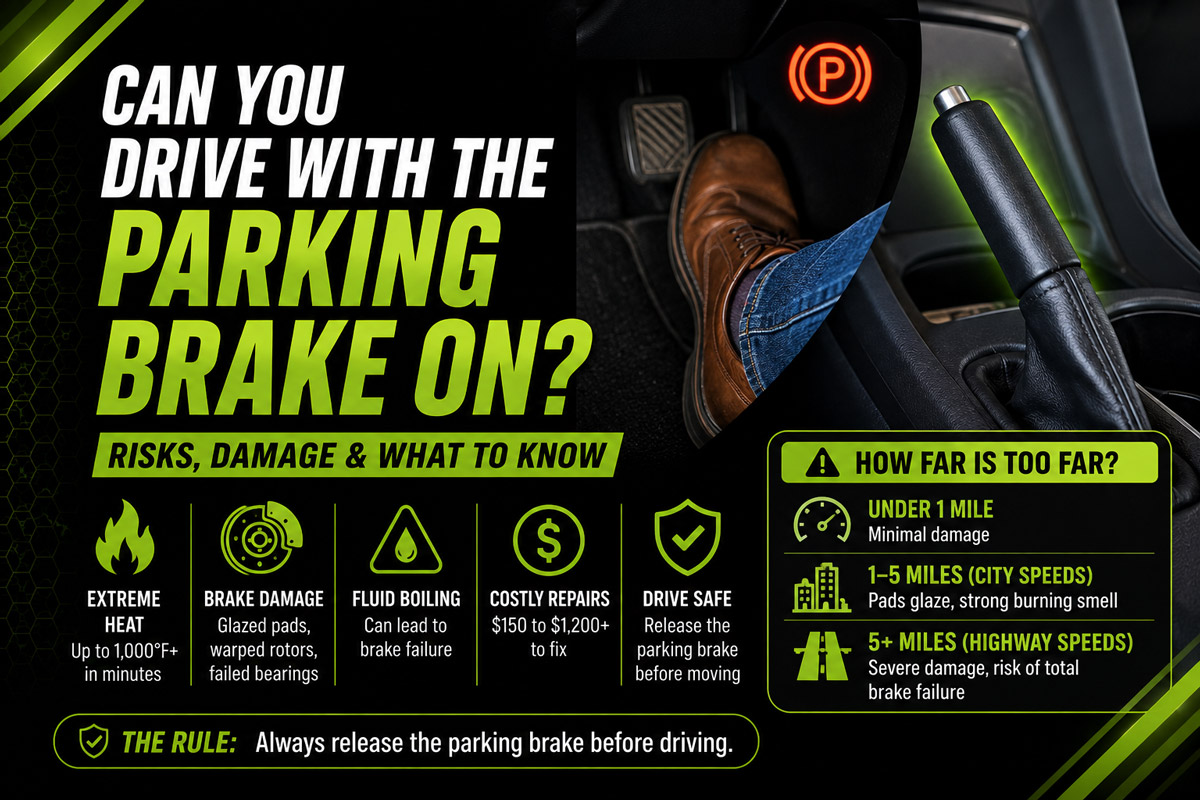
Yes, you can physically drive a vehicle with the parking brake on, because a modern car engine generates more than enough torque to overpower the mechanical resistance of the rear brakes. However, doing so forces the brake friction material to drag continuously against the moving rotors or drums, generating extreme heat that can permanently destroy your braking system in under five miles.
Key Facts / At a Glance
- Temperature spike: Dragging brake pads can push rear hub temperatures past 1,000°F within minutes at highway speeds.
- The 1-Mile Rule: Driving less than one mile at city speeds (under 30 mph) rarely causes permanent damage.
- Electronic fail-safes: Most post-2015 vehicles with Electronic Parking Brakes (EPB) feature “Drive-Away Assist,” which automatically disengages the brake when you press the accelerator.
- Primary failure mode: The most common consequence is “glazing,” where intense heat crystallizes the brake pad surface, eliminating its ability to grip.
- Repair costs: Fixing a cooked rear braking system typically ranges from $150 for basic pad replacement to over $1,200 if calipers and wheel bearings melt.
What Actually Happens When You Drive With the Parking Brake Engaged?
Driving with the parking brake engaged initiates a rapid, catastrophic sequence of thermal events inside your rear wheel hubs. Unlike the primary hydraulic brakes that clamp all four wheels when you press the brake pedal, the parking brake is an isolated mechanical or electronic system that exclusively locks the rear wheels. When the engine forces those locked wheels to turn, the resulting kinetic friction triggers a specific damage timeline.
- Friction and Drag: The parking brake cable (or electric actuator) keeps the brake pads pressed tight against the spinning rotor or brake drum. The car feels sluggish, requiring heavier throttle to maintain normal speeds.
- Thermal Runaway (600°F – 1,000°F+): Because the brakes are never released to cool in the ambient air, heat compounds exponentially. Within 60 seconds at highway speeds, the metal components exceed 600°F.
- Friction Material Glazing: At extreme temperatures, the resins inside the semi-metallic or ceramic brake pads melt and crystallize. This “glazes” the pad, turning a rough, high-friction surface into a smooth, glassy mirror that cannot grip the rotor.
- Rotor Warping: The cast-iron brake rotors or drums expand unevenly under the intense, continuous heat. This warping causes severe steering wheel or brake pedal pulsation during future stops.
- Fluid Boiling (Total Failure Risk): Heat transfers from the brake caliper directly into the hydraulic brake lines. Standard DOT 3 brake fluid boils at 401°F (when fresh). Once the fluid boils, gas bubbles form in the hydraulic lines. Because gas is compressible (and fluid is not), stepping on the main brake pedal will push it straight to the floor with zero stopping power.
Expert Insight: Many modern SUVs use a “drum-in-hat” rear brake design. The main rear disc stops the car, but a tiny, hidden drum brake inside the center hub acts solely as the parking brake. If you cook a drum-in-hat system, your main brakes will feel completely normal, but your parking brake will internally disintegrate.
How Far Can You Drive With the Parking Brake On Before Damage Occurs?
The exact distance required to destroy rear brake components depends entirely on vehicle speed and how firmly the brake lever was applied.
- Under 1 Mile (Low Speed): Minimal to zero damage. The brake pads will shave off a microscopic layer of friction material, but temperatures will not reach the glazing threshold. The parking brake cable may require a minor tension adjustment.
- 1 to 5 Miles (City Speeds): Moderate damage. You will likely smell a strong, acrid burning odor (similar to a burning carpet or chemical fire). The outer layer of the brake pads has glazed. Depending on pad thickness, a mechanic may be able to sand the glaze off, but replacement is usually recommended.
- 5+ Miles or Highway Speeds: Severe damage. Driving at 65 mph with dragging brakes generates enough thermal mass to melt caliper piston seals and cook the grease inside the rear wheel bearings. Expect to replace pads, rotors, and potentially calipers.
How Do Different Parking Brake Types Affect the Risk?
The physical design of your vehicle’s parking brake dictates how easy it is to accidentally leave engaged.
| Brake Type | Location | Engagement Mechanism | Risk of Accidental Driving |
| Mechanical Lever | Center console | Pulling a steel cable via a ratcheting handbrake. | High. Drivers frequently lower the lever 90% of the way down. The dashboard warning light turns off, but the cable retains enough tension to drag the pads. |
| Foot Pedal | Far left floorboard | Pressing a small pedal; released by a secondary pull-handle. | High. Completely out of the driver’s line of sight. Highly susceptible to being forgotten if the dashboard warning light bulb burns out. |
| Electronic (EPB) | Center console switch | Electric motors on the rear calipers clamp the pads directly. | Low. Modern EPB systems feature Drive-Away Assist, automatically releasing the motors the moment the driver shifts into Drive and touches the gas. |
FWD vs. RWD: Does the Drivetrain Matter?
The vehicle’s drivetrain drastically alters how the car behaves when you drive with the parking brake on, even though the parking brake always applies to the rear wheels.
Front-Wheel Drive (FWD): In a FWD car, the engine pulls the front wheels, while the rear wheels are effectively dead weight. If the parking brake is fully engaged, the rear wheels may lock up completely and skid across the pavement. The driver will immediately notice the severe drag, hear the tires squealing, and likely stop before mechanical heat damage occurs (though the tires will develop flat spots).
Rear-Wheel Drive (RWD): In a RWD car, the engine sends power directly to the rear wheels via the driveshaft. The engine will easily overpower the parking brake’s grip. The wheels will turn, fighting the clamped brake pads every single rotation. RWD vehicles are at a much higher risk for catastrophic heat damage because the vehicle will still drive relatively smoothly, masking the fact that the rear brakes are disintegrating.
What Are the Symptoms of Parking Brake Damage?
If you suspect you have driven with the brake on, pull over safely and immediately assess the vehicle for these four thermal indicators.
- The Smell: A sharp, sulfurous “rotten egg” or burning chemical odor emanating from the rear wheel wells.
- The Visual: Visible smoke billowing from the rear wheels. If you see smoke, the brake fluid is dangerously close to boiling.
- The Sound: A continuous metallic grinding, squealing, or chattering noise from the rear axle that changes pitch with vehicle speed.
- The Feel: The car struggles to coast. When you take your foot off the accelerator, the vehicle rapidly decelerates as if you are lightly pressing the brake pedal.
Expert Insight: Never touch the wheel rim or the brake rotor to check for heat after a suspected dragging incident. Rotors can easily exceed 800°F and will cause instantaneous third-degree burns. Instead, hold your bare hand about three inches away from the wheel spokes; if the brakes are cooked, you will feel a blast of radiant heat comparable to an open oven door.
How Much Does It Cost to Fix Parking Brake Damage?
Repairing parking brake damage is rarely limited to a single component. Heat transfers through connected metal, meaning a severely overheated brake pad often takes the rotor and caliper down with it.
| Component Damaged | Typical Repair Cost | Labor Time | Damage Mechanism |
| Brake Pads / Shoes | $150 – $350 | 1.0 Hour | Friction material glazes over, cracks, or completely disintegrates off the steel backing plate. |
| Brake Rotors / Drums | $300 – $600 | 1.5 Hours | Extreme temperature fluctuations cause the cast iron to warp, groove, or develop heat-check cracks. |
| Brake Calipers | $600 – $1,200 | 2.0 Hours | Radiant heat melts the internal square-cut rubber seals, causing hydraulic fluid leaks and seized pistons. |
| Wheel Bearings | $400 – $800 | 2.5 Hours | Heat transferring through the hub assembly liquefies the packed grease, destroying the bearing rollers. |
| Parking Brake Cable | $150 – $300 | 1.5 Hours | Continuous tension against the engine’s torque causes the braided steel cable to permanently stretch out of specification. |
How to Test Your Parking Brake After an Incident
If you caught your mistake early (under 1 mile) and want to verify if your parking brake system survived, perform the industry-standard “Hill Test” once the vehicle has completely cooled down (wait at least two hours).
- Locate a safe incline: Find a steep driveway or a quiet, sloped residential street.
- Hold the vehicle: Press firmly on the main hydraulic foot brake.
- Shift to Neutral: Move the transmission into Neutral (N).
- Apply the parking brake: Pull the handbrake lever up firmly or press the EPB button.
- Release the foot brake: Slowly lift your foot off the main brake pedal.
- Pass: The vehicle remains perfectly stationary. The parking brake retains sufficient holding power.
- Fail: The vehicle creeps or rolls downhill. The brake pads are glazed, or the tension cable has permanently stretched. Schedule a mechanic inspection immediately.
Frequently Asked Questions
Can you use the parking brake to stop if your main brakes fail?
Yes, but only in an absolute emergency. The parking brake is mechanically independent of the hydraulic system. If your brake pedal goes to the floor, gradually pull the handbrake lever up while keeping the release button pressed to prevent it from locking completely, which would cause the vehicle to spin out.
Why didn’t my dashboard warning light come on?
The dashboard “BRAKE” light relies on a simple, inexpensive contact switch located at the base of the handbrake lever. If dirt, spilled coffee, or corrosion fouls this switch, the light will not illuminate even if the brake is fully engaged.
Will an electronic parking brake (EPB) automatically engage if I lose power?
No. Electronic parking brakes require 12-volt battery power to actuate the caliper motors. If your vehicle’s alternator dies or the battery completely drains while driving, the EPB will remain in its current state (disengaged). Conversely, if the battery dies while parked, you cannot release the EPB to tow the vehicle without applying external jumper power.
Do manual transmission cars suffer worse damage?
Manual transmission drivers rely heavily on the handbrake for hill-starts to prevent rolling backward. Because manual drivers use the handbrake dynamically while the engine is applying torque, they are actually less likely to forget it’s engaged. However, if a manual driver does cook their rear brakes, they lose their primary safety net for steep parking, requiring them to leave the car in 1st gear or Reverse as a failsafe.