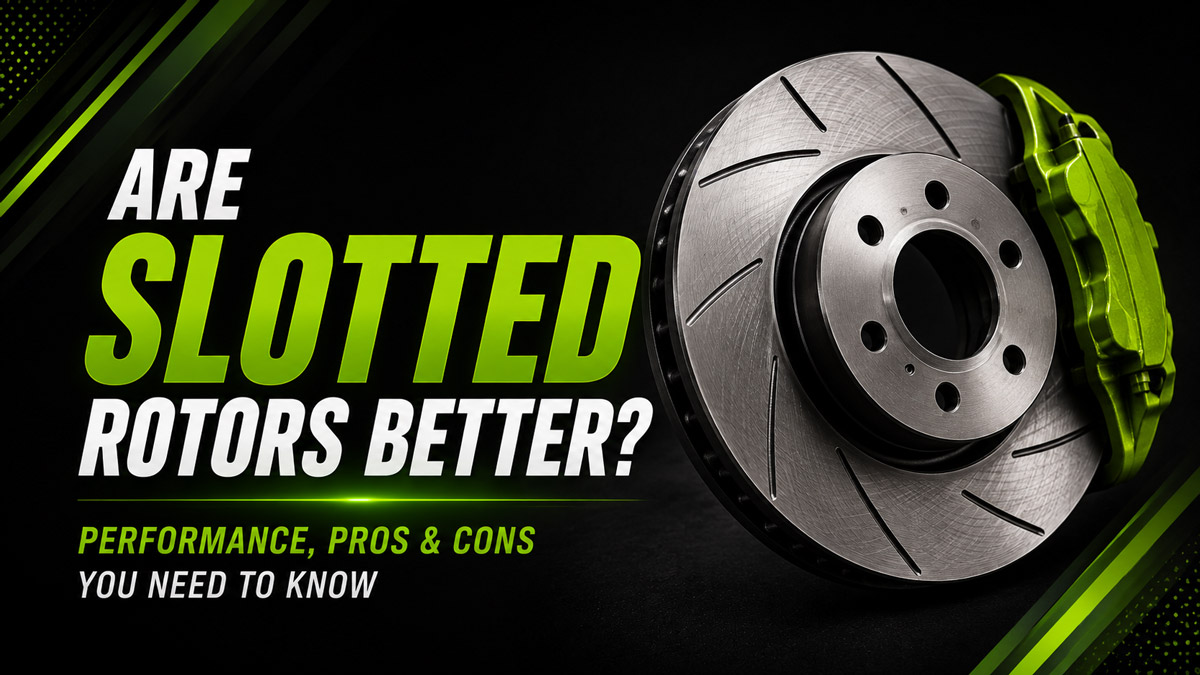
Slotted brake rotors are significantly better than standard blank rotors for sustained heavy braking environments like track racing and heavy towing, as they prevent severe thermal fade by venting pad gases. However, slotted rotors provide no measurable stopping distance advantage for daily street commuting and unnecessarily accelerate brake pad wear.
At a Glance: Slotted vs. Blank Rotors
- Fade Resistance: Grooves vent outgassing, delaying thermal fade at extreme temperatures.
- Pad Wear: Slotted designs accelerate brake pad consumption by 20% to 30%.
- Initial Bite: Extra leading edges increase the initial friction coefficient ($\mu$) by 10% to 15%.
- Thermal Reduction: Surface slots provide 0% direct thermal reduction; cooling relies on internal vanes.
- Street Value: Modern ceramic pads do not outgas significantly, making slots largely aesthetic for daily drivers.
How Do Slotted Rotors Improve Braking Performance?
Slotted rotors improve braking performance by venting trapped friction gases and increasing the initial bite coefficient by 10% to 15%. The machined grooves act as an evacuation channel across the face of the rotor. When aggressive brake pads reach extreme temperatures, they release binding gases—a phenomenon known as outgassing. The slots provide a physical escape route for this gas, preventing it from forming a pneumatic cushion that pushes the brake pad away from the disc surface.
Simultaneously, the edges of the machined slots create multiple leading edges. As the rotor spins, these sharp boundaries continuously strike the brake pad material. This interaction yields a firmer, more immediate pedal feel the moment the driver applies pressure. Furthermore, the slots scrape away glazed friction material and water, ensuring a consistently clean contact patch between the pad and the iron surface.
Do Slotted Rotors Run Cooler Than Blank Rotors?
No, standard slotted rotors provide zero percent direct thermal reduction and do not run cooler than plain blank rotors. Operating temperatures are dictated entirely by the internal cooling vanes cast into the center of the rotor, not by surface modifications. While the slots assist in managing the byproducts of heat—specifically pad outgassing—they do not physically lower the temperature of the iron mass.
In fact, machining slots into a rotor slightly reduces the overall thermal mass of the disc compared to a solid blank. Less iron means the rotor has marginally less capacity to absorb and dissipate kinetic energy converted into heat. Automotive engineers rely on directional internal vane designs (such as curved or pillar vanes) to pump cooling air outward through the rotor structure. The surface slots strictly manage friction surface integrity, leaving the internal vanes to handle the actual thermal shedding process.
Do Slotted Rotors Wear Brake Pads Faster?
Yes, slotted rotors systematically accelerate brake pad wear by 20% to 30% compared to standard blank rotors. The physical mechanism that provides increased initial bite also acts as a highly effective cheese grater against the friction material. Every time the brake pedal is depressed, the sharp leading edges of the slots shave a microscopic layer off the surface of the brake pad.
This continuous scraping prevents the pad from glazing over under high heat, which maintains optimal friction but guarantees a shorter lifespan for the hardware. Drivers who transition from plain flat discs to grooved components often find themselves replacing their brake pads thousands of miles sooner. The severity of the wear depends heavily on the pad compound; aggressive metallic track pads will withstand the abrasion better than softer organic compounds, but all pad types will experience accelerated degradation on a slotted surface.
Which Direction Should Slotted Rotors Be Installed?
Slotted brake rotors must be installed based on the orientation of their internal cooling vanes, not the visual direction of the exterior slots. If the rotor features curved internal directional vanes, those vanes must lean toward the rear of the vehicle at the top of the rotation. This backward-sweeping orientation allows the internal structure to function as a centrifugal pump, drawing cool air from the center hub and expelling hot air outward.
If the internal vanes are straight pillar designs, the rotors are generally non-directional from a cooling standpoint. In this scenario, manufacturers dictate that the exterior slots should sweep backward (toward the rear of the car) from the inner hub to the outer edge. Installing directional rotors backward disrupts the internal airflow, trapping heat inside the iron core and leading to rapid, catastrophic brake fade during high-speed decelleration. Always consult the specific manufacturer’s left/right casting stamps before mounting.
Are Slotted Rotors Good For Daily Street Driving?
Slotted rotors are a poor value for daily street driving and provide virtually no measurable performance benefit for standard commuting. Under normal traffic conditions and legal highway speeds, standard braking systems simply do not generate the extreme temperatures required to induce pad outgassing. Because they do not drastically shorten stopping distances on an initial cold stop, the primary functional benefit of the grooves goes entirely unused.
Furthermore, modern automotive brake technology has evolved. Contemporary street vehicles utilize high-end ceramic and low-metallic brake pads that are chemically formulated to prevent outgassing altogether. By pairing a modern, non-outgassing street pad with a slotted disc, the driver gains no structural advantage while voluntarily sacrificing 30% of their brake pad longevity. For the vast majority of commuter vehicles, plain blank iron discs offer the safest, quietest, and most economically sensible braking solution.
Are Slotted Rotors Better For Extreme Endurance Racing?
Ironically, slotted rotors are not always better for extreme endurance racing, and many professional teams actively prefer heavy-duty plain blank rotors. While weekend track day enthusiasts rely on slots to prevent fade during 20-minute sessions, the physics change during continuous 12-to-24-hour heat cycling. Under punishing endurance conditions, the machined edges of the slots become structural stress points that invite microscopic surface cracking.
Endurance racing heavily features “the economy paradox.” Professional teams often find it significantly more reliable and cost-effective to burn through and discard multiple sets of $40 high-carbon blank rotors than to risk premature failure with expensive $200 slotted variants. A cracked rotor requires an immediate pit stop and a lengthy caliper removal, which ruins race positioning. Blank rotors provide the maximum possible thermal mass and zero artificial stress risers, making them the most structurally sound option for non-stop, 24-hour abuse.
Are Slotted Rotors Good For Off-Roading and Deep Mud?
No, slotted rotors are highly detrimental for deep mud and severe off-road conditions. In an environment saturated with sharp silica, fine rocks, and dense clay, the surface grooves act as catchments rather than clearing mechanisms. As the wheel submerses in thick mud, debris packs tightly into the slots and hardens against the extreme heat of the braking system.
Once debris is trapped within the groove, it is continuously dragged against the brake pad during every rotation. This embedded grit acts like heavy-grit sandpaper, rapidly scoring the rotor surface and destroying both the pad and the iron face. Off-road vehicles subjected to deep mud bogging or desert silt running perform vastly better with plain blank rotors, which offer a smooth surface that allows wiper seals and pads to effectively squeegee debris away from the braking zone.
Can You Use Ceramic Brake Pads With Slotted Rotors?
Yes, you can physically use ceramic brake pads with slotted rotors, but doing so largely defeats the engineering purpose of the slots. The historical justification for grooved discs was to vent the heavy outgassing produced by older organic brake compounds. Modern high-quality ceramic friction materials barely outgas at all, even under heavy loads, eliminating the need for a physical escape channel on the iron surface.
When ceramic pads are paired with a slotted face, the driver sacrifices the longevity of the expensive ceramic compound purely for vehicle aesthetics. The slots will still provide a slight increase in initial pedal bite, but the continuous abrasive scraping will chew through the dense ceramic material prematurely. For drivers utilizing modern ceramic pad compounds, high-carbon blank rotors provide superior longevity, quieter operation, and equal stopping power for standard applications.
Are Drilled and Slotted Combo Rotors the Ultimate Upgrade?
No, drilled and slotted combination rotors are generally considered the worst of both worlds for actual performance, despite their aggressive visual appeal. Combining both modifications on a single iron disc severely reduces the total surface area available for proper heat sinking. Less surface area directly translates to a lower thermal capacity, making the brakes easier to overheat under sustained aggressive driving.
More importantly, combo rotors retain the exact same structural vulnerability as fully drilled rotors. The drilled holes create massive stress risers throughout the iron structure. When subjected to rapid heating and cooling cycles on a canyon road or racetrack, spiderweb cracks inevitably form around the holes and connect to the adjacent slots. These rotors are primarily sold for visual style to fill the negative space behind open-spoke wheels, not for measurable competitive lap times.
Do Slotted Brake Rotors Make Clicking or Whirring Noises?
Yes, slotted brake rotors consistently generate a rhythmic clicking, whirring, or humming noise under moderate-to-heavy braking. Automotive technicians often describe the sound as similar to a playing card flapping in bicycle spokes. This acoustic phenomenon is completely normal and is caused by air and microscopic pad material being violently forced into the slots as they pass underneath the brake caliper assembly.
The volume of this whirring noise scales directly with vehicle speed and pedal pressure. During light braking at parking lot speeds, the noise is usually imperceptible. However, during a rapid deceleration from highway speeds, the compressed air trapped between the pad and the groove produces a distinct, audible drone in the cabin. Drivers seeking a completely silent luxury ride should avoid grooved discs and opt for smooth blank alternatives.
Can You Turn or Resurface Slotted Rotors?
Yes, slotted rotors can be resurfaced on a standard brake lathe, but the process requires strict conditions and experienced technical execution. Unlike blank rotors, which can be machined quickly, grooved discs require the technician to take very shallow, slow cuts. If the lathe bit is fed too aggressively, it will catch on the sharp edges of the slots, causing the machine to chatter and potentially chipping the expensive carbide cutting tip.
Furthermore, resurfacing is only mathematically viable if the rotor thickness remains above the manufacturer’s minimum stamp after the procedure. Because slotted rotors wear faster and often develop subtle lips, they frequently reach their minimum safe thickness before their second set of pads is worn out. If the depth of the slots becomes shallow or disappears entirely after a lathe pass, the rotor has fallen below minimum safety specifications and must be discarded.
What Are the Signs a Slotted Rotor Needs Replacement?
A slotted brake rotor requires immediate replacement when the machined grooves visually disappear or become dangerously shallow. The original depth of the slot serves as a built-in wear indicator; when the iron face wears down to the bottom of the groove, the rotor has typically exceeded its minimum safe operating thickness. Continuing to drive on a rotor in this state risks catastrophic heat cracking or complete structural failure of the disc.
Additionally, drivers must inspect the edges of the slots for heat checking—a network of microscopic, hairline cracks radiating outward from the groove. While minor surface crazing is normal on track vehicles, any crack that catches a fingernail or extends to the outer edge of the rotor demands immediate replacement. Severe steering wheel vibration under braking, known as pulsation, also indicates uneven pad deposits or disc thickness variation that warrants new hardware.
The Bottom Line
Slotted brake rotors are highly specialized components engineered to prevent thermal pad fade and increase initial bite for track vehicles and heavy tow rigs. They accomplish this by venting outgassing and scraping the pad surface, which unfortunately accelerates pad wear by up to 30% and generates audible whirring noises under heavy braking. Because modern ceramic pads do not outgas significantly, paying a premium for slotted hardware on a daily street commuter sacrifices durability for zero measurable improvement in daily stopping distance.