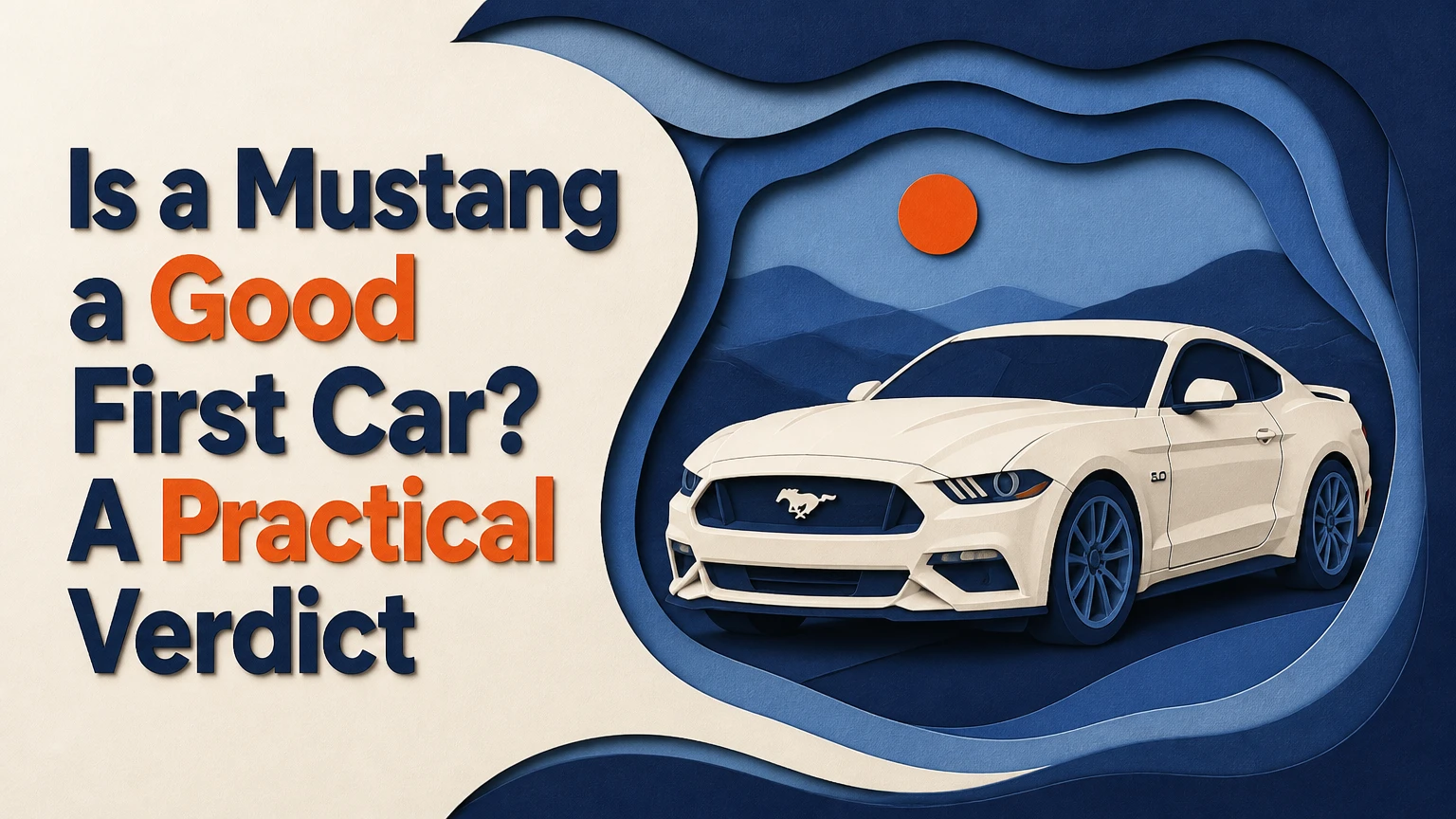
A Ford Mustang can be a first car for a disciplined, financially prepared driver, but it is not the best first car for most inexperienced motorists. The automatic EcoBoost is the most manageable version, while a Mustang GT, heavily modified example, or rear-wheel-drive car used in severe winter weather creates substantially higher risk, cost, and learning demands.
Key Facts at a Glance
A Ford Mustang is a rear-wheel-drive performance coupe or convertible, not a conventional beginner hatchback or sedan.
The turbocharged EcoBoost is more suitable for a novice than the 5.0-liter V8 Mustang GT, but it still has enough torque to overwhelm poor tires or careless throttle use.
A first-time owner should obtain an insurance quote using the exact VIN before buying, because age, location, driving record, and trim can change the premium substantially.
Electronic stability control helps a Mustang recover from some traction loss, but it cannot overcome bald tires, excessive speed, standing water, or reckless throttle input.
A used Mustang should have an independent inspection, stock or professionally documented modifications, four matching tires, and complete maintenance records.
Drivers who need low running costs, easy winter traction, or maximum practicality will usually be better served by a Honda Civic, Toyota Corolla, Mazda3, or similar front-wheel-drive car.
Is a Mustang a Good First Car for a New Driver?
A Mustang is a reasonable first car only when the driver has strong self-control, can afford performance-car ownership, and drives mostly on predictable roads. A standard commuter car remains the better default because it usually has gentler power delivery, lower insurance, better outward visibility, easier parking, and fewer consequences when a beginner makes a mistake.
The answer changes by trim and generation. A recent automatic EcoBoost with good all-season or summer tires is much easier to manage than a GT, Shelby, older V8, or modified car with a tune. A careful driver can learn in an EcoBoost, but “manageable” does not mean “forgiving.”
The strongest case against a Mustang is not that every example is inherently unsafe. Modern Mustangs include airbags, stability control, traction control, anti-lock brakes, and available driver-assistance features. The problem is that rear-wheel drive, substantial torque, wide tires, and a powerful accelerator give a novice more ways to exceed available grip.
What Kind of Car Is a Ford Mustang?
The Ford Mustang is a rear-wheel-drive American pony car introduced for the 1965 model year after its April 1964 launch. The formula combines a long hood, compact rear cabin, sporty styling, and engine choices ranging from efficient turbocharged four-cylinders to high-output V8s.
The current gasoline Mustang family includes the S550 generation, sold from 2015 through 2023, and the S650 generation, introduced for 2024. Body styles, engines, infotainment systems, safety equipment, and suspension tuning vary by model year, so “Mustang” does not describe one uniform driving experience.
A Mustang is usually sold as a fastback coupe or convertible. The fastback provides more usable cargo space than the rear seats suggest, but the sloping roof and thick rear pillars still restrict visibility compared with a Civic sedan or Corolla hatchback.
Why Is Rear-Wheel Drive Harder for Beginners?
Rear-wheel drive makes a Mustang more sensitive to throttle input during cornering because the rear tires both propel the vehicle and must preserve lateral grip. When acceleration demand exceeds the tires’ available traction, the rear can step outward, producing oversteer that a novice may not know how to correct.
Front-wheel-drive cars generally pull the vehicle through a corner. A careless driver can still lose control, but lifting off the accelerator often reduces the front tires’ workload and slows the car’s response. In a Mustang, abruptly adding power on a wet bend can produce a faster and less intuitive change in direction.
Traction control and electronic stability control reduce risk by cutting engine torque or applying individual brakes. They are safety nets, not permission to experiment. The Mustang’s owner manual warns drivers to avoid abrupt maneuvers and to reduce speed when road conditions are slippery; that advice matters more than the car’s electronic settings.
Practitioner rule: assume a rear-wheel-drive car has less usable grip in a wet corner than its straight-line acceleration suggests. Enter slowly, make smooth steering inputs, and accelerate only after the car is substantially straight.
Which Mustang Engine Is Best for a First Car?
The automatic EcoBoost is the most suitable gasoline Mustang configuration for a beginner because its turbocharged four-cylinder uses less fuel and produces less peak power than a GT. The EcoBoost remains a performance car, however, and its suitability depends on tires, insurance, weather, and the driver’s restraint.
| Mustang version | Typical power range | Drive layout | Beginner assessment |
|---|---|---|---|
| 2015-2017 V6 | 300-305 hp | Rear-wheel drive | Affordable used option, but limited driver aids and older condition |
| 2015-2023 EcoBoost | 310-330 hp | Rear-wheel drive | Most sensible Mustang starting point |
| 2024-present EcoBoost | 315 hp | Rear-wheel drive | Modern cabin and safety technology, still torque-rich |
| 2015-2023 GT | 435-460 hp | Rear-wheel drive | Excessive performance for most novices |
| 2024-present GT | 480-486 hp | Rear-wheel drive | Capable and fast, poor default choice for a beginner |
| Shelby GT350 or GT500 | 526-760 hp | Rear-wheel drive | Specialist performance car, not a first-car recommendation |
Horsepower figures vary by model year, transmission, market, and emissions specification. The 2.3-liter EcoBoost’s turbocharged torque can arrive early in the rev range, so the driver does not need to reach high engine speed to spin the rear tires.
The V8 GT adds faster acceleration, greater fuel consumption, higher tire demand, and usually higher insurance exposure. A novice who says they will “drive it gently” may still encounter wheelspin during a wet merge, an emergency maneuver, or an enthusiastic corner exit.
Is a Mustang GT Too Powerful for a First Car?
A Mustang GT is too powerful for most first-time drivers because approximately 450-486 horsepower can turn small throttle errors into rapid speed or rear-tire spin. Experienced drivers can manage a GT, but a learner lacks the practiced steering, vision, braking, and throttle responses that performance driving requires.
The risk is behavioral as much as mechanical. A V8 soundtrack, rear-wheel drive, and strong acceleration invite demonstrations for passengers or experiments on public roads. Public-road testing leaves no safe runoff area, and stability control cannot guarantee recovery after a high-speed mistake.
A GT becomes more defensible after formal training, several seasons of ordinary driving, and a budget that covers premium tires, brakes, fuel, insurance, and unexpected repairs. A performance-driving school or autocross can teach car control in a controlled environment, but training does not make street racing safe or legal.
Should a First-Time Owner Choose Automatic or Manual?
An automatic Mustang is usually the better first-car choice because it removes clutch coordination and lets a new driver concentrate on braking, steering, traffic scanning, and smooth throttle control. A manual transmission can be rewarding, but it adds workload and creates an expensive learning mistake if the clutch is repeatedly overheated or slipped.
| Transmission | Typical Mustang availability | Beginner workload | Ownership consideration |
|---|---|---|---|
| 10-speed automatic | EcoBoost and GT, modern generations | Low during traffic | Easier commuting, but more complex automatic service |
| Six-speed manual | EcoBoost in some years, GT widely available | High during starts and hills | Clutch wear depends heavily on driver technique |
| Older five-speed manual | Earlier used generations | High | Condition and clutch history matter more than advertised mileage |
| Automatic with paddle control | Most recent automatics | Moderate when manually selected | Useful for engine braking without clutch operation |
A manual transmission does not automatically make a Mustang safer. It can reduce casual acceleration because shifting requires intent, yet a rushed downshift or wrong gear can unsettle the car. Choose manual because you genuinely want to learn it, not because the transmission is assumed to protect an inexperienced driver.
How Much Does a Mustang Cost as a First Car?
A Mustang’s purchase price is only the first cost; a realistic owner budget must include insurance, fuel, tires, brakes, registration, service, and an emergency reserve. Typical used prices vary by country, mileage, accident history, trim, and import duties, so a local VIN-specific quote matters more than a global listing average.
| Ownership item | Typical EcoBoost range | Typical GT range | Timing or basis |
|---|---|---|---|
| Used purchase price in the USA | $16,000-$30,000 | $25,000-$45,000 | Clean 2015-2020 examples, market-dependent |
| Fuel economy | 21-25 city, 29-32 highway mpg | 15-18 city, 23-25 highway mpg | EPA figures vary by year and transmission |
| Four performance tires | $600-$1,200 | $800-$1,600 | Brand, size, and compound determine price |
| Front and rear brake service | $500-$1,200 | $700-$1,800 | Parts and labor vary by rotor and caliper package |
| Oil and filter service | $80-$180 | $100-$220 | Typical independent-shop pricing |
| Emergency reserve | $1,500-$3,000 | $2,000-$4,000 | Recommended cash buffer for used ownership |
Insurance is the largest unknown for a young driver. Insurers price the exact vehicle, driver age, address, annual mileage, claims record, coverage limits, deductible, and sometimes credit history. A 20-year-old in a GT may receive a dramatically different quote from a 35-year-old in an EcoBoost, even when both cars have similar purchase prices.
Request quotes before placing a deposit. Include comprehensive and collision coverage, not only the minimum legal liability, if a lender finances the Mustang.
What Maintenance Does a Mustang Need?
A Mustang generally needs oil service around 5,000-7,500 miles under normal conditions, with shorter intervals sensible for severe use, frequent short trips, extreme temperatures, or track driving. Tire pressure, tread depth, brake condition, battery health, cooling systems, and fluid leaks deserve inspection at every service visit.
| Maintenance item | Typical interval | First-car owner action | Why it matters |
|---|---|---|---|
| Engine oil and filter | 5,000-7,500 miles | Follow the year-specific Ford schedule | Protects turbocharger or V8 lubrication |
| Tire rotation and pressure check | 5,000-7,500 miles | Check monthly and before trips | Uneven rear wear reduces wet grip |
| Brake inspection | Every oil service | Measure pad and rotor thickness | Performance trims use costly consumables |
| Alignment inspection | Annually or after impacts | Check if steering pulls | Incorrect toe can destroy tires quickly |
| Coolant and hose inspection | Every service | Look for leaks or residue | Overheating can cause major engine damage |
| Transmission service | Schedule-dependent | Verify records by VIN and manual | Neglected fluid can worsen shift quality |
Rear tires may last 20,000-30,000 miles in ordinary use, but aggressive launches, poor alignment, cheap compounds, and hard driving can shorten that dramatically. Replacing only one rear tire can create grip differences, so use a matched axle pair and follow the tire manufacturer’s replacement guidance.
Is a Mustang Safe for a Beginner?
A modern Mustang has important passive and electronic safety equipment, but safety ratings and standard features differ by year, trim, and market. A beginner should verify crash-test results from the Insurance Institute for Highway Safety or the National Highway Traffic Safety Administration for the exact model year rather than generalizing across the entire Mustang nameplate.
Available features may include blind-spot monitoring, rear cross-traffic alert, forward collision warning, automatic emergency braking, lane-keeping assistance, a rear camera, and parking sensors. Older base cars may lack some of these systems, while imported or modified vehicles can have different equipment.
A rear camera helps with the Mustang’s limited rear visibility, but it does not eliminate blind spots. A novice should physically check mirrors and shoulder areas, especially when changing lanes beside motorcycles or small vehicles.
Important distinction: crash protection and accident avoidance are separate. A Mustang can protect occupants well in a tested crash while still being harder to control on a wet road than a lower-powered front-wheel-drive sedan.
Is a Mustang Good in Rain or Snow?
A Mustang can be driven in rain with appropriate tires and conservative speeds, but rear-wheel drive makes snow, ice, standing water, and mud more demanding than ordinary commuting conditions. For frequent winter use, a front-wheel-drive or all-wheel-drive vehicle with dedicated winter tires is usually the more forgiving first car.
Summer tires lose cold-weather grip well before snow appears. All-season tires improve versatility, while true winter tires use softer compounds and tread patterns designed for low temperatures. All-wheel drive helps a vehicle accelerate, but it does not shorten braking distance on ice.
Before winter, check tire tread, battery capacity, windshield visibility, washer fluid freeze protection, and the stability-control system. Never disable stability control on public roads to create a slide. If a route regularly includes unplowed roads, steep hills, or freezing rain, select a different vehicle rather than treating driving skill as a substitute for traction.
Is a Mustang Practical for a Student or Commuter?
A Mustang is practical enough for one or two occupants, commuting, and modest luggage, but it is a poor choice for frequent rear-seat passengers, bulky cargo, or easy urban parking. The fastback’s rear seats are best treated as occasional seating, while the convertible sacrifices additional cargo flexibility and adds mechanical complexity.
| Practical feature | Mustang fastback | Mustang convertible | Compact sedan benchmark |
|---|---|---|---|
| Seating capacity | 4 seats | 4 seats | 5 seats |
| Useful passenger assumption | 2 adults plus occasional rear passengers | 2 adults, limited rear comfort | 4-5 adults |
| Cargo volume, recent fastback | Approximately 13.5 cu ft | Approximately 10.3 cu ft | Approximately 14-16 cu ft |
| Rear visibility | Restricted by roof pillars | Restricted with top raised | Usually broader |
| Typical turning and parking effort | Moderate to high | Moderate to high | Low to moderate |
The long hood complicates front-corner judgment, and the low seating position can make curb and driveway clearance less obvious. A new owner should practice parking before carrying passengers and should avoid aftermarket window tint that further reduces nighttime visibility.
Which Mustang Year and Trim Should a Beginner Buy?
A recent automatic EcoBoost with a clean inspection, original safety equipment, and high-quality tires is the strongest Mustang starting point. The ideal year depends on budget, local parts availability, warranty coverage, and the exact condition of the vehicle, because a well-maintained older car can be better than a neglected newer one.
| Buyer priority | More suitable choice | Typical reason | Check before buying |
|---|---|---|---|
| Lowest practical entry cost | 2015-2017 EcoBoost or V6 | Lower listing prices | Turbo, cooling, accident, and service history |
| Newer technology | 2018-2023 EcoBoost Premium | Updated equipment in many markets | A/C performance and infotainment operation |
| Latest cabin and driver aids | 2024-present EcoBoost | S650 interior and current features | Insurance, financing, and tire replacement cost |
| V8 ownership | 2018-present GT | More mature used examples | Rear differential, clutch, tires, and modifications |
| Occasional open-air driving | EcoBoost convertible | Lower output than GT convertible | Roof seals, drains, frame noise, and water leaks |
Treat model-year recommendations as inspection priorities, not automatic guarantees. The 2015-2018 S550 generation is associated in owner and repair discussions with air-conditioning evaporator failures, and some manual cars may exhibit notchy MT82 shifting or high-rpm lockout complaints. These faults do not affect every car, but repairs can be labor-intensive.
What Used Mustang Problems Should a Beginner Check?
A used Mustang purchase should focus first on accident damage, tires, modifications, cooling, air conditioning, transmission operation, and maintenance records. Cosmetic flaws are less important than structural repairs, mismatched tires, warning lights, overheating, or an engine tune that has increased stress without documentation.
Use this inspection sequence:
- Run the VIN. Compare title, accident, mileage, recall, and service records from reputable databases and Ford’s dealer network.
- Inspect the body in daylight. Check panel gaps, paint texture, overspray, uneven tire wear, and underbody impact marks.
- Check all four tires. Confirm matching sizes, adequate tread, no sidewall damage, and a date code that is not excessively old.
- Start the engine cold. Listen for abnormal rattles, observe exhaust smoke, and verify that warning lights perform their normal startup check.
- Test the climate system. Confirm cold air, heat, fan speeds, defrost, and consistent operation across settings.
- Test the transmission. An automatic should shift without harsh engagement; a manual should select every gear without grinding or repeated lockout.
- Scan electronic systems. Test the screen, camera, sensors, windows, locks, lights, and stability-control warnings.
- Pay for an independent inspection. A pre-purchase inspection costing roughly $150-$300 can identify repairs that exceed the inspection fee many times over.
Avoid cars with unexplained rear-end damage, welded subframes, cheap coilovers, cut springs, unknown engine tunes, burnout-style rear-tire wear, or missing catalytic-converter equipment. Modifications are not automatically bad, but undocumented changes reduce predictability and can complicate insurance claims.
What Mistakes Do First-Time Mustang Owners Make?
The most damaging beginner mistakes are buying the highest-power trim, fitting cheap rear tires, disabling stability control, and modifying the car before learning its stock behavior. Each mistake removes a safety margin that a new driver needs.
- Buying by horsepower alone: A GT may be affordable to purchase but unaffordable to insure, fuel, and maintain.
- Ignoring tire quality: A 500-horsepower car on worn budget tires has less usable safety margin than its specification suggests.
- Launching on public roads: Hard acceleration near traffic, curbs, and pedestrians turns a controllable car into a hazard.
- Turning off electronic aids: Keep traction and stability systems enabled during ordinary driving.
- Skipping driver training: A short performance-driving course can teach vision, threshold braking, and skid recovery more safely than trial and error.
- Modifying before inspection: Establish that the stock car is healthy before adding wheels, springs, exhaust, or software.
A counterintuitive point matters here: better brakes do not automatically make a car safer for a beginner. Brembo brakes and a Performance Pack can reduce repeated braking fade, but they cannot compensate for excessive corner-entry speed or poor tire grip.
How Does a Mustang Compare With Alternatives?
A Mustang is the better choice when emotional appeal, rear-wheel-drive handling, and performance matter more than low operating cost or forgiving behavior. A Honda Civic, Toyota Corolla, Mazda3, Volkswagen Golf GTI, Subaru WRX, or Toyota GR86 can better match specific beginner needs.
| Vehicle | Drive layout | Typical power range | Best first-car use | Main compromise |
|---|---|---|---|---|
| Ford Mustang EcoBoost | RWD | 310-330 hp | Enthusiast who wants a coupe | Higher insurance and traction demands |
| Honda Civic | FWD | 158-200 hp | Low-cost daily commuting | Less acceleration and rear-seat space varies |
| Toyota Corolla | FWD | 169-196 hp | Reliability-focused ownership | Less engaging performance |
| Mazda3 | FWD or AWD | 191-250 hp | Premium-feeling daily driving | Rear-seat and cargo limitations |
| Volkswagen Golf GTI | FWD | 241-265 hp | Practical performance hatchback | Higher service complexity |
| Subaru WRX | AWD | 271-276 hp | Wet or snowy performance driving | Fuel, insurance, and ride costs |
| Toyota GR86 | RWD | 228 hp | Learning rear-drive handling | Small cabin and limited utility |
The Civic and Corolla usually win the financial decision. The Mazda3 offers stronger cabin quality without Mustang-level power, while the Golf GTI supplies useful hatchback cargo space. The WRX provides all-wheel-drive traction but remains a performance car with insurance and behavior risks.
The GR86 is a closer philosophical alternative because it also uses rear-wheel drive, but its lower power makes mistakes less explosive. It is still not as forgiving as a typical compact sedan in snow, heavy rain, or inexperienced hands.
Which Drivers Should Buy a Mustang First?
A Mustang suits a confident driver who has a stable budget, dry or well-maintained roads, secure parking, and a willingness to complete driver training. A different first car is preferable when the driver is very young, insurance consumes the budget, winter traction is a daily requirement, or the vehicle must carry several passengers.
The Practical Commuter
Choose a Civic, Corolla, or Mazda3 if the priority is predictable fuel cost, inexpensive tires, easy parking, and dependable daily transport. A Mustang’s styling does not offset recurring insurance and consumable costs when the commute is the only purpose.
The Enthusiast With a Controlled Budget
Choose an automatic EcoBoost after obtaining insurance quotes and setting aside at least $1,500-$3,000 for unexpected used-car repairs. Buy the cleanest unmodified example, not the most powerful one.
The V8 Enthusiast
Delay the GT until you have meaningful driving experience and can pay for premium fuel, high-performance tires, brakes, insurance, and instruction without reducing maintenance spending. A GT should be a deliberate performance purchase, not an impulse first car.
The Snow-Belt Driver
Choose a vehicle with better winter practicality unless the Mustang is a second vehicle or winter-stored. If a Mustang must be used, fit four suitable winter tires, drive slowly, and avoid treating rear-wheel-drive skill as a replacement for road-appropriate equipment.
The Bottom Line
Is a Mustang a good first car? Usually no, but an automatic EcoBoost can be a defensible choice for a mature, careful driver with verified insurance costs, good tires, dry-road needs, and money for maintenance. A Mustang GT, modified example, or daily winter vehicle is a poor first-car decision for most beginners.
The best purchase process is conservative: quote insurance by VIN, compare total monthly ownership cost, inspect the exact car independently, verify tire and service condition, and complete driver training before exploring the car’s performance. If the budget is tight or the roads are routinely slippery, choose a Civic, Corolla, Mazda3, or another forgiving commuter instead.
Frequently Asked Questions
Is a used Mustang reliable enough for a first car?
A used Mustang can be reliable when its maintenance history is complete and modifications are limited, but condition matters more than the badge. Check cooling, air conditioning, transmission operation, differential noise, tire wear, accident repairs, and warning lights. An independent inspection is especially important for turbocharged and V8 versions.
Does a Mustang have enough room for a family?
A Mustang can carry four occupants on short trips, but the rear seats are cramped and difficult for adults to access. The fastback offers useful cargo space for luggage or groceries, while the convertible reduces cargo flexibility. Families needing regular rear-seat use should choose a sedan, hatchback, or SUV.
Is a Mustang convertible a good first car?
A Mustang convertible is a reasonable first car only when open-air driving is worth its added price, weight, visibility compromises, and roof-maintenance requirements. Inspect roof seals, drains, hydraulic operation, water damage, and interior mold. The convertible does not remove the rear-wheel-drive traction risks of the coupe.
Can a teenager safely drive a Mustang EcoBoost?
A teenager can drive an EcoBoost safely only with parental oversight, conservative limits, proper tires, and enough experience to resist showing off. Parents should obtain insurance quotes, use available speed or driving-monitoring settings, prohibit passengers during early practice, and consider a lower-powered front-wheel-drive car first.
Should I buy a Mustang new or used as my first car?
A new Mustang reduces unknown mechanical history and may include warranty protection, but depreciation, financing, and insurance can increase total cost. A used Mustang costs less upfront but requires inspection and a repair reserve. For a first-time owner, a well-documented used EcoBoost is often the balanced option if the inspection is clean.
How much driving experience should I have before buying a Mustang GT?
There is no universal mileage threshold, but a driver should first build experience through multiple seasons, emergency braking practice, wet-road judgment, and consistent accident-free driving. Formal performance instruction is strongly advisable. The ability to control a GT should be demonstrated through restraint and smoothness, not confidence in straight-line acceleration.