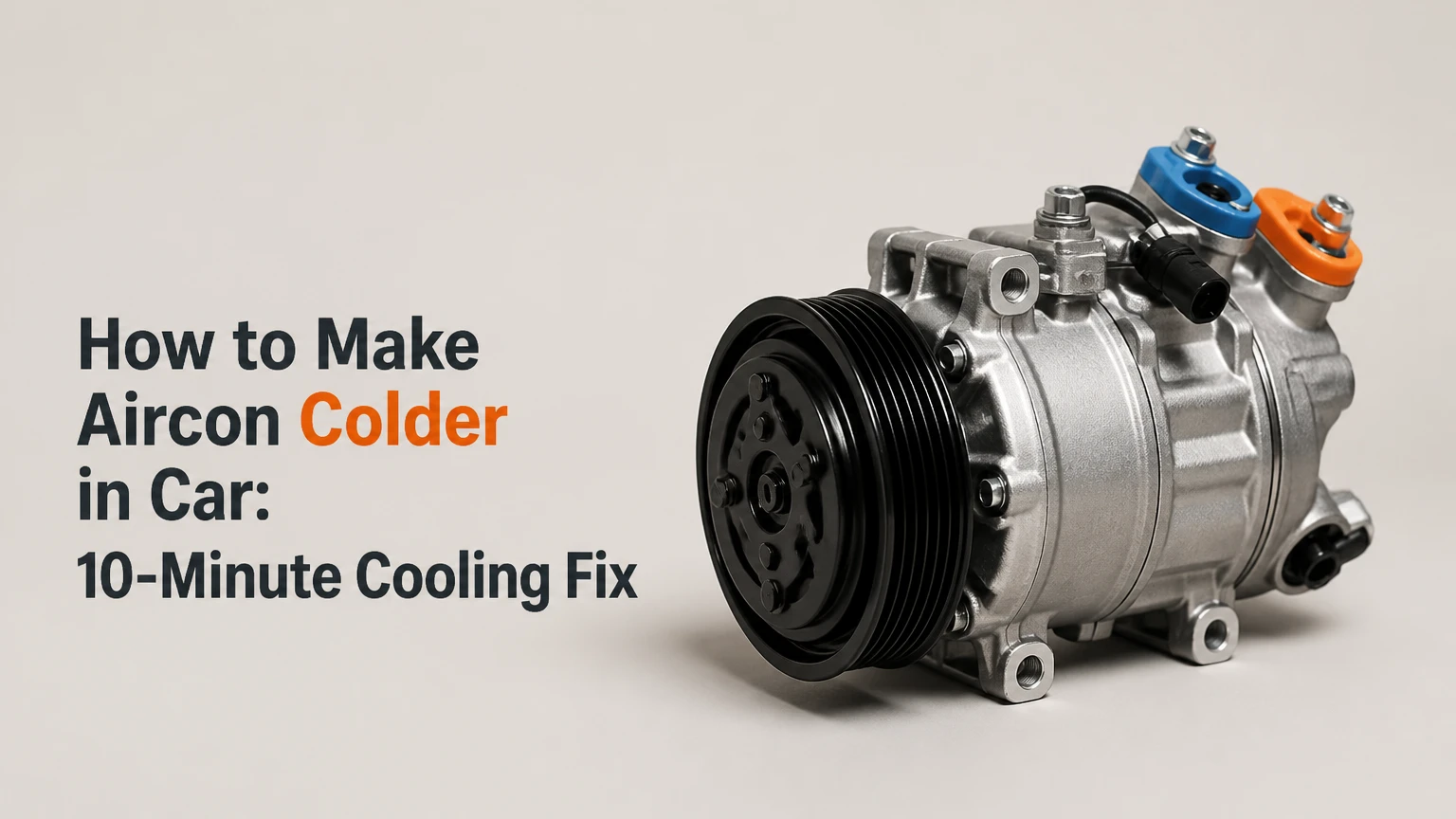
To make aircon colder in a car, expel trapped cabin heat, select maximum cooling with recirculation, reduce heat entering through the glass, and maintain unrestricted airflow across the evaporator. If the car A/C still blows warm, has weak airflow, or becomes warm at idle, the system needs diagnosis rather than colder settings, because controls cannot repair a leak, failed fan, blocked filter, or compressor fault.
Key Facts at a Glance
- Recirculation usually cools a car faster because the evaporator repeatedly processes cabin air instead of hot, humid outside air.
- Opening the windows for approximately 30-60 seconds removes stored heat before the air conditioner works against it.
- A cabin air filter affects airflow volume, not refrigerant temperature. A blocked filter can make cold air feel ineffective.
- A/C refrigerant is charged by weight specified for the vehicle, not by a universal low-side pressure number.
- Cold air at highway speed but warm air at idle commonly indicates condenser airflow trouble, such as a failed electric fan or blocked condenser.
- A car A/C system should not need frequent top-ups. Repeated recharging usually indicates a leak that requires testing.
How Does Car Air Conditioning Make Air Cold?
Car air conditioning removes heat from cabin air through a pressurized refrigerant circuit. The evaporator absorbs heat inside the dashboard, while the condenser releases that heat outside the vehicle; the system also removes water from humid air when the evaporator surface is below the cabin dew point.
The compressor raises refrigerant pressure and temperature. The condenser then rejects heat through airflow at the front of the vehicle, turning the refrigerant into a high-pressure liquid. An expansion valve or orifice tube lowers its pressure, and the resulting cold refrigerant enters the evaporator.
The blower pushes cabin air across the evaporator fins. Heat moves into the refrigerant, which boils into a low-pressure gas and returns to the compressor. A receiver-drier or accumulator manages moisture and refrigerant flow, depending on the system design.
This mechanism explains two practical facts. First, maximum cooling depends on removing heat from the condenser as well as absorbing heat inside the cabin. Second, a colder temperature dial cannot compensate for a blocked evaporator, low refrigerant charge, or non-operating condenser fan.
What Should You Do First to Cool a Hot Car?
Use a short heat-purge sequence followed by maximum cooling and recirculation. The complete procedure normally takes 5-10 minutes, but the first 60 seconds matter most because seats, dashboard materials, glass, and interior trim continue releasing stored heat after the air temperature falls.
Before You Start
| Requirement | Typical value | Practical condition |
|---|---|---|
| Heat purge | 30-60 seconds | Windows open while driving safely |
| Total initial cooldown | 5-10 minutes | Longer in direct sun or high humidity |
| Vehicle setting | MAX A/C or lowest temperature | Engine or drive system operating |
| Air intake | Recirculation after purge | Windows closed |
| Test tool | Digital or dial thermometer | Center vent, not dashboard surface |
| DIY inspection | 10-20 minutes | Filter, vents, and visible condenser only |
Do not leave a child, older person, or animal in a parked vehicle while performing the procedure. Window tint, a windshield shade, and shaded parking reduce the heat load before the A/C is switched on.
Step 1: Vent the Stored Cabin Heat
Open the windows or doors briefly before moving, then drive with the windows open for approximately 30-60 seconds if traffic and weather permit. Use the blower on low or leave the A/C off during the brief purge, because open windows allow conditioned air to escape.
You will know it worked when: air leaving the cabin no longer feels substantially hotter than outdoor air.
Common mistake: Keeping the windows open for several minutes while the A/C runs at maximum. That wastes cooling capacity and can prolong the cooldown.
A parked interior can become far hotter than the surrounding air because sunlight passes through glass and warms interior surfaces. The exact temperature varies with solar intensity, glass area, ventilation, exterior color, and parking duration, so 60°C is a possible extreme rather than a universal cabin temperature.
Step 2: Set Maximum Cooling
Close the windows and select the lowest temperature, MAX A/C, or equivalent setting. Choose the face-level vents initially, because dashboard outlets deliver cooled air directly into the cabin rather than sending it through the warmer floor area.
Set the blower to high during the first cooldown phase. High airflow removes heat from occupants and interior surfaces quickly, although the air may feel less cold at the vent than it does on a lower setting.
You will know it worked when: the center vent begins delivering air noticeably cooler than the cabin within a few minutes.
Common mistake: Selecting AUTO and assuming the system will always choose the fastest strategy. Automatic climate control may use fresh air, moderate blower speed, or a target temperature that feels comfortable but does not maximize initial cooling.
Step 3: Switch to Recirculation
Select recirculation once the windows are closed and the initial hot air has been expelled. Recirculation reuses cabin air, allowing the evaporator to cool air that is progressively less hot and less humid than outside air.
You will know it worked when: the vent output remains cold and the cabin temperature falls steadily rather than leveling off.
Common mistake: Leaving fresh-air mode selected during a hot, humid day. Continuous outside-air intake adds heat and moisture faster than necessary, especially in slow traffic.
Recirculation is not always the correct setting. Use fresh air briefly if the cabin smells of smoke, cleaning chemicals, or exhaust, and use fresh air when windows must be cleared of fog according to the vehicle manual. In many vehicles, defrost mode automatically cancels recirculation to control windshield condensation.
Step 4: Aim the Vents for Occupant Comfort
Aim dashboard vents toward the occupants during the first few minutes, then distribute airflow toward the upper cabin if the vehicle remains uncomfortable in the rear. Cold air is denser than warm air, but vent direction has less effect than solar load, seat material, airflow volume, and recirculation.
You will know it worked when: occupants feel cooler without lowering the temperature setting further.
Common mistake: Pointing every vent at one person while leaving the rear cabin exposed to direct sunlight. Balanced airflow and a windshield shade often improve whole-cabin comfort more than an extreme vent angle.
Reduce the blower one or two levels after the cabin has cooled if the airflow feels harsh or noisy. Lower fan speed can sometimes produce colder measured outlet air because air spends longer near the evaporator, but it does not make the A/C system more efficient in every vehicle and can reduce total heat removal. Do not use low fan speed to hide weak airflow.
Which A/C Settings Are Coldest?
The coldest practical settings are the lowest temperature, recirculation, face vents, and a blower speed high enough to move air effectively. MAX A/C may also close outside-air doors and activate a stronger cooling strategy, but button behavior differs by manufacturer.
| Control | Best initial setting | Why it matters | When to change it |
|---|---|---|---|
| Temperature | Lowest setting | Requests maximum cooling | Raise after occupants are comfortable |
| Intake | Recirculate | Reuses cooler, drier cabin air | Fresh air for odors or fogging |
| Blower | High | Removes cabin heat quickly | Medium after cooldown |
| Outlet | Face vents | Sends cooled air into occupied space | Upper or mixed vents for rear comfort |
| Defrost | Use only as required | Clears glass but may disable recirculation | Return to face mode after glass clears |
| AUTO climate | Lowest target initially | Lets sensors regulate the system | Use after cabin reaches target temperature |
An automatic climate-control system can be colder than manual operation when its sunload sensor, cabin sensor, and evaporator controls function correctly. If AUTO produces lukewarm air while manual MAX A/C performs better, inspect sensor readings and HVAC actuator operation rather than assuming the refrigerant is low.
How Can You Check Whether the A/C Is Performing Correctly?
Measure center-vent temperature under repeatable conditions instead of judging performance only by hand. Park in shade when possible, run the engine at approximately 1,500-2,000 rpm, close the windows, select MAX A/C and recirculation, and place a thermometer in the center vent for several minutes.
Typical healthy systems may produce vent air around 4-10°C (40-50°F) in favorable conditions, but the result changes with ambient temperature, humidity, vehicle design, compressor strategy, and test method. The manufacturer’s service specification is more reliable than a universal internet threshold.
| Test observation | Typical interpretation | Next action |
|---|---|---|
| 4-10°C vent air, strong airflow | Basic cooling performance is plausible | Check cabin comfort and heat load |
| 10-15°C vent air, normal airflow | High ambient load or reduced system performance | Inspect condenser, filter, and charge |
| Ambient-temperature air, strong airflow | Compressor, control, or refrigerant fault likely | Professional diagnosis |
| Cold air, weak airflow | Filter, blower, evaporator, or vent-door restriction | Inspect airflow path |
| Cold while moving, warm at idle | Condenser airflow or engine-speed issue | Check electric fan operation |
| Cold initially, warm after 15-30 minutes | Evaporator icing or intermittent control fault | Stop A/C and arrange diagnosis |
A vent reading alone cannot prove the refrigerant charge is correct. Low-side pressure, high-side pressure, refrigerant weight, airflow, ambient conditions, and compressor control must be interpreted together.
Why Is the Airflow Weak Even Though the Air Feels Cold?
Weak airflow usually points to a restricted cabin filter, obstructed evaporator, failing blower motor, blocked intake, or malfunctioning air-direction door. The air may feel cold at the vent because the evaporator is cold, yet the cabin receives too little cooled air to feel comfortable.
Check the cabin air filter according to the owner’s manual. Many filters sit behind the glovebox, but placement and replacement intervals vary; dusty roads, pollen, wildfire smoke, and urban traffic can clog a filter well before a standard interval.
Inspect for leaves near the cowl intake and confirm that every selected vent opens. Do not spray water, fragrance, or household cleaner into the vents. Evaporator cleaning requires products and access appropriate to the vehicle because excess liquid can damage electrical components or create another odor.
Cabin Filter Choices and Timing
| Condition | Typical inspection interval | Replacement indicator | Likely effect |
|---|---|---|---|
| Normal urban driving | 15,000-25,000 km | Gray pleats or visible dust | Reduced airflow |
| Dusty roads | 8,000-15,000 km | Dirt packed between pleats | Blower strain |
| High pollen exposure | 10,000-20,000 km | Allergy symptoms or odor | Restricted intake |
| Smoke or industrial exposure | 5,000-10,000 km | Persistent smell | Saturated filter media |
A new filter cannot restore cold refrigerant or repair a compressor. It only removes one airflow restriction, which is why replacing it is sensible maintenance but not a complete A/C service.
Why Is Car A/C Cold at Highway Speed but Warm at Idle?
Car A/C that is cold at highway speed but warm at idle commonly has inadequate condenser airflow, a weak cooling fan, blocked condenser fins, or a marginal refrigerant charge. Road speed forces air through the condenser, masking a fan or heat-rejection problem until the vehicle stops.
With the engine running and A/C selected, observe the cooling-fan behavior only from a safe distance and keep hands, clothing, and tools away from belts and moving parts. Fan logic differs by vehicle, and some systems cycle fans rather than running continuously, so the owner’s manual or service information is the correct reference.
Check the visible condenser face for leaves, insects, plastic, or bent fins. A low-pressure water rinse from the engine side outward can remove loose debris, but high-pressure water can fold fins and reduce airflow.
What Does Warm Air Constantly Usually Mean?
Constantly warm air with strong airflow usually indicates that the compressor is not operating, refrigerant pressure is outside the allowed range, a fuse or relay has failed, or a blend door is routing air around the evaporator. The cause cannot be identified safely from one pressure gauge or a visual inspection alone.
Variable-displacement compressors may not have a conventional clutch that visibly cycles in the way older fixed-displacement systems do. Hybrid and electric vehicles can use high-voltage electric compressors, so do not probe wiring or assume a pulley test applies.
A technician should verify system pressures, compressor command, electrical power, condenser fan operation, blend-door position, and refrigerant quantity. Refrigerant recovery and charging require equipment designed for the specific refrigerant.
Which Refrigerant Does Your Car Use?
The refrigerant label under the hood or the vehicle service information identifies the correct refrigerant and factory charge. R-12, R-134a, and R-1234yf systems use different service procedures, fittings, oils, and equipment, so refrigerants must never be mixed.
| Refrigerant | Common vehicle period | Key service detail | DIY risk |
|---|---|---|---|
| R-12 | Vehicles generally built before 1994 | Ozone-depleting refrigerant with restricted availability | High |
| R-134a | Many vehicles from the mid-1990s through 2020s | Charge must match the label by weight | Moderate to high |
| R-1234yf | Many newer vehicles, often from the 2010s onward | Mildly flammable HFO requiring compatible equipment | High |
| R-744 carbon dioxide | Limited specialized applications | Very high operating pressure and dedicated components | Very high |
The U.S. Environmental Protection Agency regulates refrigerant handling under Section 609, including approved equipment and technician requirements for motor-vehicle A/C service in the United States. European and other national rules differ, but the underlying safety principle is the same: recover refrigerant rather than venting it.
Should You Recharge the A/C Yourself?
A DIY recharge can temporarily restore cooling only when the system is compatible, the charge is slightly low, and no major leak or component fault exists. A professional evacuation and recharge is safer when the charge is unknown, the system is empty, the refrigerant is R-1234yf, or the vehicle has variable or electric compressor technology.
A single low-side gauge cannot establish the correct charge. Pressure changes with ambient temperature, compressor speed, airflow, refrigerant type, and evaporator load, while overcharging can raise high-side pressure and damage components.
Never use a can containing stop-leak unless the vehicle manufacturer specifically approves it. Sealant can contaminate recovery equipment, obstruct an expansion device, and complicate later repairs.
| Service option | Typical North American cost | Typical time | Appropriate use |
|---|---|---|---|
| Cabin filter replacement | $20-$60 | 10-30 minutes | Restricted airflow |
| A/C diagnostic inspection | $100-$250 | 1-2 hours | Unknown cause |
| R-134a recovery and recharge | $150-$350 | 1-2 hours | Verified compatible system |
| R-1234yf service | $250-$600 | 1-2 hours | Compatible certified equipment |
| Leak repair and recharge | $200-$1,500+ | 2 hours to several days | Confirmed leak |
| Compressor replacement | $800-$2,500+ | 3-8 hours | Confirmed compressor failure |
Prices vary by region, vehicle access, refrigerant quantity, and replacement parts. A recharge that makes the system cold for a few weeks is not a successful long-term repair if refrigerant escapes again.
What Maintenance Makes A/C Colder Over Time?
The most effective maintenance preserves airflow and heat rejection rather than adding refrigerant on a schedule. Replace a dirty cabin filter, keep the condenser face clear, repair leaks promptly, and operate the A/C periodically so seals and components remain lubricated according to the manufacturer’s guidance.
Use a reflective windshield shade whenever the car is parked in direct sun. Ceramic or other quality window film can reduce solar heat entering the cabin, but legal tint limits differ by location and tint does not repair a weak A/C system.
Keep the drain outlet clear if water normally drips beneath the vehicle after A/C use. A blocked evaporator drain can create wet carpets, odor, or water damage. Do not confuse normal clear water dripping with refrigerant leakage, which requires a different diagnostic process.
Expert Rules That Prevent Misdiagnosis
- Do not chase the coldest thermometer number. Very low outlet temperature with inadequate airflow can indicate icing, while a slightly warmer outlet with high airflow may remove more cabin heat.
- A recharge is not routine maintenance. Automotive refrigerant is contained in a closed circuit; repeated loss indicates leakage, even if the system still produces some cold air.
- The condenser is as important as the evaporator. A clean evaporator cannot reject cabin heat if the front condenser lacks airflow or is saturated with debris.
- Modern compressor behavior is software-controlled. Clutch observations from older vehicles do not reliably diagnose newer variable or electric compressors.
- Humidity changes perceived performance. Moist air requires additional heat removal for dehumidification, so identical vent temperatures can produce different comfort levels.
How Should You Adjust the Procedure for Different Situations?
Use recirculation for rapid cooling, fresh air for odors and windshield clearing, and lower expectations when solar load or humidity is extreme. The correct setting depends on whether the priority is cabin temperature, glass visibility, odor removal, or occupant comfort.
In Extreme Heat
Park in shade, use a windshield shade, purge the cabin briefly, then close the windows and select recirculation. Do not idle an unattended vehicle in an enclosed space, and never leave vulnerable occupants or pets inside.
In High Humidity
Keep the A/C operating even when the temperature setting is moderate, because the evaporator removes moisture as well as heat. If windows fog, select the manufacturer’s defrost mode and fresh air rather than forcing recirculation.
In an Electric or Hybrid Vehicle
Use the vehicle’s A/C controls normally, but avoid inspecting compressor wiring or high-voltage components yourself. Electric compressors can operate with the engine off and may use specialized oil, so refrigerant service must follow the manufacturer’s procedures.
With Automatic Climate Control
Set the target temperature low during initial cooling, allow the system to run, and then raise the target after the cabin stabilizes. If one side is cold and the other is warm, suspect a blend-door actuator or dual-zone control problem rather than assuming low refrigerant.
Common Mistakes and How to Fix Them
| Mistake | What happens | Corrective action |
|---|---|---|
| Running MAX A/C with windows open | Cooling escapes outside | Purge briefly, then close windows |
| Leaving fresh air selected | Hot, humid air continually enters | Select recirculation after purging |
| Using only a low-side gauge | Charge diagnosis is incomplete | Use measured recovery and charge by weight |
| Adding stop-leak | Components and recovery machines may be contaminated | Avoid sealant; diagnose the leak |
| Replacing refrigerant without leak testing | Cooling returns temporarily | Request leak detection and repair |
| Setting blower very low immediately | Cabin heat leaves slowly | Use high airflow during initial cooldown |
A dirty cabin filter is worth checking because it is inexpensive and accessible on many vehicles. It is not a substitute for professional diagnosis when the vent temperature is warm or the compressor fails to operate.
When Should You Stop DIY Troubleshooting?
Stop DIY troubleshooting if refrigerant must be recovered, the system is empty, the vehicle uses R-1234yf or a high-voltage compressor, the compressor is noisy, or the A/C repeatedly loses cooling. Refrigerant can cause frost injury, high-pressure systems can rupture, and incorrect oil or charge quantities can damage the compressor.
Book service promptly when the compressor produces grinding or squealing, the belt shows damage, the condenser fan does not operate as specified, oily residue appears at a fitting, or the cabin develops unexplained wetness. A professional can use nitrogen or approved tracer methods, electronic detection, pressure testing, and recovery equipment without releasing refrigerant.
A temporary improvement after adding refrigerant does not prove the system is healthy. Ask for the refrigerant type, recovered amount, specified charge, leak-test result, and repair warranty.
FAQ
Does turning the A/C temperature lower make the air colder?
The lowest temperature setting requests maximum cooling, but the control cannot create cooling capacity that the system lacks. If the car A/C has a dirty condenser, weak fan, low charge, blocked filter, or failing compressor, lowering the dial may change nothing except compressor demand and fuel or battery consumption.
Should I use recirculation or fresh air in a car?
Use recirculation after briefly venting a hot cabin because it reuses air that is cooler and drier than outside air. Select fresh air when removing odors, clearing windshield fog under the vehicle’s recommended procedure, or preventing stale air during a long drive. Recirculation should not compromise visibility.
Can a dirty cabin filter make A/C less cold?
A dirty cabin filter usually reduces airflow rather than refrigerant temperature. Reduced airflow makes the cabin feel warm because less cooled air reaches occupants, and severe restriction can contribute to evaporator icing. Replace the filter when its pleats are packed with dirt or when airflow falls noticeably.
Why does my car A/C smell musty?
A musty smell commonly comes from moisture and biological growth on the evaporator or in the cabin filter. Replace a contaminated filter, confirm that the evaporator drain works, and use an appropriate vehicle HVAC cleaning procedure. Persistent odor may require evaporator access rather than perfume or deodorizer.
How often should car A/C refrigerant be recharged?
A properly sealed car A/C system should not require a routine recharge at a fixed annual interval. If cooling declines and refrigerant is low, the system has a leak or another fault. Have the leak located and repaired instead of repeatedly adding refrigerant, because repeated top-ups increase cost and environmental release risk.
How can I make aircon colder in car without using more fuel?
Reduce heat entering the cabin with shade and a windshield cover, purge stored heat quickly, use recirculation, and maintain the cabin filter and condenser airflow. These measures reduce the heat load, allowing the compressor to reach the target with less sustained work, although any active A/C operation still consumes engine or battery energy.
The Bottom Line
To make aircon colder in a car, open the windows briefly to purge stored heat, close them, select the lowest temperature and recirculation, use strong initial airflow, and reduce solar heat with shade. If the system remains warm, weak, warm at idle, or cold only temporarily, stop changing settings and diagnose airflow, condenser fans, refrigerant charge, leaks, compressor control, and blend doors.