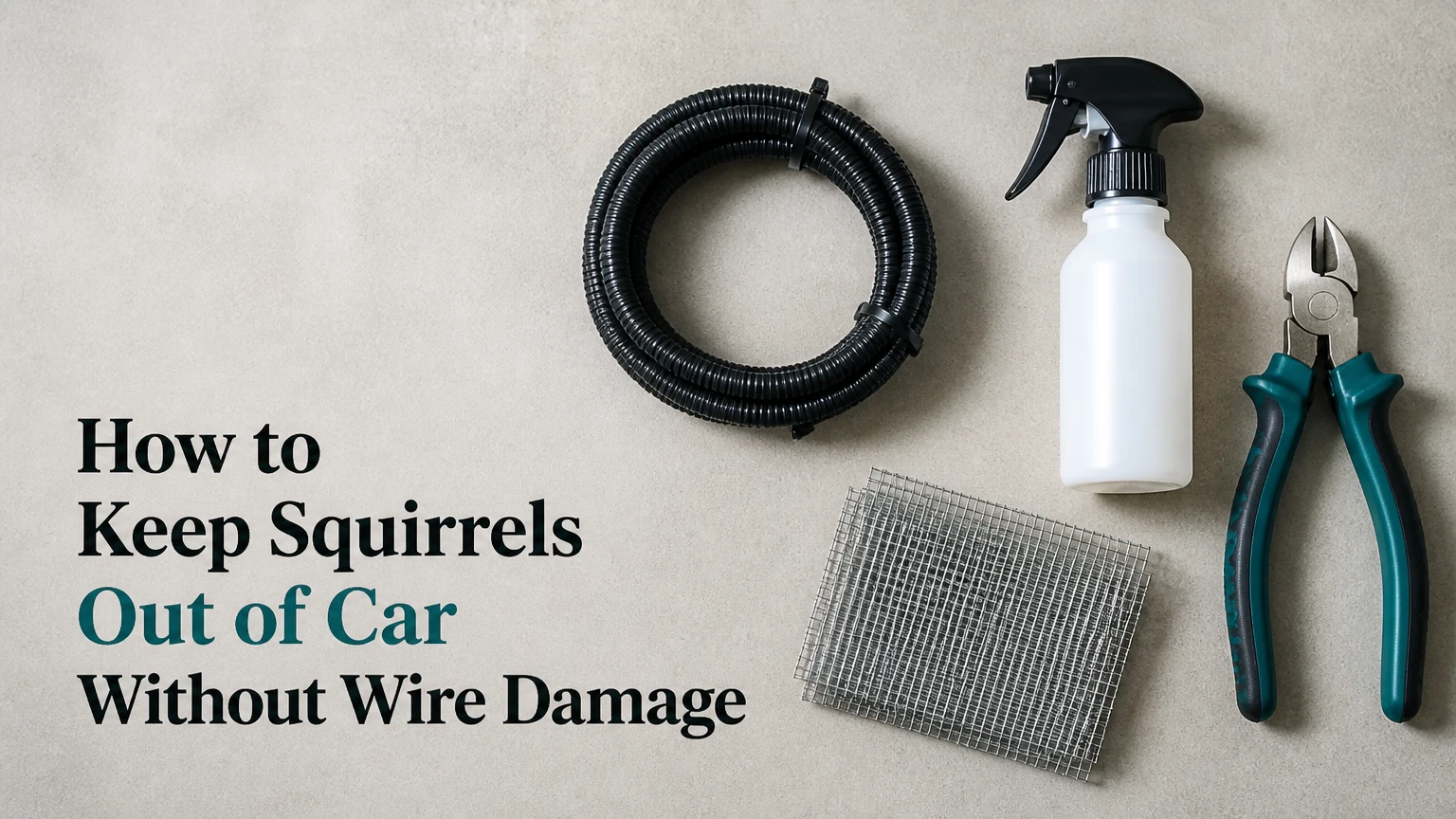
To keep squirrels out of a car, inspect for entry and nesting evidence, remove food and nesting material, clean accessible surfaces, block safe access points, and change the parking environment. Physical exclusion and repeated inspections are more dependable than scent or ultrasonic products alone, especially when a vehicle remains parked for several days.
Key Facts / At a Glance
Squirrels commonly enter engine bays through openings near the wheel wells, cowl, grille, and underside of the vehicle.
Soy-based wire insulation is not present in every vehicle, and squirrel chewing is driven by nesting, exploration, and tooth maintenance rather than a proven preference for soy.
Never start a vehicle when a nest, animal, or damaged wiring is near belts, fans, exhaust components, or electrical connections.
Mothballs and ammonia are unsafe choices for a car because their vapors can enter the cabin and expose people or pets.
A typical first inspection takes 15-30 minutes; professional wiring repair can cost $150-$2,000 or more depending on harness damage.
The most reliable prevention combines parking changes, attractant removal, safe exclusion, and weekly checks.
What should you do first?
The first action is to make the vehicle safe, not to spray a repellent. Park outdoors away from people and pets if possible, switch off the ignition, let the engine cool completely, and inspect the engine bay before moving the car.
Open the hood slowly and tap the hood or make moderate noise before reaching inside. A squirrel may be hiding beneath insulation or behind the battery. Do not put your hands into a dark compartment, and do not use the engine, wipers, or remote start until you have checked for an animal and loose nesting material.
Look for acorns, leaves, shredded paper, fur, droppings, odor, tooth marks, and disturbed insulation. Photograph the evidence before cleaning if an insurance claim or repair estimate may be necessary. Squirrel damage can affect ignition, fuel-injection, sensor, charging, and safety systems, so a small visible mark does not prove that the damage is minor.
When should you stop driving?
Stop driving and arrange a mechanic inspection when the check-engine light appears with rough running, electrical accessories malfunction, warning lights flicker, the vehicle smells of burning insulation, or wiring is visibly exposed. Towing is safer when a harness near the battery, starter, alternator, fuel system, airbag system, or cooling fan is damaged.
A car can appear to start normally while a partly severed wire fails after vibration or moisture reaches it. That failure can immobilize the vehicle or disable a monitored system at an unsafe time.
How do squirrels enter vehicles?
Squirrels enter vehicles through the underside, wheel-well gaps, grille openings, and cowl areas below the windshield. They climb from nearby trees, fences, walls, or stored materials, then use the warm, protected engine compartment as a temporary shelter or nesting site.
The cabin air intake, usually located beneath the windshield cowl, is a separate risk from the engine bay. Leaves and nesting material can block airflow or reach the blower housing when the cabin filter is missing, damaged, or poorly seated. Hood insulation, plastic wire covers, fuse-box cavities, and air-filter boxes can also provide sheltered spaces.
Automotive wiring insulation varies by manufacturer and model year. Some insulation uses plant-derived or soy-based materials, but the claim that all squirrels chew such insulation because it tastes like food is too broad. Rodents and squirrels chew many materials for tooth maintenance, investigation, access, or nest construction, and a manufacturer’s insulation formula cannot be inferred from the vehicle’s appearance.
Which signs indicate an active squirrel problem?
Fresh, pale chew marks, newly moved leaves, warm droppings, repeated footprints on dusty surfaces, and material that reappears after cleaning indicate recent activity. Old dry debris alone may represent a previous visitor rather than an active infestation.
Check these locations:
- Battery and fuse-box area: Look for shredded insulation, acorn shells, and gnawing near cable sheaths.
- Cowl and cabin filter: Lift the filter cover and inspect for leaves, fur, droppings, or nesting fibers.
- Air box and intake tube: Check for torn filter material or food storage.
- Wheel wells and underbody: Look for nesting paths, hair, and entry gaps.
- Hood insulation: Search for pulled fibers and concentrated droppings.
- Visible harnesses: Look for circumferential marks, exposed copper, or loose clips.
Step 1: Inspect the vehicle and remove access risks
Inspect the engine bay, cowl, wheel wells, and cabin filter housing with a flashlight after the engine cools. Allow 15-30 minutes for a basic check, or 45-60 minutes when removing covers and inspecting an unfamiliar vehicle.
Before touching anything, gather nitrile gloves, disposable coveralls, a flashlight, a dust mask or suitable respirator, disinfectant, sealable bags, a camera, and a nonconductive tool. Avoid compressed air because it can spread contaminated dust and nesting particles into the cabin or across the engine compartment.
If a live squirrel is inside, close the hood without trapping it and contact a licensed wildlife professional or local animal-control service. Do not poke the animal, flood the compartment, or start the engine to force it out. A trapped animal can injure itself and may damage additional wiring while trying to escape.
You will know the inspection is complete when every accessible nesting area has been checked, the cabin filter has been examined, and you have photographed all damage.
Common mistake: Inspecting only the top of the engine. Squirrels often use protected edges, lower splash shields, and cowl cavities that are invisible from above.
Step 2: Remove nesting material and clean attractant cues
Remove loose leaves, acorns, food, and nesting fibers with gloved hands and disposable tools, placing waste in sealed bags. Do not vacuum dry droppings or nesting debris unless the equipment is designed for contaminated material, because dust can become airborne.
Disinfect contaminated areas according to the product label, then use a vehicle-safe degreaser on oily or greasy surfaces. A 1:1 water-and-vinegar mixture can remove some surface odors, but it is not a reliable disinfectant and should not be sprayed into connectors, alternators, fuse boxes, sensors, air intakes, or other electrical components.
Cleaning removes food smells and familiar nesting cues, but cleaning alone does not stop re-entry. Squirrels can return because the vehicle remains under a tree, beside a feeder, or near a building route.
Replace a contaminated cabin air filter rather than washing it. Typical replacement cost is $15-$60 for the filter and 10-20 minutes of labor, depending on vehicle design.
You will know cleaning worked when no loose food or nest material remains, the cabin filter area is clear, and surfaces are dry before the vehicle is operated.
Common mistake: Applying water to a hot engine. Thermal shock, steam, and moisture in electrical connectors can create new problems.
Step 3: Repair damage before installing deterrents
Repair damaged wiring before relying on repellents. A mechanic should inspect the harness for broken conductors, missing insulation, corrosion, and damage hidden beneath loom coverings, because a surface patch can conceal a high-resistance connection.
Small, accessible insulation damage may be repaired with automotive-grade split loom, heat-shrink tubing, or a manufacturer-approved harness repair. Household electrical tape is a temporary wrap, not a durable repair for a hot, wet, vibrating engine bay. Never use wire nuts, ordinary duct tape, or unsealed household connectors in an automotive harness.
Typical costs vary widely:
| Repair or service | Typical parts or service cost | Typical time | Escalation point |
|---|---|---|---|
| Cabin air-filter replacement | $15-$60 | 10-20 minutes | Nesting inside blower housing |
| Minor wire insulation repair | $100-$250 | 1-2 hours | Multiple wires or inaccessible loom |
| Sensor or connector replacement | $150-$500 | 1-3 hours | Warning light or drivability fault |
| Harness section repair | $300-$1,200 | 2-8 hours | Several circuits damaged |
| Major harness replacement | $1,000-$2,000 or more | 1-3 days | Main harness or airbag wiring |
| Wildlife inspection or removal | $150-$500 | 1-3 hours | Live animal, babies, or repeated entry |
You will know repair is adequate when the mechanic confirms continuity, insulation protection, secure routing, and clearance from heat, belts, fans, and sharp edges.
Common mistake: Covering a chewed wire without testing it. Copper strands may be broken inside intact-looking insulation.
Step 4: Block safe entry points
Use metal hardware cloth or a purpose-made barrier to cover suitable stationary openings, but never obstruct cooling airflow, drainage, exhaust clearance, steering movement, brake components, belts, fans, sensors, or service access. Stainless-steel mesh with openings around 6 millimeters can stop many small animals, although the correct size depends on the gap and vehicle design.
Do not permanently seal factory ventilation paths or tape over the grille. A blocked intake can cause overheating, poor cabin ventilation, water retention, or a warning light. Ask a mechanic to identify an entry route before fastening any mesh near the engine.
Physical exclusion works best at the parking structure rather than directly on the vehicle. Seal garage gaps larger than about 6 millimeters around doors, pipes, and wall penetrations, while preserving required ventilation. Keep mesh away from moving components and use heat-resistant fasteners where temperatures demand them.
You will know exclusion worked when the suspected route is covered without changing airflow, drainage, temperature, or component movement.
Common mistake: Installing loose mesh inside the engine bay. A piece that falls into a belt or cooling fan can create a more serious mechanical failure.
Step 5: Change the parking environment
Move the vehicle away from tree limbs, roof edges, woodpiles, compost, unsecured garbage, and bird feeders. A practical target is at least 15 feet from a feeder and outside direct contact with branches, although squirrels can cross open ground and climb nearby structures.
Remove birdseed from beneath feeders and store seed in a metal container with a tight lid. Trim branches that provide a direct route to the roof or hood, subject to local tree regulations. Keep garage doors closed and do not leave pet food in the garage overnight.
Parking changes reduce the number of visits but do not remove a squirrel population from the neighborhood. Their home range can include several properties, so a vehicle may remain exposed even after one tree is trimmed.
You will know the habitat change is helping when fresh tracks and debris decline during the next 7-14 days, especially after the vehicle is moved and food sources are removed.
Common mistake: Moving the car only a few feet beneath the same canopy. The access route remains unchanged.
Step 6: Add a targeted deterrent layer
Use a vehicle-safe capsaicin or bittering spray only on surfaces identified by the label, and keep the product away from belts, brakes, tires, air intakes, hot exhaust components, painted finishes, and electrical connectors. Reapply according to the label, often every 2-4 weeks outdoors, because rain and engine-bay heat reduce persistence.
A light or motion-triggered device can provide another layer near a garage or parking area. Ultrasonic devices have inconsistent real-world performance in open engine bays because sound is blocked by components, frequency output changes with distance, and animals can habituate. Treat ultrasound as supplemental, not as proof of exclusion.
| Deterrent | Typical cost | Typical service interval | Best use | Main limitation |
|---|---|---|---|---|
| Capsaicin or bitter spray | $15-$35 | Reapply every 2-4 weeks | Targeted wire protection | Washes off and must avoid sensitive parts |
| Motion light | $20-$80 | Replace batteries every 3-12 months | Garage or driveway | Squirrels may habituate |
| Ultrasonic unit | $25-$70 | Check monthly | Enclosed garage or local area | Variable coverage and evidence |
| Metal mesh exclusion | $20-$100 | Inspect every 1-3 months | Fixed entry gap | Unsafe if placed near moving parts |
| Odor sachet | $10-$25 | Replace every 2-4 weeks | Temporary garage support | Heat and airflow reduce effect |
| Vehicle cover | $40-$200 | Wash and inspect monthly | Long-term storage | Does not block underside access |
Predator urine and essential oils are not reliable primary controls. Peppermint odor may fade quickly, and predator scent does not create a permanent risk for an animal that repeatedly finds shelter near the car.
You will know the deterrent layer is useful when inspection finds no fresh chew marks for at least two consecutive checks. The absence of damage matters more than a strong smell or a flashing indicator.
Common mistake: Installing a battery-powered device beside the exhaust manifold. Engine heat can shorten battery life and damage electronics.
Step 7: Reinspect on a fixed schedule
Inspect a frequently targeted vehicle every 3-7 days for the first month, then weekly during squirrel nesting seasons or whenever the car sits unused. Check the same locations each time so that new debris is distinguishable from old material.
A daily commuter that moves several times per day usually needs fewer vehicle-mounted controls than a car parked for a week. A stored vehicle needs physical exclusion, a sealed garage, or a storage facility inspection plan because deterrents can fail unnoticed.
Keep a dated log with photographs, parking location, weather, product application, and damage findings. Documentation helps identify whether the squirrel is entering through the car, garage, or nearby vegetation.
You will know prevention is holding when four consecutive inspections show no fresh material, odor, droppings, or chewing.
Common mistake: Stopping after one clean inspection. Squirrels can rebuild a nest overnight when access remains open.
Which deterrent combination works best?
The best combination depends on how long the vehicle remains parked, whether pets are nearby, and whether a physical access route can be removed. Physical exclusion and habitat modification provide the durable foundation; sprays, lights, and sound devices add temporary pressure but rarely solve an unrestricted access problem.
| Parking situation | Primary control | Secondary control | Inspection frequency | Typical first-month cost |
|---|---|---|---|---|
| Daily driveway commuter | Remove food and tree routes | Labeled capsaicin spray | Weekly | $20-$100 |
| Outdoor vehicle parked several days | Parking relocation | Spray plus motion light | Every 3-7 days | $40-$180 |
| Enclosed garage | Seal gaps and food storage | Motion light or ultrasonic unit | Weekly | $60-$250 |
| Seasonal storage | Garage exclusion and cover | Professional pre-storage inspection | Monthly | $100-$400 |
| EV or hybrid | Mechanic-approved exclusion | Parking and habitat changes | Weekly | $30-$200 |
| Home with dogs or cats | Mesh and parking changes | Physical controls over chemicals | Weekly | $30-$150 |
For a pet-owning household, physical barriers and food removal are preferable to loose chemicals or devices whose specifications do not address animal exposure. For a long-term storage owner, a cover alone is insufficient because squirrels can enter from below and nest under the hood.
Are ultrasonic devices worth buying?
Ultrasonic devices are worth considering only as a supplemental garage or parking-area measure, not as a standalone engine-bay solution. Product claims often cite frequencies above 20 kilohertz, but frequency alone does not establish effective sound pressure at the squirrel’s location.
Choose a unit with a stated operating temperature range, weather resistance appropriate to the installation site, low-voltage protection if connected to a 12-volt system, and a mounting position away from exhaust heat. Do not hardwire an accessory to a vehicle battery unless the manufacturer specifies the connection and a qualified installer adds an appropriate fuse and low-voltage cutoff.
Do peppermint oil and vinegar keep squirrels away?
Peppermint oil and vinegar may temporarily change odor but do not reliably keep squirrels away from a vehicle. Their effect declines as volatile compounds evaporate, wash away, or become familiar, especially in a ventilated engine bay.
Use vinegar for limited surface cleaning when compatible with the material, not as a guaranteed repellent. Never place oil-soaked cloths near hot components, belts, filters, or ignition sources, and never put strong-smelling chemicals inside the HVAC intake.
Common mistakes and how to fix them
Using mothballs or ammonia
Mothballs contain pesticides such as naphthalene or paradichlorobenzene, and their vapors can expose occupants and pets. Ammonia fumes also create respiratory hazards and do not reliably exclude a squirrel from an open engine compartment.
Remove these products, ventilate the area, and follow local hazardous-waste guidance. Use exclusion and parking changes instead.
Leaving food or nest material behind
A single acorn cache can reinforce the vehicle as a safe storage site. Remove food, clean accessible surfaces, and inspect the air box and cowl rather than focusing only on the visible engine cover.
Spraying a hot engine
Many repellents and cleaners are flammable or unsuitable for heated surfaces. Wait until components are cool, read the label, and keep products away from exhaust parts, alternators, belts, and connectors.
Blocking the wrong opening
A grille, drain, cooling passage, or air intake may look like an entry gap but perform a necessary vehicle function. Have a technician approve any permanent barrier near the front, underside, or cowl.
Trapping and relocating without checking local rules
Wildlife regulations vary by state, province, county, and municipality. Relocation may be restricted, and a female may leave dependent young behind. A licensed wildlife-control operator can identify the animal, inspect for babies, and use a lawful removal method.
What changes for garages, EVs, and stored cars?
A garage offers the strongest prevention opportunity because the structure can be sealed and food sources controlled. Install a door sweep, repair wall penetrations, store seed in metal containers, and inspect the roofline and rafters. Keep required garage ventilation unobstructed.
Hybrid and electric vehicles still contain wiring, insulation, battery-related components, and underbody cavities that can be damaged. Do not touch orange high-voltage cables, remove battery covers, or install mesh near cooling systems. A certified automotive technician should handle suspected damage around high-voltage components.
Long-term storage requires a written inspection schedule. Clean the vehicle, remove food, seal the garage, use a breathable cover, inspect the engine bay and cabin filter monthly, and ask the storage operator to document the vehicle’s condition. Starting the car periodically is not a substitute for inspection, and running it in an enclosed garage creates a carbon-monoxide hazard.
How do you troubleshoot a returning squirrel?
A returning squirrel usually indicates an unresolved access route, a nearby food source, a nest that was not fully removed, or a deterrent that changed odor without changing the habitat. Reinspect the cowl, wheel wells, underbody, air box, and garage perimeter rather than repeatedly applying the same spray.
Use this sequence:
- Photograph fresh evidence and compare it with previous images.
- Move the vehicle to a different parking location for 7-14 days.
- Remove birdseed, pet food, garbage, and acorns from the route.
- Inspect the garage, tree branches, fence, and roof access.
- Check for a hidden nest or babies with a wildlife professional.
- Repair any newly exposed wiring before applying another product.
- Add a safe physical barrier only after confirming that it will not affect vehicle operation.
A foul cabin smell, reduced airflow, or rattling behind the dashboard may indicate a nest or dead animal in the cabin filter housing or blower motor. Replace the filter, inspect the housing, and use an automotive-safe enzymatic cleaner after removing the source. A mechanic should handle inaccessible blower or HVAC contamination.
How much time and money should you budget?
A basic DIY prevention visit typically takes 30-90 minutes and costs $20-$100 for gloves, cleaner, a filter, and a labeled repellent. Adding mesh, a motion light, or a garage seal raises the typical first setup to $60-$250.
Professional wildlife removal commonly costs $150-$500 for inspection and removal, while wiring repairs range from about $100 for minor accessible damage to more than $2,000 for a major harness. Prices depend on vehicle access, labor rates, replacement parts, diagnostic time, and local wildlife regulations.
The cheapest successful intervention is often relocation of the parking position plus removal of food and nesting material. The most expensive mistake is driving repeatedly with damaged wiring until several circuits or a complete harness require replacement.
FAQ
Can squirrels damage a car overnight?
Yes, a squirrel can move nesting material or chew wiring overnight, particularly when a vehicle is parked near trees, feeders, or a garage opening. One night does not prove severe damage, so inspect before driving and look for fresh debris, exposed conductors, warning lights, and disturbed insulation.
Should I leave my hood open to deter squirrels?
Leaving the hood open may make the engine bay less sheltered, but it is not a dependable control and can expose the compartment to rain, contamination, and accidental contact. A safer approach is to remove access and attractants, then inspect the vehicle regularly while it remains parked.
Will a car cover stop squirrels?
A car cover may reduce access to hood insulation and can make the vehicle less inviting, but a cover does not seal the underside, wheel wells, or engine bay. Use a correctly fitted, breathable cover with physical parking-area controls, especially for a car stored outdoors.
Does starting the car scare squirrels away?
Starting a car may frighten an animal temporarily, but it can injure or kill an animal near a belt, fan, or hot exhaust component and may worsen wiring damage. Inspect under the hood and around the vehicle before starting, particularly after several days of storage.
Does insurance cover squirrel-chewed wiring?
Comprehensive auto insurance often covers animal damage, while collision coverage typically does not, but deductibles, exclusions, and claim rules vary by policy. Photograph the damage, avoid unnecessary driving, and ask the insurer whether a diagnostic inspection and wildlife-related repair are covered before authorizing extensive work.
What smell do squirrels hate most?
No single smell reliably excludes squirrels from cars. Capsaicin may discourage chewing on a treated surface, but essential oils, vinegar, predator urine, and similar odors lose effect outdoors and cannot replace access control, food removal, and repeated inspection.
The Bottom Line
The most dependable answer to how to keep squirrels out of car is a layered prevention routine: inspect safely, remove nests and food, repair wiring, change the parking route, block only approved entry gaps, and recheck the vehicle every 3-7 days at first. Use sprays, lights, or ultrasonic devices as secondary tools, not as substitutes for physical exclusion.