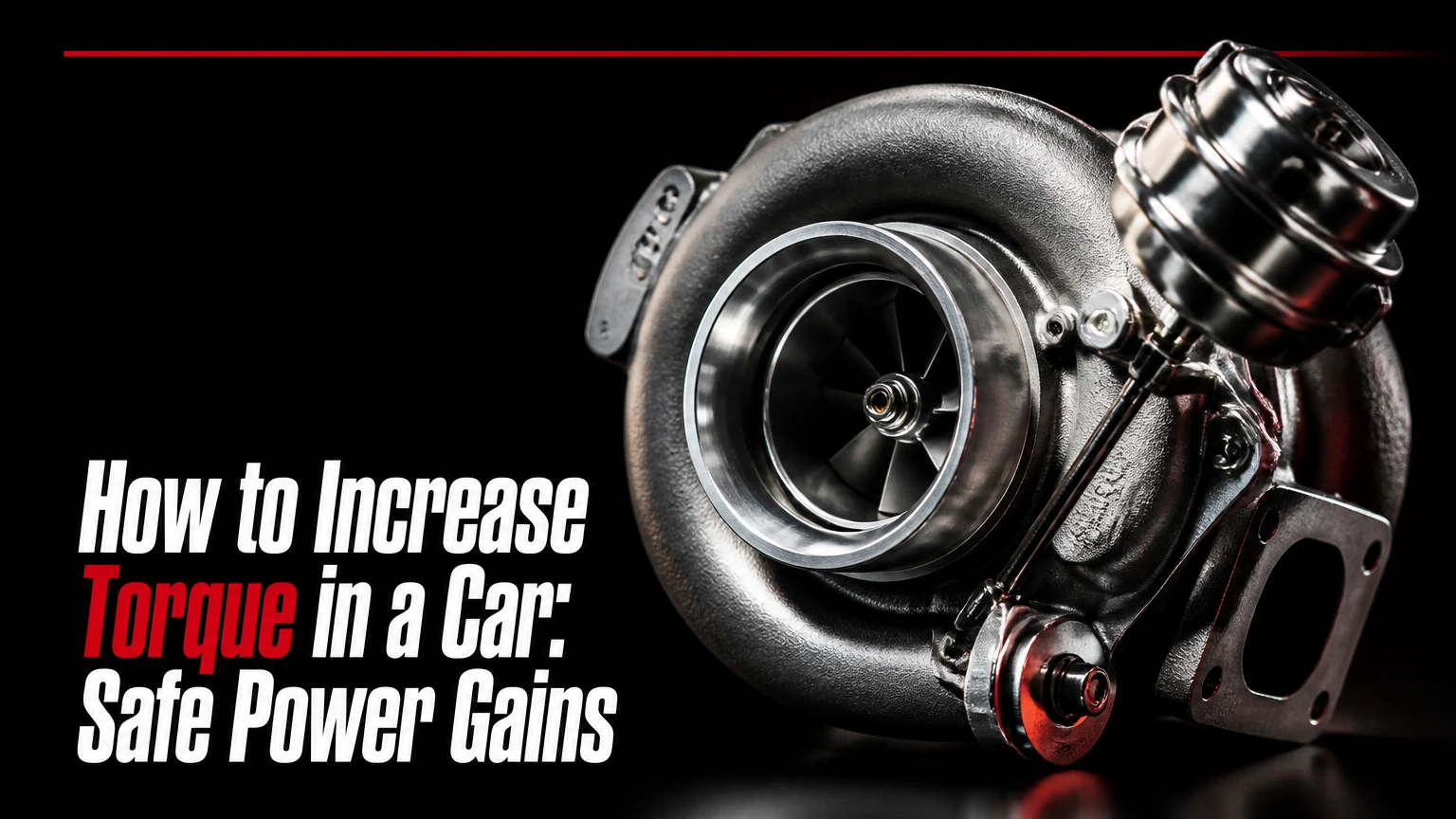
To increase torque in a car, first restore lost factory performance, then choose gearing, ECU tuning, airflow improvements, displacement, or forced induction according to the engine and intended use. Differential gearing increases torque at the wheels without increasing engine torque, while turbocharging or supercharging produces the largest engine-torque gains but demands fuel, cooling, and drivetrain upgrades.
Key Facts at a Glance
- Engine torque is rotational force, measured in pound-feet (lb-ft) or Newton-meters (Nm).
- Wheel torque equals engine torque multiplied by transmission, final-drive, and driveline ratios, minus mechanical losses.
- Re-gearing increases launch and climbing force at the tires but does not increase the torque produced by the engine.
- ECU tuning usually produces larger gains on factory turbocharged engines than on naturally aspirated engines.
- A larger exhaust does not automatically increase torque; excessive diameter can reduce low-rpm exhaust velocity.
- Extra torque can exceed clutch, automatic-transmission, axle, tire, or cooling-system capacity before the engine fails.
What Torque Means in a Car
Torque is the twisting force produced by an engine or electric motor. The standard relationship is (T = F \times r), where force acts through a lever arm; in an internal-combustion engine, combustion pressure pushes the piston and the crankshaft converts that force into rotation.
Horsepower describes how quickly torque is applied. In U.S. units, horsepower equals torque in lb-ft multiplied by engine speed in rpm, divided by 5,252. A 300 lb-ft engine at 3,000 rpm therefore produces about 171 horsepower, while the same torque at 6,000 rpm produces about 343 horsepower.
The driver feels torque through the driven tires, not at the crankshaft. A transmission first multiplies engine torque, the final drive multiplies it again, and the differential distributes it between the wheels. First gear can therefore create several times more wheel torque than the engine produces, although friction and tire grip limit the usable result.
Engine Torque Versus Wheel Torque
Engine torque is measured at the crankshaft. Wheel torque is the force available after gear multiplication and driveline losses, so a change in final-drive ratio can improve acceleration without changing the engine’s dyno torque curve.
For example, moving from a 3.23:1 final drive to a 4.10:1 ratio provides approximately 27 percent more ratio multiplication in the same gear, calculated as 4.10 divided by 3.23. The engine still produces the same torque, but the wheels receive more force while vehicle speed at a given rpm decreases.
This distinction prevents a common buying mistake. A differential gear is a torque multiplication upgrade, not an engine-power upgrade.
How Should You Increase Torque in a Car?
The safest sequence is diagnosis, gearing, airflow, calibration, forced induction, and internal engine work. The best choice depends on whether the car needs stronger launch force, low-rpm towing ability, midrange passing power, or maximum output at high engine speed.
Start with the least invasive change that solves the actual problem. A worn spark plug, restricted fuel filter, dragging brake, leaking intake hose, or slipping clutch can make a healthy engine feel weak. Adding modifications before measuring the baseline often hides the fault and raises repair costs.
Before You Start
| Requirement | Typical value | Why it matters |
|---|---|---|
| Baseline diagnostic time | 1-3 hours | Finds lost factory torque |
| Compression-test equipment | 1 gauge, 100-300 psi range | Checks cylinder sealing |
| OBD-II scan tool | 1 tool, live data capability | Reads fuel trims, misfires, and boost |
| Chassis dyno session | 2-3 pulls, $100-$250 | Measures wheel torque before and after |
| Premium fuel | 91-93 AKI in the USA | Reduces knock risk under higher cylinder pressure |
| Modification budget | $300-$12,000+ | Covers mild bolt-ons through engine building |
Confirm the car has correct ignition timing, fuel pressure, tire pressure, fluid levels, and a functioning cooling system. Inspect engine mounts, CV joints, driveshafts, and transmission fluid before increasing output.
Vehicle laws also matter. A tune, downpipe, catalytic-converter change, or evaporative-emissions alteration may violate local inspection rules, California Air Resources Board requirements, or federal emissions law in the United States. Check registration and insurance conditions before installing parts intended for closed-course use.
Step 1: Restore Lost Factory Torque
Repairing faults is the highest-return torque modification because a healthy engine can recover its original output without changing its design. A neglected car may lose drivability through misfires, low fuel pressure, vacuum leaks, clogged filters, incorrect valve timing, or a malfunctioning mass-airflow sensor.
Use a scan tool to check misfire counters, short-term fuel trim, long-term fuel trim, coolant temperature, throttle position, and manifold pressure. Fuel trims consistently above approximately +10 percent suggest the engine is adding fuel to compensate for a lean condition, although the correct threshold varies by manufacturer and operating condition.
Check the intake tract for cracks after the mass-airflow sensor. Inspect turbocharged cars for loose charge pipes and oily connections that indicate pressurized-air leakage. A compression test with cylinders within roughly 10-15 percent of one another is a useful screening result, but manufacturer specifications remain authoritative.
You will know this step worked when the engine reaches normal temperature, idles evenly, shows no active misfire codes, and produces repeatable acceleration times. The common mistake is treating a throttle-response problem as a torque shortage. A pedal module can alter pedal mapping, but it cannot create additional engine torque.
Step 2: Choose Shorter Gearing for Wheel Torque
Shorter gearing is the most direct way to increase usable pulling force at the tires without opening the engine. A higher numerical differential ratio, such as 4.10:1 instead of 3.23:1, multiplies torque more strongly and keeps the engine in a higher part of its torque band.
Transmission gear changes and final-drive changes have similar mechanical effects. A close-ratio transmission can reduce rpm drop between shifts, while a higher final-drive ratio improves launch, hill climbing, and low-speed response. The trade-offs include higher cruising rpm, more noise, reduced fuel economy, and earlier redline-limited top speed.
| Final-drive change | Ratio multiplication | Approximate wheel-torque change | Typical use |
|---|---|---|---|
| 3.08 to 3.55 | 1.15x | 15% | Street acceleration |
| 3.23 to 3.73 | 1.15x | 15% | Mixed road and track use |
| 3.23 to 4.10 | 1.27x | 27% | Drag launches and towing |
| 3.73 to 4.56 | 1.22x | 22% | Off-road crawling |
| 4.10 to 4.88 | 1.19x | 19% | Low-speed competition |
These percentages describe ratio multiplication, not guaranteed vehicle acceleration. Traction control, tire grip, shift strategy, and aerodynamic drag can reduce the measured improvement.
You will know the gearing is appropriate when the engine reaches its useful torque band sooner without cruising rpm becoming unacceptable. The common mistake is selecting a ratio without checking tire diameter, transmission gear spacing, axle strength, and speedometer calibration.
Step 3: Improve Airflow Without Losing Low-Speed Response
A properly matched intake and exhaust system can improve volumetric efficiency, but bolt-on parts usually produce modest torque changes on a stock naturally aspirated engine. The largest gains occur when airflow hardware corrects a genuine restriction and the ECU calibrates fuel and ignition for the new flow rate.
A cold-air intake can reduce inlet temperature and pressure loss when its ducting draws air from outside the engine bay. It can also reduce performance if the filter sits near exhaust heat, the pipe disrupts mass-airflow-sensor readings, or the design allows water ingestion.
Exhaust headers, a suitable downpipe, and a correctly sized exhaust can improve cylinder scavenging. Exhaust gas velocity and pulse timing matter more than simply minimizing backpressure. An oversized pipe often weakens low-rpm torque because gas velocity falls, particularly on a small-displacement engine.
| Airflow modification | Typical parts cost | Installation time | Typical torque result |
|---|---|---|---|
| High-flow panel filter | $35-$90 | 15-30 minutes | 0-2% |
| Sealed cold-air intake | $200-$600 | 1-3 hours | 0-4% |
| Intake manifold | $400-$1,500 | 4-8 hours | 2-8% |
| Exhaust headers | $500-$1,800 | 4-10 hours | 3-10% |
| Turbo downpipe | $250-$1,000 | 2-5 hours | 3-10% with tune |
| Cat-back exhaust | $400-$1,500 | 2-5 hours | 0-5% |
These ranges are typical aftermarket figures, not promised results. A dyno comparison must control fuel, temperature, tire pressure, and test gear before attributing a small gain to one part.
You will know the airflow change is successful when fuel trims remain stable, no sensor codes appear, and the torque curve improves rather than shifting the peak higher. The common mistake is installing a large intake tube or exhaust and assuming maximum diameter equals maximum torque.
Step 4: Tune the ECU With Measured Data
ECU tuning adjusts ignition timing, fueling, throttle control, boost, variable valve timing, and torque-management limits. Factory turbocharged engines usually respond strongly because the manufacturer leaves thermal, fuel, and boost margin for different climates, fuels, emissions requirements, and model variants.
Naturally aspirated engines have less unused airflow to exploit. A tune may sharpen throttle control and adjust cam timing, but a 10-20 percent torque increase is not a reliable expectation without major hardware changes. On a turbocharged engine, a conservative calibration can produce a larger midrange improvement, but the result depends on turbo size, fuel quality, intercooling, and factory torque limits.
A custom dyno tune is preferable to a generic file when hardware differs from the tuner’s assumptions. Monitor commanded and measured air-fuel ratio, knock feedback, intake-air temperature, exhaust temperature where available, fuel pressure, and boost. Keep the original calibration so the car can be returned to stock.
| Tuning approach | Typical cost | Typical time | Best application | Main risk |
|---|---|---|---|---|
| Off-the-shelf naturally aspirated flash | $300-$700 | 1-2 hours | Stock daily driver | Small or inconsistent gain |
| Off-the-shelf turbo flash | $400-$900 | 1-2 hours | Stock turbo engine | Fuel and heat sensitivity |
| Custom dyno calibration | $700-$1,500 | 3-8 hours | Modified engine | Poor tuner decisions |
| Piggyback controller | $300-$1,200 | 2-5 hours | Reversible boost changes | Sensor and torque-model errors |
| Flex-fuel calibration | $800-$2,000 | 4-10 hours | Compatible fuel system | Incorrect ethanol content data |
You will know the tune is safe when repeated pulls show stable fuel pressure, controlled knock activity, and consistent power after heat soak. The common mistake is using a high-boost map with fuel below its specified octane. Detonation can damage pistons, ring lands, bearings, and head gaskets.
Step 5: Add a Turbocharger or Supercharger
Forced induction produces the largest practical engine-torque increase because compressed intake air allows more oxygen and fuel into each cylinder. A turbocharger uses exhaust energy, while a supercharger receives mechanical drive from the crankshaft; both raise cylinder pressure and system heat.
A turbocharger can deliver a strong midrange increase with good efficiency, but response depends on turbine sizing, exhaust energy, wastegate control, and calibration. A small turbo responds quickly but may restrict high-rpm airflow. A large turbo can produce more peak torque and horsepower while increasing lag.
A positive-displacement supercharger provides immediate low-rpm boost and predictable response, which suits towing and street driving. A centrifugal supercharger behaves more like a turbocharger because boost rises with rpm. No forced-induction system is free power: fuel delivery, intercooling, exhaust flow, engine sealing, and transmission capacity must match the target.
| System | Typical torque increase | Parts and installation | Response | Supporting requirements |
|---|---|---|---|---|
| Small turbo kit | 25-60% | $4,500-$10,000 | Fast midrange | Intercooler, fuel, tune |
| Large turbo kit | 50-100%+ | $6,000-$15,000+ | Later boost | Engine, clutch, cooling |
| Roots supercharger | 25-60% | $5,000-$10,000 | Immediate low rpm | Belt drive, intercooler, tune |
| Twin-screw supercharger | 35-80% | $6,000-$12,000 | Strong low and midrange | Fuel, cooling, calibration |
| Centrifugal supercharger | 25-70% | $4,000-$9,000 | Rising with rpm | Belt, fuel, intercooler |
Typical figures vary widely and cannot replace a vehicle-specific build plan. A factory turbo engine may need only calibration and intercooling for a moderate increase, while a naturally aspirated engine converted to boost may require pistons, injectors, pump capacity, sensors, and exhaust fabrication.
You will know forced induction is working when boost reaches the commanded target, air temperatures remain controlled, and the torque curve is repeatable after several pulls. The common mistake is choosing the maximum advertised boost before confirming compression ratio, fuel quality, head-bolt capacity, and knock control.
Step 6: Increase Displacement or Change Engine Hardware
Increasing displacement raises the amount of air the engine can process each cycle and usually strengthens torque across a broad rpm range. A stroker crank increases piston travel, while larger cylinder bores increase displacement through larger piston diameter.
Stroker kits require precise crankshaft balancing, bearing clearances, piston-to-valve checks, rod clearance, compression-ratio calculation, and machine-shop measurement. Boring may be limited by cylinder-wall thickness and can require sleeves if the original bore cannot safely accommodate the intended diameter.
Camshaft selection also affects torque location. A long-duration, high-overlap cam can improve high-rpm breathing while reducing idle quality and low-speed cylinder filling. For a towing or street car, a moderate cam matched to intake runner length, compression, and exhaust timing usually produces a more useful curve than a peak-power cam.
| Internal modification | Typical torque gain | Typical cost | Typical downtime | Main limitation |
|---|---|---|---|---|
| Mild camshaft and springs | 3-12% | $1,200-$3,500 | 2-5 days | Idle and emissions changes |
| Stroker kit | 15-35% | $4,000-$12,000 | 2-4 weeks | Machine-shop accuracy |
| Overbore with pistons | 5-15% | $4,000-$10,000 | 2-4 weeks | Cylinder-wall thickness |
| Higher-compression pistons | 5-15% | $4,500-$11,000 | 2-4 weeks | Octane requirement |
| Complete engine swap | 20-100%+ | $8,000-$30,000+ | 2-8 weeks | Wiring and legal compliance |
You will know the engine build is sound when compression is even, oil pressure meets specification, break-in data is stable, and the calibration matches the new displacement. The common mistake is budgeting only for parts. Bearings, gaskets, machining, balancing, fluids, fasteners, labor, and tuning often determine the final cost.
Which Torque Upgrade Fits Your Goal?
The best upgrade depends on the operating condition that feels weak. A commuter usually benefits from restoring lost performance and a conservative tune, while an off-road vehicle may gain more from final-drive gearing than from peak engine output.
| User situation | First choice | Second choice | Avoid first | Reason |
|---|---|---|---|---|
| Daily commuter | Diagnosis and mild tune | Sealed intake | Large camshaft | Preserves drivability |
| Factory turbo street car | ECU tune and intercooler | Downpipe where legal | Maximum boost map | Strong midrange gain |
| Naturally aspirated tow vehicle | Gearing | Displacement | Oversized exhaust | Low-rpm force matters |
| Off-road crawler | Lower gearing | Tire and cooling upgrades | High-rpm cam | Control beats peak power |
| Track car | Tire, tune, cooling | Turbo or supercharger | Uncontrolled torque spike | Traction and repeatability |
For towing, torque is only one part of capability. Gross vehicle weight rating, axle rating, cooling capacity, transmission temperature, braking performance, and trailer stability remain binding limits. More engine torque cannot legally raise the manufacturer’s tow rating.
For an electric vehicle or hybrid, the motor often produces peak torque from zero rpm, so aftermarket hardware is less relevant. Software limits, battery temperature, inverter current, reduction gearing, and traction control determine how much torque reaches the road. A diagnostic scan and manufacturer-approved software are safer than attempting internal combustion engine modifications.
What Supporting Parts Prevent Torque-Related Failures?
Supporting parts determine whether extra torque becomes reliable acceleration or repeated drivetrain damage. A manual-transmission car may need a clutch rated above the intended wheel torque, while an automatic car may need fluid service, software calibration, and additional cooling.
Tires are the final torque-transfer component. If available wheel torque exceeds tire grip, the engine cannot accelerate the car faster; it only spins the tires or activates traction control. A wider tire does not automatically provide more grip, because compound, temperature, load, alignment, and road surface also matter.
| Component | Typical upgrade threshold | Failure symptom | Practical response |
|---|---|---|---|
| Manual clutch | 20-30% above target engine torque | Slips in high gear | Install matched clutch and inspect flywheel |
| Automatic transmission cooler | 15-30% power increase | Fluid exceeds 200°F | Add monitored external cooling |
| Fuel injectors | 15-25% duty-cycle reserve | Lean condition at load | Size injectors with flow and pressure data |
| Intercooler | 20-40% boost increase | Power falls after pulls | Reduce intake-air temperature |
| Performance tires | 200-400 treadwear range | Wheel spin in second gear | Use suitable compound and alignment |
| Engine mounts | 15-25% torque increase | Excess movement or impact | Replace worn mounts with matched stiffness |
A torque increase can expose an existing weak component immediately. Inspect differential fluid, axle boots, CV joints, driveshaft couplers, wheel studs, and engine mounts before hard launches.
Why Did Torque Drop After an Upgrade?
Torque can drop after a modification because the new part shifted airflow tuning away from the intended rpm range, introduced a leak, or caused the ECU to reduce ignition timing. A dyno graph comparing the original and modified curves is more useful than peak horsepower claims.
Use this diagnostic sequence:
- Scan for diagnostic trouble codes and misfire counts.
- Smoke-test the intake and charge-air system.
- Verify fuel pressure under load, not only at idle.
- Check mass-airflow or manifold-pressure sensor installation.
- Compare commanded and actual boost.
- Inspect ignition timing and knock correction.
- Recheck exhaust diameter and camshaft timing.
- Repeat the dyno test under similar temperature and fuel conditions.
A large exhaust can reduce low-speed torque when its diameter is excessive for the engine’s displacement and rpm range. A smaller pipe, properly sized header collector, or resonator may restore gas velocity, but adding artificial restriction is not a universal solution.
A rolling-throttle hesitation often points to a boost leak, unmetered air, incorrect calibration, weak ignition, or insufficient fuel volume. Do not solve it by increasing boost. Find the missing air or fuel first.
How Much Does Increasing Torque Cost?
A useful street improvement typically costs $400-$1,500 for diagnosis, gearing-related work, or a conservative ECU calibration. Large gains cost $4,500-$15,000 or more once forced induction, fuel delivery, cooling, clutch capacity, fabrication, and tuning are included.
| Upgrade path | Typical total cost | Labor time | Expected result | Reliability effect |
|---|---|---|---|---|
| Restore factory output | $100-$1,000 | 1-8 hours | Recovers lost torque | Improves reliability |
| Intake and panel filter | $250-$700 | 1-3 hours | 0-4% torque | Low when sealed correctly |
| Gearing change | $1,000-$2,500 | 1-2 days | 15-30% wheel multiplication | Low with correct setup |
| ECU tune | $400-$1,500 | 1-8 hours | 5-20% NA, higher turbo | Medium under poor calibration |
| Forced induction | $5,000-$15,000+ | 2-10 days | 25-100%+ engine torque | Higher thermal and drivetrain stress |
| Built engine | $8,000-$30,000+ | 2-8 weeks | Vehicle-specific | Depends on machining and tune |
The lowest cost-per-feel is often diagnosis followed by gearing or a well-supported tune on a factory turbocharged car. The lowest cost-per-peak-number is not necessarily the lowest cost-per-mile, because heat management and drivetrain repairs can exceed the original modification budget.
Common Mistakes and How to Fix Them
Using Lower-Octane Fuel After Tuning
Higher boost, compression, or ignition advance increases knock sensitivity. Use the fuel grade specified by the tuner, and do not assume an octane booster makes unsuitable fuel safe for sustained high load.
Ignoring the Transmission
A stock clutch or automatic transmission may tolerate factory torque but slip after a tune. Record transmission temperature, inspect fluid condition, and confirm the gearbox torque rating before repeated launches.
Buying a Throttle Controller
A throttle controller changes pedal sensitivity rather than combustion pressure. It can make the car feel sharper during the first part of pedal travel, but it does not increase measured engine torque.
Chasing Peak Torque Only
A sudden torque spike can make a car slower if it overwhelms the tires or forces early torque management. A broad, repeatable torque curve often produces better road acceleration than a higher peak with wheel spin.
Deleting Emissions Equipment
Removing a catalytic converter or disabling diagnostic monitoring can create legal violations, inspection failure, odor, and calibration problems. Use emissions-compliant parts where road use requires them.
Skipping Heat Management
Repeated torque pulls raise coolant, oil, transmission-fluid, exhaust, and intake-air temperatures. A car that makes one strong dyno run may lose power or suffer damage during sustained towing or track use.
FAQ
Does a cold-air intake significantly increase torque?
A sealed cold-air intake usually produces a small gain, commonly 0-4 percent on a stock engine, and may produce no measurable improvement if the original system is already adequate. The intake must avoid hot engine-bay air, preserve accurate sensor readings, and maintain water protection.
Is torque or horsepower more important for acceleration?
Both affect acceleration, but wheel torque determines the force available at the tires while horsepower determines how long the engine can continue producing force as speed rises. Low-speed launches favor gearing and tire grip, while high-speed acceleration depends more heavily on power and aerodynamic resistance.
Can a tune damage a stock engine?
A tune can damage a stock engine if it increases cylinder pressure beyond the fuel, cooling, turbocharger, or knock-control margin. Risk rises with low-octane fuel, high intake temperature, poor maintenance, aggressive ignition timing, and repeated full-load operation.
Does a bigger engine always make more torque?
A larger engine usually has greater torque potential because it processes more air per cycle, but cam timing, compression ratio, intake design, exhaust tuning, turbocharging, and rpm determine the final curve. A smaller turbocharged engine can exceed the torque of a larger naturally aspirated engine.
Can heavier tires reduce the benefit of more torque?
Heavier tires can reduce acceleration because the engine must accelerate more rotational mass, while larger diameter tires also increase the effective gearing ratio. Choose tire diameter and compound according to traction, clearance, gearing, and the vehicle’s intended use.
The Bottom Line
The most dependable way to increase torque in a car is to establish a healthy baseline, select gearing or calibration for the desired rpm range, and add supporting fuel, cooling, clutch, transmission, and tire capacity before pursuing large gains. Re-gearing increases wheel torque efficiently, ECU tuning works best on factory turbo engines, and forced induction provides the greatest engine-torque increase at the highest cost and risk.
Use a dyno graph, scan data, and repeatable road testing rather than relying on advertised peak figures. A modest torque curve that the tires and drivetrain can use will outperform a larger number that causes wheel spin, heat soak, clutch slip, or transmission failure.