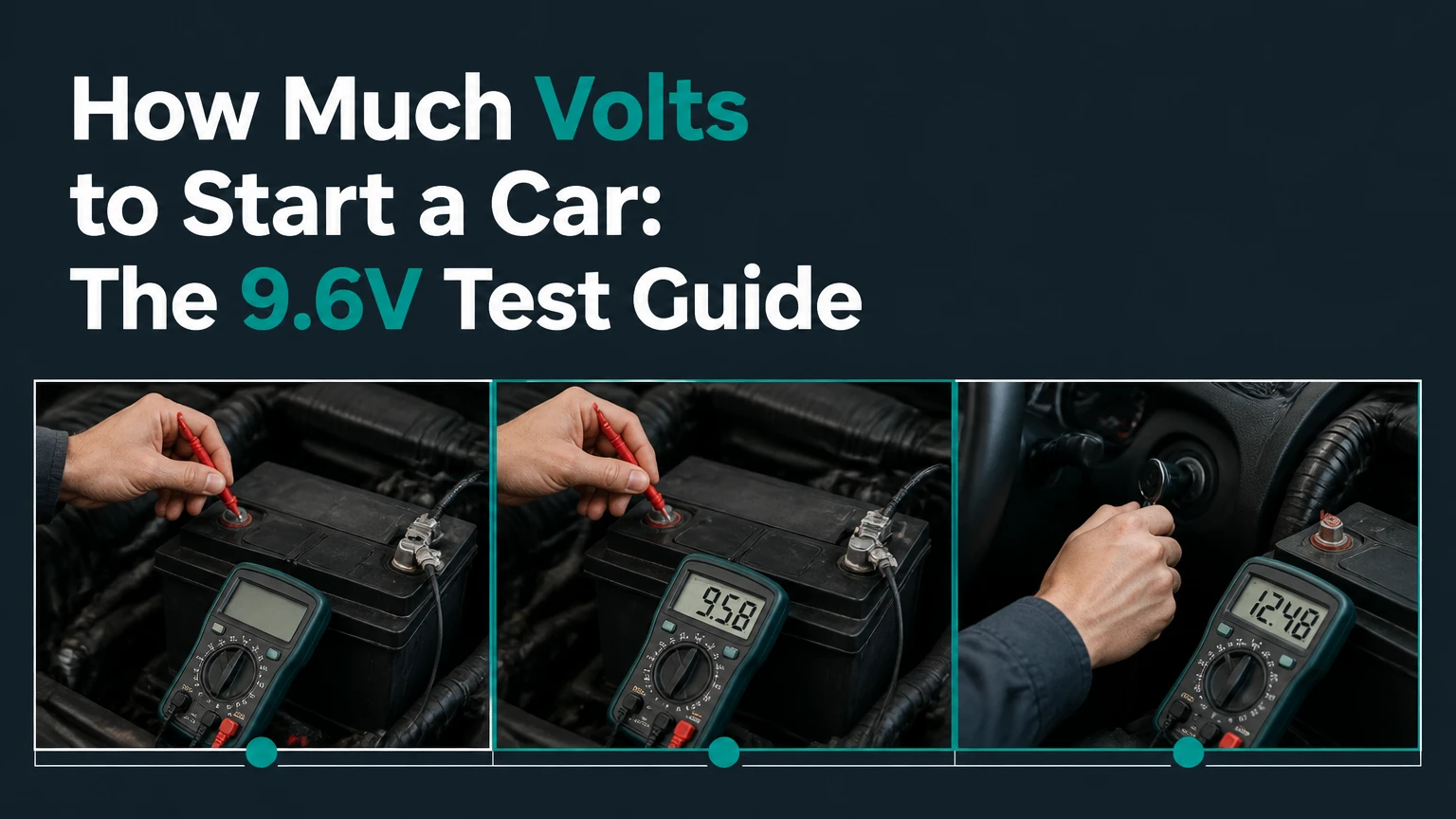
A standard gasoline car normally needs a healthy 12-volt battery that stays at about 9.6 volts or higher while the starter is cranking. Before cranking, the battery should measure roughly 12.6-12.8 volts after resting, but voltage alone cannot prove its condition because a worn battery may show a normal resting reading and collapse under load.
Key Facts at a Glance
- A fully charged conventional 12-volt lead-acid battery usually measures 12.6-12.8 volts after several hours of rest.
- A common 70°F battery load test uses 9.6 volts as the minimum acceptable voltage during a 15-second test.
- A battery reading 12.0 volts at rest is heavily discharged, not normally “healthy” simply because the battery is called 12V.
- Starter motors commonly draw about 150-500 amps, with large diesel engines often demanding more.
- A running vehicle may show approximately 13.5-14.7 volts, although smart charging systems can deliberately use lower or changing voltage.
- A 12.6-volt reading does not guarantee starting power; cold-cranking amps, internal resistance, cables, and starter condition also determine whether the engine turns.
How Much Voltage Does a Car Need to Start?
A typical internal-combustion car needs about 9.6 volts at the battery terminals while the starter is actively cranking at around 70°F. The battery also must supply enough current, often 150-500 amps, to turn the engine at the manufacturer’s required cranking speed.
The 9.6-volt figure is a widely used load-test benchmark rather than a universal electronic starting rule. A small gasoline engine may crank below that value in some circumstances, while a cold diesel, high-compression engine, or vehicle with sensitive control modules may fail even when the meter briefly shows 10 volts.
A starter can operate with less voltage, but motor torque falls as voltage falls. Low torque slows the crankshaft, reducing fuel-pump pressure, injector performance, ignition energy, and compression heat. The result can be a click, sluggish rotation, or a normal-sounding crank that never reaches ignition speed.
Resting and cranking voltage are different measurements
Resting voltage measures the battery with almost no major load. Cranking voltage measures the battery while the starter demands hundreds of amps. The second measurement is more useful for deciding whether the battery can actually start the engine.
| Measurement condition | Typical voltage | Practical interpretation |
|---|---|---|
| Fully rested flooded battery | 12.6-12.8V | Approximately full charge |
| Fully rested AGM battery | 12.7-12.9V | Approximately full charge |
| Rested, partly discharged battery | 12.2-12.4V | About 50-75% charged |
| Battery during starter operation | 9.6-10.8V | Usually acceptable at 70°F |
| Battery during starter operation | Below 9.6V | Weak battery, high resistance, or excessive load |
| Engine running, conventional charging | 13.5-14.7V | Alternator is charging in many vehicles |
Why Does a 12-Volt Battery Read 12.6 Volts?
A 12-volt lead-acid battery contains six cells connected in series, and each fully charged cell produces approximately 2.1 volts at rest. Six cells therefore produce about 12.6 volts, while “12V” identifies the electrical system’s nominal category rather than its exact open-circuit measurement.
Lead-acid cell voltage depends on sulfuric-acid concentration, temperature, charge history, and surface charge. Immediately after charging, a battery can temporarily read above 13 volts, so a technician removes the surface charge by switching on the headlights briefly or allowing the battery to rest.
Yuasa’s battery technical guidance gives the practical benchmark that “a fully charged battery should have a voltage of approximately 12.7 volts.” That figure applies to a rested 12-volt lead-acid battery, not to a battery being charged by an alternator or connected to a charger.
A low reading does not always mean a failed battery. A battery may simply be discharged, while a battery with a normal reading may have sulfated plates, a weak cell, or high internal resistance.
What Do Car Battery Voltage Readings Mean?
Resting voltage provides a useful estimate of charge, but it is not a complete battery-health test. The table applies most reliably after the vehicle has been off for several hours and the battery has not recently been charged or subjected to a heavy electrical load.
| Resting battery voltage | Approximate charge level | Starting implication |
|---|---|---|
| 12.7-12.8V | 100% | Charged, but still requires a load test for health |
| 12.5-12.6V | 90-100% | Normally ready if CCA and connections are sound |
| 12.4V | About 75% | May start normally; recharge before cold use |
| 12.2V | About 50% | Marginal for repeated starts; recharge promptly |
| 12.0V | About 25% | Heavily discharged; starting failure is likely |
| 11.8V or lower | Very low charge or failed cell | Charge and test; do not assume replacement immediately |
| 10.5V or lower | Possible shorted cell or severe discharge | Inspect, charge cautiously, and obtain a professional test |
These percentages are approximate. Battery temperature and construction change the relationship between voltage and charge. A battery can also lose capacity while preserving a normal open-circuit voltage, which is why voltage should be combined with a conductance or load test.
Can a car start with 12.0 volts?
A car can occasionally start at 12.0 volts, especially with a warm, small engine and a battery that still has low internal resistance. A 12.0-volt resting reading nevertheless indicates substantial discharge, and repeated starting attempts can quickly reduce the voltage below the starter and engine-control thresholds.
Recharge a 12.0-volt battery before relying on the vehicle. If the battery returns to 12.6 volts but falls rapidly after sitting, test for parasitic drain or battery failure.
How Do You Test Starting Voltage With a Multimeter?
A digital multimeter can measure resting voltage and voltage during cranking in about five minutes. The most useful test connects directly to the battery posts, records the rested voltage, then watches the minimum voltage while a second person attempts to start the engine.
Before you start
| Item | Typical requirement | Safety detail |
|---|---|---|
| Digital multimeter | 1 tool, DC volts range | Use a 20V range if manual selection is required |
| Rest period | 2-12 hours | Longer rest improves accuracy |
| Cranking observation | 5-10 seconds maximum | Stop if the engine does not begin cranking normally |
| Test location | Ventilated, secure parking area | Keep sparks and flames away from lead-acid batteries |
| Battery condition | Terminals accessible | Do not test a cracked, leaking, or visibly swollen battery |
Step 1: Measure the rested battery
Set the meter to DC voltage. Touch the red probe to the positive battery post and the black probe to the negative post, not merely to cable clamps covered with corrosion.
Record the reading before turning on the ignition. A healthy, fully charged lead-acid battery normally displays 12.6-12.8 volts after rest.
You know the first step worked when the reading remains stable for at least 30 seconds. A reading below 12.4 volts means the battery should be charged before drawing conclusions about its condition.
The common mistake is testing immediately after driving. The alternator’s surface charge can temporarily elevate the measurement.
Step 2: Observe the voltage during cranking
Keep the probes connected and have an assistant turn the key or press the start button. Watch the lowest voltage reached while the starter turns, then stop the attempt after about 5-10 seconds.
A minimum near 9.6 volts at 70°F is a common pass point for a conventional load test. A brief dip below 9.6 volts during a very cold start is not, by itself, a complete diagnosis, because temperature, engine oil, starter draw, and battery rating affect the result.
You know the test is informative when the meter captures the lowest value without probe movement. The common mistake is reading the voltage after the starter stops, when the battery has already recovered.
Step 3: Check for voltage drop in the cables
Place one probe on the positive battery post and the other on the starter’s main positive terminal. Crank the engine and observe the difference between those points. Repeat the procedure between the negative battery post and the starter housing.
As a typical workshop guideline, a positive-side or ground-side drop above about 0.2-0.5 volts during cranking deserves investigation. Exact limits vary by vehicle and cable design, but a battery can pass a direct-post test while excessive resistance in a cable prevents the starter from receiving adequate voltage.
You know the connection test has found a likely fault when cleaning or tightening a terminal materially improves cranking. The common mistake is replacing the battery without testing the engine ground strap.
Step 4: Measure charging voltage after the engine starts
If the engine starts, measure across the battery posts again with the engine idling. Switch off accessories first, then repeat at approximately 1,500-2,000 rpm if the vehicle manufacturer provides no different procedure.
A conventional alternator commonly produces 13.5-14.7 volts. Smart charging systems, including many vehicles from Ford, General Motors, BMW, and Volkswagen Group, can command lower voltage during cruising or raise it during deceleration, so a single 13.2-volt reading does not automatically prove alternator failure.
You know the charging test needs further diagnosis when voltage remains near the rested battery value with the engine running, the battery warning lamp stays illuminated, or measured voltage changes erratically with electrical load.
Why Does Battery Voltage Drop When the Starter Turns?
Battery voltage drops because the starter’s high current passes through the battery’s internal resistance and the vehicle’s cables. The voltage loss follows the relationship described by Ohm’s law, so a battery with increased internal resistance can show 12.6 volts at rest yet fall sharply when the starter demands several hundred amps.
Starter demand varies with engine displacement, compression, oil viscosity, ambient temperature, and starter design. A typical four-cylinder gasoline engine may draw roughly 150-250 amps, while a large diesel or seized engine can require 300-800 amps or more during difficult conditions.
Cold weather reduces battery chemical activity and thickens engine oil. Battery Council International testing uses standardized cold-cranking conditions, commonly 0°F for 30 seconds, and the battery’s CCA rating indicates how much current it can provide under that test. CCA is therefore more useful for cold-start capacity than resting voltage alone.
A counterintuitive diagnostic rule follows: a slow crank with 12.6 volts at rest does not automatically mean the battery is weak. High-resistance positive cables, a poor engine ground, or a worn starter can create the same symptom.
What Voltage Should a Car Show While Running?
A conventional 12-volt charging system usually shows 13.5-14.7 volts at the battery with the engine running, but modern vehicles do not maintain one fixed number under every condition. The engine control module may lower alternator output to reduce fuel consumption and increase it during braking, acceleration, battery recovery, or heavy electrical demand.
| Running voltage at battery posts | Likely meaning | Next check |
|---|---|---|
| 14.2-14.7V | Strong conventional charging | Check again with lights and blower operating |
| 13.5-14.1V | Common charging range | Compare with vehicle service data |
| 13.0-13.4V | Could be smart charging or low output | Test under load and inspect belt and connections |
| 12.4-12.9V continuously | Battery may not be charging | Check alternator, regulator, fuse, and wiring |
| Above 15.0V | Possible overcharging | Stop prolonged operation and test regulator control |
| Voltage fluctuates widely | Smart strategy or charging fault | Scan charging data and inspect battery sensor |
A dashboard gauge is less precise than a multimeter connected to the battery posts. Alternator voltage also does not prove battery capacity, because the alternator can power the vehicle while a damaged battery remains unable to restart the engine.
Which Battery Type Provides the Best Starting Power?
The correct battery is the type, physical size, terminal layout, capacity, and CCA specified for the vehicle. AGM is often the better choice for factory-equipped AGM vehicles, heavy accessory loads, or frequent start-stop use, but replacing a flooded battery with AGM requires compatibility with the vehicle’s charging and battery-management system.
| Battery type | Typical cost | Typical service life | Starting and cycling traits |
|---|---|---|---|
| Flooded lead-acid SLI | $80-$150 | 3-5 years | Affordable, strong starting output, limited deep-cycle tolerance |
| Enhanced flooded EFB | $140-$200 | 4-6 years | Better cycling than flooded, common in entry-level start-stop systems |
| AGM | $200-$350 | 4-7 years | High vibration resistance, strong cycling, fast recharge capability |
| LiFePO4 starting battery | $400-$1,000+ | 5-10+ years | Low weight, stable output, cold-weather and charging restrictions |
LiFePO4 batteries are not universal drop-in replacements. The vehicle must support the battery’s voltage characteristics and charging requirements, and cold-weather models may need an internal heater. Many ordinary alternators and battery-management systems are designed around lead-acid chemistry.
Battery age also matters. A three-year-old battery that repeatedly reaches 12.0 volts may recover after charging, while a seven-year-old battery with the same reading has a much higher probability of capacity loss. Typical prices vary by group size, CCA rating, retailer, warranty, and installation location.
How Do You Tell a Weak Battery From a Bad Starter?
A weak battery usually produces low cranking voltage, rapid clicking, or progressively slower operation, while a bad starter may leave the battery near 12.4-12.7 volts and draw abnormal current. Cable faults can imitate either problem, so diagnosis requires voltage measurements at the battery and starter terminals.
| Symptom | Resting voltage | Cranking result | Most likely direction |
|---|---|---|---|
| Rapid clicking | 11.8-12.3V | Often below 9.6V | Discharged battery or poor terminal connection |
| Slow crank | 12.4-12.7V | Below 9.6V | Battery, cable resistance, cold oil, or starter draw |
| Single heavy click | 12.4-12.7V | Little or no crank | Starter solenoid, starter motor, cable, or ground |
| No lights or sounds | Below 10.5V | Not testable normally | Discharged battery, failed cell, or disconnected cable |
| Normal crank, no engine start | 12.4-12.7V | Voltage stays acceptable | Fuel, ignition, immobilizer, sensor, or compression fault |
| Starts with a jump, fails later | Low after shutdown | Improves with external power | Battery, charging system, or parasitic drain |
A battery load tester or electronic conductance tester provides stronger evidence than a resting-voltage check. The tester should be matched to the battery’s rated CCA, and a battery that fails after a full charge normally warrants replacement rather than repeated jump-starts.
What does a 10.5-volt reading mean?
A 10.5-volt resting reading often indicates a shorted cell because a six-cell lead-acid battery loses approximately one cell’s contribution. Deep discharge can also produce a similar reading before charging, so the next step is a controlled recharge followed by another resting and load test.
Do not repeatedly crank a vehicle with a damaged or swollen battery. Hydrogen gas, acid leakage, and internal faults create avoidable safety risks.
What Should You Do if the Car Will Not Start?
If the battery is discharged but physically sound, recharge it or use a correctly rated jump pack, then test the charging system and battery afterward. A jump-start is a recovery method, not proof that the battery or alternator has been repaired.
Follow this sequence:
- Turn off lights, climate controls, and audio equipment.
- Inspect the battery for swelling, cracks, leakage, and loose or heavily corroded terminals.
- Measure resting voltage if a multimeter is available.
- Connect a jump pack or jumper cables according to the vehicle and equipment instructions.
- Connect the negative jumper to an approved engine ground when the owner’s manual specifies one.
- Start the donor vehicle only when the cable manufacturer permits that procedure.
- Let the recovered engine run, then remove cables in reverse order.
- Measure charging voltage and arrange a battery load test.
Never reverse positive and negative connections. Do not jump-start a frozen, leaking, or visibly damaged battery. Hybrid and electric vehicles have separate high-voltage systems, so their manufacturer procedures must be followed even when a small 12-volt accessory battery is discharged.
Does Temperature Change the Voltage Needed to Start?
Cold weather does not create a new universal minimum voltage, but it makes the 9.6-volt threshold harder to maintain. Battery output falls as electrolyte activity slows, while engine oil becomes thicker and the starter requires more torque.
At approximately 32°F, a lead-acid battery may deliver materially less usable starting power than at 70°F; the exact reduction depends on battery design, charge level, age, and CCA rating. At subfreezing temperatures, a battery at about 12.2 volts is a poor starting prospect even if the same reading might crank a warm engine.
Cold-weather preparation is practical:
- Keep the battery fully charged, preferably near 12.6-12.8 volts at rest.
- Select the manufacturer-specified CCA rating rather than judging by voltage alone.
- Inspect the battery tray, terminal clamps, and engine ground before winter.
- Reduce repeated crank attempts, which consume charge rapidly.
- Use the correct engine oil viscosity specified for the climate and vehicle.
- Investigate overnight discharge if the voltage falls substantially after one night.
What About Diesel, 24-Volt, and Electric Vehicles?
Gasoline cars, diesel vehicles, heavy trucks, and electric vehicles do not share identical starting-voltage requirements. A diesel may use the same 12-volt architecture as a gasoline car but demand more cranking current and glow-plug power, while many heavy trucks use two 12-volt batteries in a 24-volt system.
A 24-volt truck should not be treated as a normal 12-volt car. Battery arrangement, jump-start connection, charger voltage, and starter specifications must match the vehicle manual.
Battery-electric vehicles do not use a 12-volt battery to drive the traction motor. An EV typically uses a high-voltage traction battery and a separate low-voltage battery that powers computers, contactors, locks, and accessories. A discharged 12-volt battery can prevent an EV from entering its ready state, but the safe recovery procedure differs by manufacturer.
Expert Rules That Prevent Misdiagnosis
A normal resting voltage can be misleading. A battery may display 12.6 volts because its surface chemistry is normal while its plates have lost usable capacity. The decisive evidence is voltage under a specified load, conductance, or measured starter current.
Test the battery posts before testing the clamps. Measuring across corroded cable clamps can hide connection resistance or give a deceptively low reading. Direct post-to-post testing isolates battery condition; post-to-terminal testing then reveals cable losses.
Do not condemn the alternator after one low reading. Smart charging may intentionally operate near battery voltage during some driving phases. Compare the reading with electrical loads, engine speed, battery-sensor data, and the vehicle’s service information.
A jump-start result is not a battery verdict. External power can overcome a weak battery, a poor connection, or excessive starter demand. If the engine starts but the battery warning lamp remains on, the charging system needs immediate testing.
FAQ
Can 12.4 volts start a car?
A rested battery at 12.4 volts is approximately 75% charged and can start many cars when warm. The reading does not establish battery health, however, and cold temperatures, a high-compression engine, low CCA, or repeated short trips may make 12.4 volts insufficient. Recharge the battery before diagnosing another component.
How long should a car battery rest before testing?
Allow a car battery to rest for at least two hours after driving, and preferably overnight, before measuring open-circuit voltage. If the battery was connected to a charger, remove surface charge by waiting several hours or applying a brief electrical load before recording the final voltage.
Can a bad battery still show 12.6 volts?
A bad battery can show 12.6 volts at rest and still fail to start a car. Open-circuit voltage measures charge potential, not available capacity or internal resistance. A load test matched to the battery’s CCA rating can reveal a battery that collapses when the starter demands current.
Why does my battery lose voltage overnight?
Overnight voltage loss can result from a weak battery, an interior or trunk lamp, an aftermarket dash camera, a security system, or a vehicle module that fails to enter sleep mode. Measure the battery after resting, then have a technician perform a parasitic-draw test after the vehicle’s modules have timed out.
Is 14.5 volts too high for a car?
A 14.5-volt reading is within the normal range for many conventional charging systems, especially during battery recovery or cold operation. Sustained readings above approximately 15.0 volts may indicate regulator or sensing problems, but smart systems require comparison with manufacturer specifications before parts are replaced.
How many volts does a diesel car need to start?
A 12-volt diesel generally needs the same broad cranking-voltage benchmark, about 9.6 volts under a standardized warm load test, but it often requires more current than a gasoline engine. Glow plugs, higher compression, cold oil, and low temperature make CCA and cable condition especially important.
The Bottom Line
The answer to “how much volts to start a car” is approximately 9.6 volts or more while a healthy 12-volt battery is cranking a typical warm engine, with about 12.6-12.8 volts at rest. Treat those numbers as diagnostic benchmarks, not guarantees. Measure resting voltage, capture the cranking minimum, inspect cable voltage drop, and verify alternator output before buying a battery or starter.