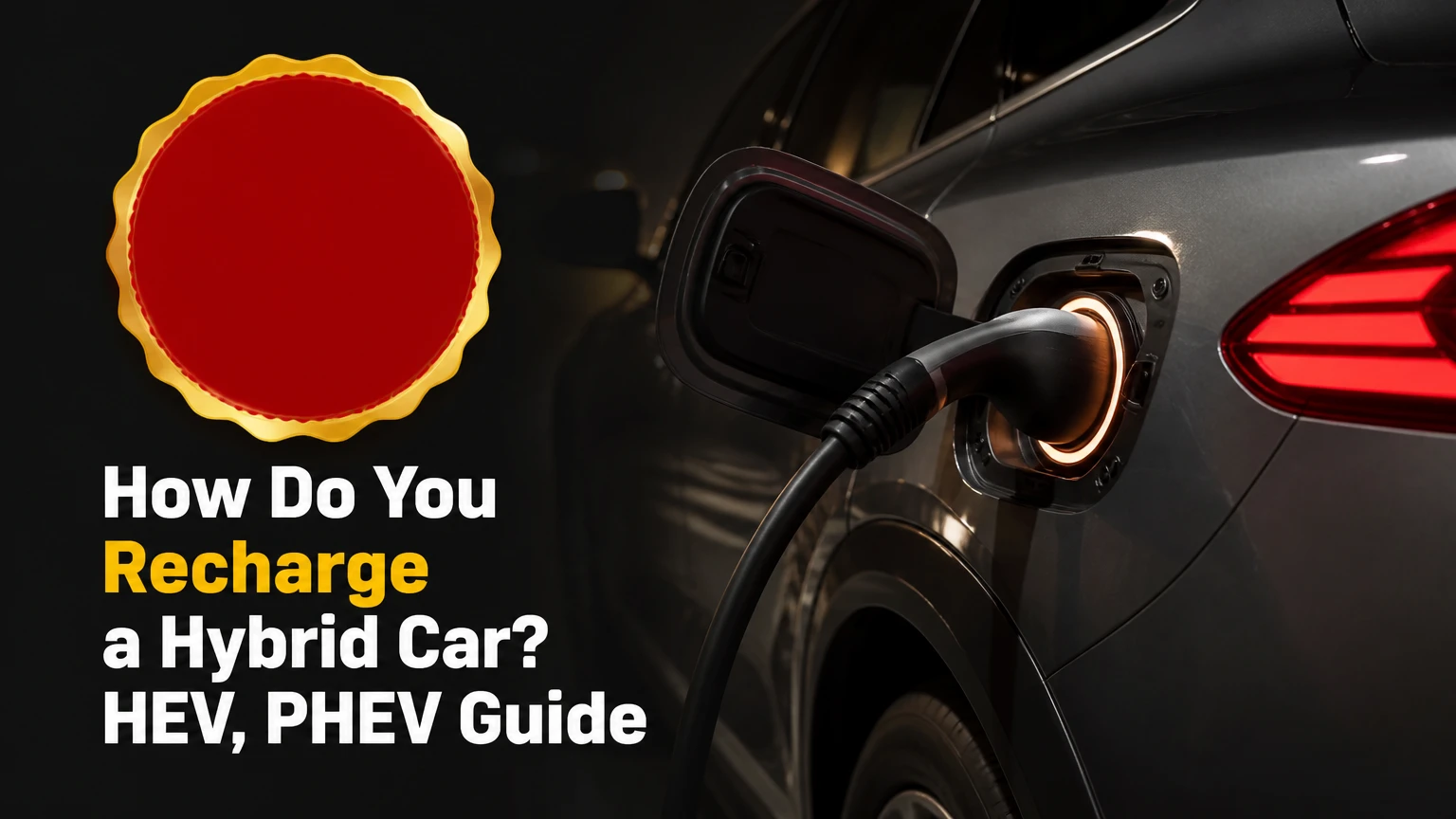
A hybrid car recharges in one of two ways: a traditional hybrid or mild hybrid replenishes its small battery automatically through regenerative braking and engine-generated electricity, while a plug-in hybrid electric vehicle must also connect to an external power source. The vehicle badge, charge port, and owner’s manual identify which procedure applies.
Key Facts at a Glance
- A traditional hybrid electric vehicle, or HEV, cannot be plugged into a wall outlet.
- A mild hybrid electric vehicle, or MHEV, also cannot accept external charging.
- A plug-in hybrid electric vehicle, or PHEV, charges through a vehicle-specific charge port.
- Regenerative braking converts some vehicle motion into electrical energy in HEVs, MHEVs, and PHEVs.
- A PHEV usually charges from a 120-volt outlet in about 5-12 hours or from a 240-volt Level 2 unit in about 1.5-4 hours, depending on battery size and onboard charger capacity.
- A PHEV can still operate on gasoline after its usable electric range is depleted.
Which Hybrid Cars Can Be Plugged In?
Only a plug-in hybrid electric vehicle can normally be recharged from household or public electricity. A traditional hybrid, sometimes called a self-charging hybrid, has no grid-charge inlet, and a mild hybrid uses a small 12-volt, 48-volt, or similar system that the engine and regenerative braking maintain automatically.
Check the vehicle rather than relying on the word “hybrid.” A Toyota Prius Prime, Mitsubishi Outlander PHEV, Ford Escape Plug-in Hybrid, and Volvo XC60 Recharge have external charge ports. A standard Toyota Prius Hybrid, Honda CR-V Hybrid, and many Suzuki mild hybrids do not.
| Vehicle system | External charge port | Typical battery role | How electricity enters |
|---|---|---|---|
| Mild hybrid, MHEV | No | Torque assistance and accessory support | Regeneration and engine-driven generator |
| Traditional hybrid, HEV | No | Electric launch, assistance, and limited EV driving | Regeneration and gasoline engine |
| Plug-in hybrid, PHEV | Yes | Longer electric driving and hybrid assistance | Grid electricity, regeneration, and engine |
| Battery-electric vehicle, BEV | Yes | All propulsion energy | Grid electricity and regeneration |
The fastest identification method is physical. Look for a marked flap labeled Charge, EV, or a lightning-bolt symbol on the front fender, rear quarter panel, or grille area. A fuel door alone does not indicate a plug-in hybrid. Some PHEVs place the charge inlet beside the gasoline filler, while others use separate doors.
What Does “Self-Charging Hybrid” Mean?
“Self-charging hybrid” describes a non-plug-in HEV, not a vehicle that creates free energy. The gasoline engine supplies energy, and regenerative braking recovers part of the vehicle’s kinetic energy during deceleration. The battery cannot sustain propulsion indefinitely because the energy ultimately comes from fuel or previously stored motion.
The term is useful for distinguishing an HEV from a PHEV, but it does not mean an HEV produces more energy than it consumes. The U.S. Department of Energy describes regenerative braking as a way to recover energy that conventional vehicles lose during braking, not as a replacement for an external energy source.
How Do You Recharge a Hybrid Car?
To recharge a hybrid car, first identify whether it is an HEV, MHEV, or PHEV. Drive an HEV or MHEV normally because its control system manages battery replenishment automatically; connect a PHEV to a compatible wall outlet or AC charging station, confirm that the session begins, and leave the vehicle connected until the scheduled or requested charge level is reached.
The charging process is controlled by the battery-management system, inverter, contactors, and onboard charger. The onboard charger converts incoming alternating current, or AC, into direct current, or DC, that the high-voltage battery cells can store. The vehicle limits current when the battery is full, hot, cold, or otherwise outside its preferred operating range.
A PHEV does not necessarily charge faster just because a public station advertises a high output. The vehicle’s onboard charger sets the maximum AC acceptance rate, which may be 3.3, 6.6, 7.2, or 11 kilowatts depending on the model and market. A 7.2-kilowatt station cannot force a 3.3-kilowatt PHEV to charge at 7.2 kilowatts.
How Do Non-Plug-In Hybrids Recharge?
Non-plug-in hybrids recharge automatically when the vehicle slows down, coasts, or runs the gasoline engine under conditions that allow efficient electricity generation. The driver does not connect a cable, select a charging station, or wait for a full battery cycle.
During regenerative braking, the traction motor operates as a generator. Electrical energy passes through power electronics and returns to the battery, while generator resistance helps slow the vehicle. Conventional friction brakes still operate when stronger braking, low speed, emergency stopping, or battery limitations require them.
The gasoline engine can also drive a motor-generator or alternator to maintain the high-voltage battery’s state of charge. Hybrid software decides when to generate electricity, when to use stored energy, and when to protect the battery from excessive temperature or charge levels.
| Driving condition | Main energy flow | Driver action | Typical result |
|---|---|---|---|
| Coasting downhill | Wheels to motor-generator to battery | Lift accelerator smoothly | Partial energy recovery |
| Gentle braking | Wheels to motor-generator to battery | Brake progressively | Regeneration before friction braking |
| Hard braking | Wheels to regeneration and friction brakes | Press brake firmly | Shorter stopping distance, less recovery |
| Acceleration | Battery and engine to wheels | Apply accelerator | Stored electricity assists propulsion |
| Steady cruising | Engine to wheels, occasional generation | Maintain speed | Battery state managed automatically |
| Vehicle stopped | Engine off or idling by control logic | Remain in Park or Drive | Little or no useful traction charging |
Hard braking does not maximize battery charging. Progressive deceleration gives the control system more opportunity to recover energy, but safety and stopping distance always take priority over regeneration.
How Do You Charge a PHEV at Home?
A PHEV charges at home by connecting its portable charging cable to a correctly rated outlet or to a professionally installed Level 2 charging unit. A standard 120-volt connection is usually sufficient for overnight charging, while a 240-volt circuit reduces charging time when the vehicle accepts the higher power.
Before You Start
| Requirement | Typical specification | Why it matters |
|---|---|---|
| Vehicle | PHEV with charge inlet | HEVs and MHEVs cannot use the cable |
| Level 1 outlet | 120 volts, grounded, 15-amp circuit | Provides roughly 1.0-1.4 kW to many portable chargers |
| Level 2 circuit | 208-240 volts, dedicated circuit | Commonly supplies 3.3-9.6 kW to a PHEV |
| Charging cable | Manufacturer-supplied portable EVSE or compatible unit | Controls current and provides electrical protection |
| Parking location | Dry, stable, ventilated area with cable clearance | Reduces trip, water, and connector risks |
| Cost basis | Electricity price multiplied by energy delivered | Produces a better estimate than a flat “full charge” price |
A portable EVSE, or electric vehicle supply equipment, is not simply an extension lead. The control box communicates with the vehicle and manages the electrical connection. Plug the EVSE directly into the wall outlet unless the vehicle manufacturer and electrical professional specifically approve another arrangement.
Step 1: Park and Secure the Vehicle
Put the PHEV in Park, switch the ignition off, and apply the parking brake. Keep the vehicle unlocked or follow the manufacturer’s instructions if the charge-port lock requires an unlocked vehicle during connection.
You will know this step worked when the instrument panel is off or shows the vehicle in a charging-ready state. A common mistake is leaving the car in accessory mode, which can prevent a session from starting or drain the low-voltage accessory battery.
Step 2: Inspect the Outlet, Cable, and Port
Inspect the wall receptacle, EVSE cable, connector, and vehicle inlet for heat damage, cracks, dirt, standing water, ice, or bent contacts. Do not charge through a visibly damaged outlet or connector.
The connector and inlet do not need to be sterilized, but they must be clean and dry. Stop if the outlet feels hot, smells burnt, or shows discoloration. A common mistake is forcing a frozen or obstructed charge-port door, which can damage the latch and sealing surfaces.
Step 3: Connect the EVSE to the Power Source
For Level 1 charging, insert the portable EVSE plug directly into the grounded 120-volt outlet. For Level 2 charging, connect the vehicle to the wallbox with the approved cable, or plug the cable into the station according to the station design.
The EVSE should illuminate its status indicators or complete a self-check. If the unit reports a ground fault, overtemperature condition, or error code, disconnect it and follow the manufacturer’s instructions. Do not bypass a safety warning with an adapter.
Step 4: Insert the Vehicle Connector
Open the charge-port door and insert the connector straight into the PHEV inlet until the latch clicks. Avoid twisting the handle or allowing the cable to hang from the port.
A successful connection usually produces a click, dashboard message, audible tone, or flashing charge indicator. The connector may lock electronically so that it cannot be removed while current is flowing. A common mistake is stopping after the connector touches the inlet without pushing it fully home.
Step 5: Confirm That Charging Has Started
Check the vehicle display and EVSE screen for charging power, estimated completion time, battery percentage, or a scheduled-start message. A solid or pulsing indicator often means charging is active, but color meanings vary by manufacturer.
The session is working when the vehicle reports current flowing or the station displays delivered energy in kilowatt-hours. If the battery percentage remains unchanged, check for a timer, low-cost charging schedule, authentication failure, open door, or connector that did not latch.
Step 6: Set a Schedule or Charge Limit
Use the vehicle’s charging menu to select an immediate start, departure time, or manufacturer-approved charge limit. Daily driving may require 100 percent, but frequent maximum charging and prolonged high temperatures can increase battery aging in some PHEVs.
A scheduled session is useful when overnight electricity is cheaper or when the cabin should precondition before departure. Do not assume every PHEV has the same charge-limit controls. The owner’s manual takes priority over generic battery advice.
Step 7: Stop the Session Before Unplugging
End charging through the vehicle, charging station, or key fob, depending on the system. Unlock the vehicle if the port lock remains engaged, then press the connector release and pull the handle straight out.
The connector should release without force. A common mistake is pulling on the cable before the vehicle has removed the electrical lock, which can damage the latch or connector. If the cable remains locked, use the vehicle’s normal unlock command and consult the manual for the emergency release.
Step 8: Store the Equipment Correctly
Close the charge-port door, replace the connector cap if supplied, and store the cable where it will not be crushed, soaked, or exposed to excessive heat. Do not drive away while the cable remains connected.
A completed session should show a final battery percentage or charging history. The vehicle may stop drawing power before the displayed battery reaches the nominal maximum because the battery-management system reserves a protective buffer.
Which Home Charging Option Is Best?
Level 1 charging is the lowest-cost installation option and fits a PHEV that covers a modest commute overnight. Level 2 charging is preferable when the battery is larger, the vehicle returns home late, or multiple drivers need a predictable recharge window.
| Charging option | Electrical input | Typical PHEV charging time | Typical equipment cost |
|---|---|---|---|
| Level 1 portable EVSE | 120 V, 8-12 A | 5-12 hours | Usually included with vehicle |
| Level 2 portable unit | 240 V, 16-32 A | 2-6 hours | About $300-$900 |
| Level 2 wallbox | 208-240 V, 24-48 A | 1.5-4 hours | About $500-$1,500 installed, location dependent |
| Public AC Level 2 | 208-240 V, station controlled | 1.5-4 hours | About $0.20-$0.60 per kWh, network dependent |
Charging time depends on usable battery capacity, starting state of charge, ambient temperature, current limit, and the PHEV’s onboard charger. A 14-kWh usable battery receiving 1.4 kW cannot refill in the same time as a 9-kWh battery receiving 3.3 kW.
Use this estimate:
Charging cost = energy delivered in kWh × electricity price per kWh
For example, delivering 12 kWh at $0.18 per kWh costs about $2.16 before taxes or station fees. Public stations may add connection, idle, time-based, or membership charges, so the displayed electricity rate is not always the final price.
Can a PHEV Use a Public Fast Charger?
Most PHEVs cannot use a DC fast charger because they lack a DC charge inlet and the high-power conversion hardware required for direct-current charging. A PHEV with a compatible CHAdeMO or other DC connector may accept fast charging, but compatibility depends on the exact model year and market.
A public AC Level 2 station is the normal public option for PHEVs. Check the vehicle inlet, station connector, and network listing before parking. A CCS or NACS connector on the station does not automatically mean a PHEV can use it.
| Public charging type | Connector or standard example | PHEV compatibility | Practical expectation |
|---|---|---|---|
| AC Level 1 | 120-volt household connection | Broad with portable EVSE | Overnight charging |
| AC Level 2 North America | SAE J1772, or vehicle adapter where approved | Common | Several hours |
| AC Type 2 Europe | Type 2 AC connection | Common on compatible vehicles | Several hours |
| DC fast charging | CCS, CHAdeMO, or NACS | Model-specific and uncommon | Verify before arrival |
A PHEV may cost more to charge at a time-billed station than at home because its small battery takes hours to absorb a comparatively small amount of energy. Compare the station’s total fee with the gasoline cost for the same trip.
How Much Does PHEV Charging Cost?
A typical home PHEV charge costs about $1-$5, but the result depends on battery capacity, charging losses, and the local electricity tariff. Public charging can cost less or substantially more because networks may add session fees, parking charges, demand pricing, or idle fees.
| Example battery refill | Energy delivered | Electricity price | Approximate energy cost |
|---|---|---|---|
| Small PHEV | 8 kWh | $0.15/kWh | $1.20 |
| Medium PHEV | 12 kWh | $0.20/kWh | $2.40 |
| Large PHEV | 18 kWh | $0.30/kWh | $5.40 |
| Public session | 12 kWh | $0.45/kWh | $5.40, before extra fees |
Charging losses mean the energy drawn from the wall can exceed the energy stored in the battery. A practical household estimate adds roughly 10-20 percent to the battery’s nominal energy, although vehicle design and temperature change the result.
The economic comparison should use electric miles displaced, not the cost of a theoretical full battery. A driver who returns home with half the battery already charged pays for fewer kilowatt-hours than a driver starting from empty.
How Often Should You Charge a Plug-In Hybrid?
Charge a PHEV whenever convenient if electric driving reduces fuel use, especially after a daily commute that fits within its usable electric range. A PHEV does not need to reach zero before charging, and partial top-ups generally fit normal lithium-ion battery operation.
Daily charging is most useful when the car can use the stored energy before its next gasoline-intensive trip. A driver with a 25-mile electric commute may charge nightly, while a driver without reliable parking electricity may use the PHEV mainly as a gasoline hybrid.
For long-term storage, follow the manufacturer’s specified state-of-charge range. Many manufacturers recommend avoiding prolonged storage at either a completely full or completely empty displayed battery, particularly in high heat, but the exact percentage and procedure differ by model.
Does Cold Weather Change Charging?
Cold temperatures can slow charging and reduce electric range because the battery-management system may limit current until the cells warm. Cabin heating, denser air, winter tires, and reduced regenerative braking also increase energy consumption.
A PHEV parked outside in freezing conditions may show a longer completion estimate than the same vehicle in a heated garage. Preconditioning while connected can warm the cabin and, on supported vehicles, the battery, but it may extend the session’s energy demand.
Never use a heat source, open flame, or improvised cover near the charge connector. Clear ice gently according to the manual rather than striking the charge-port door.
What Are the Most Common Charging Mistakes?
The most common PHEV charging errors involve unsuitable electrical equipment, a locked connector, an active schedule, or unrealistic assumptions about charging speed. Correcting the equipment and vehicle settings usually resolves the problem without replacing the battery or charger.
- Using an ordinary extension cord: Extension cords can overheat, suffer voltage drop, or lack the required grounding. Connect the portable EVSE directly to an approved outlet.
- Ignoring a hot receptacle: Stop charging if the plug or outlet becomes unusually warm, discolored, loose, or odorous. Have the circuit inspected by a qualified electrician.
- Forgetting a charging timer: A departure schedule may delay charging even when the cable is connected correctly. Select immediate charging or adjust the schedule.
- Forcing the connector: Unlock the vehicle and end the session before removal. Pulling against an engaged lock can break the release mechanism.
- Assuming every station is compatible: Confirm AC connector type and vehicle acceptance before driving to a public charger.
- Leaving a full PHEV in extreme heat: Use the manufacturer’s storage and charge-limit settings when the car will sit unused for weeks.
An expert rule of thumb is to troubleshoot in this order: vehicle status, schedule, connector latch, EVSE indicator, outlet, then network payment. Replacing a cable before checking a programmed delay wastes time and money.
Why Is My PHEV Not Charging?
A PHEV that will not charge usually has a power-supply problem, a connector-lock problem, a scheduled session, an incompatible station, or a battery-temperature limitation. Read the vehicle and EVSE error messages before disconnecting equipment or resetting the system.
| Symptom | Likely cause | Safe first response |
|---|---|---|
| No lights on EVSE | Outlet, breaker, or cable fault | Test the outlet only with approved procedure; inspect breaker |
| Connected but delayed | Charging timer or departure schedule | Select immediate charge |
| Connector will not release | Port lock still engaged | Stop session, unlock vehicle, retry |
| Slow power in cold weather | Battery conditioning or thermal limit | Allow temperature to stabilize |
| Public session rejected | Payment, connector, or network issue | End session and verify station compatibility |
| Repeated ground-fault warning | Outlet or EVSE safety fault | Stop using that circuit and seek inspection |
Do not open high-voltage components or attempt to repair the traction battery. A PHEV’s orange cables, inverter, and battery pack require trained technicians and manufacturer-specific procedures.
What If the Hybrid Battery Is Empty?
An “empty” PHEV battery display normally means the vehicle has reached its lower usable reserve, not that the cells contain no energy. The gasoline engine starts, and the hybrid control system preserves enough electrical capacity for starting, emissions control, and power assistance.
A non-plug-in HEV also manages its battery automatically. If an HEV shows a persistent battery warning, loses hybrid propulsion, or enters a reduced-power mode, the issue requires diagnostic service rather than an external charging cable.
A weak 12-volt accessory battery creates a different problem. The 12-volt system powers computers, relays, locks, and startup functions, so a PHEV may fail to begin charging even when its high-voltage battery has energy. Follow the manufacturer’s jump-start procedure and never connect a jump pack to high-voltage terminals.
Which Hybrid Type Fits Your Situation?
A PHEV fits a driver with dependable overnight electricity and daily trips that often fall within the vehicle’s electric range. An HEV fits drivers who park on the street, live in an apartment without charging access, or regularly travel long distances without wanting charging stops.
| Driver situation | Better fit | Reason | Main limitation |
|---|---|---|---|
| 10-25-mile daily commute and driveway outlet | PHEV | Electric miles can replace frequent gasoline use | Higher purchase price |
| Apartment parking without reliable outlet | HEV | No external charging routine | Limited electric-only driving |
| 300-mile highway trips every week | HEV | Fast gasoline refueling and efficient hybrid operation | Fuel remains necessary |
| Short trips in a cold climate with home charging | PHEV | Electric operation remains convenient | Reduced winter range |
| Mixed urban driving and occasional road trips | PHEV or HEV | Both retain gasoline backup | PHEV benefits depend on charging frequency |
A PHEV is not automatically cheaper to own. Its financial advantage shrinks when the owner rarely plugs in, electricity is expensive, or the vehicle spends most of its time on highways after the battery reserve is depleted.
An HEV is not automatically less capable. For a driver without home charging, an efficient HEV can deliver more consistent real-world convenience than an unused PHEV. The best choice follows parking access and trip patterns, not the vehicle’s electric-range number alone.
Frequently Asked Questions
Can You Recharge a Hybrid Car While Driving?
A traditional hybrid and mild hybrid recharge while driving through regenerative braking and engine-generated electricity. A PHEV can also recover energy while moving, but external grid charging requires a stationary connection. Selecting a charge mode that uses the gasoline engine to raise battery charge may be available on some PHEVs, but it generally consumes more fuel than charging from the grid.
Can You Charge a Hybrid From a Regular Wall Outlet?
You can charge a PHEV from a regular grounded wall outlet when the supplied Level 1 EVSE and vehicle manufacturer permit it. A standard HEV or MHEV has no external charging function. The outlet should be suitable for sustained current, and the EVSE should connect directly rather than through an unapproved extension cord.
Is It Safe to Charge a PHEV in the Rain?
Charging a PHEV in ordinary rain is normally safe when the vehicle, connector, EVSE, and outlet are undamaged and used as directed. Do not connect equipment while standing water enters the inlet, and never handle damaged cables. Weather resistance does not make submerged connectors or flooded outlets safe.
Should You Leave a PHEV Plugged In Overnight?
Leaving a PHEV plugged in overnight is normally acceptable when the manufacturer-approved EVSE and electrical circuit are used. The vehicle stops or reduces current after charging, and many models support scheduled charging. For storage lasting weeks, use the manufacturer’s state-of-charge recommendation instead of leaving the battery at maximum charge in extreme heat.
Do Hybrid Cars Need Gasoline After Charging?
A PHEV still needs gasoline for trips beyond its usable electric range and may start the engine for heating, high power, battery protection, or emissions control. An HEV and MHEV always rely on gasoline for primary energy. Plugging in a PHEV reduces fuel consumption, but it does not convert the car into a battery-electric vehicle.
What Should You Do If a Hybrid Charge Cable Is Stuck?
Stop the charging session, unlock the vehicle, and press the connector release according to the owner’s manual. Never yank the cable. If the port lock remains engaged, use the model-specific manual release only as instructed; repeated lock failures require dealer or qualified EV service because the mechanism may be electrically or mechanically damaged.
The Bottom Line
How do you recharge a hybrid car? Plug in a PHEV using its approved Level 1 or Level 2 equipment, verify the charging indicator, and release the connector through the vehicle’s normal unlock procedure. Do not plug in an HEV or MHEV because those systems recharge automatically through regenerative braking and engine-generated electricity. Choose the method that matches the vehicle’s charge port and the manufacturer’s instructions.