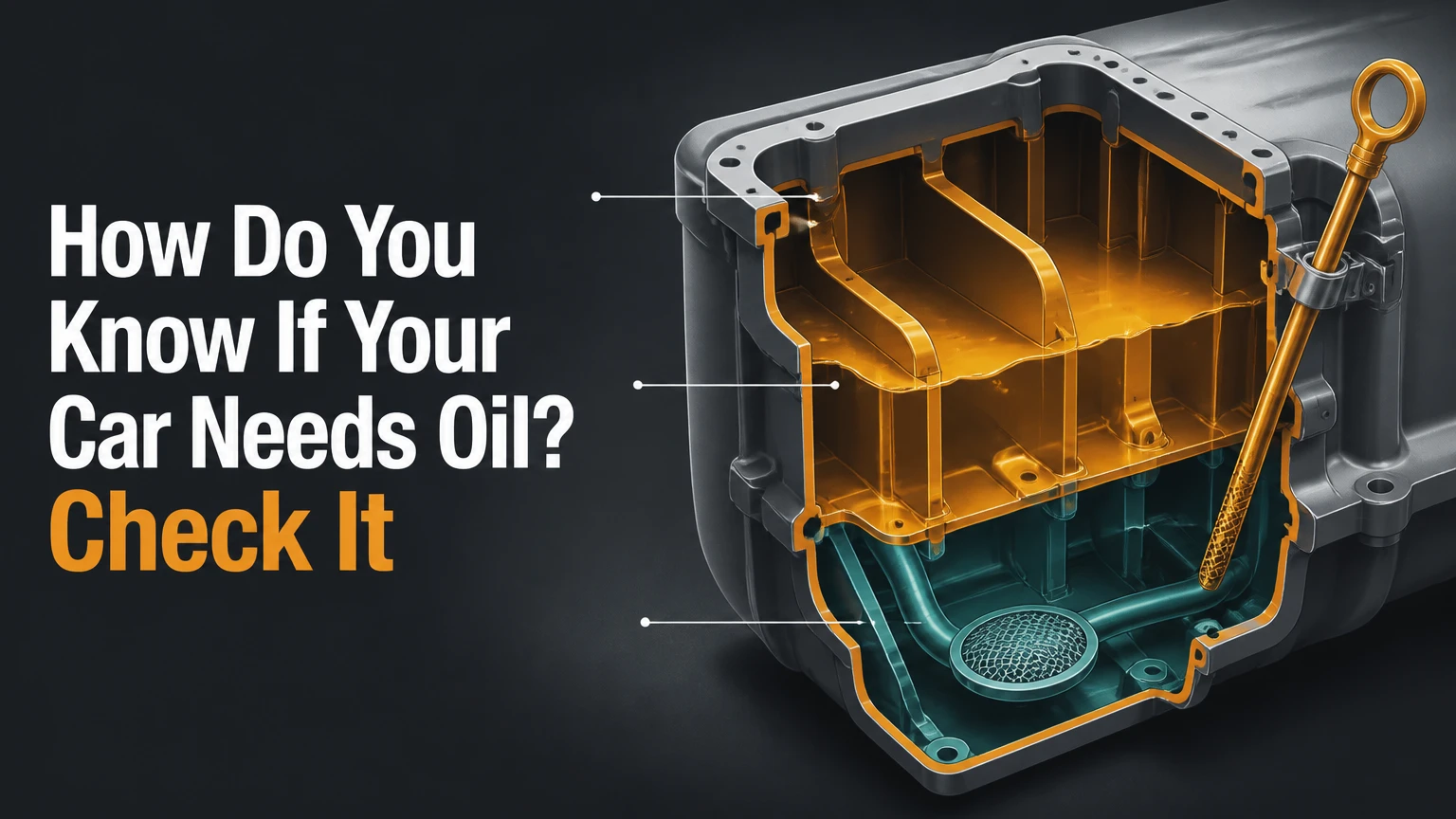
Your car needs oil when the dipstick level is at or below its minimum mark, the vehicle’s oil-life schedule is due, or an oil warning indicates low pressure. Check the level before assuming an oil change is needed, because adding the correct oil may solve low level while dark color alone does not prove oil is worn out.
Key Facts at a Glance
- The engine-oil dipstick, not oil color alone, is the quickest confirmation of oil level.
- The red oil-can warning light usually indicates low oil pressure, so stop the engine as soon as it is safe.
- Oil between the dipstick’s minimum and maximum marks is normally within the acceptable range.
- The correct viscosity and manufacturer specification appear in the owner’s manual or oil-filler cap.
- A low oil level requires finding the cause, because leaks and internal oil consumption can damage an engine.
- Synthetic oil does not create a universal change interval; the vehicle manufacturer’s schedule controls.
What Does Engine Oil Do?
Engine oil lubricates, cools, cleans, seals, and protects moving engine components under high pressure and temperature. A thin oil film separates bearings, cam lobes, piston rings, and cylinder walls, while detergent and dispersant additives suspend contaminants until the oil filter captures them.
The oil pump sends lubricant through galleries to components such as crankshaft bearings, turbocharger bearings, hydraulic lifters, and variable valve timing actuators. Oil also carries heat away from pistons and valve-train parts that coolant cannot directly reach.
Oil performs several jobs at once:
| Oil function | Engine area affected | What happens when oil is inadequate |
|---|---|---|
| Lubrication | Bearings, camshafts, piston skirts | Metal contact, scoring, accelerated wear |
| Cooling | Turbocharger, pistons, timing chain | Higher component temperature and breakdown |
| Cleaning | Ring grooves, crankcase, valve train | Deposits, sludge, restricted oil passages |
| Sealing | Piston rings and cylinder walls | Lower compression, smoke, power loss |
| Hydraulic control | VVT phasers and lifters | Ticking, fault codes, poor running |
A low oil level and degraded oil are different conditions. A car can have clean-looking oil at a dangerously low level, or a full crankcase containing oil that has exceeded its service interval.
How Do You Know If Your Car Needs Oil?
The most reliable immediate test is a correctly performed dipstick check, followed by the maintenance schedule in the owner’s manual. A low reading means the engine needs the specified oil added; a due interval means the oil and filter should be replaced even if the level is full.
What Symptoms Suggest an Oil Problem?
Oil-related symptoms include a low reading, oil-pressure warning, new valve-train ticking, an oil-burning smell, blue exhaust smoke, or a visible leak. Symptoms do not identify the exact fault, so confirm the level and inspect for leaks before authorizing repairs.
| Symptom | More likely meaning | Immediate response |
|---|---|---|
| Oil level below minimum | Leak, consumption, or missed service | Add specified oil in small amounts and inspect |
| Red oil-can light | Low pressure or pressure-sensor fault | Stop engine and check level when safe |
| Blue smoke from exhaust | Oil burning inside cylinders | Avoid hard driving and arrange diagnosis |
| Oil smell near hood | External leak on hot exhaust | Stop if smoke appears and inspect safely |
| Ticking after startup | Low level, drain-back, lifter, or wear | Check oil before driving farther |
| Thick sludge under cap | Severe deposit buildup or neglected service | Schedule professional inspection |
| Rough running with check-engine light | Possible VVT oil-pressure issue | Scan fault codes and check oil condition |
Low oil can produce noise before a warning light appears. Conversely, a faulty oil-pressure switch can trigger a warning when the level is normal, which is why a light requires both a level check and professional pressure testing.
Which Dashboard Lights Matter?
The red oil-pressure light matters more urgently than an oil-change reminder. An oil-life monitor estimates remaining service life from time, mileage, and driving conditions, while an oil-pressure sensor reports pressure in the lubrication system.
| Dashboard message or symbol | What it usually reports | Driving decision |
|---|---|---|
| Red oil can | Low oil pressure | Stop the engine promptly |
| “Change engine oil soon” | Estimated service interval | Book service according to the manual |
| Oil-level warning | Low measured level on some vehicles | Park level and verify the reading |
| Check-engine light with VVT code | Possible oil-flow or actuator issue | Diagnose soon; stop for severe noise |
| Oil-temperature warning | Excessive oil temperature on equipped vehicles | Stop, cool down, and investigate |
Never treat the red oil-pressure light as a routine oil-change reminder. The light can mean an empty crankcase, failed oil pump, clogged pickup, worn bearings, incorrect oil, or a bad sensor. Running for even a short time with genuinely low pressure can destroy bearings and a turbocharger.
How Do You Check the Oil?
Check engine oil on level ground with the engine off and cooled for about 5-10 minutes, unless the owner’s manual specifies a cold-engine procedure. The process takes about five minutes and needs a clean rag, gloves, and the exact oil specification for a possible top-off.
Before You Start
- Time: 5-10 minutes
- Difficulty: Easy, but avoid hot moving parts
- Tools: Lint-free rag or paper towel, gloves, flashlight
- Materials: Correct oil, usually 1 quart or 1 liter for a top-off
- Prerequisites: Level parking surface and engine switched off
- Safety: Do not reach near belts, fans, or a hot exhaust manifold
Step 1: Park on Level Ground
Park on a flat surface, engage the parking brake, and switch off the engine. Sloped ground shifts oil inside the pan and can make a normal level appear low or make a low level appear acceptable.
Success checkpoint: The vehicle is stable and the oil has had several minutes to drain into the pan.
Common mistake: Checking immediately after shutdown, before oil drains from the cylinder head and galleries.
Step 2: Find the Dipstick or Electronic Oil Menu
Look for a yellow or orange handle marked “engine oil.” Some newer vehicles, including certain BMW, Mercedes-Benz, and Audi models, use an electronic oil-level procedure instead of a physical dipstick.
Success checkpoint: The owner’s manual identifies the required temperature, idle time, and menu sequence.
Common mistake: Confusing the transmission dipstick or a capped service tube with the engine-oil dipstick.
Step 3: Wipe and Reinsert the Dipstick
Pull the dipstick out, wipe its entire measuring area clean, push it fully back into the tube, then remove it again. Hold the tip horizontally and read the oil film at both sides of the marked area.
Success checkpoint: The film is continuous and reaches a level between the minimum and maximum marks.
Common mistake: Reading a smeared upper edge caused by the dipstick rubbing against the tube.
Step 4: Interpret the Level
Oil between the minimum and maximum marks is generally usable. The distance often represents about 1 quart or 1 liter, but capacity varies, so add only the amount specified by the manual.
| Dipstick result | Typical meaning | Correct action |
|---|---|---|
| At maximum mark | Full | Do not add oil |
| Halfway between marks | Usable level | Monitor and follow service schedule |
| At minimum mark | Approximately 1 quart low on many cars | Add the manual’s specified amount gradually |
| Below minimum mark | Potentially significant shortage | Add in 0.25-0.5 quart increments and recheck |
| No oil visible | Severe shortage or reading error | Do not start until level is restored and cause checked |
The common instruction to add one full quart immediately is unsafe when the level is only slightly low. Add a small amount, wait briefly, and recheck to prevent overfilling.
Step 5: Inspect Condition Without Overdiagnosing
Fresh oil may be amber, brown, or dark soon after service, especially in a gasoline direct-injection or diesel engine. Grit, thick sludge, coolant-colored emulsion, or a strong fuel smell deserves diagnosis, but color alone cannot establish oil life.
Success checkpoint: The oil has a smooth fluid texture without visible metal flakes, cream-colored contamination, or an overwhelming gasoline odor.
Common mistake: Changing oil solely because it is black, while overlooking a low level or active leak.
Does Dark Oil Mean It Needs Changing?
Dark oil does not automatically mean an engine needs an oil change. Detergents can darken oil as they suspend soot and deposits, while diesel and direct-injection gasoline engines may turn oil dark quickly; mileage, time, oil-life data, and the manufacturer’s schedule provide better evidence.
Oil that looks thick, tar-like, gritty, or gelatinous is more concerning than oil that is merely brown or black. An oil laboratory can measure viscosity, oxidation, fuel dilution, coolant contamination, and wear metals, but most drivers only need that testing for unusual consumption, fleet maintenance, or a suspected internal fault.
When Should Oil Be Changed?
Change oil at the mileage or time interval listed by the vehicle manufacturer, commonly about 5,000-10,000 miles or 6-12 months for many modern vehicles. Severe use, including towing, dusty roads, repeated short trips, extreme temperatures, racing, or prolonged idling, can require a shorter interval.
| Driving pattern | Typical planning range | Why it changes the schedule |
|---|---|---|
| Frequent highway trips | 7,500-10,000 miles | Oil reaches operating temperature consistently |
| Short trips under 10 minutes | 3,000-5,000 miles or 6 months | Moisture and fuel may accumulate |
| Towing or heavy loads | 3,000-5,000 miles | Higher heat and engine load |
| Mostly stop-and-go traffic | 5,000-7,500 miles | More idling and thermal cycling |
| Vehicle stored for long periods | At least annually, per manual | Time and condensation still affect oil |
The “every 3,000 miles” rule is not universal. Some vehicles specify 10,000 miles with approved synthetic oil, while some turbocharged, diesel, or severe-service applications require less. The oil filler cap can identify viscosity, but only the manual or manufacturer service information reliably identifies the complete specification.
Which Oil Should You Add?
Use the viscosity grade and performance specification printed in the owner’s manual, such as SAE 0W-20 or 5W-30 with an API or manufacturer approval. Brand preference is secondary to using the correct grade, certification, and quantity.
| Oil option | Suitable application | Typical interval range | Important limitation |
|---|---|---|---|
| Conventional | Older engines that permit mineral oil | 3,000-5,000 miles | Lower high-temperature reserve |
| Synthetic blend | Vehicles permitting blend formulations | 5,000-7,500 miles | Not automatically approved for every engine |
| Full synthetic | Turbocharged engines and modern engines | 5,000-10,000 miles | Does not override the manual |
| High-mileage formula | Engines over roughly 75,000 miles with consumption | 5,000-7,500 miles | Seal conditioners cannot repair major leaks |
A small emergency top-off with a nearby viscosity is usually less harmful than running dangerously low, but the full oil service should use the specified grade and approval. Mixing 5W-30 and 0W-20 does not automatically starve an engine; the practical risk is using a mixture that fails the manufacturer’s cold-flow, emissions, or wear requirements.
Can You Add Oil Without Changing It?
You can top off oil when the level is low and the oil is otherwise within its service interval. Topping off restores quantity, but it does not remove oxidized oil, fuel dilution, coolant, suspended contaminants, or a saturated filter.
Add approximately 0.25-0.5 quart at a time, wait 30-60 seconds, and recheck on level ground. Stop at or just below the maximum mark. Never pour the full engine capacity into a low-reading crankcase, because the remaining oil has not left the engine.
When Is Low Oil an Emergency?
Low oil becomes an emergency when the red oil-pressure light stays on, the dipstick is dry, the engine knocks, smoke comes from the engine bay, or oil is visibly pouring out. Shut the engine off, move to a safe location if possible, and arrange towing rather than testing whether the car can continue.
What Do Abnormal Oil Conditions Mean?
Abnormal oil appearance or odor often points to a fault beyond routine maintenance. Milky oil suggests coolant contamination, a gasoline smell suggests fuel dilution, and rapidly falling oil with no puddle suggests internal consumption or a hidden leak.
| Observation | Possible cause | Recommended response |
|---|---|---|
| Beige “mayonnaise” under cap | Condensation from short trips, or coolant leak | Check dipstick; inspect urgently if widespread |
| Chocolate-milk oil on dipstick | Coolant in crankcase | Do not drive; arrange towing |
| Strong raw-fuel odor | Injector fault, misfire, or short-trip dilution | Change oil after diagnosis |
| Metal glitter | Bearing, cam, or timing-component wear | Stop driving and inspect |
| Oil on exhaust shield | Valve-cover or turbo oil leak | Stop if smoke or fire risk develops |
| Falling level without puddles | Rings, valve seals, PCV, or evaporation | Measure consumption and perform diagnosis |
A small creamy deposit only under the filler cap can occur in cold weather when condensation does not evaporate. Coolant-colored oil throughout the dipstick is a different finding and can damage bearings quickly.
Why Does Oil Level Keep Dropping?
Oil level drops because oil leaks externally, passes piston rings or valve seals, enters the intake through the PCV system, or evaporates under high temperature. Modern turbocharged engines can consume measurable oil without producing an obvious blue smoke cloud.
Measure the dipstick at the same location and temperature every 500-1,000 miles. Record the amount added. A repair shop can use UV dye, a pressure inspection, compression testing, leak-down testing, or PCV testing to separate external leakage from internal burning.
Which Oil Type Fits Each Driver?
Full synthetic oil is often sensible for turbocharged engines, severe temperatures, and long manufacturer-approved intervals, while conventional oil remains acceptable where the manual permits it. High-mileage oil can reduce minor seepage, but it cannot substitute for a gasket, seal, PCV, or turbocharger repair.
| Driver situation | Practical choice | Service approach |
|---|---|---|
| New turbocharged commuter car | Manufacturer-approved full synthetic | Follow the severe or normal manual schedule |
| Older car with minor seepage | Approved high-mileage blend or synthetic | Track level and repair active leaks |
| Frequent short winter trips | Correct synthetic grade | Use severe-service timing |
| Highway-focused road-trip vehicle | Approved synthetic | Use the maximum manual interval |
| Towing a trailer | Approved synthetic with required rating | Use the towing or severe-service schedule |
Synthetic oil is not a cure for sludge, worn rings, or a leaking rear main seal. Its advantages include stronger temperature performance and more stable viscosity, but the correct approval matters more than the word “synthetic” on the bottle.
What Mistakes Cause Oil Damage?
The most expensive oil mistakes are driving with an active pressure warning, overfilling, using the wrong specification, and assuming a full dipstick rules out an oil-system fault. A full crankcase cannot compensate for a failed oil pump, blocked pickup, clogged filter, or worn bearing.
- Overfilling: Excess oil can contact the crankshaft, foam, raise crankcase pressure, and damage seals or catalytic components. Drain the excess rather than relying on eventual consumption.
- Ignoring a leak: Adding oil prevents immediate starvation but does not repair the leak. Check the parking surface, filter seal, drain plug, valve cover, and turbo plumbing.
- Reusing the old filter: A filter retains contaminants and may have a bypass valve that opens when restricted. Replace the filter at every oil change.
- Trusting the oil-life monitor blindly: The monitor estimates service life and cannot detect a punctured pan or a suddenly low level.
- Using additives to solve mechanical wear: Additives cannot restore bearing clearance or repair a cracked head gasket.
- Failing to verify the reading: A tilted vehicle, recently started engine, or incompletely seated dipstick can produce a false result.
A practitioner’s rule is simple: verify quantity first, identify the correct specification second, and diagnose why the quantity changed third. That order prevents a cheap top-off from masking an expensive developing fault.
How Much Does an Oil Service Cost?
A typical oil change costs about $50-$120 for a common passenger vehicle, while premium synthetic, diesel, luxury, or high-capacity engines can cost $100-$250. A top-off usually costs $8-$25 for one quart, depending on oil grade and brand.
| Service item | Typical quantity or time | Typical US cost |
|---|---|---|
| DIY conventional oil change | 4-6 quarts, 30-60 minutes | $25-$50 |
| DIY full synthetic change | 4-6 quarts, 30-60 minutes | $35-$80 |
| Shop synthetic oil change | 4-6 quarts, 15-45 minutes | $70-$150 |
| Large truck or diesel service | 7-12 quarts, 30-60 minutes | $120-$250 |
| Diagnostic oil-pressure test | 30-90 minutes | $75-$180 |
Engine capacity varies widely. A small four-cylinder may require 4-5 quarts, while a V8 pickup or diesel may need 7-12 quarts, so confirm capacity before purchasing oil.
Frequently Asked Questions
Can I check engine oil when the car is hot?
You can check oil warm only when the owner’s manual permits it. Switch the engine off, wait about 5-10 minutes, and keep hands away from hot exhaust components; some vehicles require a fully cold reading or a precise electronic measurement sequence.
How long can a car run after the oil light comes on?
A car should not be driven with the red oil-pressure light illuminated, even for a planned short distance. Pull over safely, shut off the engine, and check the level after several minutes. If the level is normal, tow or test the vehicle because pressure may still be dangerously low.
Is it bad to add a different brand of motor oil?
Different brands can generally be mixed temporarily when they meet the same viscosity and performance specification. Brand mixing is less concerning than using the wrong SAE grade, API category, manufacturer approval, or oil type for the engine.
Why is my oil full but the car still says low oil?
A full dipstick with a low-oil message can indicate a faulty level sensor, incorrect electronic measurement procedure, wiring problem, or oil trapped on an uneven surface. Recheck according to the manual and have the sensor system scanned if the warning remains.
Does a hybrid car need engine oil?
A hybrid with a gasoline engine still needs engine oil and scheduled oil changes. The gasoline engine may run fewer hours, but short starts, cold operation, and the manufacturer’s time limit still apply; follow the hybrid-specific maintenance schedule rather than estimating from electric miles alone.
The Bottom Line
To answer “how do you know if your car needs oil,” park on level ground, wait 5-10 minutes, and read the dipstick correctly. Add the specified oil only when the level is low, change oil according to the manufacturer’s mileage or time schedule, and stop driving immediately if the red oil-pressure light, severe engine noise, smoke, or rapid oil loss appears.