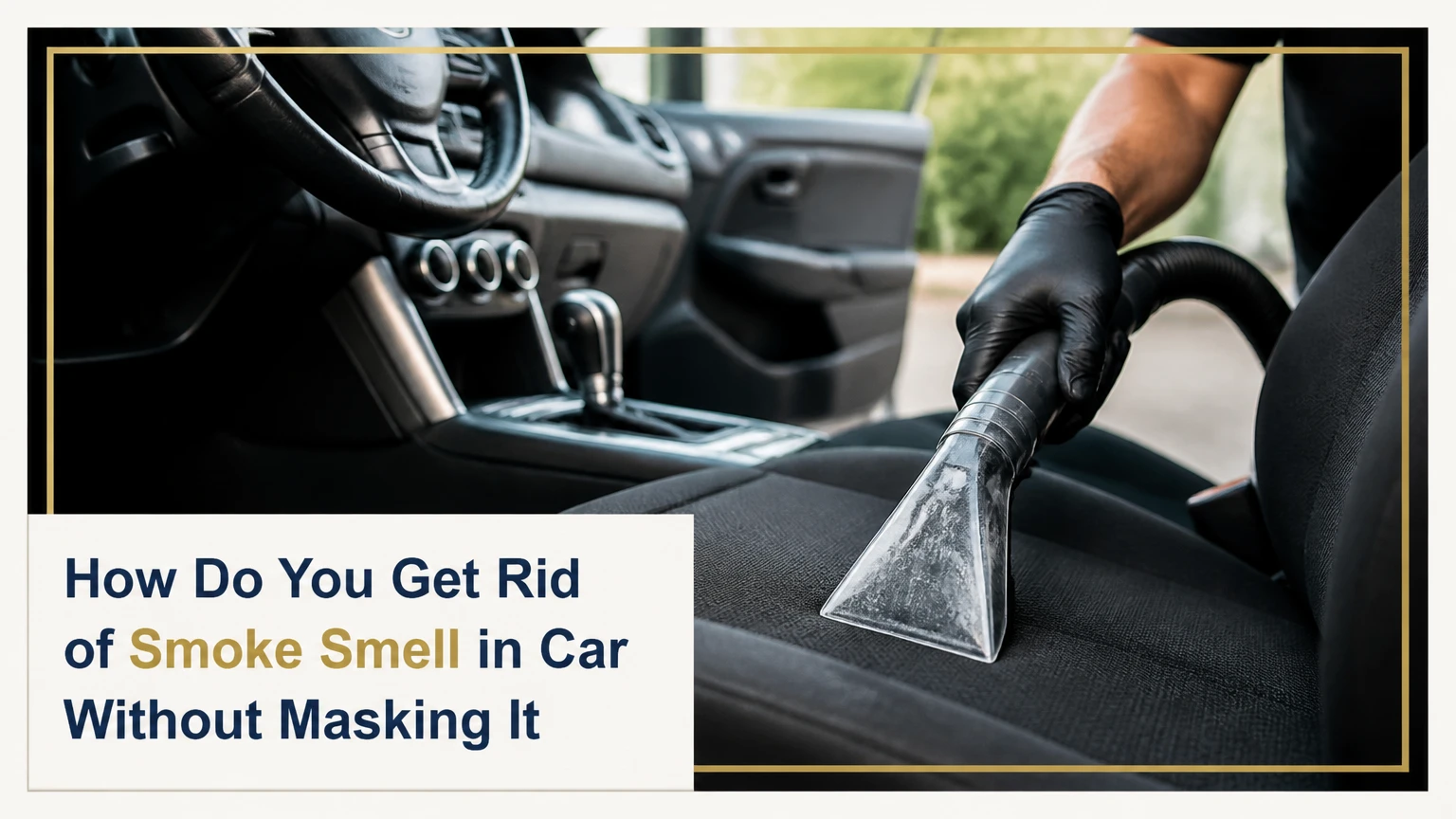
To get rid of smoke smell in a car, remove ash and debris, degrease every hard surface, extract contaminated fabric, replace the cabin filter, and then deodorize only after the interior is completely dry. A mild odor may take 2-4 hours of work, while heavy third-hand smoke usually requires professional extraction or replacement of contaminated materials.
Key Facts at a Glance
- Smoke odor persists because nicotine, tar, and volatile compounds form residue on glass, plastics, fabric, foam, and HVAC components.
- A complete DIY treatment typically costs $30-$100 and takes 4-8 hours, including drying time.
- Cabin-filter replacement helps when the air conditioner smells, but it cannot remove residue from seats, carpet, or headliner.
- Baking soda and charcoal can reduce a faint odor, but they cannot dissolve heavy tar or nicotine film.
- Ozone is toxic to breathe and can damage rubber, plastics, dyes, and leather when misused; nobody may occupy the vehicle during treatment.
- The most reliable sequence is dry removal, wet cleaning, extraction, HVAC service, full drying, and final deodorization.
Why Does Smoke Odor Return After Cleaning?
Smoke odor returns when cleaning removes airborne scent but leaves third-hand smoke residue inside porous materials. Cigarette and cannabis smoke contain fine particles, nicotine, tar-like compounds, and volatile organic compounds that settle on the headliner, seat foam, carpet backing, door panels, glass, and ventilation system.
Smoke contamination has two layers. The first is loose ash and dust, which a vacuum can remove. The second is a sticky film that needs a compatible cleaner and physical wiping or extraction. Fabric can hold residue below its visible surface, so a car may smell acceptable immediately after spraying and become odorous again when the cabin heats in sunlight.
The American Lung Association states, “There is no safe level of exposure to secondhand smoke.” Odor removal is not the same as making a vehicle chemically uncontaminated, especially after years of smoking. Cleaning reduces residue and odor; it does not certify that every compound has been eliminated.
Which areas usually hold the most odor?
| Interior location | Typical contamination | Why it matters | Recommended treatment |
|---|---|---|---|
| Headliner | High | Smoke rises and bonds to foam-backed fabric | Light damp wiping, no saturation |
| Front seat foam | High | Clothing and open windows expose cushions | Fabric cleaner plus extraction |
| Carpet and padding | High | Ash settles into fibers and backing | Vacuum, shampoo, wet extraction |
| Cabin air filter | Medium to high | Filter media traps circulating particles | Replace with new filter |
| Glass and dashboard | Medium | Film remains on nonporous surfaces | Degreaser and glass cleaner |
| Seat belts and buckles | Medium | Belts contact smoke-heavy clothing | Pull out, wipe, dry fully |
How Do You Get Rid of Smoke Smell in Car?
The most dependable car-smoke odor removal method has six stages: remove loose debris, clean nonporous surfaces, wash and extract fabrics, service the HVAC system, dry the cabin completely, and apply a final deodorizer if needed. Plan on 4-8 hours of hands-on and drying time for a typical sedan.
The order matters. Wet-cleaning before vacuuming turns ash into a smear, and deodorizing before removing residue usually creates a temporary perfume-and-smoke mixture. Work outdoors or in a well-ventilated space, check every product on an inconspicuous area, and follow the vehicle and cleaner manufacturer’s instructions.
Before You Start
| Requirement | Typical specification |
|---|---|
| Total project time | 4-8 hours, including 2-6 hours of drying |
| DIY materials cost | $30-$100, depending on extractor access |
| Difficulty | Moderate for fabric, easy for hard surfaces |
| Cleaner quantity | 16-32 fl oz automotive interior cleaner |
| Extraction water | 1-3 gallons for a sedan |
| Vacuum time | 20-40 minutes |
| Replacement part | One vehicle-specific cabin air filter |
| Conditions | Dry weather, shade, ventilation, electrical access |
Remove child seats, floor mats, cargo, trash, and personal belongings before cleaning. Read labels for leather, alcantara, suede, vinyl, and coated plastics. Never mix bleach, ammonia, acids, enzyme products, chlorine dioxide, or other cleaners.
Step 1: Remove Ash, Trash, and Loose Residue
Start by removing every loose contamination source from the vehicle. Take out floor mats, seat covers, rubbish, ashtrays, spare clothing, and removable trunk liners, then vacuum the cabin with a crevice attachment before applying liquid.
Move the front seats fully forward and backward so the vacuum reaches rails and carpet edges. Check door pockets, the console bin, seat gaps, under-seat wiring covers, cup holders, trunk wells, and the area around the spare tire. Use a soft brush around switches and vents instead of forcing debris into them.
Wash rubber or plastic mats separately with warm water and an automotive cleaner. Do not vacuum loose ash with a household vacuum if it contains a hot ember. Dispose of ash in a sealed bag only after confirming that no heat remains.
Success checkpoint: The vacuum can no longer collect visible gray particles from seams, tracks, or carpet edges.
Common mistake: Spraying fragrance or cleaner before removing ash, which spreads residue across the cabin.
Step 2: Degrease Hard Surfaces and Clean Glass
Clean the dashboard, steering wheel, steering column, door panels, console, trim, grab handles, instrument surround, and inside door frames with an automotive interior cleaner. Apply the product to a microfiber towel rather than directly onto electronics, speaker grilles, switch gaps, or air vents.
Smoke film is especially noticeable on the inside of glass. Use a dedicated automotive glass cleaner and two clean microfiber towels, one for cleaning and one for buffing. Clean the rear-view mirror, visor mirrors, sunroof glass, and the upper edge of each window where residue often remains.
Use separate towels for the steering wheel and glass. A greasy cleaner left on the steering wheel can reduce grip, while an alcohol-heavy product can damage some soft-touch coatings. Product compatibility is more important than choosing the strongest chemical.
Success checkpoint: A white microfiber towel stays nearly clean after wiping a dashboard edge and the upper inside of a window.
Common mistake: Saturating buttons or vents, which can cause electrical faults or trap moisture behind trim.
Step 3: Treat the Headliner, Belts, Seats, and Carpet
Clean the headliner with minimal moisture because its fabric is commonly bonded to a thin foam layer. Lightly dampen a microfiber towel with an interior or fabric cleaner, wipe a small section gently, and immediately follow with a dry towel. Do not spray the headliner directly or scrub in circles.
Pull each seat belt out to its stop and clamp it safely so it cannot retract during cleaning. Wipe the belt webbing with diluted fabric cleaner, remove residue with a second damp towel, and leave the belt extended until completely dry. Keep liquid away from the retractor mechanism.
For cloth seats and carpet, use an automotive upholstery cleaner compatible with an extractor. Agitate lightly with a soft upholstery brush, extract the dirty solution, and make additional dry passes with the wet vacuum. Extraction removes dissolved residue; spraying without extraction leaves it in the cushion.
| Material | Safe starting method | Drying requirement | Avoid |
|---|---|---|---|
| Cloth seat | Diluted upholstery cleaner, light agitation | 4-8 hours | Flooding seat foam |
| Nylon carpet | Cleaner plus wet extraction | 2-6 hours | Leaving detergent in backing |
| Leather | Leather cleaner, damp cloth, conditioner | 1-3 hours | Enzyme cleaner or excess water |
| Alcantara or suede | Manufacturer-approved cleaner only | 4-8 hours | Steam or aggressive brushing |
| Headliner | Lightly damp microfiber towel | 2-4 hours | Direct spraying and saturation |
| Seat belt webbing | Damp wipe while extended | 2-4 hours | Soaking the retractor |
Success checkpoint: Extracted water becomes progressively clearer, and fabric feels damp rather than wet after the final pass.
Common mistake: Adding more cleaner when odor remains. More chemical often means more residue, not better odor removal.
Should you use steam on a smoke-contaminated interior?
Steam can loosen residue on durable, water-resistant surfaces, but it is risky on headliners, glued trim, leather coatings, electronics, and seat occupancy sensors. A professional may use controlled vapor on appropriate materials, but a household steam cleaner should not be treated as a universal interior solution.
Step 4: Replace the Cabin Filter and Diagnose the HVAC System
Replace the cabin air filter because smoke particles can accumulate in its media and re-enter the cabin whenever the blower operates. Install the exact filter size and airflow direction specified by the vehicle manufacturer; a filter installed backward may restrict airflow or filter poorly.
Test the HVAC system before using any duct product. With the car stationary outdoors, switch between fresh-air and recirculation modes, then run the blower at several speeds. If odor appears mainly when outside-air mode is selected, inspect the cowl intake and filter housing. If odor appears immediately from the vents in both modes, the evaporator case, duct surfaces, or heater box may be contaminated.
Do not spray an entire aerosol can into an exterior intake unless the product label specifically directs that procedure for the vehicle. Liquid overspray can reach blower electronics, wiring, or sensors. Many HVAC cleaners use a small access tube or drain-tube application, and the correct method varies by model.
Success checkpoint: Vent odor is substantially lower after the new filter is installed and the blower runs for 10 minutes.
Common mistake: Assuming the cabin filter caused all odor. The filter is replaceable, but seat foam and carpet remain independent sources.
Step 5: Dry the Vehicle Completely
Drying is part of odor removal, not an optional finishing step. Open all doors and the trunk in a secure, dry location, use fans if available, and run the vehicle only outdoors when operating the HVAC system.
Do not close the vehicle while carpets or seats feel cool and damp. Moisture trapped below carpet padding can produce mildew odor and can wick dissolved smoke residue back to the surface. A moisture meter is useful, but the practical test is to press a clean, dry towel firmly into upholstery and carpet edges; the towel should remain dry.
Typical drying times range from 2 hours for lightly damp hard-wearing fabric in warm airflow to 8 hours for thick carpet padding or seat cushions. Humid weather extends the process.
Step 6: Use Final Deodorization Only if Residue Cleaning Is Complete
Use activated charcoal or a vehicle-safe odor absorber for a faint residual smell after cleaning. Place 200-500 grams in breathable containers under the seats for 48-72 hours, then remove and assess the cabin. Charcoal adsorbs some odor molecules, but it does not dissolve nicotine film.
Ozone and chlorine dioxide are specialized treatments, not substitutes for cleaning. Ozone can irritate lungs and oxidize rubber, plastics, dyes, adhesives, and leather finishes. Chlorine dioxide products can also irritate the respiratory system and must be used exactly as labeled in an empty, sealed vehicle.
If a qualified professional uses ozone, the vehicle must be unoccupied, the treatment area must be controlled, and the cabin must be ventilated thoroughly afterward. Never sit in the car to monitor a running ozone generator. A smell-free cabin is not proof that ozone has fallen to a safe concentration.
| Method | Typical cost | Contact time | Best use | Main limitation |
|---|---|---|---|---|
| Baking soda | $2-$8 | 8-24 hours | Very faint fabric odor | Does not remove tar film |
| Activated charcoal | $8-$25 | 48-72 hours | Residual odor after cleaning | Slow and low-capacity |
| Enzyme or upholstery cleaner | $10-$30 | 30-60 minutes before extraction | Cloth seats and carpet | Requires compatible fabric and extraction |
| Chlorine dioxide kit | $15-$35 | 2-4 hours | Residual odor in an empty vehicle | Label, ventilation, and exposure limits |
| Ozone treatment | $40-$150 DIY equipment or rental | 30-120 minutes | Professional post-cleaning treatment | Respiratory and material risks |
| Professional detailing | $200-$600 or more | 1-2 days | Heavy, long-term contamination | Cost and possible material replacement |
Which Smoke-Odor Method Should You Choose?
The best method depends on contamination severity, interior material, HVAC involvement, and whether the vehicle must be usable the same day. Mild odor responds to cleaning and ventilation, while visible yellow film, ash deposits, or odor from the vents usually requires extraction and HVAC service.
| Situation | First treatment | Expected DIY time | Likely total cost | Professional threshold |
|---|---|---|---|---|
| Faint odor, no stains | Vacuum, wipe, charcoal | 2-4 hours | $15-$40 | Not usually needed |
| Moderate cigarette odor | Full cleaning, extraction, filter | 4-8 hours | $40-$120 | Consider after one failed cycle |
| Heavy odor with yellow film | Professional extraction and deodorization | 1-2 days | $200-$600 | Recommended immediately |
| Odor only from vents | Filter and HVAC diagnosis | 1-3 hours | $20-$150 | Needed for evaporator access |
| Leather interior | Leather-safe cleaning, ventilation | 3-6 hours | $30-$100 | Needed for foam or trim contamination |
| Cannabis smoke and ash | Same residue-removal sequence | 4-8 hours | $40-$120 | Recommended for persistent odor |
When is professional detailing worth the cost?
Professional detailing is justified when smoke odor is strong after one complete cleaning, when the headliner or seat foam is visibly stained, or when the odor comes from the HVAC system. A professional detailer can use commercial extraction equipment, remove interior panels, access hidden carpet padding, and determine whether replacement is cheaper than repeated treatment.
Ask for an itemized scope rather than an “ozone-only” promise. The estimate should state whether it includes vacuuming, hard-surface degreasing, headliner treatment, carpet extraction, cabin-filter replacement, HVAC cleaning, drying, and post-treatment ventilation.
A professional treatment may still fail if smoke entered behind the dashboard or if foam, insulation, carpet backing, or the headliner has absorbed years of residue. Replacement of one headliner or seat cushion can sometimes outperform repeated chemical treatment.
Can Baking Soda, Coffee, or Vinegar Remove Smoke Smell?
Baking soda and activated charcoal can reduce a faint residual odor, but coffee, perfume, and vinegar do not remove heavy smoke contamination. Vinegar may add its own odor, coffee masks rather than extracts residue, and fragrance products commonly produce a combined smoke-and-perfume smell.
Use household absorbents only after source cleaning. Sprinkle a thin layer of baking soda on removable, compatible carpet or fabric, leave it for 8-24 hours, and vacuum it completely. Do not place loose powder near seat rails, switches, vents, or exposed electronics.
Do not combine vinegar with bleach or other cleaners. Chemical mixtures can release irritating gases. For a persistent odor, another controlled cleaning and extraction cycle is more useful than adding a stronger household odor absorber.
Why Does the Car Smell Worse in Hot Weather?
Heat increases off-gassing from smoke residue trapped in fabric, foam, carpet backing, and plastics. A vehicle can smell acceptable in cold weather and become strongly odorous after sitting in direct sun because warmth drives volatile compounds back into the cabin air.
Use a heat test after cleaning. Close the dry vehicle in sunlight for 30-60 minutes, then open the door and smell the headliner, front seat belt, seat crease, carpet edge, trunk, and air vents separately. The strongest location identifies the next treatment target.
Do not treat a hot interior with excessive cleaner. Allow surfaces to cool, follow product temperature limits, and ventilate before occupants enter. Heat helps diagnose odor, but it does not replace extraction.
What If the Smell Still Remains?
A remaining odor usually indicates one missed reservoir, insufficient extraction, trapped moisture, or HVAC contamination. Recheck the cabin systematically instead of applying more deodorizer.
- Smell the seat belts, especially the driver’s belt and the belt beside the smoking window.
- Wipe the steering-wheel underside, turn-signal stalks, column shroud, and lower dashboard.
- Inspect the carpet under front seats, seat rails, trunk wells, and removable trim.
- Check the headliner above the driver and passenger windows.
- Run fresh-air and recirculation modes separately to identify HVAC involvement.
- Check for damp carpet or a mildew note that may have developed after over-wetting.
If odor appears only when the blower starts, arrange model-specific evaporator or duct cleaning. Do not drill random holes or spray through a drain tube without service information, because incorrect access can damage the HVAC case or introduce liquid into electrical components.
Situational Variations for Different Interiors
Leather, cloth, alcantara, child restraints, and convertible tops need different cleaning limits. The safest product is the one approved for the specific material, not necessarily the strongest odor neutralizer.
Leather seats
Vacuum seams, wipe with a leather-safe cleaner, and apply a compatible conditioner after the surface dries. Leather itself is less absorbent than cloth, but perforations, stitching, seat foam, and carpet underneath can retain smoke odor. Keep liquid out of perforated seat cushions and electrical controls.
Alcantara and suede
Use only the manufacturer-approved cleaner and technique. Excess water can create rings, flatten the nap, or damage adhesive layers. Professional treatment is preferable when odor has penetrated an alcantara headliner or seat.
Child seats
Follow the child-seat manufacturer’s washing instructions. Do not use ozone, chlorine dioxide, bleach, or unapproved solvents on harness webbing or padding, because chemical and oxidation damage may not be visible. Replace a child seat if the manufacturer prohibits the required cleaning method.
Cannabis smoke
Cannabis odor often combines volatile plant compounds with ash and tobacco residue. Remove ash, clean glass and fabric, replace the cabin filter, and inspect the trunk and spare-tire well if cannabis was stored there. Air freshener rarely resolves the plant-oil component.
Common Mistakes and How to Fix Them
| Mistake | Why it fails | Recovery action | Prevention |
|---|---|---|---|
| Using fragrance first | Masks residue and creates mixed odor | Degrease and extract again | Deodorize last |
| Flooding cushions | Pushes residue into foam and slows drying | Extract repeatedly and ventilate | Use controlled spray |
| Skipping seat belts | Belt webbing retains smoke film | Extend, wipe, and dry belts | Include belts in Step 3 |
| Running ozone while wet | Adds respiratory and material risk | Ventilate and dry completely | Use only after drying |
| Spraying HVAC intake blindly | May damage electronics or sensors | Stop and inspect service method | Follow vehicle-specific instructions |
| Reusing the old filter | Reintroduces trapped particles | Install the correct new filter | Replace during HVAC work |
One practitioner rule is worth remembering: if a clean white towel turns yellow or brown after wiping a supposedly clean panel, odor treatment is premature. The surface still contains transferable residue.
Another counterintuitive rule is that a stronger-smelling cleaner is not necessarily more effective. Residual detergent can hold odor compounds at the surface and make the vehicle smell clean until humidity or heat releases both odors.
A third rule concerns drying: extraction removes contaminated liquid, but only airflow removes the remaining moisture. A wet vacuum alone cannot guarantee a dry seat cushion.
The Bottom Line
To get rid of smoke smell in a car, clean the contamination source rather than covering the odor. Vacuum ash, degrease hard surfaces, treat the headliner carefully, extract cloth and carpet, clean or replace the cabin filter, dry every material completely, and reserve ozone or chlorine dioxide for controlled post-cleaning use.
A faint odor can usually be handled for $15-$100 in one day. Heavy smoke with visible staining, recurring heat-related odor, or smell from the HVAC system justifies professional detailing at roughly $200-$600 or more. The decisive factor is physical residue removal, not the strength of the final fragrance.
Frequently Asked Questions
Does leaving the car windows open remove smoke odor?
Leaving windows open improves ventilation but does not remove nicotine film embedded in fabric, foam, carpet, or plastic. Ventilation is useful after wet cleaning and chemical treatment, yet it should follow vacuuming, degreasing, extraction, and HVAC service rather than replace them.
How many times should I clean a smoke-filled car?
One complete cleaning cycle is often enough for a mild odor, while moderate contamination may need two cycles separated by full drying. If strong odor remains after two properly executed cycles, inspect the HVAC system and consider replacing contaminated foam, carpet padding, or the headliner.
Does replacing the cabin air filter remove cigarette smell?
Replacing the cabin filter removes a concentrated source of trapped smoke particles and can improve vent odor, but it cannot remove residue from the cabin. A new filter works best alongside HVAC cleaning and interior surface treatment.
Can I use an ozone generator in a car overnight?
Do not run an ozone generator overnight unless a qualified operator has established a controlled, label-compliant procedure. Ozone is unsafe to inhale and prolonged exposure can oxidize rubber, plastics, adhesives, dyes, and leather. The vehicle must be empty, isolated, and ventilated before use.
How do I remove smoke smell from a car headliner?
Use a lightly dampened microfiber towel and a compatible fabric cleaner, working in small sections without saturating or aggressively scrubbing. Direct spray can loosen the headliner adhesive and cause sagging. Severe odor or staining may require professional removal or headliner replacement.
Will a car wash remove smoke smell?
An exterior car wash does not remove smoke odor because the contamination is inside the cabin, upholstery, carpet, glass, and HVAC system. An interior detail that includes residue removal, fabric extraction, filter replacement, and drying is the relevant service.