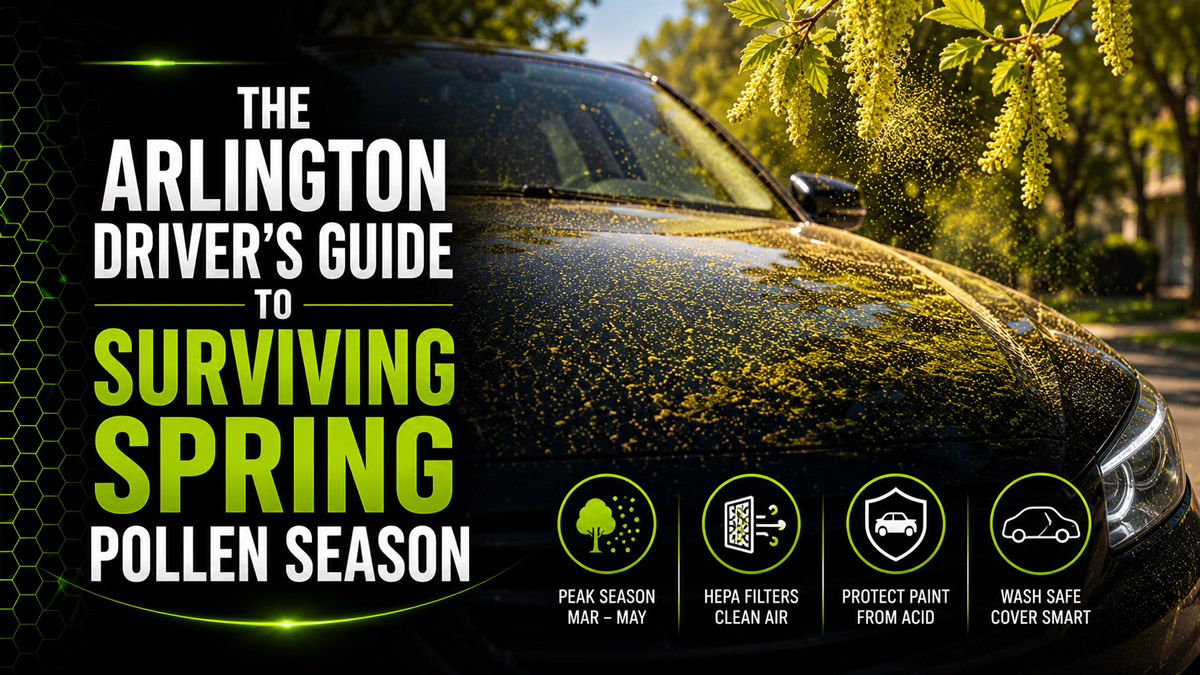
The Arlington driver’s guide to surviving spring pollen season is a comprehensive vehicle maintenance strategy that prevents exterior paint degradation from acidic botanical fallout and eliminates interior allergen infiltration. This localized protocol utilizes high-efficiency cabin air filters, synthetic surface sealants, and adapted HVAC circulation practices to mitigate the heavy tree pollen loads native to Northern Virginia.
Key Facts / Quick Answer
- Peak Season: Arlington’s spring pollen season typically runs from early March through late May, dominated by oak, birch, and pine allergens.
- Filtration: Replacing OEM filters with HEPA-grade cabin air filters captures 99.97% of particulates (down to 0.3 microns) and reduces interior allergy symptoms.
- HVAC Settings: Engaging the HVAC recirculation mode blocks outside air from pulling fresh pollen into the vehicle cabin during heavy bloom days.
- Paint Protection: Applying polymer sealants creates a synthetic barrier against pollen, which becomes highly acidic and corrosive when mixed with morning dew.
- Safe Cleaning: Washing vehicles with a pH-neutral automotive soap and utilizing a 5-layer car cover outdoors prevents the micro-scratches caused by dry-wiping pollen dust.
- Maintenance Interval: Activated carbon and HEPA cabin filters require replacement every 10,000 to 12,000 miles to maintain optimal airflow and filtration efficiency.
When Does the Arlington Spring Pollen Season Peak?
The Arlington spring pollen season peaks between early March and late May, driven by dense populations of mature deciduous and coniferous trees in the Northern Virginia area. Oak, birch, and pine trees are the primary contributors to the yellow-green dust that coats vehicles during this 90-day window. Pine pollen produces the most visible accumulation due to its large grain size, while birch and oak pollen generate finer particulates that easily bypass standard automotive weather stripping and lower-tier ventilation filters.
Why Does Spring Pollen Damage Vehicle Clear Coats?
Spring pollen damages vehicle clear coats through a combination of mechanical abrasion and chemical etching. Under a microscope, individual pollen grains feature sharp, hook-like structures designed to cling to pollinators. When drivers dry-wipe pollen off a vehicle, these microscopic hooks drag across the clear coat, inflicting highly visible swirl marks and spiderweb scratches.
Furthermore, pollen triggers chemical etching when exposed to moisture. When dry pollen settles on a hood and mixes with Arlington’s heavy spring morning dew or light rain, the pollen prematurely germinates and releases tannic and humic acids. This sticky, acidic buildup lowers the localized pH on the paint surface to roughly 4.0 to 5.0. If left unwashed and baked by the sun, this acidic slurry permanently etches into the clear coat, requiring professional machine compounding to remove.
How Can You Protect Exterior Paint from Acidic Buildup?
Protecting exterior paint from acidic buildup requires establishing a sacrificial chemical barrier between the clear coat and the environment. Because pollen naturally clings to bare paint, untreated vehicles accumulate fallout at a much higher rate. Modern chemical surface protectants lower the surface tension of the paint, making the exterior slick and preventing the microscopic hooks of the pollen from anchoring to the vehicle.
Polymer Sealants vs. Ceramic Coatings vs. Natural Waxes
Selecting the correct surface protectant dictates how easily a vehicle sheds sticky, acidic buildup. While traditional carnauba wax provides a deep shine, synthetic options deliver superior chemical resistance.
In practice, polymer sealants offer the most practical defense for the average driver. They are cost-effective, resist the acidic nature of wet pollen, and can be applied quickly by hand before the peak bloom in early March.
Steps for Safely Washing Pollen Without Scratching Paint
Washing vehicles to remove heavy pollen requires specific lubrication techniques to avoid driving the abrasive grains into the clear coat. Automatic car washes with spinning brushes aggressively grind pollen into the paint. Instead, manual washing with high-lubricity chemicals is mandatory.
- Pre-Rinse with a Foam Cannon: Cover the dry, pollen-coated vehicle with a thick layer of pH-neutral automotive snow foam. Allow the foam to dwell for five minutes to encapsulate and lift the pollen grains off the paint.
- Pressure Wash Top to Bottom: Rinse the foam off using a pressure washer (set to no more than 1,500 PSI) or a strong garden hose, starting at the roof and working downward. This removes 90% of the abrasive material without any physical contact.
- Prepare the Two-Bucket Wash System: Fill one bucket with soapy water and a second bucket with clean water and a grit guard.
- Agitate with a Microfiber Wash Mitt: Dip the microfiber mitt into the soapy water, gently wash a single panel in straight lines (never circles), and immediately rinse the dirty mitt in the clean water bucket before reloading it with soap.
- Dry with Forced Air or High-Pile Towels: Blow the vehicle dry with a leaf blower or gently pat the surface dry using a damp, high-pile microfiber drying towel to prevent friction.
What Are the Best Physical Barriers for Parked Vehicles?
The best physical barriers for parked vehicles are specialized multi-layer fabrics that block microscopic particulate matter while allowing trapped moisture to evaporate. For vehicles parked outdoors in Arlington’s tree-heavy neighborhoods, experts recommend a 5-layer car cover.
A high-quality 5-layer cover consists of a soft fleece inner lining to protect the clear coat, three micro-porous breathable mid-layers to filter out pollen grains, and a UV-resistant outer shell. Drivers must never use cheap, single-layer plastic tarps; these lack breathability and will trap ground moisture underneath, creating a greenhouse effect that accelerates paint oxidation and rust. Furthermore, covers should only be placed on freshly washed cars, as dragging a cover over a pollen-dusted vehicle will act like sandpaper against the paint.
How Does the Arlington Driver’s Guide to Surviving Spring Pollen Season Protect Cabin Air?
The Arlington driver’s guide to surviving spring pollen season protects cabin air by transforming the vehicle’s HVAC system into a sealed, hospital-grade respiratory defense mechanism. Without active mitigation, a vehicle’s ventilation system actively pulls thousands of cubic feet of pollen-dense air into the passenger compartment every minute.
Selecting Activated Carbon and HEPA-Grade Cabin Filters
Standard original equipment manufacturer (OEM) cabin air filters consist of thin, single-layer paper designed only to catch large debris like leaves and bugs. To survive peak allergy season, upgrading the filtration media is non-negotiable.
Activated carbon cabin filters represent the first tier of defense. These filters feature a layer of charcoal that neutralizes exhaust odors and traps larger pollen grains. For allergy sufferers, HEPA-grade filtration (High-Efficiency Particulate Air) is the ultimate solution. True HEPA automotive filters capture 99.97% of airborne particles down to 0.3 microns, easily trapping the microscopic birch and oak pollen that triggers severe sinus reactions. To maintain this level of protection, drivers must replace cabin air filters at least every 10,000 to 12,000 miles. Waiting longer causes the filter media to clog, restricting airflow and forcing the HVAC blower motor to overwork and potentially fail.
The HVAC Recirculation Protocol
The HVAC recirculation protocol is a daily driving habit that blocks exterior air from entering the cabin. When the recirculation button (the icon showing an arrow turning inside a car silhouette) is engaged, the climate control system stops pulling fresh air from the cowl at the base of the windshield—the exact area where pollen naturally accumulates. Instead, the system re-filters and conditions the existing interior air.
However, running recirculation indefinitely leads to elevated carbon dioxide (CO2) levels and window fogging. In practice, drivers should engage recirculation while driving through dense residential neighborhoods or driving behind other vehicles kicking up pollen dust. When traveling on open highways at higher speeds, where pollen density is slightly lower and airflow is high, drivers should briefly turn off recirculation for 5 to 10 minutes to introduce fresh oxygen, then re-engage the system.
Expert Insights: Common Mistakes Arlington Drivers Make
Through years of analyzing vehicle degradation and HVAC performance during Northern Virginia’s heavy bloom cycles, practitioners note several critical errors drivers make when combating botanical fallout:
- Using Standard Windshield Washer Fluid: Most drivers use cheap blue washer fluid to clear pollen from the windshield. Because pollen is highly resinous, standard fluids simply smear the yellow dust into a dangerous, opaque paste, blinding the driver in direct sunlight. Experts recommend swapping to a high-concentration bug-and-tar washer fluid combined with new silicone wiper blades during spring.
- Neglecting Sunroof and Cowl Drains: Pollen acts like silt. When it washes off the roof during a rainstorm, it flows into the vehicle’s water channels. If drivers do not blow out their sunroof drains and windshield cowls with compressed air, the heavy pollen sludge hardens and clogs the tubes, leading to severe interior water leaks into the footwells.
- Leaving Windows Cracked for Heat Ventilation: Attempting to keep a parked car cool by leaving the windows cracked a half-inch is disastrous during spring. This creates a vacuum effect that pulls fine birch pollen into the interior, embedding it deeply into the porous fibers of cloth seats and carpets, requiring expensive hot-water extraction to remove.
Frequently Asked Questions About The Arlington Driver’s Guide to Surviving Spring Pollen Season
How do I clean pollen out of my car interior if I left the windows down?
To clean interior pollen, do not use water, which turns the pollen into a sticky dye. First, use a HEPA-filtered shop vacuum with a soft brush attachment to dry-extract the grains. Next, wipe hard plastics with an interior detailing spray and a microfiber towel. For cloth seats, use a dry, stiff-bristled detailing brush to lift the pollen before vacuuming.
Does a ceramic coating make washing pollen off the car easier?
Yes, a ceramic coating significantly improves pollen removal. The silicon dioxide (SiO2) creates a chemically inert, highly hydrophobic surface with extremely low surface tension. This prevents the microscopic hooks of the pollen from gripping the paint, allowing drivers to rinse off the majority of the accumulation using only a pressure washer.
Can pollen permanently ruin my car’s clear coat?
Yes, if left untreated. When pollen gets wet from dew or rain, it releases tannic acid. If this acidic mixture is allowed to bake into the clear coat under the hot spring sun, it etches the paint. Once etching occurs, washing will not fix it; the clear coat must be physically leveled via professional machine compounding.
Are HEPA cabin filters bad for my car’s HVAC blower motor?
HEPA filters restrict airflow more than standard paper filters due to their dense media structure. While modern vehicle blower motors can handle this slight resistance, a dirty HEPA filter will strain the motor severely. It is critical to adhere strictly to the 10,000 to 12,000-mile replacement interval to prevent premature HVAC motor failure.
Why does my car smell like a dirty sponge during spring?
A sour or dirty sponge odor indicates that organic matter, including pollen and tree sap, has bypassed a cheap cabin filter and accumulated on the HVAC system’s air conditioning evaporator core. The trapped pollen ferments in the dark, damp environment, causing mold. Resolving this requires spraying an enzymatic cleaner directly into the evaporator case.