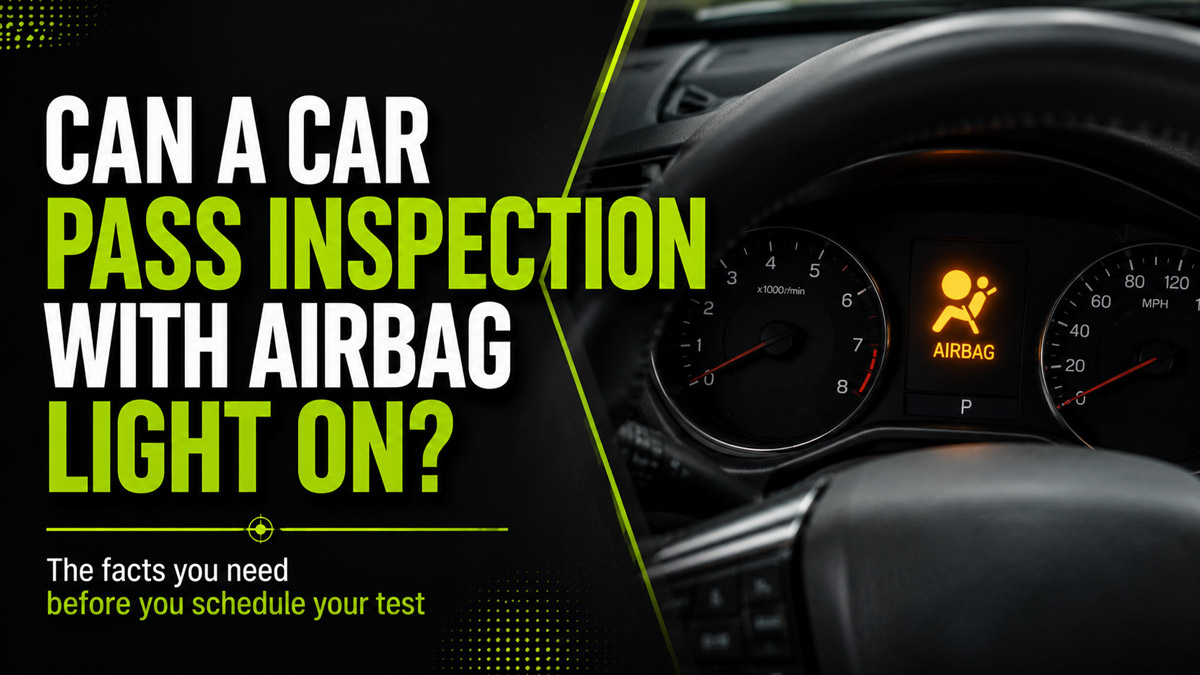
A car can sometimes pass inspection with the airbag light on, but the result depends on the jurisdiction and the type of inspection being performed. An illuminated airbag warning light may be advisory during an emissions-only test, while a comprehensive safety or rebuilt-vehicle inspection may treat it as a failure.
Key Facts at a Glance
- An airbag light indicates that the Supplemental Restraint System has detected a fault.
- Passing inspection does not prove that the airbags will operate correctly in a collision.
- Emissions inspections usually evaluate engine-emissions systems rather than airbags.
- Safety-inspection rules differ between states, provinces and countries.
- Clearing the warning light without repairing the fault rarely provides a permanent solution.
- A professional SRS diagnostic scan commonly costs about $100 to $200.
Will an Airbag Light Automatically Fail Inspection?
An airbag light does not automatically cause an inspection failure everywhere. The result depends on whether the inspection program includes the Supplemental Restraint System as a pass-or-fail safety item.
For example, New York inspectors check the airbag warning lamp and notify the owner when it remains illuminated, but the condition is advisory and is not itself a reason to reject an ordinary passenger vehicle.
Texas changed its inspection system on January 1, 2025. Most non-commercial vehicles no longer receive an annual safety inspection, although vehicles registered in designated emissions counties may still require emissions testing. An airbag warning light is not one of the emissions systems evaluated during that test.
California’s standard Smog Check focuses on emissions-related OBD functions, including the check-engine malfunction indicator, readiness monitors and emissions trouble codes. The SRS airbag warning light is separate from the emissions malfunction indicator.
These examples should not be treated as universal rules. Regulations can differ for commercial vehicles, taxis, imported vehicles, rebuilt titles and salvage examinations.
What Does the Airbag Warning Light Mean?
The airbag warning light means the vehicle’s Supplemental Restraint System, or SRS, has detected a malfunction. The affected system may include airbags, impact sensors, seat-belt pretensioners, passenger-occupancy sensors, wiring or the airbag control module.
When the ignition is switched on, the SRS warning light normally illuminates briefly while the control module performs a self-test. The light should then turn off.
A problem is likely present when the light:
- Remains illuminated after startup
- Flashes continuously or in a repeating pattern
- Never illuminates during startup
- Turns on intermittently while driving
Depending on the vehicle and fault, one airbag, several airbags or the complete restraint system may be disabled. The seat belts still provide protection, but the supplemental protection expected from the airbags or pretensioners may not be available.
What Does an Inspector Check?
An inspector generally observes whether the airbag warning lamp completes its normal startup sequence. The exact result depends on the inspection manual governing that vehicle.
A typical observation follows this sequence:
- The inspector switches on the ignition or starts the engine.
- The airbag light illuminates during the system self-check.
- The light turns off if the control module detects no active fault.
- The light remains on or flashes if an SRS fault is stored.
- The inspector applies the jurisdiction’s pass, fail or advisory rule.
A warning light that never comes on can also attract attention. It may indicate a burned-out bulb, removed instrument-cluster LED or deliberate tampering rather than a functioning restraint system.
Does the Inspection Type Matter?
Yes. The inspection type is often more important than the warning light itself.
| Inspection type | Likely effect of airbag light |
| Emissions-only inspection | Usually not directly tested |
| Routine safety inspection | Pass, advisory or fail depending on local rules |
| Combined safety and emissions test | Depends on the safety inspection checklist |
| Rebuilt or salvage examination | More likely to require an operational SRS |
| Commercial vehicle inspection | Separate rules may apply |
| Pre-purchase inspection | Usually reported as a serious safety defect |
An emissions inspection evaluates pollution-control equipment such as the catalytic converter, fuel-vapor controls, oxygen sensors and emissions-related OBD system. The airbag system does not control tailpipe emissions.
A rebuilt-title inspection can be more demanding because inspectors may need to confirm that collision damage was repaired properly and that required safety equipment is present. Never assume that the rule for an ordinary annual inspection also applies to a salvage or reconstructed vehicle.
Can the Car Pass Emissions With the Airbag Light On?
A car can generally pass an emissions test with only the airbag light illuminated, provided the emissions system satisfies all applicable requirements. The airbag light and check-engine light belong to different vehicle systems.
A vehicle may still fail emissions testing because of:
- An illuminated check-engine light
- Emissions-related diagnostic trouble codes
- Incomplete OBD readiness monitors
- Communication failure with the emissions computer
- Missing or modified emissions equipment
- Excessive exhaust emissions
Do not confuse an SRS warning with the engine-shaped malfunction indicator lamp. Inspectors treat the two lights differently.
Can the Car Pass a Safety Inspection?
A car may pass a safety inspection with the airbag light on when local regulations classify the warning as advisory. It will fail where the inspection standard specifically requires the airbag lamp and SRS to operate correctly.
Before the appointment, consult the current inspection checklist published by the government agency responsible for the vehicle’s registration. Do not rely only on a repair shop, an old forum discussion or rules from another state.
Important variables include:
- Vehicle registration location
- Passenger or commercial classification
- Model year
- Original equipment requirements
- Standard, salvage or rebuilt title
- Annual, transfer or import inspection
- Whether the lamp is illuminated, flashing or inoperative
Why Is the Airbag Light On?
The most common causes are electrical connection faults, damaged steering-wheel components, seat-sensor problems and crash-related SRS codes.
Loose Wiring Under a Front Seat
Front seats contain wiring for side airbags, buckle switches, pretensioners and occupant-detection systems. Moving the seat, storing objects beneath it or cleaning the interior can disturb a connector.
A loose connection may cause an intermittent warning that appears after the seat is moved.
Failed Clock Spring
The clock spring is a ribbon-style electrical connection behind the steering wheel. It maintains contact with the driver’s airbag, horn and steering-wheel controls while the wheel turns.
A damaged clock spring may cause several symptoms together:
- Airbag warning light
- Inoperative horn
- Failed steering-wheel buttons
- Cruise-control problems
Seat-Belt Pretensioner Fault
Pretensioners tighten the seat belts during a serious collision. A damaged buckle switch, pretensioner circuit or wiring connector can activate the SRS warning.
A deployed pretensioner normally requires replacement rather than resetting.
Passenger-Occupancy Sensor Problem
The front passenger seat may use pressure sensors or an occupant-classification module to determine whether the passenger airbag should be enabled.
Liquid spills, damaged seat foam, wiring faults and improper seat replacement can interfere with calibration.
Low Battery Voltage
A weak battery, charging-system failure or jump-start event can produce low-voltage SRS codes. Replacing the battery may correct the voltage problem, but a stored code may remain until it is diagnosed and cleared with compatible equipment.
Previous Collision or Water Damage
A previous crash can deploy airbags or pretensioners and store crash data in the control module. Floodwater can corrode connectors, sensors and modules, causing intermittent or permanent faults.
How Much Does Airbag-Light Repair Cost?
Airbag-light repair may cost less than $100 for a minor connection issue or more than $2,000 when multiple restraint components require replacement.
| Repair | Typical total cost |
| Professional SRS diagnostic scan | $100–$200 |
| Connector or minor wiring repair | $50–$250 |
| Seat-belt buckle or pretensioner | $200–$700 |
| Clock spring replacement | $250–$600 |
| Occupancy sensor or seat calibration | $350–$1,000 |
| Impact sensor replacement | $250–$700 |
| SRS control module repair or replacement | $400–$1,500 |
| Airbag and related collision repairs | $1,000–$5,000+ |
Actual pricing depends on the vehicle, labor rate, calibration requirements and number of damaged components. Luxury vehicles and cars with dashboard, curtain or seat-mounted airbags can cost substantially more.
Can You Reset the Airbag Light Before Inspection?
The airbag light can be cleared only after the underlying condition is repaired or no longer active. Deleting a code without correcting the fault usually causes the light to return during the next startup self-test.
Disconnecting the battery is not a reliable repair. Many SRS modules retain fault information in nonvolatile memory, meaning the code remains stored without battery power.
A correct reset process is:
- Scan the SRS module using a tool that supports the vehicle.
- Record the diagnostic trouble code.
- Follow manufacturer-specific diagnostic procedures.
- Repair or replace the faulty component.
- Perform any required calibration.
- Clear the code.
- Cycle the ignition and confirm that the light turns off normally.
- Rescan the module to confirm that no active code returns.
Standard low-cost OBD-II readers often read only powertrain codes. The scanner must specifically support airbags or SRS functions.
Is It Safe to Check the Wiring Yourself?
A visual inspection around the seats can be performed cautiously, but probing, measuring or repairing airbag circuits should be left to a trained technician. Airbags and pretensioners contain pyrotechnic devices that can deploy with considerable force.
Safe preliminary checks include:
- Remove objects stored under the front seats.
- Look for obviously pinched or disconnected wiring.
- Note whether the warning changes when a seat is moved.
- Check whether the battery recently failed or was disconnected.
- Look for open manufacturer safety recalls.
Do not use a test light or ordinary multimeter directly on airbag deployment circuits. Do not splice wires, install resistors or use an emulator to imitate a functioning airbag.
Before disconnecting an SRS connector, technicians normally disconnect the battery and follow the manufacturer’s specified waiting period. The correct procedure varies by vehicle because the system can retain backup electrical energy.
Can You Bypass the Airbag Light to Pass?
You should not bypass the airbag light. Removing the bulb, covering the warning, adding a resistor or installing an emulator can hide the symptom without restoring occupant protection.
A bypass may also create several problems:
- The airbags may fail to deploy.
- An airbag may deploy incorrectly.
- The vehicle may fail a later inspection.
- The alteration may reduce resale value.
- A buyer may claim that a safety defect was concealed.
- Insurance or liability disputes may follow a collision.
An inspection sticker is not worth defeating a life-safety system.
What Should You Do Before Inspection?
Check the current inspection rules first, then have the vehicle scanned if the airbag light could cause failure or if you want the restraint system restored.
Use this preparation checklist:
- Confirm whether your area requires emissions, safety or combined testing.
- Determine whether different standards apply to rebuilt or commercial vehicles.
- Start the car and observe the warning-light sequence.
- Check for items interfering with wiring under the seats.
- Arrange an SRS-capable diagnostic scan.
- Ask for the exact fault code and written repair estimate.
- Check the vehicle identification number for open airbag recalls.
- Complete the repair and confirm that the light remains off after several starts.
A recall-related airbag repair may be performed without charge by the manufacturer. New York DMV, for example, warns that certain unresolved “Do Not Drive” airbag recalls must be corrected before affected vehicles can be inspected.
Should You Drive With the Airbag Light On?
Driving may still be mechanically possible, but the vehicle’s crash-protection system cannot be assumed to work correctly. Treat the illuminated light as a safety defect rather than merely an inspection problem.
The risk is especially serious when:
- The vehicle has been in a collision.
- An airbag or pretensioner previously deployed.
- The horn and steering controls also stopped working.
- The vehicle has flood damage.
- A manufacturer issued an airbag recall.
- A child or front-seat passenger regularly uses the vehicle.
Seat belts should always be worn because airbags supplement seat belts rather than replace them.
The Bottom Line
A car can pass inspection with the airbag light on in some jurisdictions, particularly when the test is emissions-only or the SRS warning is advisory. It can fail in locations or inspection categories that require a fully operational airbag system.
Check the exact rules for the vehicle’s registration location, but do not treat a passing result as proof that the car is safe. Diagnose and repair the SRS fault so the airbags and seat-belt pretensioners can provide their intended protection.
Frequently Asked Questions
Will a disconnected seat connector cause an airbag light?
Yes. A loose connector under a front seat can interrupt communication with a side airbag, seat-belt buckle, pretensioner or occupancy sensor. Reconnecting it may correct the electrical fault, but the stored SRS code may still require clearing with a compatible diagnostic scanner.
Will disconnecting the battery turn off the airbag light?
Usually not permanently. SRS modules commonly store diagnostic codes even when battery power is removed. If the original fault remains, the warning light will return as soon as the system performs another self-test.
Can a regular OBD-II scanner clear an airbag light?
Most basic OBD-II scanners cannot access the airbag control module. You need a scan tool that specifically supports SRS functions for the vehicle’s manufacturer, model and year.
Can a car be sold with the airbag light on?
Rules vary by location, but the defect should be disclosed clearly. Concealing an SRS warning or falsely claiming that the airbags function can expose the seller to legal and financial disputes, especially after a collision.
Is the airbag light the same as the check-engine light?
No. The airbag light monitors the Supplemental Restraint System, while the check-engine light monitors emissions-related engine and powertrain faults. An emissions test may ignore the airbag warning but fail the vehicle for an illuminated check-engine light.
How long does an airbag-light diagnosis take?
An initial scan may take 15 to 30 minutes, while complete diagnosis commonly takes one to two hours. Intermittent wiring faults, occupancy-sensor calibration and previous collision repairs can require additional testing.