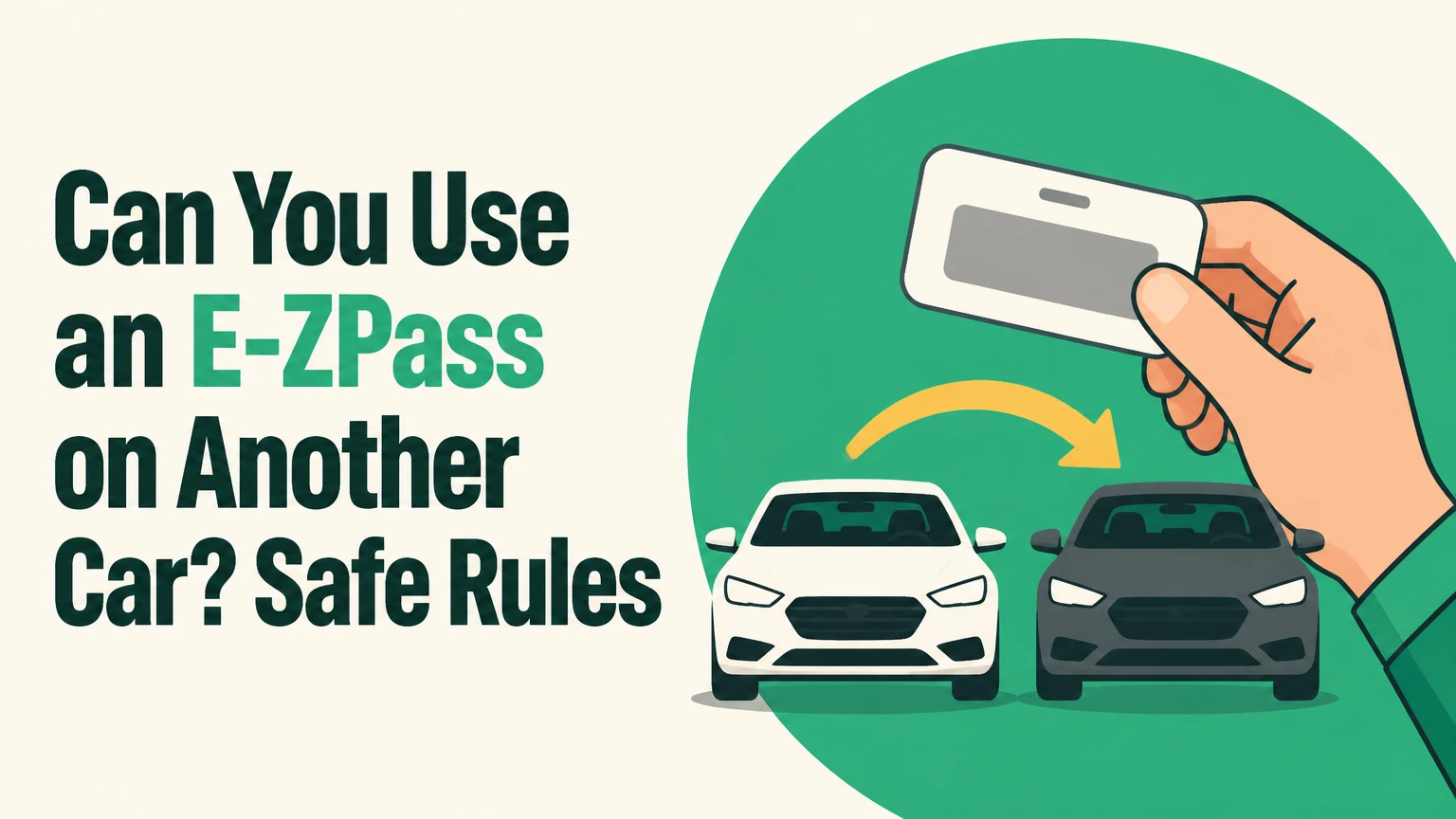
Yes, you can use an E-ZPass transponder in another car if the toll agency permits it, the second vehicle is added to your account, and the vehicle has the same toll classification. A removable hardcase tag can usually move between passenger cars, but adhesive sticker tags are generally vehicle-specific. Rental-car rules require extra care.
Key Facts at a Glance
- An E-ZPass transponder identifies the account, while the toll agency also uses the vehicle’s license plate and classification.
- Add the other car’s plate to your E-ZPass account before driving through a toll point.
- A standard two-axle passenger car usually matches another two-axle passenger car, but trucks, trailers, buses, and motorcycles may differ.
- Removable hardcase transponders can usually move; adhesive sticker transponders commonly cannot.
- A rental company may charge its own toll-service fee even when your personal E-ZPass pays the toll.
- E-ZPass agencies set their own account rules, so the issuing agency’s official website controls when guidance differs.
Can You Use an E-Z Pass on Another Car?
You can use an E-ZPass on another car, but the safe method is to register that car’s license plate on the same E-ZPass account before the trip. The transponder should also be mounted according to the issuing agency’s instructions, and the second vehicle should have the same toll class as the vehicle normally associated with the tag.
The key distinction is between physically moving the device and being authorized to use it. Radio-frequency identification can read the tag in a different vehicle, but an unlisted plate or mismatched vehicle class can cause a violation, an incorrect toll, or manual review.
Policies differ among New York E-ZPass, New Jersey E-ZPass, Maryland E-ZPass, Pennsylvania Turnpike, Ohio Turnpike, and other participating agencies. E-ZPass is an interoperable network, not one single customer-service office. The agency that issued your account determines registration, replacement, rental, and vehicle-class rules.
What Does an E-ZPass Actually Identify?
An E-ZPass transponder sends a unique electronic identifier to an overhead toll reader. The toll system links that identifier to your account, then checks the vehicle plate, axle count, and other classification information when the toll transaction is processed.
If the reader cannot detect the tag, a camera may capture the license plate. The toll authority can then issue a video toll or plate-based invoice. A registered plate may receive the account’s ordinary toll rate, while an unregistered plate can receive a higher invoice and an administrative fee.
The Pennsylvania Turnpike Commission, Ohio Turnpike, and individual E-ZPass agencies describe plate-based enforcement differently, so a failed read does not guarantee the same outcome everywhere. A working transponder is still the most reliable method.
What Must You Do Before Using E-ZPass in Another Vehicle?
Before using E-ZPass in another vehicle, add the vehicle’s exact plate information to the issuing agency’s account and verify its classification. The account should show the correct state, plate number, plate type, and effective date before the vehicle enters a toll facility.
Use this preparation sequence:
- Identify the issuing agency. Check the logo, account statement, or transponder number.
- Log in through the official website or application. Avoid links in unsolicited text messages or emails.
- Open the vehicle or tag section. Labels include Vehicles, Vehicles and Tags, Manage Vehicles, or License Plates.
- Enter the plate precisely. Include the correct state, letters, numbers, plate type, and expiration information.
- Set the effective date. Some agencies allow immediate activation; others advise updating the account in advance.
- Check the vehicle class. Confirm axle count and any special category shown by the agency.
- Mount the transponder. Place a removable tag in the approved windshield position.
- Remove the temporary vehicle afterward. Deleting a borrowed or rental plate reduces the risk of future charges being assigned to your account.
You will know the setup worked when the portal displays the plate as active and the tag shows a normal account status. A confirmation email or screenshot provides useful evidence if the toll agency later asks when the change was made.
How Long Does a Plate Update Take?
A plate update may appear immediately in the customer portal, but cross-system processing can take longer. A practical safety margin is to update the vehicle several hours before travel, or one business day when the agency provides no timing guarantee.
| Account action | Typical online timing | Safer planning interval |
|---|---|---|
| Add an existing plate | 5-30 minutes | 2-24 hours before travel |
| Change vehicle details | 15-60 minutes | Before the next toll trip |
| Delete a temporary plate | 5-30 minutes | Immediately after return |
| Request a replacement tag | 5-10 business days by mail | Order before the old tag is unusable |
These are typical planning ranges, not universal agency guarantees. A customer-service representative can confirm whether a same-day plate change is active across toll facilities.
Which E-ZPass Transponders Can Move Between Cars?
Removable hardcase transponders are the most transferable E-ZPass type. Adhesive sticker tags are usually designed for one vehicle and may stop working or violate the agency’s terms if peeled off and moved.
| Transponder type | Transferability | Typical use | Main limitation |
|---|---|---|---|
| Removable windshield hardcase | Usually transferable | Sedans, SUVs, and ordinary passenger cars | Must be mounted correctly in each vehicle |
| Exterior or license-plate tag | Transferable with tools | Metalized windshields and motorcycles | Requires compatible bracket and secure installation |
| E-ZPass Flex or HOV tag | Transferable if removable | Express lanes with occupancy settings | Switch must match the actual passenger count |
| Adhesive sticker tag | Usually nontransferable | One assigned passenger vehicle | Removal can damage the embedded antenna |
Do not peel an adhesive tag unless the issuing agency specifically says it is reusable. Many sticker transponders contain an antenna that breaks or becomes unreliable when removed. Agencies may also require the sticker to remain with the originally assigned plate.
A windshield with metallic tint, heated glass, or a solar-reflective coating can block radio signals. An exterior tag may be the correct solution, but the issuing agency must approve the tag type and mounting location.
Can You Use an E-ZPass Flex in Another Car?
You can move a removable E-ZPass Flex between compatible cars, but the HOV switch must reflect the occupants in the vehicle at that moment. The switch does not make a single occupant eligible for free or discounted high-occupancy toll travel.
Virginia Express Lanes and Maryland facilities use occupancy rules that can differ by road, time, and lane. Some facilities require two occupants, while others require three. The driver remains responsible for checking the lane’s posted requirement and setting the tag correctly.
An incorrect HOV setting can produce a toll violation even when the transponder reads normally. HOV eligibility is separate from ordinary E-ZPass interoperability.
How Do You Move E-ZPass to a Borrowed Car?
To move E-ZPass to a borrowed car, register the borrowed vehicle, confirm the class, mount the removable tag, and remove the plate from the account when the loan ends. The process usually takes less than 15 minutes online, excluding any agency processing delay.
Step 1: Record the Borrowed Vehicle Details
Write down the plate number, issuing state, plate type, make, model, and year. Confirm whether the vehicle has two axles or carries a trailer, because the account may use those details to determine the toll category.
Step 2: Add the Plate Before the Trip
Use the official E-ZPass portal rather than relying on the transponder alone. A plate camera can still identify the vehicle if the tag fails, and the plate must be attached to the correct account for ordinary billing.
Step 3: Install the Removable Tag
Detach the hardcase tag from its mounting strips and place it behind the rearview mirror or in the location specified by the agency. Do not hold the tag in your hand while passing through a toll point, because inconsistent positioning can cause a missed read.
Step 4: Confirm the Toll Class
A passenger sedan and a passenger SUV may both be two-axle vehicles, but a pickup carrying a trailer is not equivalent to an ordinary sedan. Ask the agency how it classifies unusual vehicles before travel.
Step 5: Remove the Temporary Vehicle
Delete the borrowed vehicle after the trip or when the loan ends. Retain the transaction record and account confirmation until the tolls have posted.
Can You Use Your E-ZPass in a Rental Car?
You can use a personal E-ZPass in a rental car when the rental plate is added to your account and the rental company’s toll device is disabled or shielded. The rental agreement and the rental company’s toll policy still control whether personal transponders are allowed.
Rental cars commonly create two separate billing paths:
| Billing path | What triggers it | Likely charge source | Main risk |
|---|---|---|---|
| Personal E-ZPass | Your tag reads the toll | Your E-ZPass account | Rental plate was never added |
| Rental transponder program | Rental device or switch is active | Rental company | Daily service or convenience fee |
| Plate-based rental billing | Camera reads rental plate | Rental company or toll agency | Delayed administrative charges |
| Mixed billing | Both devices remain active | Two accounts | Duplicate toll payment |
Before leaving the rental lot, ask where the rental toll transponder is located and whether it can be closed. Some vehicles use a switchable box near the mirror; others use a toll-service device controlled by the rental company.
Enterprise, Hertz, Avis, and regional rental operators publish different toll-program terms. Some charge a daily fee for each day the vehicle incurs a toll, while others add a processing fee to each toll. Photographing the rental agreement, plate, and device setting creates a useful record.
Do not assume that placing foil around a tag inside a moving vehicle is an approved permanent solution. Use the agency’s storage sleeve or a purpose-built RF-blocking pouch when the tag is not in service.
Is It Better to Move One Tag or Get One for Each Car?
Moving one E-ZPass tag costs less, while a dedicated tag for each vehicle reduces missed reads and account-maintenance errors. The better choice depends on how often the cars travel through toll facilities and whether different drivers use them.
| Arrangement | Typical upfront cost | Convenience | Best fit | Primary failure |
|---|---|---|---|---|
| One removable tag for two cars | $0-$25 | Low during vehicle swaps | Occasional borrower | Tag remains in the wrong car |
| Two dedicated hardcase tags | $0-$25 per tag | High | Daily multi-car household | Extra account inventory |
| One hardcase plus one sticker | $0-$25 plus agency fee | Medium | Main car and backup car | Sticker cannot be moved |
| Rental use with personal tag | Usually $0 extra | Medium | Frequent rental traveler | Double billing or unlisted plate |
A second tag may require a refundable deposit, prepaid balance, replacement fee, or separate vehicle association. Agencies vary widely, so check the account’s published fee schedule rather than assuming every additional tag is free.
A dedicated tag is usually worth the cost when two vehicles are used weekly, when multiple household members drive independently, or when one vehicle has a different windshield or toll classification. One movable tag is reasonable for an occasional weekend vehicle swap.
Does E-ZPass Work in a Different State?
E-ZPass generally works across participating toll facilities in its interoperable network, but account rules, discounts, HOV programs, and plate requirements vary by issuing agency and roadway. A tag issued in New Jersey may work on a Pennsylvania or Ohio toll road, but the applicable toll is determined by the facility.
The E-ZPass network spans agencies in the eastern and Midwestern United States. Interoperability does not mean that every toll road accepts E-ZPass, and it does not guarantee that a state-specific discount follows the account across state lines.
Check four things before an interstate trip:
- Whether the destination road accepts E-ZPass.
- Whether the account has a valid balance or payment method.
- Whether the plate is registered in the issuing agency’s required format.
- Whether an HOV, commuter, resident, or commercial discount has location-specific eligibility rules.
A toll agency may classify a vehicle differently from your home agency. Trucks, buses, motorcycles, and vehicles with trailers deserve a classification check before a long trip.
What Happens If the Other Car Is Not Registered?
If the other car is not registered, the toll system may still charge the account through a plate image, but the outcome is not guaranteed. The vehicle may receive a violation notice, a higher toll, an administrative fee, or a rental-company charge.
The outcome usually depends on four variables: whether the transponder read, whether the plate was visible, whether the plate belonged to an active account, and how the facility processes video tolls. A successful electronic read does not excuse an account record that violates agency rules.
Contact the issuing agency promptly if an unregistered trip has already occurred. Provide the transaction date, toll location, tag number, vehicle plate, and account number. Some agencies can correct a plate association or reduce an administrative charge, but a correction is discretionary and should not be assumed.
Can Someone Else Drive a Car With Your E-ZPass?
Someone else can drive a car with your E-ZPass when the account and vehicle association comply with the issuing agency’s terms. The driver’s name usually matters less than the active tag, registered plate, vehicle classification, and any occupancy setting.
Account sharing becomes risky when the other driver uses the tag in an unlisted vehicle, changes the HOV switch, or takes the transponder through a toll lane while it is assigned to another moving car. One transponder should not be used simultaneously in two vehicles.
What Are the Most Common E-ZPass Mistakes?
The most common E-ZPass mistakes are failing to add the plate, mixing vehicle classes, using a damaged sticker tag, leaving two toll devices active in a rental, and mounting the tag behind signal-blocking glass.
| Mistake | Typical symptom | Immediate fix | Prevention |
|---|---|---|---|
| Plate omitted from account | Video toll or violation notice | Add plate and contact agency | Update before travel |
| Class mismatch | Unexpected higher toll | Ask agency for reclassification | Compare axle and trailer details |
| Tag mounted on metallic tint | No beep or missed read | Relocate or request exterior tag | Follow mounting diagram |
| Rental device left active | Two toll charges | Contact rental company and agency | Close or shield the rental device |
| Sticker peeled from glass | Intermittent reads | Replace through issuing agency | Treat sticker as permanent |
The “wave” technique is unreliable. Toll readers are designed for a mounted transponder in a predictable location, not a tag held at varying angles inside the cabin.
A positive account balance also matters. A tag can be correctly mounted and registered yet fail because the account is suspended, the payment card expired, or auto-replenishment did not process.
What Should You Do After a Failed Read?
After a failed E-ZPass read, check the account, review the transaction history, inspect the mount, and contact the issuing agency if a notice arrives. Do not repeatedly move or hand-hold the tag while driving, because inconsistent placement can create additional missed reads.
Use this recovery sequence:
- Check whether the account is active and funded.
- Confirm the other vehicle’s plate appears as active.
- Verify that the tag number matches the account.
- Inspect the windshield for metallic tint or a heated-glass area.
- Wait for the transaction to post or for an invoice to arrive.
- Dispute or request correction through the official agency channel.
An unread tag does not automatically mean the toll was unpaid. Cameras and plate systems can record the trip, but the agency’s billing rules determine the final charge.
Which Option Is Best for Each Driver?
The best E-ZPass arrangement depends on vehicle frequency, driver independence, and the cost of a missed toll. Occasional borrowers usually need one removable tag, while households with two daily toll vehicles generally benefit from dedicated transponders.
Occasional Car Borrower
Use one removable hardcase tag and add the borrowed plate before departure. Delete the plate afterward. This arrangement minimizes cost but requires a calendar reminder or account check whenever the tag changes cars.
Multi-Car Household
Request a dedicated tag for each frequently used vehicle. Separate tags prevent a driver from leaving the only transponder in another car and reduce repeated mounting-strip wear.
Frequent Rental Traveler
Keep a removable tag in an approved RF-blocking pouch, add each rental plate before toll travel, and verify that the rental company’s device is closed. Compare the rental toll program’s daily fee with the toll cost before choosing which system to use.
Motorcycle Owner
Ask the issuing agency for a motorcycle-compatible transponder and mounting method. A passenger-car windshield tag may not be appropriate, and motorcycle toll classifications vary by facility.
When Should You Replace the Transponder?
Replace an E-ZPass transponder when the agency marks it defective, the device repeatedly fails despite correct mounting and funding, or an adhesive tag has been removed. Do not discard a malfunctioning tag until the agency records its return or replacement.
| Replacement situation | Common agency response | Typical cost range | Useful evidence |
|---|---|---|---|
| Defective hardcase tag | Mail or service-center exchange | $0-$25 | Failed-read history |
| Lost transponder | Deactivation and replacement | $10-$30 | Loss date and tag number |
| Damaged adhesive sticker | New vehicle-specific sticker | $0-$10 | Plate and account record |
| Windshield interference | Exterior or alternative tag | $0-$30 | Vehicle glass details |
Fees and deposits differ by agency. The New Jersey E-ZPass, Maryland DriveEzMD, Delaware E-ZPass, and other official programs publish separate terms for lost, damaged, and returned equipment.
Expert Rules That Prevent Most Toll Problems
Practitioner rule one: update the plate before moving the tag, not after reaching the toll road. If the plate change fails to save, the transponder will not repair the account record.
Practitioner rule two: treat vehicle class as a toll attribute, not a vehicle description. “SUV” is not enough information; axle count, trailer use, and commercial status can change the charge.
Practitioner rule three: rental-car double billing is usually a device-state problem. Before driving, identify the rental device, close it according to the contract, and confirm that your own tag is the only active toll instrument.
E-ZPass is also not a substitute for checking road-specific rules. Express lanes, cashless toll points, HOV discounts, and resident programs can apply separate eligibility conditions even when ordinary toll collection is interoperable.
Frequently Asked Questions
Can I use my spouse’s E-ZPass in my car?
You may be able to use a spouse’s E-ZPass in your car if the issuing agency allows account sharing and your plate is registered to the account. The transponder should not be used in two vehicles at once, and the vehicle class must match the tag’s permitted use. Confirm the policy with the agency that issued the account.
Can I leave my E-ZPass in another car overnight?
You can leave a removable E-ZPass in another car overnight, but the tag should not remain active in a vehicle that is not registered to the account. Add the vehicle before use, and store the tag in an approved RF-blocking pouch when it is not traveling through toll lanes to prevent accidental reads.
Can I use E-ZPass with temporary license plates?
Temporary plates may be eligible, but registration requirements vary by toll agency. Enter the temporary plate exactly as issued, including the state and plate type, and confirm the effective date before travel. Update the account again when the permanent plate arrives, because toll cameras may distinguish temporary and permanent plate formats.
Can I use one E-ZPass for a car and a trailer?
A single E-ZPass may work for a car and trailer only when the transponder and account support the combined vehicle classification. A trailer can increase the axle count and toll category, so a standard passenger-car tag should not be assumed valid. Ask the issuing agency how to report the trailer before entering the toll facility.
Will E-ZPass charge me if the tag is in a parked car?
A parked car will not normally create a toll transaction because the vehicle must pass a toll reader or camera location. An active transponder can still cause an accidental read if the vehicle travels through a toll point, and a nearby vehicle may be charged if the tag is removed and carried improperly.
What should I do if I receive a toll violation after using another car?
Check the notice against your E-ZPass transaction history, then contact the issuing agency with the account number, transponder ID, plate, date, and toll location. Explain whether the plate was added before travel and request a review. Do not ignore the notice, because late fees and collection procedures may follow.
The Bottom Line
You can use an E-ZPass on another car when the car is registered to the account, the vehicle classification is compatible, and the transponder is a transferable type. Add the plate before travel, mount the tag correctly, manage rental-car devices separately, and remove temporary vehicles afterward. For frequent multi-car use, dedicated tags reduce avoidable billing errors.