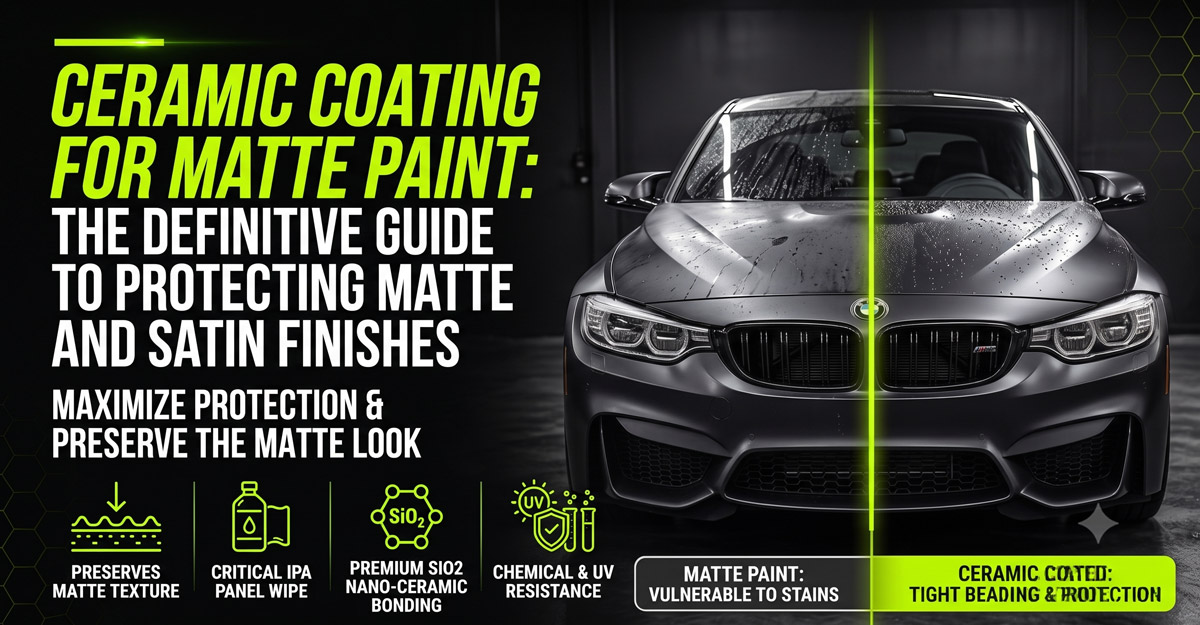
Matte paint is one of the most striking visual statements an automotive enthusiast can choose. From factory options like BMW Frozen Gray, Mercedes Benz Magno Cashmere, Porsche Silk Matte, and Hyundai Shooting Star to custom satin vinyl wraps and matte films, these non reflective surfaces exude an undeniable aura of luxury and performance.
However, owning a matte vehicle introduces a unique set of care challenges that catch many car owners off guard. Unlike standard glossy clear coats, matte paint cannot be polished, buffed, or corrected with rubbing compounds. If a scratch, water spot, or chemical stain embeds into a matte clear coat, traditional paint correction will permanently ruin the finish by creating an unnatural shiny patch. The only remedy for damaged matte paint is an expensive and time consuming trip to a body shop for a full panel repaint.
Because mechanical repair is impossible, matte paint maintenance must be entirely preventative. This reality raises a critical question for every owner: Can you ceramic coat matte paint safely without ruining its signature flat look?
The definitive answer is yes, provided you use a ceramic coating formula engineered specifically for matte and satin finishes.
In this comprehensive guide, we unpack the chemistry behind matte paint, explain why standard glossy coatings cause permanent damage, explore the hydrophobic benefits of specialized ceramic coatings, compare ceramic coatings against matte paint protection film (PPF), and outline the exact step by step care protocol to keep your matte vehicle looking flawless for years.
Key Takeaways for Matte Vehicle Owners
- Matte paint gets its flat appearance from microscopic surface roughness that scatters light instead of reflecting it directly.
- Standard car waxes, polishes, and glossy ceramic coatings fill these microscopic valleys, creating permanent blotchy gloss patches.
- Matte specific ceramic coatings utilize low viscosity silica formulas that coat the surface ridges evenly without altering texture or adding shine.
- Ceramic coatings provide vital chemical resistance against bird droppings, bug splatter, road salt, and harmful UV radiation.
- Prepping matte paint requires pure chemical decontamination (iron and tar removers) and alcohol wipes while strictly avoiding clay bars and buffing machines.
Understanding Matte Paint Chemistry: The Science of Non Reflective Finishes
To understand why matte paint requires specialized ceramic protection, one must first explore how matte clear coats are manufactured and how they interact with light.
Microscopic Topography and Flattening Agents
Glossy vehicle paint features a smooth, flat clear coat surface that acts like a mirror. When light rays strike a glossy clear coat, they reflect off the smooth surface at uniform angles (specular reflection), creating deep gloss and shine.
Matte paint, on the other hand, utilizes a clear coat infused with microscopic flattening agents, such as finely dispersed silica particles or polyurethane matting additives. During the curing process, these flattening agents create an uneven microscopic topography consisting of millions of nano scale hills and valleys across the paint surface.
When light hits this micro textured clear coat, the light rays bounce off in countless different directions (diffuse reflection). Because the light is scattered rather than reflected in a single direction, the human eye perceives a smooth, flat, non reflective satin or matte sheen.
Light Reflection Mechanics
How surface topography controls PPF visual finish and sheen
Gloss Finish
SpecularMatte / Satin Finish
DiffuseThe Vulnerability of Matte Clear Coats
While this microscopic texture creates stunning visual depth, it also acts as a natural trap for environmental contamination.
The microscopic valleys in matte clear coats easily capture dirt particles, road tar, grease, brake dust, tree sap, and hard water minerals. On a glossy car, these contaminants rest on top of a smooth surface where they can be wiped or polished away easily. On a matte vehicle, contaminants lodge deeply within the surface valleys.
Furthermore, because matte paint lacks a smooth protective plane, aggressive rubbing or improper cleaning attempts generate friction. This friction levels out the microscopic hills, effectively burnishing the paint and turning that section shiny. Once matte paint is burnished, the original texture cannot be restored through detailing.
Can You Ceramic Coat a Matte Finish? The Science of Matte Specific Formulations
A common myth among car owners is that ceramic coatings are strictly designed to make cars glossy and should never touch matte paint. While this is true for standard ceramic coatings, it is entirely false for coatings formulated specifically for matte finishes.
Standard Gloss Ceramic Coating vs Matte Specific Ceramic Coating
Standard ceramic coatings engineered for glossy vehicles contain high concentrations of solids, heavy resin fills, and optical gloss enhancers. When applied to paint, these heavy formulas fill in minor surface imperfections and microscopic valleys to create a perfectly flat, glass like surface that maximizes light reflection.
If a glossy ceramic coating is applied to a matte vehicle, the heavy resins fill in the microscopic valleys created by the flattening agents. As a result, the light scattering effect is destroyed, leaving behind uneven, blotchy, and permanent shiny patches across the car.
In contrast, a matte specific ceramic coating is chemically formulated with a lower viscosity and a micro thin nano silica (SiO2) or silicon carbide (SiC) matrix. Instead of leveling out the surface valleys, the thin matte formula contours perfectly over the existing microscopic hills and valleys. It forms a covalent chemical bond directly with the clear coat while preserving the precise micro topography required for diffuse light scattering.
The result is robust surface defense that preserves the exact flat or satin appearance intended by the vehicle manufacturer.
Structural Comparison: Standard Gloss Coating vs Matte Coating
Core Benefits of Ceramic Coating for Matte Paint
Applying a dedicated ceramic coating to your matte vehicle delivers immense functional value, elevating your maintenance routine while safeguarding your vehicle investment.
Hydrophobic Defense and Easier Hand Washing
One of the greatest advantages of a matte ceramic coating is extreme hydrophobicity. The ceramic matrix creates a slick hydrophobic barrier that repels water, mud, and waterborne dirt.
Because water beads up and rolls off easily, environmental grime cannot bond tightly to the micro textured clear coat. During routine maintenance washes, dirt slides off effortlessly with gentle pressure, eliminating the need for aggressive scrubbing that causes micro abrasions and burnishing over time.
Chemical Etching Defense Against Environmental Contaminants
Organic contaminants such as bird droppings, bug splatter, tree sap, and acid rain contain concentrated acids. On an unprotected matte clear coat, these acidic compounds can eat into the raw paint surface within hours.
Because you cannot polish out acid etching on a matte finish, a chemical stain often permanent. A matte ceramic coating forms an inert, sacrificial SiO2 barrier that resists acidic and alkaline chemicals ranging from pH 2 to pH 12. Even if bird droppings sit on the surface for a day, the coating prevents the acid from penetrating into the underlying paint structure.
UV Ray Shielding and Pigment Preservation
Prolonged exposure to solar ultraviolet (UV) radiation breaks down chemical bonds within vehicle paint pigments, leading to oxidation, chalking, and premature fading. On matte paint, UV oxidation often manifests as uneven, blotchy discoloration across flat body panels.
Matte ceramic coatings contain high grade UV blockers that absorb and dissipate harmful UV radiation. This protection keeps rich factory colors, such as deep matte black, frozen silver, or satin gray, looking crisp and vibrant without fading under harsh sunlight.
Stealth PPF vs Ceramic Coating for Matte Paint: Choosing the Right Protection Strategy
Vehicle owners looking to protect a matte finish frequently evaluate two primary options: Paint Protection Film (PPF), such as XPEL Stealth or SunTek Matte, and ceramic coatings. Understanding how these two protection methods compare is essential for making an informed decision.
Paint Protection Film (PPF) Mechanics for Physical Rock Chip Shielding
Matte Paint Protection Film is a thick (typically 6 to 8 mil), transparent polyurethane film with a satin finish. PPF is designed specifically to absorb physical impacts from flying gravel, rock chips, road debris, and physical scratches. Advanced matte PPF products feature self healing top coats that erase swirl marks when exposed to heat from the sun or warm water.
However, PPF is significantly more expensive than ceramic coating, requiring specialized professional installation that can range from several thousand dollars for a front end wrap to over ten thousand dollars for a full vehicle installation.
Ceramic Coating Mechanics for Chemical and Environmental Defense
Ceramic coating is a liquid nano silica coating (approximately 1 to 2 microns thick) that bonds chemically to the vehicle clear coat. Unlike PPF, ceramic coating is not designed to stop flying rocks or high speed road debris from chipping the paint.
Instead, ceramic coating excels at providing supreme chemical resistance, hydrophobic self cleaning properties, anti fouling defense, and UV protection at a fraction of the cost of PPF.
The Ultimate Hybrid Protection Strategy
For maximum vehicle preservation, detailing professionals recommend a hybrid approach:
- Apply matte Paint Protection Film (PPF) to high impact zones or the entire vehicle to shield against physical rock chips and scratches.
- Apply a matte specific ceramic coating over the entire vehicle, including over the PPF.
Applying a matte ceramic coating over matte PPF enhances the film’s hydrophobic qualities, prevents stain discolouration on the film, repels road grime, and makes washing the wrapped vehicle effortless.
Performance Benchmark: PPF vs Ceramic Coating for Matte Vehicles
PPF vs. Ceramic Coating Performance
Direct property score comparison across key protective metrics
Step by Step Matte Car Detailing Prep Protocol
Proper surface preparation is crucial before applying a ceramic coating to a matte finish. On a glossy vehicle, detailers perform compound buffing and machine polishing to eliminate defects. On matte paint, machine polishing is strictly forbidden.
The prep process must rely entirely on safe chemical decontamination to achieve a pristine surface for coating bonding.
Step 1: Safe Wash and Initial Rinsing
Begin by washing the vehicle in a shaded environment away from direct sunlight. Use a dedicated pH neutral matte car shampoo free of waxes, gloss enhancers, or silicones. Wash using the two bucket method equipped with grit guards to prevent dirt recirculation.
Rinse the vehicle thoroughly with clean water to remove loose dirt and surface dust.
Step 2: Chemical Decontamination (Iron and Tar Removers)
Never use a traditional clay bar or clay mitt on matte paint. The friction created by claying will burnish the matte clear coat, creating unwanted shiny spots.
Instead, perform chemical decontamination:
- Iron Decontamination: Spray a dedicated pH neutral iron remover across the paint panels. The chemical reacts with embedded metallic brake dust particles, dissolving them into a soluble liquid that turns purple. Rinse thoroughly after three to five minutes.
- Tar and Sap Removal: Apply a specialized chemical tar remover to lower rocker panels and rear bumpers to dissolve stubborn tar spots and road rubber without rubbing.
Step 3: Isopropyl Alcohol (IPA) Surface Wipe Down
After washing and chemical decontamination, dry the vehicle using clean micro fiber towels or compressed air.
Next, perform a panel wipe using a diluted Isopropyl Alcohol (IPA) solution (15% to 20% concentration) or a dedicated panel prep spray. Spray the prep solution onto a plush micro fiber towel and gently wipe each panel. This step strips away residual oils, silicones, and cleaning surfactants, leaving raw matte clear coat ready for covalent bonding with the ceramic coating.
Step 4: Applying the Matte Ceramic Coating
Apply the matte ceramic coating panel by panel using the supplied applicator pad:
- Apply several drops of matte coating to the applicator cloth.
- Work in small sections (such as a 2 foot by 2 foot grid) using a straight line cross hatch pattern (horizontal followed by vertical passes) to ensure uniform coverage.
- Observe the flash time specified by the manufacturer (typically one to three minutes depending on ambient temperature and humidity).
- Level and buff off the residue gently using a clean, heavy weight microfiber towel. Do not apply heavy downward pressure while wiping.
- Inspect the panel using multi angle LED detailing lights to ensure no high spots or uneven residue remain.
- Allow the vehicle to cure in a dry, enclosed environment for at least 24 hours without exposure to moisture or rain.
Essential Matte Paint Care and Maintenance Rules
Once your matte vehicle is ceramic coated, adhering to proper maintenance protocols will ensure maximum coating longevity and preserve your paint texture indefinitely.
Rule 1: Hand Wash Only (Avoid Automatic Car Washes)
Never take a matte vehicle through an automatic drive through car wash. Spinning friction brushes carry harsh dirt from previous vehicles that will cause irreversible micro abrasions and burnishing across matte panels.
Even touchless automatic car washes should be avoided because they utilize extremely harsh alkaline detergents (pH 12+) and acidic presoaks that degrade protective coatings and dry out matte clear coats over time.
Rule 2: Use Only pH Neutral Matte Specific Shampoos
Standard retail car wash soaps frequently contain synthetic waxes, silicone gloss agents, or carnauba emulsifiers designed to add shine to glossy cars. If used on matte paint, these additives leave oily films and patchy streak marks.
Always select pH neutral car shampoos labeled explicitly as safe for matte paint or satin wraps. These formulas clean effectively while rinsing 100% residue free.
Rule 3: Practice Microfiber Pat Drying or Touchless Air Drying
Wiping a wet car with coarse towels or dragging dry cloths across the paint can introduce friction marks.
The ideal drying method for ceramic coated matte vehicles is touchless air drying using a leaf blower, dedicated car dryer, or compressed air. The extreme hydrophobic properties of the ceramic coating allow water to bead up and blow off effortless.
If drying manually with a microfiber towel, use a high GSM plush micro fiber drying towel and gentle patting motions instead of dragging the towel across body lines.
Rule 4: Address Contaminants Immediately
Bird droppings, bug splatters, and tree sap should never be allowed to bake onto matte paint under direct sunlight. Keep a bottle of specialized matte detail spray and a clean micro fiber towel in your vehicle trunk.
When you spot contamination, spray the matte detailer generously over the area to saturate and lubricate the debris, then gently blot it away with your microfiber towel without scrubbing.
Top Industry Matte Ceramic Coating Products Reviewed
Selecting a proven ceramic coating manufactured specifically for matte finishes guarantees safety and long lasting performance. Here are four leading products trusted by automotive detailing professionals worldwide:
1. Dr. Beasley’s Matte Paint Coating
Dr. Beasley’s is widely recognized as a pioneer in matte care technology. Their Matte Paint Coating is an inorganic ceramic coating engineered exclusively for matte and satin paint finishes. It forms a micro thin protective barrier that repels water and oils, blocks UV rays, and resists chemical etching without adding a hint of gloss.
2. Gtechniq Halo and C1 Matte Formulations
Gtechniq offers advanced nanotechnology protection designed for delicate surfaces. Gtechniq C1 Matte and Halo Flexible Topcoat are specifically optimized for satin paint, matte vinyl wraps, and matte PPF films. They provide exceptional flexibility, chemical resistance, and dirt repellency.
3. Gyeon Q2 Matte Ceramic Coating
Gyeon Q2 Matte is a dedicated quartz coating engineered for matte finishes. Featuring a high content of silicon dioxide (SiO2), Q2 Matte enhances color depth and satin richness while maintaining a 100% matte sheen. It offers impressive hydrophobic performance and strong chemical resistance.
4. Ceramic Pro Matte
Ceramic Pro Matte is a professional grade ceramic coating available through certified installer networks. Applied in multiple layers, Ceramic Pro Matte bonds permanently to matte paint, delivering multi year protection against UV fading, industrial fallout, and environmental stains.
Frequently Asked Questions (FAQ) About Ceramic Coating Matte Paint
1. Can you ceramic coat a matte or satin vinyl wrap?
Yes, specialized matte ceramic coatings work exceptionally well on matte and satin vinyl wraps as well as matte Paint Protection Film (PPF). The coating seals the porous vinyl surface, prevents UV fading and yellowing, and stops road oils from staining the wrap.
2. Does ceramic coating change the texture of matte paint?
No, a properly formulated matte ceramic coating will not alter the texture or tactile feel of matte paint. Because it contours micro thin over the clear coat topography, the original flat appearance remains untouched.
3. How long does a matte ceramic coating last?
Depending on the product formula and maintenance habits, consumer grade matte ceramic coatings typically last between 12 and 24 months. Professional grade ceramic coatings applied by certified detailers can last from 3 to 5 years with proper routine care.
4. Can you use quick detailer sprays on a ceramic coated matte car?
You can use quick detailers provided they are specifically formulated for matte finishes and contain zero waxes, gloss enhancers, or silicone additives. Dedicated matte quick detailers remove light dust, finger prints, and fresh bird droppings safely.
5. What happens if someone accidentally waxes a matte vehicle?
If standard car wax or a glossy quick detailer is applied to matte paint by mistake, do not attempt to buff or polish it off. Instead, wash the vehicle thoroughly with a matte safe decontamination soap or perform a gentle wipe down with a diluted Isopropyl Alcohol (IPA) solution to dissolve and strip the wax residue without damaging the clear coat.
Conclusion: Safeguarding Your Matte Investment
Owning a matte vehicle is a rewarding experience that guarantees your car stands out wherever you drive. However, preserving that distinctive non reflective appearance requires a clear understanding of matte paint chemistry and strict adherence to preventative maintenance protocols.
Because matte clear coats cannot be polished or buffed to correct scratches and stains, waiting for damage to occur is a recipe for expensive paint shop bills. Installing a specialized, matte specific ceramic coating is the ultimate preventative insurance policy.
By creating an invisible, hydrophobic, UV resistant, and chemically inert SiO2 shield, a matte ceramic coating keeps dirt from bonding, protects against environmental acids, simplifies your hand washing routine, and preserves your vehicle’s factory matte beauty for years to come.
Next Step: Elevate and Protect Your Matte Vehicle
Whether your vehicle features factory OEM matte paint, a satin vinyl wrap, or matte Paint Protection Film, professional grade ceramic protection is essential for long term peace of mind.
If you are ready to safeguard your vehicle with premium matte care solutions, contact our team of certified automotive protection specialists today for a personalized consultation and estimate. Protect your investment before the road takes its toll.