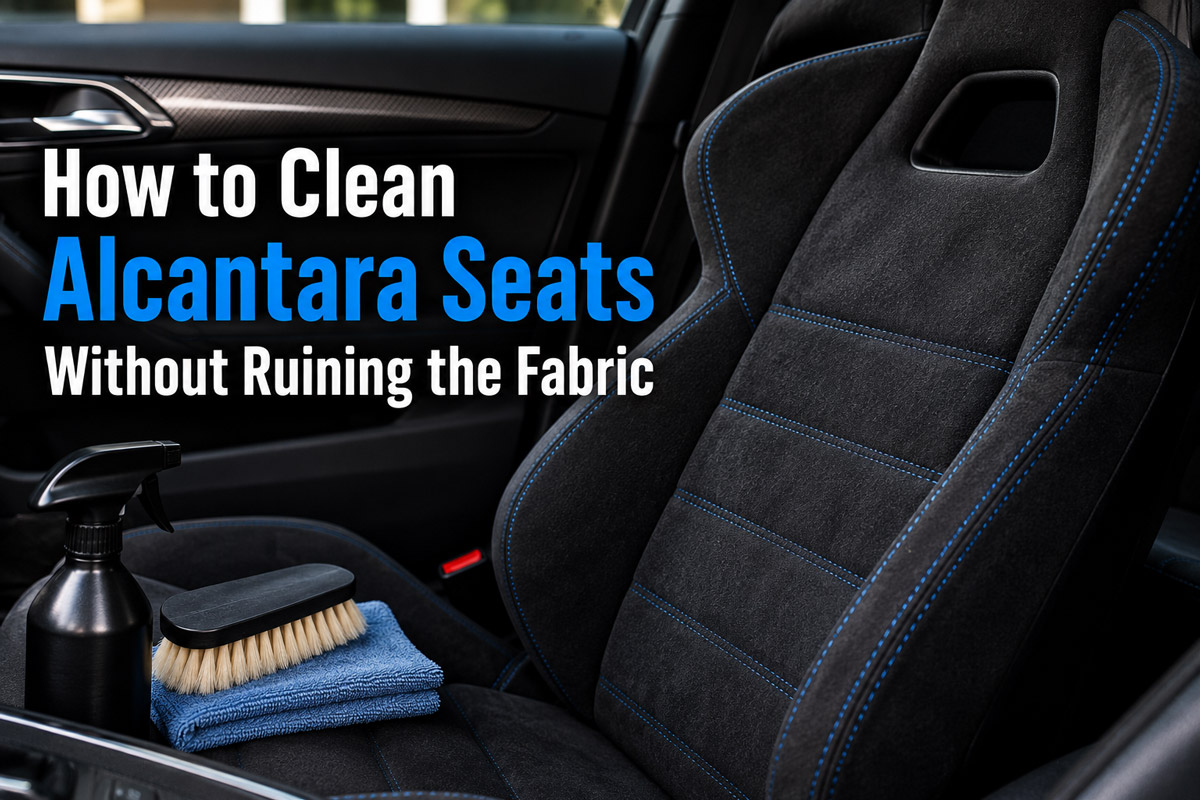
To clean Alcantara seats without ruining the fabric, use thorough dry extraction with a soft horsehair brush followed by a low-moisture, dedicated Alcantara cleaner. Because Alcantara is a synthetic blend of polyester and polyurethane, excessive water, heavy friction, or high-heat steam will permanently melt or mat the ultra-fine microfibers. Always apply cleaner to your tools, never directly to the seat.
Key Facts / At a Glance
- Material composition: 68% polyester and 32% polyurethane.
- Primary vulnerability: Absorbs body oils and liquids, causing fibers to mat flat and appear greasy.
- Safe chemicals: pH-neutral or slightly acidic dedicated cleaners (e.g., Sonax, Koch Chemie Pol Star).
- Lethal to Alcantara: Steam cleaners (melts fibers), stiff nylon brushes (causes pilling), and high-alkaline All-Purpose Cleaners (strips polyurethane).
- Drying time: 2 to 6 hours of air drying with cross-ventilation.
What Makes Alcantara Different from Suede?
Alcantara is a proprietary composite material spun into a tight, interlocking microfiber matrix, whereas traditional suede is the porous underside of animal hide. This synthetic structure provides exceptional friction and grip for performance driving, but it handles dirt fundamentally differently than leather or suede.
While traditional automotive leather features a clear-coat sealant that blocks spills, Alcantara is unsealed. It actively absorbs sweat, body oils, and environmental moisture. Over time, friction from sliding in and out of the seat forces these oils deep into the polyurethane base, compressing the microfibers. This compression turns the soft, matte finish into a hard, glossy, and greasy-looking surface. Attempting to clean Alcantara like traditional leather—using heavy liquids, conditioners, or stiff scrubbing—will permanently separate the polyester nap from the polyurethane backing.
Before You Start: Tools, Time, and Costs
Restoring Alcantara requires patience and chemical action, not aggressive scrubbing. Gathering the exact right tools prevents permanent textural damage.
Project Overview
- Total Time: 1 to 2 hours per vehicle interior.
- Difficulty: Moderate (requires careful moisture management).
- Cost: $20–$45 for DIY; $150–$300 for a professional detail.
- Prerequisites: A shaded, dry environment to control evaporation rates.
Required Tools and Materials:
- Dedicated Alcantara Cleaner: 1 bottle (e.g., Sonax Upholstery & Alcantara Cleaner, Colourlock Alcantara Textile Cleaner).
- Horsehair Brushes: 2 clean brushes (one for agitating cleaner, one dry brush for resetting the fibers).
- Microfiber Towels: 5–7 edgeless, lint-free towels (300–400 GSM).
- Vacuum: A standard shop vacuum with a clean, soft-bristle crevice attachment.
- Distilled Water: 1 small spray bottle (tap water leaves mineral rings).
How Do You Clean Alcantara Step-by-Step?
Step 1: Perform a Thorough Dry Extraction
Vacuum the Alcantara seats completely using a soft brush attachment, paying special attention to the bolsters and seams.
- Specifics: Keep the vacuum nozzle slightly elevated off the fabric to prevent hard plastic edges from scraping the fibers.
- Success Checkpoint: You will know it worked when the surface is entirely free of loose crumbs, dust, and pet hair.
- Common Mistake: Skipping this step. If you introduce liquid cleaner to dusty Alcantara, you instantly create liquid mud that sinks into the polyurethane backing, creating permanent dark stains.
Step 2: Agitate the Surface with a Dry Brush
Gently sweep the surface with a soft-bristled horsehair brush to open the matted pile, then vacuum the area a second time.
- Specifics: Use light, flicking motions in multiple directions. Do not press hard.
- Success Checkpoint: The fabric should look slightly lighter in color and feel softer to the touch as trapped particulate matter is released.
- Common Mistake: Using nylon or brass detailing brushes. Stiff bristles will tear the delicate microfibers, causing them to “pill” into small fuzz balls.
Step 3: Apply a Minimalist Cleaner to Your Tools
Spray your dedicated Alcantara cleaner directly onto the horsehair brush or a folded microfiber cloth.
- Specifics: Use 2 to 3 sprays per panel. If working on perforated Alcantara seats (seats with cooling holes), use foam-based cleaners instead of liquid sprays to prevent liquid from bypassing the fabric and soaking the internal foam cushion.
- Success Checkpoint: The brush should be damp but not dripping.
- Common Mistake: Spraying cleaner directly onto the seat. This causes oversaturation, which degrades the adhesive holding the Alcantara to the seat foam.
Step 4: Lift Dirt with Light Circular Agitation
Work the damp brush into the fabric using very light, rapid circular motions to emulsify the embedded body oils.
- Specifics: Work in small, 12-by-12-inch sections. Let the chemical surfactants do the work, not downward pressure.
- Success Checkpoint: A light foam should briefly appear on the surface, lifting the dark grease away from the fibers.
- Common Mistake: Scrubbing aggressively to remove a stubborn stain. This burns the fabric. If a stain remains, repeat Step 3 and 4 with fresh cleaner rather than increasing physical pressure.
Step 5: Blot and Transfer Emulsified Dirt
Immediately wipe the agitated area firmly with a clean, dry microfiber towel to transfer the suspended dirt out of the fabric.
- Specifics: Use a twisting, blotting motion. Flip the towel to a clean side after every single pass.
- Success Checkpoint: The towel will pull up brown/black residue, and the seat will look noticeably cleaner but slightly damp.
- Common Mistake: Wiping back and forth with a dirty towel, which simply spreads the grease over a larger surface area.
Step 6: Reset the Microfibers While Damp
Take your second, completely dry horsehair brush and comb all the damp microfibers in a single, uniform direction.
- Specifics: Brush from the back of the seat toward the front, laying the “nap” perfectly flat.
- Success Checkpoint: The seat should look uniform in color with no swirl marks from the towel.
- Common Mistake: Leaving the fabric to dry untouched. Unbrushed, damp Alcantara will dry clumped together, resulting in a stiff, crunchy texture.
Step 7: Allow for Complete Air Drying
Let the interior air out completely before anyone sits in the vehicle.
- Specifics: Roll down the windows slightly to create cross-ventilation. Allow 2 to 6 hours for a complete cure, depending on ambient humidity.
- Success Checkpoint: The fabric will feel soft, plush, and cool to the touch.
- Common Mistake: Using a heat gun or hair dryer to speed up the process. Focused heat shrinks the polyester matrix and ruins the fabric tension.
What Are the Worst Alcantara Cleaning Mistakes?
The most common mistakes detailers make when cleaning Alcantara stem from treating it like standard automotive carpet or heavy-duty leather.
- Using Steam Cleaners: High heat (anything over 180°F / 82°C) permanently melts the ultra-fine polyurethane fibers. This turns the soft, luxurious fabric into a rough, plastic-like texture that cannot be reversed.
- Household Detergents and APCs: Diluted All-Purpose Cleaners (APCs), dish soaps, and laundry detergents contain heavy alkaline surfactants. If not rinsed out completely—which is impossible to do on a car seat without oversaturating it—these sticky surfactants act as a dirt magnet, causing the seat to look filthy again within weeks.
- Leather Conditioners and Baby Wipes: Leather wipes and baby wipes contain lanolin, moisturizers, and heavy oils. Applying these to Alcantara immediately mats the fibers down and creates a greasy slick that requires chemical extraction to remove.
- Oversaturation: Flooding the seat with water creates water rings (tide marks) as it dries. Furthermore, water trapped in the underlying seat foam breeds mold and degrades the seat’s internal heating elements.
How Do You Fix Stiff, Matted, or Stained Alcantara?
Troubleshooting damaged Alcantara requires specific, localized interventions. Do not re-clean the entire seat to fix a small defect.
- Issue: The seat dried stiff and crunchy.
- The Fix: Reactivate the fabric by misting a very small amount of distilled water over the area. Take a dry horsehair brush and vigorously (but gently) brush the pile back and forth to break the stiffness.
- Issue: The fabric is pilling (covered in small fuzzy balls).
- The Fix: Use a battery-powered electric fabric shaver or hold a clean razor blade flat against the surface. Carefully glide it over the fabric to shave off the pills without cutting into the base layer. Brush smooth afterward.
- Issue: Spot stains from ink, grease, or food.
- The Fix: Dab a microfiber towel with ethyl alcohol (rubbing alcohol) or a specialized solvent. Blot the stain gently from the outside edges inward to prevent the pigment from spreading. Never pour alcohol directly onto the seat.
- Issue: The fabric still looks dark and flat after cleaning.
- The Fix: If heavy cleaning does not restore the nap, you are likely looking at “friction burn,” not dirt. Heavy ingress/egress wears the microscopic fibers entirely off the polyurethane backing. This is permanent physical damage that cleaning cannot fix; the panel must be re-upholstered.
Which Cleaning Strategy Fits Your Routine?
How often you maintain Alcantara dictates how long it survives. Tailor your maintenance schedule to your driving habits to prevent irreversible matting.
The Daily Commuter (Low Maintenance)
Prevention is your primary tool. Immediately after your first deep clean, apply a hydrophobic fabric protector rated specifically for Alcantara (such as Gtechniq Smart Fabric or Colourlock Alcantara Protector). Vacuum the seats once a month with a soft brush attachment to prevent dust from settling deep into the pores.
The Track Day or Performance Driver (High Sweat/Oil)
Performance driving induces heavy sweating, transferring body oils directly into the steering wheel and seat bolsters. Keep a dry horsehair brush and a clean microfiber towel in your glovebox. Brush the high-contact areas immediately after high-intensity driving to lift the sweat before it bakes into the fabric. Perform a localized deep clean on the steering wheel and bolsters every 3 months.
The Used Car Buyer (Restoring Matted Seats)
When restoring heavily neglected seats, do not attempt to lift years of grease in a single pass. Plan for 2 to 3 light cleaning passes separated by drying times. If a wet extraction vacuum is available, use it to pull the emulsified dirt out, but keep the extraction head moving rapidly. Pausing for even three seconds will push water past the Alcantara and soak the seat foam beneath.
Frequently Asked Questions
Can you use leather cleaner on Alcantara? No. Leather cleaners contain oils, waxes, and conditioning agents designed to nourish organic animal hide. Applying them to synthetic Alcantara will instantly clog the microfibers, leaving a matted, greasy residue that attracts heavy dirt.
Does Alcantara wear out or just get dirty? It does both. While dirt and oil cause reversible matting, repeated sliding across the seat bolsters causes “friction burn,” physically shaving the polyester fibers off the polyurethane backing. If cleaning doesn’t restore the soft texture, the fibers are permanently gone.
How often should you apply Alcantara protector? Apply a dedicated Alcantara fabric protector every 6 to 12 months, depending on usage. Commuters should reapply annually, while track drivers or drivers in highly humid climates should reapply every 6 months to maintain the hydrophobic barrier.
Are baby wipes safe for quick Alcantara spot cleaning? Absolutely not. Baby wipes are formulated with skin moisturizers, lotions, and lanolin. Wiping Alcantara with them transfers these heavy oils directly into the fabric, darkening the color and flattening the nap. Always use distilled water or a dedicated interior cleaner.
Can you repair torn or cigarette-burned Alcantara? Unlike traditional leather, which can be filled, sanded, and re-dyed, Alcantara cannot be patched seamlessly. The complex microfiber texture cannot be replicated with liquid fillers. Torn or burned sections must be completely cut out and re-upholstered by a professional trimmer.