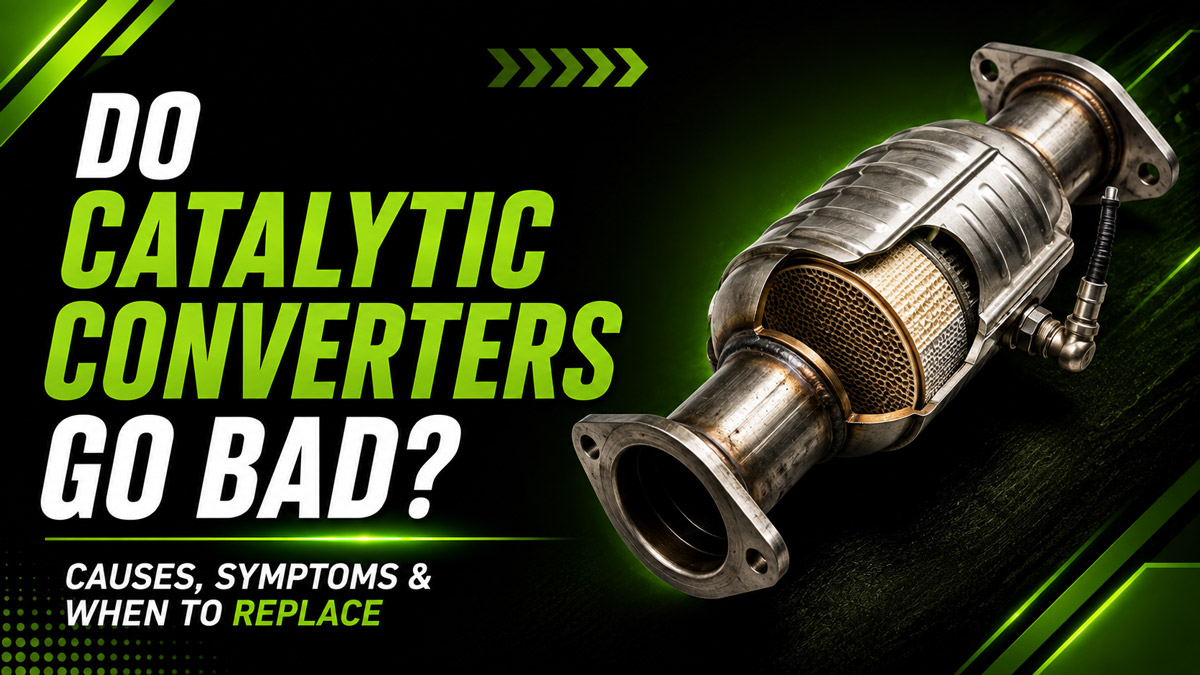
Yes, catalytic converters go bad, although most are designed to last at least 100,000 miles and may survive for the life of the vehicle. Premature failure usually occurs because an engine misfire, rich fuel mixture, oil leak, coolant leak, physical impact, or another upstream problem damages the converter’s internal catalyst.
Key Facts / At a Glance
- A healthy catalytic converter commonly lasts 10–15 years or more than 100,000 miles.
- Engine problems cause most premature converter failures; age alone is rarely the primary cause.
- P0420 and P0430 codes indicate low catalyst efficiency but do not prove the converter itself is defective.
- Misfires can overheat and melt the converter’s ceramic honeycomb.
- Oil and coolant can coat the catalyst and permanently reduce its ability to clean exhaust gases.
- The underlying engine fault must be repaired before installing a new converter.
What Is a Catalytic Converter?
A catalytic converter is an emissions-control device installed in the exhaust system between the engine and muffler. It converts harmful pollutants into less harmful gases before exhaust leaves the tailpipe.
A modern three-way converter processes three major pollutants:
- Carbon monoxide: Converted into carbon dioxide.
- Unburned hydrocarbons: Converted mainly into carbon dioxide and water vapor.
- Nitrogen oxides: Converted primarily into nitrogen and oxygen.
The converter does not function like a disposable filter. Its precious-metal coating accelerates chemical reactions without being consumed under normal operating conditions.
How Does a Catalytic Converter Work?
A catalytic converter channels hot exhaust through a ceramic or metallic honeycomb coated with platinum, palladium, and rhodium. The honeycomb provides thousands of small passages, creating enough surface area for chemical reactions to occur.
The converter generally contains:
- A stainless-steel outer housing.
- An insulated ceramic or metallic substrate.
- A washcoat that increases surface area.
- Platinum, palladium, and rhodium catalysts.
- Heat shields that protect nearby vehicle components.
Gasoline vehicles typically use a three-way catalyst. Diesel vehicles may use a diesel oxidation catalyst combined with a diesel particulate filter and selective catalytic reduction system.
How Long Do Catalytic Converters Last?
A catalytic converter typically lasts at least 100,000 miles, while many original converters remain functional beyond 150,000 miles. A vehicle driven with a properly maintained engine may never require catalytic converter replacement.
Converter lifespan depends more on engine condition than mileage. A converter can fail at 40,000 miles when exposed to severe misfires, while another may still function correctly at 200,000 miles.
Factors affecting lifespan include:
- Frequency and severity of engine misfires
- Oil consumption
- Coolant entering the combustion chambers
- Fuel-mixture control
- Exhaust leaks
- Road impact
- Vehicle operating temperature
- Quality of the original converter
- Length and type of driving trips
Repeated short journeys can prevent the converter from reaching an effective operating temperature, but overheating is generally more destructive than running too cool.
Why Do Catalytic Converters Go Bad?
Catalytic converters usually fail because excessive fuel, oil, coolant, contamination, or physical damage compromises the internal honeycomb. The specific failure generally falls into one of four categories.
Catalyst Contamination
Oil, coolant, silicone, phosphorus, or other contaminants can coat the catalyst surface. Exhaust may continue flowing normally, but the precious metals can no longer interact effectively with the gases.
Common contamination sources include:
- Worn piston rings
- Worn valve seals
- Failed head gaskets
- Internal coolant leaks
- Excessive oil additives
- Improper sealants containing silicone
- Long-term oil burning
A contaminated converter may show an efficiency code without causing severe power loss.
Thermal Meltdown
Unburned fuel can ignite inside the converter and raise its temperature high enough to melt the ceramic substrate. The melted passages fuse together, restricting exhaust flow.
Common causes include:
- Failed spark plugs
- Weak or failed ignition coils
- Leaking fuel injectors
- Incorrect ignition timing
- Excessive fuel pressure
- Rich air-fuel mixture
- Persistent cylinder misfires
A flashing check engine light often indicates a severe misfire capable of damaging the converter. Driving should be minimized until the cause is diagnosed.
Structural Damage
The converter’s ceramic core is brittle and can crack after a strong impact or rapid temperature change. A shattered substrate may produce a metallic rattle and eventually block the exhaust outlet.
Possible causes include:
- Hitting road debris
- Bottoming out over a curb
- Crossing a high speed bump
- Incorrect lifting or jack placement
- Driving through deep water with a very hot exhaust
- Broken exhaust hangers placing stress on the housing
Normal Catalyst Degradation
Catalyst efficiency can gradually decline after years of heat cycles and exposure to exhaust. However, natural aging is usually slower than damage caused by an unresolved engine fault.
What Are the Signs of a Bad Catalytic Converter?
The most common signs are a check engine light, reduced acceleration, sulfur odor, rattling, excessive exhaust heat, failed emissions testing, and poor fuel economy. Symptoms vary depending on whether the converter is contaminated, melted, cracked, or clogged.
| Symptom | What it may indicate |
| P0420 or P0430 code | Catalyst efficiency below the expected threshold |
| Loss of power | Restricted exhaust flow |
| Slow acceleration | Partial converter blockage |
| Stalling under load | Severe exhaust restriction |
| Rattling under the vehicle | Broken ceramic substrate |
| Rotten-egg odor | Sulfur compounds not being processed correctly |
| Excessive floor heat | Overheated or restricted converter |
| Failed emissions test | Insufficient pollutant conversion |
| Dark exhaust smoke | Rich mixture or oil consumption damaging the converter |
| Reduced fuel economy | Engine-control or exhaust-flow problem |
These symptoms are not exclusive to catalytic converter failure. Ignition faults, oxygen sensors, exhaust leaks, fuel-system problems, and internal engine wear can produce similar results.
Can a Bad Catalytic Converter Cause Power Loss?
Yes. A melted or collapsed converter can restrict exhaust flow, preventing the engine from expelling combustion gases efficiently. The resulting backpressure reduces cylinder filling, acceleration, and high-speed performance.
A restricted converter often allows the engine to idle but causes severe hesitation when accelerating or climbing a hill. In advanced cases, the vehicle may stall after several minutes because pressure and heat build inside the exhaust system.
Power loss is less common when the converter is chemically contaminated but still physically open.
Does P0420 Always Mean the Converter Is Bad?
No. Code P0420 means the engine computer has detected low catalyst efficiency on Bank 1, while P0430 refers to Bank 2. The codes do not identify the catalytic converter as the guaranteed cause.
The computer compares signals from oxygen sensors positioned before and after the converter. A healthy converter smooths the downstream sensor signal. When the downstream pattern begins to resemble the upstream pattern, the computer concludes that oxygen-storage capacity has fallen.
Other possible causes include:
- Exhaust leaks before or near the converter
- Slow or contaminated oxygen sensors
- Damaged sensor wiring
- Incorrect fuel trim
- Engine misfires
- Oil burning
- Coolant contamination
- Software or calibration issues
Replacing the converter based only on a stored code can lead to an unnecessary and expensive repair.
Can a Bad Oxygen Sensor Mimic Converter Failure?
Yes. A lazy, biased, or contaminated downstream oxygen sensor can report inaccurate catalyst activity and contribute to a P0420 or P0430 code. Sensor performance should therefore be evaluated before condemning the converter.
A technician may compare live upstream and downstream sensor data, inspect fuel trims, check heater operation, and test sensor response. However, replacing oxygen sensors blindly is also poor diagnostic practice. A functional sensor should not be replaced merely because a catalyst code is present.
How Do You Test a Catalytic Converter?
A catalytic converter should be diagnosed using several tests rather than a single code or temperature reading. The strongest diagnosis combines engine-code analysis, fuel-trim data, oxygen-sensor behavior, exhaust inspection, and restriction testing.
1. Scan All Diagnostic Codes
Connect an OBD-II scanner and record all stored, pending, and permanent codes. Misfire, fuel-trim, oxygen-sensor, coolant-temperature, or injector codes may reveal the problem that damaged the converter.
Do not erase the codes before recording freeze-frame data. Freeze-frame information shows engine speed, load, temperature, and fuel-trim conditions when the fault occurred.
2. Inspect the Engine and Exhaust
Check for:
- Exhaust leaks
- Damaged wiring
- Crushed exhaust pipes
- Oil consumption
- Coolant loss
- Misfire symptoms
- Rich exhaust odor
- Physical dents in the converter
- Loose or broken exhaust mounts
The engine should be repaired before converter efficiency is judged.
3. Review Oxygen-Sensor Data
The upstream sensor should respond rapidly to changes in the fuel mixture. The downstream sensor should remain comparatively stable when the converter is storing oxygen and processing emissions correctly.
A downstream waveform that closely copies the upstream waveform may indicate low catalyst efficiency, but the result must be interpreted with fuel trims and exhaust condition.
4. Check Converter Temperature Carefully
After the engine reaches operating temperature, an infrared thermometer can compare the exhaust temperature before and after the converter. The outlet may be hotter because oxidation reactions generate heat.
However, a fixed temperature difference does not prove converter health. Engine load, converter design, sensor location, mixture, and recent driving conditions affect readings. Temperature testing is a supporting test, not a standalone verdict.
5. Test Exhaust Backpressure
A technician can remove the upstream oxygen sensor and install an exhaust backpressure gauge. Excessive pressure that rises sharply with engine speed suggests a blocked converter or another exhaust restriction.
Typical readings are often below approximately:
- 1.5 PSI at idle
- 2–3 PSI around 2,500 RPM
Specifications vary by engine and test method. A pressure increase does not automatically identify which exhaust component is blocked.
6. Perform a Vacuum Test
Connect a vacuum gauge to an intake-manifold vacuum source. Vacuum may begin normally and gradually fall as engine speed is held steady if exhaust restriction is present.
The test can reveal restriction but cannot always distinguish a clogged converter from a collapsed muffler or damaged exhaust pipe.
Can a Catalytic Converter Be Cleaned?
A catalytic converter with a melted, cracked, collapsed, or heavily contaminated substrate cannot be restored with a fuel additive. Physical damage requires replacement.
Some cleaning products may remove minor carbon deposits under limited conditions, but they cannot replace missing catalyst material, remove a glass-like oil or coolant coating, or reopen fused ceramic passages.
Before using any cleaner:
- Confirm that the converter is not physically restricted.
- Repair misfires and fuel-mixture problems.
- Verify that the engine is not burning oil or coolant.
- Follow the product and vehicle-manufacturer instructions.
- Do not expect the product to repair a confirmed mechanical failure.
An apparent improvement after using a cleaner may result from changed driving conditions or temporary code clearing rather than actual converter restoration.
Can You Drive With a Bad Catalytic Converter?
A vehicle may continue to run with a chemically inefficient converter, but driving with a severely clogged or overheating converter can cause stalling, engine damage, fire risk, and further exhaust-system failure. A flashing check engine light, glowing converter, major power loss, or strong burning smell requires immediate attention.
Limited driving may be possible when the only symptom is a steady check engine light and the vehicle performs normally. Even then, diagnosis should not be delayed because an active misfire can rapidly destroy the converter.
Driving without a functional converter may also cause emissions-test failure and violate emissions laws.
How Much Does Catalytic Converter Replacement Cost?
Catalytic converter replacement commonly costs approximately $800–$2,500 for a mainstream passenger vehicle. Luxury vehicles, hybrids, trucks with multiple converters, and models requiring OEM or CARB-approved parts may cost $3,000–$4,500 or more.
| Expense | Typical range |
| Universal aftermarket converter | $200–$800 |
| Direct-fit aftermarket converter | $400–$1,500 |
| OEM converter | $800–$2,500+ |
| Labor | $150–$600+ |
| Diagnostic testing | $50–$200 |
| Gaskets, bolts, and hardware | $20–$150 |
| Oxygen sensor replacement | $150–$400 each |
Actual cost depends on the vehicle, converter location, number of converters, emissions certification, labor rate, rust, and whether cutting or welding is required.
Should You Buy an OEM or Aftermarket Converter?
An OEM converter is generally the safest choice for fit, durability, catalyst capacity, and emissions-system compatibility. A reputable direct-fit aftermarket converter can be a practical lower-cost option for an older vehicle.
Choose OEM When:
- The vehicle is relatively new.
- Long-term ownership is planned.
- The vehicle has strict emissions requirements.
- Aftermarket units have a history of recurring efficiency codes.
- Fitment is complex.
- The factory emissions warranty or repair policy applies.
Choose Aftermarket When:
- The vehicle is older or has limited market value.
- A legal, certified direct-fit part is available.
- The underlying engine problem has been corrected.
- The repair budget does not justify OEM pricing.
- A reputable exhaust shop will perform the installation.
Federal and CARB-compliant converters are not interchangeable in every jurisdiction. The replacement must be approved for the vehicle, engine family, model year, and registration location.
What Must Be Fixed Before Replacing the Converter?
Every condition that caused the original converter to fail must be corrected before replacement. Installing a new converter without repairing the root cause can destroy the replacement within days or weeks.
Inspect and repair:
- Active or intermittent misfires
- Worn spark plugs
- Weak ignition coils
- Leaking injectors
- Excessive fuel pressure
- Rich fuel mixture
- Oil consumption
- Coolant leaks
- Exhaust leaks
- Faulty oxygen sensors
- Incorrect engine-temperature readings
A replacement converter should be the final stage of the repair, not the first guess.
How Can You Prevent Catalytic Converter Failure?
Catalytic converter failure is best prevented by addressing engine faults before raw fuel, oil, or coolant reaches the exhaust.
Use these preventive practices:
- Repair a flashing check engine light immediately.
- Replace spark plugs according to the maintenance schedule.
- Diagnose oil or coolant consumption early.
- Avoid driving with severe misfires.
- Use the correct engine oil and fuel.
- Repair exhaust leaks.
- Protect the underside of the vehicle from impact.
- Investigate recurring fuel-trim or oxygen-sensor codes.
- Avoid repeatedly jump-starting or cranking a flooded engine.
- Complete manufacturer software updates when applicable.
The most important rule is simple: protect the converter by keeping the engine’s combustion process healthy.
Common Catalytic Converter Diagnosis Mistakes
Replacing the Converter Based Only on P0420
P0420 identifies an efficiency problem, not a guaranteed failed part. Exhaust leaks, sensor faults, fuel-control problems, and misfires must be eliminated first.
Ignoring a Misfire
A misfire allows unburned fuel to enter the converter. The fuel can ignite inside the substrate and melt it rapidly.
Using Cleaner on Physical Damage
No additive can repair cracked ceramic, melted channels, or a loose internal core.
Installing the Wrong Certification
A federally compliant converter may not be legal for a vehicle registered in a state that follows CARB standards.
Replacing the Converter Before Repairing Oil Burning
A new catalyst will become contaminated again when worn piston rings, valve seals, or another internal engine problem continues sending oil into the exhaust.
The Bottom Line
Catalytic converters do go bad, but premature failure is usually a consequence of another vehicle problem rather than ordinary aging. Misfires, excessive fuel, oil burning, coolant leaks, contamination, impact damage, and overheating are the leading causes.
A P0420 or P0430 code should begin a diagnostic process, not trigger an automatic converter replacement. Confirm engine health, inspect for exhaust leaks, evaluate oxygen-sensor data, and test for restriction before purchasing a replacement. When replacement is necessary, repair the original cause first and install a converter legally approved for the vehicle and registration area.
Frequently Asked Questions
Can a catalytic converter fail without a check engine light?
Yes. A converter can become partially restricted or physically damaged before the computer detects a catalyst-efficiency problem. Early symptoms may include rattling, heat, reduced high-speed power, or stalling under load. Diagnostic codes become more likely as efficiency declines or oxygen-sensor readings move outside programmed limits.
What does a bad catalytic converter smell like?
A failing converter may produce a sulfur or rotten-egg odor, especially when the engine runs rich or the catalyst cannot process sulfur compounds effectively. However, the odor can also result from contaminated fuel, battery problems, or fuel-mixture faults, so smell alone cannot confirm converter failure.
Can a clogged catalytic converter damage the engine?
Yes. Severe exhaust restriction increases backpressure and heat, reducing engine performance and potentially damaging exhaust valves, turbochargers, manifolds, gaskets, and nearby wiring. The vehicle may lose power, stall, or fail to restart once the exhaust system becomes extremely hot.
Will removing the catalytic converter improve performance?
Removing a functioning catalytic converter does not provide a meaningful benefit for most standard road vehicles and can create check engine lights, excessive emissions, noise, odor, inspection failure, and legal problems. A clogged converter should be replaced with an approved component rather than removed or bypassed.
Can a catalytic converter suddenly fail?
Yes. A severe ignition misfire, leaking injector, road impact, or thermal shock can damage a converter quickly. Chemical degradation usually happens gradually, while a melted or shattered substrate may produce sudden power loss, rattling, overheating, or stalling.
Does premium fuel clean a catalytic converter?
Premium fuel does not repair a damaged catalytic converter unless the vehicle specifically requires higher-octane fuel to prevent combustion problems. Octane rating measures resistance to knock, not cleaning ability. A melted, cracked, clogged, or contaminated converter requires proper diagnosis and often replacement.