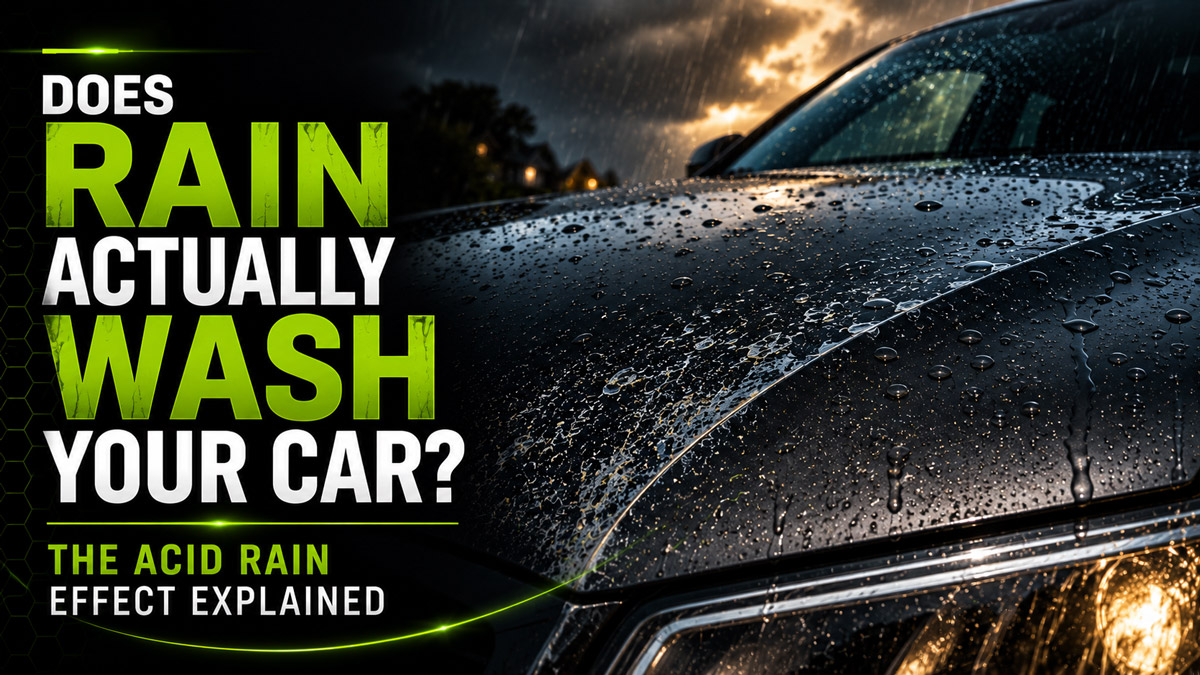
No, rain does not actually wash your car; instead, it acts as a delivery system for environmental pollutants. As precipitation falls, it collects airborne particulates and leaves behind sulfuric and nitric acid residues upon evaporation. These concentrated acids attack your vehicle’s clear coat, causing permanent chemical etching within 24 hours if left untreated.
Key Facts / At a Glance
- Rainwater is a carrier for atmospheric pollutants, soot, and industrial fallout, rather than a cleansing agent.
- Evaporating rain leaves highly concentrated sulfuric and nitric acid deposits that physically eat through automotive clear coats.
- Type II water spots (chemical etching) cause permanent paint damage that requires abrasive machine polishing to repair.
- The chemical etching process can ruin an unprotected clear coat in under 24 hours when exposed to direct sunlight.
- Washing with a high-quality, pH-neutral automotive soap effectively neutralizes these acidic deposits.
- True ceramic coatings (SiO2) provide the highest chemical resistance against the acid rain effect, outperforming traditional waxes.
Why Does My Car Look Dirtier After It Rains?
Your car looks dirtier after rain because falling water droplets absorb atmospheric dust, industrial fallout, and smog on their way down to the surface. When this contaminated water sits on your vehicle and evaporates, it leaves those concentrated solids permanently bonded to the exterior. Rain is never pure; it carries a high volume of Total Dissolved Solids (TDS).
The visual dirt you see after a rainstorm is a combination of these evaporated atmospheric pollutants and the road grime kicked up by your tires. Furthermore, water droplets act as a magnet for loose dust already sitting on the paint. As the water pools and dries, it pulls the dry dust into highly visible, concentrated ringlets across your hood and roof.
What Is the Acid Rain Effect on Car Paint?
The acid rain effect is a destructive chemical reaction where evaporated sulfuric and nitric acid residues eat microscopic craters into the porous layer of automotive clear coats. When precipitation falls through polluted air, it mixes with sulfur dioxide and nitrogen oxides—the primary byproducts of fossil fuel combustion.
Once this acidic water lands on your vehicle, the liquid itself is only mildly dangerous. The severe damage occurs during evaporation. As the pure water turns to gas, the ratio of acid to water in the droplet spikes. The remaining microscopic ring of residue becomes a hyper-concentrated acid that physically burns into the clear coat resin. Automotive detailers categorize this damage into two main types:
- Type I Water Spots: Superficial mineral deposits resting on top of the clear coat. Easily removed with chemical descalers.
- Type II Water Spots: Sub-surface chemical etching caused by the acid rain effect. The acid has hollowed out a crater in the paint, requiring mechanical leveling (polishing) to repair.
How Do UV Rays Accelerate Rain Damage?
UV rays accelerate rain damage by heating the water droplet, which acts as a miniature magnifying glass, exponentially increasing the chemical reaction rate of the acids underneath. Heat acts as a catalyst for chemical etching.
When the sun comes out immediately following a rain shower, the clear coat expands, opening its microscopic pores. The intensified sunlight boils the water off rapidly, immediately baking the concentrated sulfuric and nitric acids deep into the expanded paint structure.
How Long Before Acid Rain Damages Your Clear Coat?
Acid rain can begin permanently etching your clear coat in as little as 24 hours, particularly under direct sunlight and high ambient temperatures. Factory automotive clear coats are remarkably thin, typically measuring between 35 to 50 microns in total depth (roughly the thickness of a Post-It note).
A severe acid rain droplet baking in 90-degree ambient heat can eat through 1 to 3 microns of that clear coat in a single afternoon. If the vehicle is left outside for a week without being washed, the etching can penetrate so deeply that it reaches the base color coat, at which point the panel must be completely repainted.
Which Coatings Offer the Best Acid Rain Protection?
You can protect your vehicle from rain damage by applying a chemically resistant, hydrophobic barrier like a true ceramic coating or graphene matrix. Traditional carnauba waxes offer almost zero protection against modern acid rain, as the low melting point of natural wax allows acids to penetrate effortlessly in the sun.
Ceramic coatings utilize a silicon dioxide (SiO2) matrix that cures into a hardened shell over the paint. This shell boasts a much wider chemical tolerance, preventing sulfuric and nitric acids from reaching the factory clear coat.
How Do You Mitigate Acid Rain Damage Safely?
You mitigate acid rain damage by neutralizing the acidic residues with a high-quality, pH-neutral automotive shampoo as soon as possible after the storm. Do not use dish soap, as its aggressive alkaline profile will strip protective sealants and dry out window seals without properly lubricating the acidic surface dirt.
To properly halt the acid rain effect without inducing micro-scratches, follow this practitioner-approved decontamination sequence:
- Pre-Soak the Surface: Apply a thick layer of pH-neutral snow foam using a pressure washer cannon. Let it dwell for 5 minutes. This encapsulates the acidic dust and lifts it away from the clear coat without mechanical friction.
- Two-Bucket Hand Wash: Use one bucket for soapy water and one for rinsing your microfiber wash mitt. This prevents dragging the sharp, abrasive atmospheric fallout back across the paint.
- Forced-Air Drying: Use an automotive leaf blower or dedicated car dryer to remove standing water. Towel drying a vehicle that has recently suffered heavy acid rain exposure often grinds lingering microscopic minerals into the finish.
Expert Insights: The Quick Detailer Mistake
A common mistake owners make is attempting to wipe away dried rain spots with a quick detailer spray and a microfiber towel. Because the acid rain effect leaves behind bonded, sharp atmospheric pollutants, dry wiping acts like fine-grit sandpaper. Furthermore, a quick detailer cannot chemically neutralize Type II acid etching. If the rain has dried, a full contact wash is mandatory.
The Bottom Line
Relying on rain to wash your car guarantees accelerated degradation of the vehicle’s exterior. Rainwater is heavily contaminated with atmospheric pollutants that convert into highly corrosive sulfuric and nitric acids as they dry. To preserve your clear coat, you must treat rain exposure as a contamination event, promptly neutralizing the surface with a pH-neutral wash and investing in a ceramic-grade chemical barrier.
Frequently Asked Questions
Is it bad to wipe rain off a wet car?
Wiping rainwater off a car with a microfiber towel is highly destructive to the clear coat. Because rain is filled with abrasive airborne pollutants and atmospheric dust, dragging a towel across the wet paint acts like fine sandpaper, inducing swirl marks and permanent micro-scratches.
Will heavy rain wash off bird droppings?
Heavy precipitation will not completely remove baked-on bird droppings. Instead, rain rehydrates the highly corrosive uric acid found in the droppings, reactivating the chemical process. This combination of bird acid and acid rain aggressively accelerates clear coat failure, requiring immediate safe removal.
Does rain damage car glass and windshields?
Yes, the acid rain effect permanently etches automotive glass if left untreated. While glass is physically harder than clear coat, prolonged exposure to acidic rainwater creates microscopic pitting and hard water stains. Removing severe glass etching requires specialized cerium oxide polish and a machine buffer.
Can white vinegar fix acid rain spots?
White vinegar effectively dissolves superficial Type I mineral deposits due to its mild acetic acid content. However, vinegar cannot repair Type II acid rain spots. Since the acid rain effect causes physical craters in the clear coat, correcting the damage requires abrasive machine polishing, not liquid chemical removers.
Is a garage-kept car safe if put away wet?
Parking a rain-soaked car in a climate-controlled garage accelerates the acid rain effect. The warmer indoor temperatures cause the water droplets to evaporate much faster, baking the sulfuric and nitric acid residues directly into the paint before you have a chance to wash the vehicle.