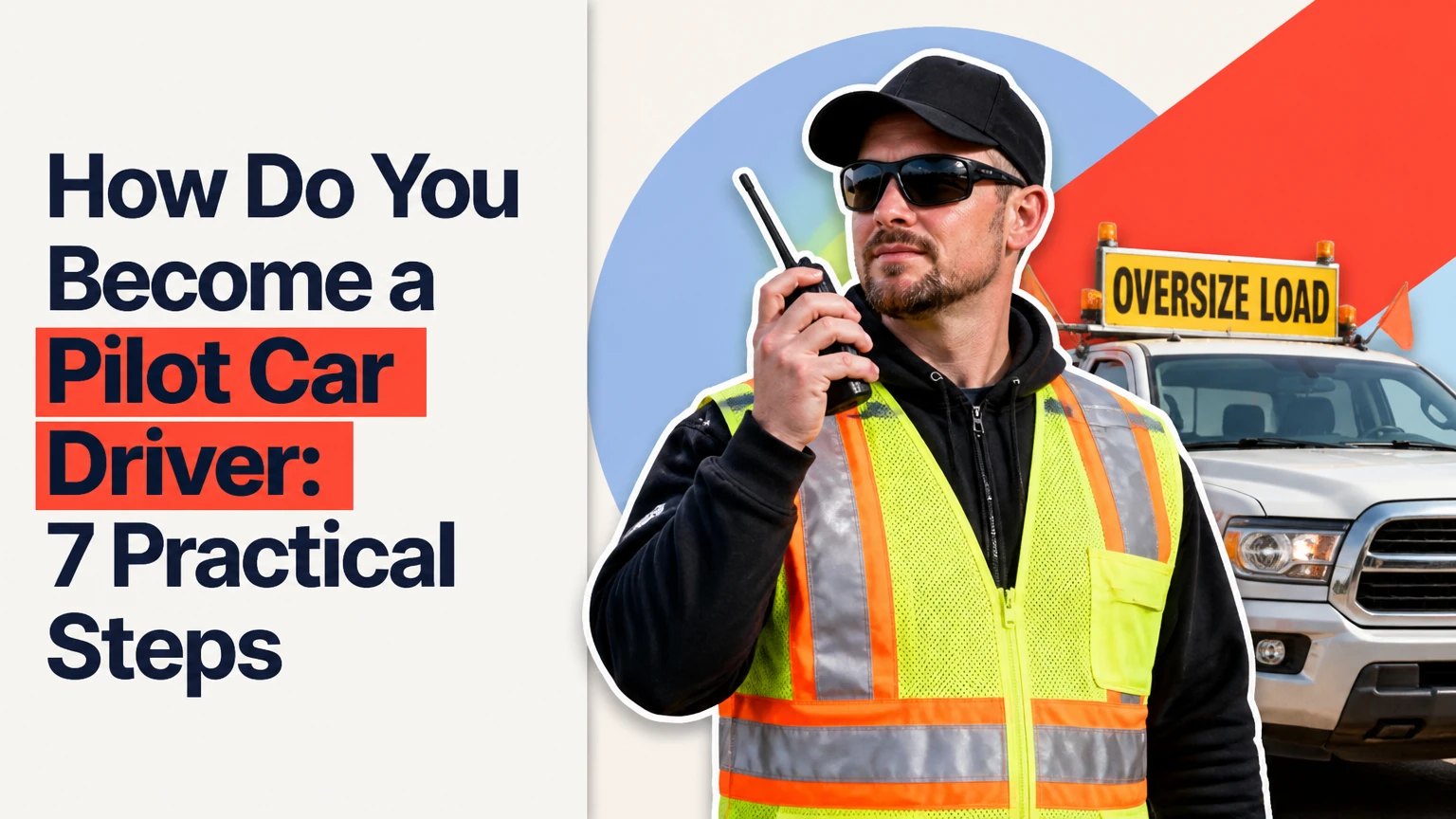
To become a pilot car driver, also called a Pilot Escort Vehicle Operator (PEVO), you must meet your state’s driver requirements, complete required training, equip an escort vehicle, obtain appropriate commercial insurance, and secure work with a carrier or escort company. The process commonly takes several days to several weeks, depending on certification and insurance.
Key Facts at a Glance
A pilot car driver escorts oversized or overweight loads and does not replace the truck driver’s legal responsibility.
A standard driver’s license is often sufficient, but PEVO certification, age, vehicle, and equipment rules vary by state.
State-approved training commonly covers route surveys, traffic control, radio procedures, permits, and emergency response.
Independent operators typically face vehicle, equipment, insurance, registration, and deadhead costs before earning revenue.
Personal auto insurance usually excludes commercial escort operations, so written confirmation from a commercial insurer matters.
Certification from one state is not automatically valid nationwide; verify every operating state through its transportation agency.
What Does a Pilot Car Driver Do?
A pilot car driver warns an oversized-load convoy about hazards, communicates road conditions, helps the permitted load negotiate restricted road sections, and protects other road users. The pilot car driver does not have unrestricted authority to stop traffic, remove obstacles, or direct motorists unless state law and the situation specifically authorize that action.
Oversize-load escorts commonly accompany mobile homes, bridge beams, construction machinery, wind-turbine components, industrial vessels, aircraft parts, and military equipment. The required escort arrangement depends on dimensions, route, permit conditions, road type, and state law.
A lead escort travels ahead of the load. The driver identifies low bridges, narrow lanes, roadworks, stopped traffic, railroad crossings, sharp turns, and changing conditions. A rear escort, often called a chase car, warns following traffic, watches for load or equipment problems, and protects the convoy during lane changes or turns.
The job is operational rather than ceremonial. A lead driver may need to report a bridge clearance concern within seconds, while a chase driver may need to identify a detached warning flag before it becomes a traffic hazard.
Lead Car and Chase Car Duties
| Position | Typical location | Primary duties | Main failure risk |
|---|---|---|---|
| Lead escort | 10-30 seconds ahead, when conditions permit | Scout hazards, assess clearance, communicate road conditions | Missing a changing obstruction |
| Rear escort | Behind the permitted load | Warn following traffic, monitor load, protect turns | Rear-end conflict or poor visibility |
| High-pole lead | Immediately ahead or at a permit-defined position | Check overhead clearance with specialized equipment | Pole contact or false clearance judgment |
| Additional escort | Position specified by permit | Control complex intersections or restricted routes | Conflicting radio instructions |
Spacing is not a universal fixed distance. A convoy may compress in urban traffic and spread out on open roads, but the escort team must remain close enough for reliable radio communication and far enough apart to preserve sightlines and reaction time.
How Do You Become a Pilot Car Driver?
The standard route has seven stages: confirm eligibility, complete required training, verify state recognition, equip the vehicle, arrange commercial coverage, find compliant work, and maintain records. The most important success factor is not buying a light bar first; it is confirming the exact rules for the states and routes where you intend to operate.
A new driver should begin with the state department of transportation, not an equipment retailer or online forum. Permit conditions can impose requirements that differ from ordinary PEVO rules, including escort numbers, vehicle dimensions, warning devices, route knowledge, travel hours, and specialized qualifications.
The following sequence reduces wasted spending because it postpones vehicle customization until the operator knows which state and customer requirements apply.
Before You Start
| Requirement | Typical range or standard | Verification source |
|---|---|---|
| Minimum age | 18 in many jurisdictions, 21 in some programs or contracts | State DOT and employer |
| Driver credential | Valid noncommercial license often accepted | State DOT |
| Training time | Approximately 8 hours for many entry courses | Approved course provider |
| Entry training cost | Approximately $150-$400 | State-approved provider |
| Independent startup cash | Approximately $2,500-$8,000 | Insurer, equipment suppliers, business budget |
| Vehicle condition | Reliable SUV, pickup, or sedan with required visibility | State rules and permit |
Step 1: Confirm Your Eligibility and Driving Record
Start by checking your age, license status, driving history, physical ability, and ability to work irregular hours. Many states accept a regular driver’s license for an escort vehicle, while a CDL is usually unnecessary unless the job also involves operating a commercial motor vehicle.
Employers and insurers may apply stricter standards than the state minimum. Recent DUI convictions, reckless-driving offenses, suspended licenses, repeated speeding citations, or serious at-fault crashes can raise premiums or prevent hiring even when the state does not formally prohibit certification.
Request your official motor vehicle record before paying for training. A consumer copy of an insurance record is not always the same document used by a carrier or insurer. Check whether your license has restrictions, whether medical documentation is required by the employer, and whether your vehicle registration is current.
You will know this step is complete when a state agency or prospective employer confirms your eligibility and an insurer gives an initial underwriting indication.
Common mistake: assuming a clean personal driving history guarantees affordable commercial coverage. Insurance underwriting also considers vehicle use, territory, limits, experience, claims, and the operator’s business structure.
Step 2: Complete State-Required Training
Enroll in a PEVO or pilot-escort course accepted by the state where you plan to operate. Training commonly addresses oversize-load permits, route surveys, bridge and utility clearance, traffic-control devices, radio etiquette, convoy positioning, incident response, and documentation.
The Evergreen Safety Council offers a recognized pilot-car training program, and the University of Florida’s Transportation Technology Transfer Center has offered pilot escort and flagging instruction. Availability, approval, exam format, and renewal periods change, so confirm current acceptance with the relevant state transportation department before enrolling.
A training certificate is evidence of completed instruction. It is not always a license to operate in every state. Some jurisdictions require a state credential, registration, or additional course, while others recognize certificates from approved providers under defined conditions.
Most entry programs can be completed in one day, but a certificate does not create practical experience. A beginner should ride with an experienced escort, if permitted, before accepting a complex route involving urban traffic, multiple escorts, utility lines, or a high-value load.
You will know this step is complete when you possess the certificate or credential named in the state’s current escort rules and understand its expiration date.
Common mistake: treating an online course advertisement as proof of state approval. Ask the state agency for the accepted provider list or written confirmation.
Step 3: Verify State Certification and Reciprocity
Check every state in which the convoy will operate, including states crossed during a repositioning trip. Reciprocity is conditional rather than automatic. A certificate accepted in Florida, Utah, or Colorado may not satisfy another state’s rules, and recognition can depend on the course provider, certificate date, vehicle equipment, or permit language.
New York is frequently cited as a state with its own pilot-escort requirements, but New York is not the only jurisdiction requiring careful state-specific verification. Rules also vary for warning signs, lights, flags, cones, radios, certification renewal, escort numbers, and traffic-control authority.
Use a written compliance file containing the current state rule, certificate, expiration date, equipment checklist, insurance certificate, vehicle registration, and emergency contacts. Ask the carrier or permit office which requirements govern the specific load rather than relying on a generic national checklist.
| Compliance item | State-dependent question | Practical proof to carry |
|---|---|---|
| Certification | Is this provider and course accepted? | Certificate and provider details |
| Reciprocity | Does the state recognize this credential? | Agency page, email, or rule citation |
| Equipment | What sign, light, cone, and flag sizes apply? | State checklist and vehicle photos |
| Traffic control | May the escort stop or direct traffic? | Statute, permit, or agency guidance |
| Renewal | When does the credential expire? | Certificate issue and expiration dates |
You will know this step is complete when the operating states and the load permit requirements have been checked individually.
Common mistake: buying one “nationwide” equipment package and assuming it settles legal compliance. Equipment can satisfy one state while failing another.
Step 4: Equip the Escort Vehicle
Fit the vehicle only after confirming the governing requirements. Typical equipment includes an exterior “OVERSIZE LOAD” sign, amber warning lights, two-way communications, high-visibility clothing, warning flags, traffic paddles, cones, a fire extinguisher, a first-aid kit, and reflective markings.
The sign is commonly roof-mounted and visible from the front or rear, but dimensions and wording vary. Some jurisdictions specify a 5-foot sign, while others define lettering, color, mounting, or visibility differently. Amber lights may be a rotating beacon or LED light bar, but brightness, placement, and use rules remain state-specific.
A CB radio is common in heavy-haul work, although a permitted convoy may use commercial two-way radios or another approved communication system. Test radio range on the actual route, establish call signs, and reserve the channel for concise safety information.
| Equipment | Typical specification | Inspection point |
|---|---|---|
| Oversize-load sign | Often about 5 feet wide, state dependent | Legible, secure, visible front and rear |
| Amber warning light | Roof beacon or LED bar, state dependent | Visible, functional, legally positioned |
| Traffic cones | Commonly 28-40 inches, state dependent | Correct height, clean, weighted if required |
| Flags | High-visibility red or fluorescent material | Correct size, attachment, and condition |
| Radio | CB or approved two-way radio | Charged, tested, spare power available |
| Paddle | “STOP/SLOW” sign, where required | Reflective face and intact handle |
| Safety gear | Vest, hard hat, flashlight, extinguisher | Accessible and within inspection date |
You will know this step is complete when every item matches the strictest applicable rule and remains secured during highway travel.
Common mistake: using a personal magnetic sign or small emergency beacon that looks visible in a driveway but cannot be read at convoy distance.
Step 5: Arrange Commercial Insurance and Budget the Operation
Obtain an insurance quote that explicitly covers pilot-escort operations before taking a job. Personal auto insurance commonly excludes business use involving paid escort services, and a claim denial can leave the operator responsible for vehicle damage, third-party injury, or property loss.
Ask the broker about commercial auto liability, general liability, hired and non-owned auto coverage, physical damage, roadside assistance, medical payments, and coverage for equipment. A $1 million liability limit is a common commercial benchmark, but the required limit comes from the carrier, contract, state rule, or permit, not from a universal PEVO standard.
Errors and omissions coverage may be relevant to some businesses, but it does not automatically cover physical damage from an incorrect clearance judgment. Ask the insurer to explain exclusions involving route surveys, traffic control, utility strikes, and work performed under another company’s dispatch.
| Startup category | Typical independent-operator amount | Cost control |
|---|---|---|
| Training and credential | $150-$400 | Verify approval before enrollment |
| Signs, lights, and safety gear | $800-$1,800 | Buy compliant equipment, not decorative upgrades |
| Commercial insurance down payment | $1,000-$2,500 typical estimate | Compare deductibles and exclusions |
| Business registration and permits | $100-$600 | Confirm local and state filings |
| Vehicle reserve | $1,000-$3,000 | Keep cash for tires, brakes, and repairs |
| Total initial cash | $2,500-$8,000 | Delay optional specialization |
These figures are typical planning ranges, not legal or quoted prices. Location, vehicle, driving history, liability limits, and annual mileage can move insurance costs sharply.
You will know this step is complete when the declarations page names the correct business use and the policy limits meet the customer’s written requirements.
Common mistake: accepting a dispatch before checking whether the customer requires additional insured status, a certificate of insurance, or a particular liability limit.
Step 6: Find a Carrier, Broker, or Escort Employer
Choose an employment path before purchasing expensive specialty equipment. A W-2 escort company or heavy-haul carrier may provide the vehicle, insurance, fuel, training, and dispatch, while an independent contractor usually supplies those assets and manages taxes, maintenance, customer acquisition, and unpaid travel.
Search for heavy-haul carriers, specialized transportation companies, mobile-home movers, crane transport firms, pilot-car service companies, and regional escort networks. Verify that a recruiter is representing a real operating business, obtain the pay structure in writing, and avoid paying an unexplained fee for access to loads.
Ask each customer five operational questions:
- Is pay based on loaded miles, total miles, hours, or a flat route fee?
- Is deadhead mileage paid, reimbursed, or excluded?
- Who supplies permits and confirms route restrictions?
- What happens during a delay, cancellation, breakdown, or weather shutdown?
- Which insurance documents and equipment standards are mandatory?
| Work arrangement | Startup cash | Typical pay structure | Main risk |
|---|---|---|---|
| W-2 escort employee | $0-$1,500 | Hourly wage or salary | Less schedule control |
| Company vehicle contractor | $500-$3,000 | Route fee or mileage split | Contract deductions |
| Independent owner-operator | $2,500-$8,000 | Flat fee, hourly, or mileage | Insurance and deadhead |
| Specialized high-pole operator | $5,000-$12,000 | Premium route or mileage rate | Clearance liability |
You will know this step is complete when you have a written dispatch, route, pay terms, permit contact, meeting location, and cancellation policy.
Common mistake: comparing a quoted loaded-mile rate with an employee’s hourly wage without including return travel, waiting time, fuel, maintenance, insurance, taxes, and vehicle depreciation.
Step 7: Run the First Assignment Conservatively
Review the permit, route, dimensions, weight, escort positions, communication plan, weather, travel hours, and emergency contacts before departure. Confirm the truck’s actual height and width, because a route survey based on an incorrect load measurement can create a dangerous false clearance.
At the pre-trip meeting, establish who leads decisions, which radio channel is used, what words indicate an immediate stop, how the convoy handles a lost escort, and where vehicles regroup after a traffic signal. Inspect signs, lights, tires, brakes, radios, fuel, and tie-down visibility.
During the trip, communicate facts rather than conversation. A useful call includes location, distance, hazard, lane, and required action, such as: “Bridge inspection at mile marker 42, right lane narrowed, truck remain left.” Never claim that an escort can physically guarantee clearance if the measurement or route condition is uncertain.
Document delays, unusual instructions, damage, near misses, weather stops, and permit changes. Photographs and time-stamped notes support insurance reporting and payment disputes.
You will know this step is complete when the convoy reaches the destination without an unresolved safety incident and your job records reconcile with the agreed pay terms.
Common mistake: allowing schedule pressure to override a clearance concern. A delayed load costs money; a collision can end the business.
Should You Work for a Company or Operate Independently?
A new pilot car driver should usually begin with an established escort company or heavy-haul carrier if the operator lacks commercial insurance, route experience, or repair reserves. Independent contracting offers more control and potentially higher gross revenue, but the operator assumes costs that advertised mileage rates often conceal.
| Decision factor | W-2 employee | Independent operator | Best fit |
|---|---|---|---|
| Initial outlay | $0-$1,500 | $2,500-$8,000 | Beginner: W-2 |
| Insurance responsibility | Employer arranged | Operator arranged | Risk-averse driver: W-2 |
| Schedule control | Employer dispatch | Self-directed | Entrepreneur: independent |
| Vehicle cost | Often supplied or reimbursed | Owner pays repairs | Existing reliable vehicle: independent |
| Tax administration | Payroll withholding | Quarterly estimates and records | Simplicity: W-2 |
| Revenue ceiling | Lower gross ceiling | Higher gross possibility | Established network: independent |
A gross rate of $1.50-$2.25 per loaded mile can sound attractive, but a 600-mile assignment may include unpaid repositioning, two nights of lodging, fuel, meals, tires, and maintenance. Net income depends on billable utilization, not the headline rate.
How Much Does a Pilot Car Driver Make?
Pilot car earnings vary by region, assignment length, certification, specialization, employment status, and unpaid travel. A typical planning range is approximately $18-$28 per hour for employee work and roughly $45,000-$85,000 or more in annual gross revenue for an established independent operator, before operating expenses and taxes.
Those figures are not guaranteed salaries. A new independent driver may have irregular bookings, while a regional employee may receive steadier hours but less control over routes. Wind-energy and industrial projects can pay premium rates, yet they may involve remote travel, weather delays, long waits, and difficult access roads.
Calculate a job using total compensated time and total vehicle miles:
Estimated net before tax = gross job pay – fuel – lodging – meals – maintenance reserve – insurance allocation – taxes.
A practical maintenance reserve should account for tires, brakes, oil, suspension, and depreciation. High annual mileage can turn a seemingly profitable route into a loss if the operator ignores vehicle replacement costs.
What Is High-Pole Work, and Should Beginners Do It?
A high-pole operator uses a specialized pole mounted to the escort vehicle to identify potential overhead clearance conflicts before the load reaches them. High-pole work carries greater consequence because an incorrect setup or judgment can damage utility lines, signals, bridges, the load, and the escort vehicle.
High-pole equipment is not a universal requirement for ordinary pilot-car work. It requires specific training, suitable mounting, route knowledge, and an agreement about who verifies the load height and clearance. The pole is a detection aid, not permission to strike infrastructure or substitute for a proper route survey.
New operators should gain ordinary escort experience first unless a reputable company provides supervised training and assumes clear operational responsibility. A premium of roughly $0.25-$0.50 per mile is sometimes cited by contractors, but the rate depends on region, equipment, contract, and liability terms.
Common Compliance and Safety Failures
The most expensive pilot-car mistakes occur before the vehicle moves. Each failure below has a practical correction.
- Using personal insurance: Obtain written commercial-use confirmation and a certificate naming the required limits before accepting paid work.
- Assuming reciprocity: Check each state, certificate provider, renewal period, and permit condition through current transportation-agency sources.
- Buying the wrong cones or signs: Build an equipment matrix by state, then use the strictest applicable dimensions only when the vehicle can legally and safely carry them.
- Overusing the radio: Restrict calls to location, hazard, distance, and action. Unnecessary conversation can mask an urgent warning.
- Skipping route verification: Compare permit instructions with current construction, bridge restrictions, utility work, and weather.
- Ignoring fatigue: Set a maximum duty period, schedule breaks, and stop when visibility or alertness becomes unsafe. Escort work often involves more waiting and night driving than applicants expect.
A pilot escort cannot cure an illegal permit, an inaccurate truck height, an unsafe driver, or a failed mechanical component. The escort’s value lies in early hazard detection and disciplined communication, not in taking responsibility for every convoy decision.
Situational Rules for New Drivers
Can You Start Part-Time?
Yes, part-time entry is practical through a regional employer or company vehicle arrangement. Independent part-time work is less efficient when insurance, equipment, and vehicle costs continue during weeks without assignments.
Part-time drivers should target local manufactured-home moves, regional construction equipment, or scheduled plant relocations before accepting multistate wind-component work. The shorter routes build permit, radio, and convoy experience without immediately creating large lodging and deadhead costs.
Can You Work Without a Pickup Truck?
Often, yes. States and customers may accept a sedan, SUV, or pickup if the vehicle meets visibility, lighting, sign, communication, and safety requirements. A vehicle with adequate cargo capacity, reliable brakes, strong alternator output, and stable roof-sign mounting is more important than body style.
Do not buy a large truck solely for appearance. A smaller, fuel-efficient vehicle can reduce operating cost if it carries the required equipment and performs reliably on the route.
Can You Escort at Night or in Bad Weather?
Only when the permit, customer, state rules, and actual conditions allow it. Night travel, fog, snow, high winds, flooding, and severe thunderstorms reduce sight distance and increase stopping risk, especially for wide or tall loads.
A convoy should stop when the lead escort cannot reliably identify hazards or the truck cannot maintain safe control. The permit schedule is subordinate to roadway safety and lawful operating conditions.
Frequently Asked Questions
Do pilot car drivers need a CDL?
Most pilot car drivers do not need a CDL merely to operate an escort vehicle. A CDL may become necessary if the driver also operates a commercial motor vehicle that meets federal or state CDL thresholds, or if an employer imposes a higher qualification standard. Confirm the rule with the state DOT and employer.
How long does PEVO certification last?
Certification periods vary by issuing state and program. Some credentials commonly last three or four years, while other jurisdictions use different renewal rules or require a refresher course. Record the expiration date and verify renewal requirements directly with the issuing agency rather than assuming national uniformity.
What vehicle is best for pilot-car work?
A reliable SUV, pickup, or sedan can work if it meets the applicable sign, light, communication, visibility, and safety requirements. Reliability, cargo space, braking condition, electrical capacity, and fuel economy matter more than vehicle brand. A dedicated vehicle should also have a maintenance reserve because escort work creates substantial mileage.
Are pilot car drivers paid for deadhead miles?
Deadhead treatment depends on the contract. Some customers pay total miles, some pay only loaded miles, and others offer a reduced repositioning rate or a flat route fee. Ask for the payment formula before accepting the dispatch, then calculate fuel, time, lodging, and maintenance across every mile driven.
Is pilot-car work dangerous?
Pilot-car work carries roadway, traffic-control, weather, fatigue, and liability risks, although the level varies by load and route. The escort vehicle is exposed to ordinary highway collisions and must work near large vehicles with limited maneuverability. Training, conservative decisions, clear radio discipline, and fatigue management reduce risk but cannot eliminate it.
How do pilot car drivers find their first job?
Start with established heavy-haul carriers, specialized transportation companies, mobile-home movers, crane haulers, and escort-service firms in your region. Present your driver record, training certificate, equipment list, insurance documents, service territory, and availability. A supervised first assignment is more valuable than an unverified high-rate dispatch.
The Bottom Line
How do you become a pilot car driver? Become a certified PEVO where required, verify every state and permit rule, prepare a compliant vehicle, obtain commercial insurance, and begin with work that matches your experience and financial reserves. The safest entry is usually an established employer or supervised regional assignment, followed by independent contracting only after you understand deadhead economics, maintenance, documentation, and route risk.