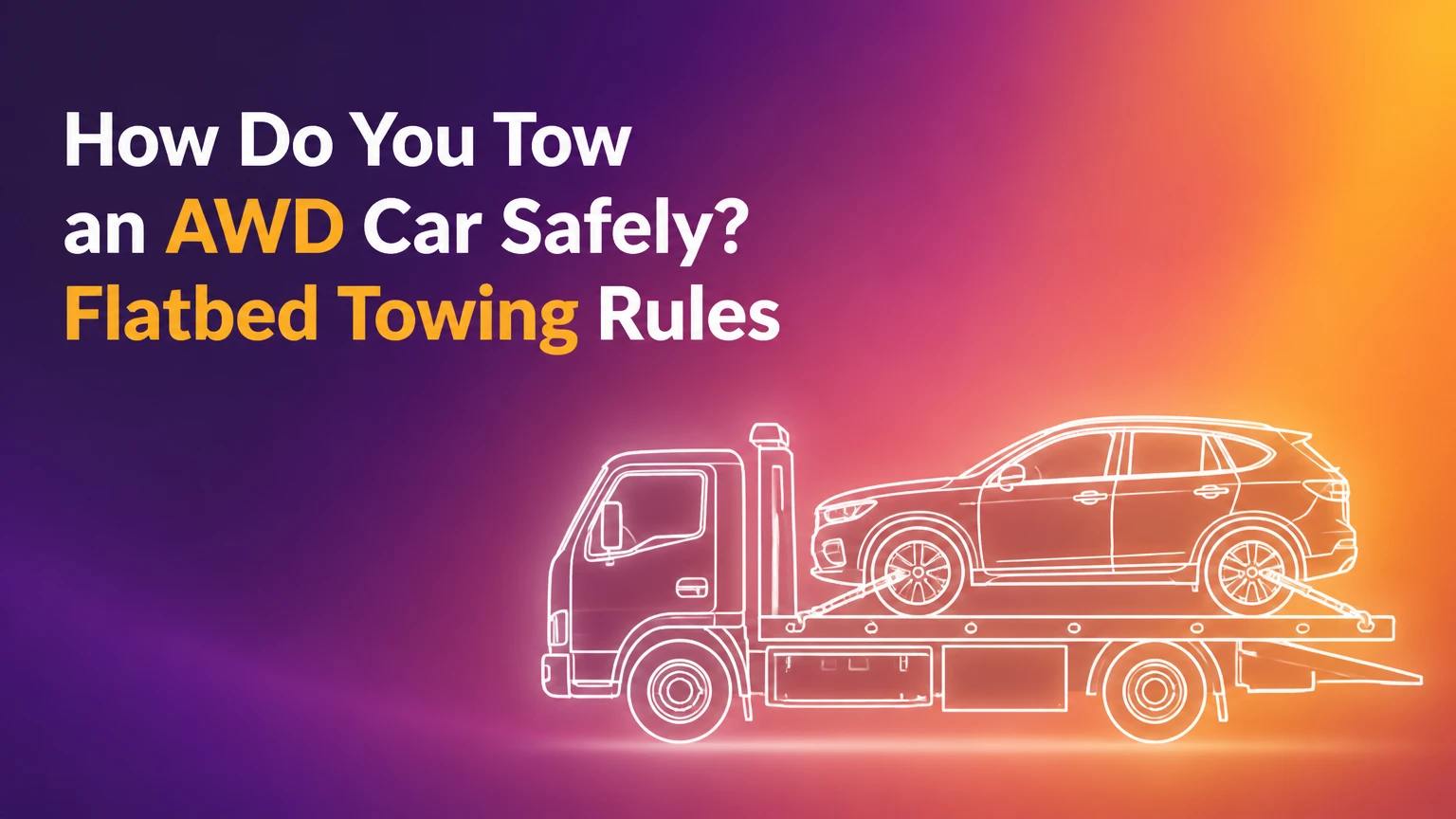
To tow an AWD car safely, use a flatbed truck or a car trailer that keeps all four wheels off the road unless the vehicle manufacturer expressly approves another method. Place the transmission in Neutral only for loading, release the parking brake when possible, use the designated tow eye, and secure the vehicle by its tires after loading.
Key Facts at a Glance
- A flatbed tow truck is the safest general method for transporting an all-wheel-drive car because every road wheel remains stationary.
- Selecting Neutral does not automatically disconnect an AWD vehicle’s front and rear driveline components.
- A wheel-lift truck is suitable only when the other axle is placed on properly rated towing dollies, leaving no vehicle wheel rolling on the pavement.
- Most modern automatic, hybrid, electric, and CVT-equipped AWD cars are not approved for recreational four-wheel towing behind an RV.
- Vehicle-specific instructions in the owner’s manual override generic towing advice, especially for Subaru, Audi, BMW, Tesla, Toyota, Honda, and Jeep models.
- Typical local flatbed towing costs range from $150 to $350 for a short trip, but location, distance, access, weight, and roadside conditions change the price.
Why Does AWD Towing Require Special Care?
AWD towing requires special care because the front and rear axles can remain mechanically or electronically connected while the engine is off. If two tires rotate on the pavement while the other two are lifted, the center differential, transfer case, or electronically controlled clutch must absorb the speed difference, which can create heat and wear without normal lubrication or control-system operation.
An AWD system may use a center differential, a viscous coupling, a multi-plate clutch, or a transfer case. Some systems drive all four wheels continuously; others engage the second axle only when sensors detect slip. The visible AWD badge does not reveal which design is installed.
The key risk is not simply whether the transmission is in Park. A vehicle can be in Neutral and still have rotating axle shafts, bearings, clutch packs, or transfer-case components connected to the wheels. Engine-driven oil pumps may also stop when the engine is off, so a short tow can create damage that is not immediately obvious.
A limited exception exists. Some selectable four-wheel-drive vehicles have a manufacturer-approved transfer-case Neutral position that mechanically isolates the driveline for four-wheel towing. That feature is different from the ordinary Neutral position on an automatic transmission and must be confirmed in the owner’s manual.
Does Neutral Make an AWD Car Safe to Tow?
Neutral does not make every AWD car safe to tow with two wheels on the ground. Neutral allows the transmission output to rotate more freely in many vehicles, but it does not guarantee that the center differential, transfer case, electric axle, or rear-drive unit is disconnected.
Use Neutral to load an AWD car onto a flatbed, trailer, or towing dollies when the manual instructs you to do so. Do not treat Neutral as permission for a wheel-lift truck to pull the vehicle with an axle rolling on the road.
Which Towing Method Is Safest?
A flatbed tow truck is the best default for an AWD car, while a full car trailer provides a comparable four-wheels-off-ground solution when a suitable tow vehicle is available. A wheel-lift truck with correctly installed dollies can work for many recoveries, but it requires more setup and greater operator attention.
| Method | Wheels on road | Typical local use | Main limitation |
|---|---|---|---|
| Flatbed truck | 0 | Breakdown transport, collision recovery, long-distance towing | Requires truck access and ramp clearance |
| Car trailer | 0 | Private transport, motorsport, planned relocation | Requires a properly rated tow vehicle and trailer |
| Wheel lift plus 2 dollies | 0 | Garages, narrow streets, restricted access | Dollies add setup time and clearance concerns |
| Two-wheel wheel lift | 2 | Many 2WD vehicles only | Generally unsuitable for AWD unless the manual approves it |
| Tow bar, four wheels down | 4 | Certain approved 4WD vehicles | Often prohibited for automatic or CVT AWD cars |
Flatbed Versus Wheel Lift With Dollies
A flatbed is usually preferable because it supports the entire vehicle on one platform and reduces the number of moving recovery components. Dollies are a practical alternative when a tall flatbed cannot enter a parking structure, but the operator must lift the second axle completely clear of the road and secure each dolly according to its manufacturer’s instructions.
The term “dolly” can create confusion. A small wheel-lift attachment that supports only part of a tire is not necessarily equivalent to a rated towing dolly under both tires of the remaining axle. Ask the dispatcher whether the truck carries two suitable dollies and tell the operator the vehicle is AWD before loading begins.
A dolly setup can also be unsuitable when a wheel is damaged, a tire is flat, the vehicle has severe collision damage, or the car has very low ground clearance. In those situations, a flatbed with winching equipment, tire skates, or a recovery trailer is safer.
Can You Tow an AWD Car Behind an RV?
You can tow an AWD car behind an RV only when the owner’s manual explicitly permits four-wheel-down towing and specifies the required transfer-case, transmission, speed, distance, and lubrication procedure. Most modern AWD passenger cars do not meet those conditions.
Certain Jeep models with a selectable transfer-case Neutral position are designed for recreational towing in specific configurations. That approval does not extend automatically to every Jeep, every trim, or every 4WD vehicle. Subaru, Audi quattro, BMW xDrive, Honda i-VTM4, Toyota Dynamic Torque Control AWD, and many other systems require different transport methods, commonly a flatbed or trailer.
| Vehicle configuration | Four-wheel-down towing default | Safer transport choice |
|---|---|---|
| Automatic AWD crossover | Usually prohibited | Flatbed or full trailer |
| CVT AWD sedan or SUV | Usually prohibited | Flatbed |
| Battery-electric AWD vehicle | Often restricted | Flatbed, with EV recovery instructions |
| Selectable 4WD with transfer-case Neutral | Sometimes approved | Follow manual procedure exactly |
| Manual-transmission 2WD car | Model-dependent | Verify manual before using a tow bar |
Before You Start: What Must You Confirm?
Before towing, confirm the make, model, model year, drivetrain, vehicle condition, access route, and owner-manual procedure. Tell roadside assistance that the vehicle is AWD, whether it is an EV or hybrid, whether the wheels turn, and whether the car is trapped in Park or inside a low-clearance garage.
| Item to confirm | Typical value or condition | Why it matters |
|---|---|---|
| Towing equipment | Flatbed, full trailer, or 2 rated dollies | Determines whether all wheels stay off the road |
| Vehicle weight | Approximately 2,800-5,500 lb for many cars and SUVs | Prevents truck and trailer overload |
| Loading time | 10-20 minutes on a normal flatbed | Increases with locked wheels or collision damage |
| Access clearance | Truck height and ramp angle measured onsite | Prevents roof, bumper, and underbody contact |
| Electrical condition | 12-volt battery charged or jump pack available | Allows shifting, steering, and parking-brake release |
| Tie-down points | Four tire straps or manufacturer-approved restraints | Controls the vehicle without damaging suspension parts |
Do not rely on an online towing chart when the owner’s manual is available. Manufacturer instructions can differ between model years because an automaker may change a transfer case, rear motor, transmission, or parking-brake system without changing the vehicle’s badge.
What Should You Tell the Tow Company?
Tell the tow company, “This is an AWD vehicle and needs all four wheels off the ground,” then provide the exact make, model, year, location, and condition. Mention flat tires, locked steering, missing keys, a dead 12-volt battery, collision damage, steep ramps, and low garage ceilings before dispatch sends a truck.
Ask for the truck type, maximum vehicle weight, expected arrival time, estimated hook-up fee, mileage rate, and whether the operator carries tire skates or dollies. A dispatcher who records only “car tow” may send a wheel-lift truck that is unsuitable for the vehicle.
How Do You Load an AWD Car Onto a Flatbed?
Loading an AWD car onto a flatbed involves preparing the controls, connecting the winch to a designated recovery point, guiding the car up the ramps, and securing the tires after the vehicle reaches the bed. The tow operator should control the process, especially when the car cannot steer, roll, or power itself.
Step 1: Position the Truck and Inspect the Route
Position the flatbed as straight as practical with hazard lights and warning devices in place. Check ramp angle, overhead clearance, traffic exposure, curb height, fluid leaks, damaged suspension parts, and the direction in which the vehicle can be safely winched.
The operator should not drag a locked tire across the pavement if tire skates, a recovery trailer, or another method can prevent damage. You will know this step is complete when the truck is stable, the ramps are aligned, and no obstacle can contact the car during loading.
The common mistake is choosing a truck that can carry the vehicle but cannot reach it. A low garage entrance, narrow turning radius, or steep approach can make a standard flatbed unusable.
Step 2: Prepare the AWD Vehicle for Movement
Use the owner’s manual to select Neutral, unlock the steering system, and release the parking brake if the vehicle permits those actions. Keep the key or key fob available, and do not leave an electronic vehicle unattended with the ignition switched on.
If the battery is dead, the operator may use an approved 12-volt boost source, the manual shift-lock override, or a manufacturer-specified parking-brake release. Electric vehicles often require a charged low-voltage battery even when their high-voltage battery retains energy.
You will know the car is ready when the drive wheels roll without resistance, the steering can be guided, and the parking brake indicator is no longer engaged. The common mistake is forcing a shifter or pulling a cable without finding the model-specific override procedure.
Step 3: Attach the Winch to a Designated Point
Install the screw-in tow eye in its factory-threaded location when the manual identifies that point for recovery or loading. Use a factory recovery loop or approved chassis point only when the vehicle instructions permit it.
Never attach a winch hook to a tie rod, control arm, stabilizer bar, exhaust component, plastic bumper reinforcement, or an unverified suspension bracket. Those parts can bend or tear even when the car appears to load successfully.
You will know the attachment is correct when the hook and strap pull in line with the vehicle and the operator can inspect the connection without placing anyone in the cable’s path. The common mistake is using a shipping tie-down point as a recovery point, because the two points may have different load ratings.
Step 4: Winch the Car Slowly Onto the Bed
Keep the transmission in the manufacturer-specified loading position and winch at a controlled speed. A spotter should guide the driver or operator while watching tire position, bumper clearance, underbody contact, and cable alignment.
Do not allow anyone to stand between the vehicle and the truck, inside a pinch point, or directly in line with a tensioned winch cable. Stop immediately if a tire binds, the vehicle shifts sideways, or a suspension component contacts the ramp.
The loading checkpoint is four tires fully inside the bed’s supported area with adequate clearance around the vehicle. The common mistake is accelerating the winch to overcome resistance, which can damage the tow eye, pull the car off line, or overload the cable.
Step 5: Set the Parking Brake and Select Park
Once the vehicle is fully supported, set the parking brake and select Park if the owner’s manual and operator’s procedure call for it. Turn off the ignition after the steering position and restraint requirements are satisfied.
A car in Park is safer on the stationary flatbed because the transmission is no longer being used to control a rolling vehicle. Park does not replace tire straps, and the parking brake may be unavailable on a vehicle with a dead battery or mechanical damage.
Step 6: Secure All Four Tires
Use four rated tire straps or wheel nets attached to the flatbed’s designated anchor points. Secure the tires rather than compressing suspension components, and follow the strap manufacturer’s instructions for strap angle, tension, and anchor location.
| Restraint approach | Contact point | Appropriate use | Damage risk |
|---|---|---|---|
| Tire strap or wheel net | Tire tread and sidewall area | Standard flatbed transport | Low when correctly fitted |
| Factory wheel tie-down | Approved wheel opening or rim area | Manual-approved applications | Rim or finish damage if misused |
| Axle strap | Approved solid axle housing | Certain trucks and trailers | Suspension or brake-line damage |
| Control-arm strap | Suspension arm | Not a general-purpose tie-down | Bent arm, alignment damage, torn bushing |
The checkpoint is four straps tight enough to prevent vehicle movement without crushing the tire or contacting brake lines. The common mistake is using one strap over the body or hooking a chain to a suspension arm.
What If the Car Is in a Garage, Park, or Has No Power?
A locked, powerless, or inaccessible AWD car still needs all wheels supported during transport, but the recovery method may involve skates, a portable winch, dollies, or a low-clearance trailer. The operator should solve the movement problem without dragging locked tires or forcing drivetrain components to rotate.
For a car stuck in Park, locate the model-specific shift-lock override, usually near the shifter and protected by a small removable cover. The override may place the transmission in Neutral, but it does not release an electronic parking brake, unlock a steering column, or authorize two-wheel towing.
For an engaged electronic parking brake, the manual may specify a 12-volt connection, diagnostic release, or service procedure. Tire skates can support individual wheels and allow the vehicle to slide onto a flatbed, but skates must be rated for the vehicle’s weight and used on a surface where they will not escape.
For collision damage, do not assume the car can be driven onto the bed. A bent wheel, leaking fluid, damaged high-voltage system, deployed airbag, or shifted subframe calls for a recovery operator trained for collision transport.
How Is an AWD EV or Hybrid Towed?
An AWD EV or hybrid should normally be moved on a flatbed with the drive wheels off the road, because electric drive units can be damaged by unintended wheel rotation and high-voltage systems introduce additional recovery hazards. Follow the manufacturer’s emergency-response guide, not a generic gasoline-car procedure.
A dead EV may still have a charged traction battery but no usable 12-volt power. The 12-volt system commonly controls shift selection, electronic parking brakes, steering locks, charging interlocks, and vehicle access, so a qualified operator may need the specified jump terminals.
Do not touch orange high-voltage cables, attempt to tow a submerged EV without specialist guidance, or load a vehicle that is smoking, hot, or showing battery-damage warnings without notifying emergency personnel. Tire skates and a flatbed can move a disabled EV without energizing its drive motors.
What Does AWD Towing Cost and How Long Does It Take?
A typical short urban flatbed tow costs about $150-$350 for fewer than 15 miles, including a common hook-up charge, while unusual access, collision recovery, tolls, storage, distance, and after-hours service can raise the final bill. A normal loading operation takes roughly 10-20 minutes after the truck arrives.
These are planning ranges, not universal prices. Roadside-assistance plans may cover a defined distance, while independent operators may charge a base rate, mileage, winching fee, dollies, storage, or special-equipment fee.
| Cost or time item | Typical range | Variables that change it |
|---|---|---|
| Flatbed hook-up fee | $75-$125 | Region, time, membership coverage |
| Mileage charge | $3-$7 per mile | Distance, fuel, commercial rates |
| Short local tow | $150-$350 | Usually under 15 miles |
| Standard loading | 10-20 minutes | Steering, battery, tire condition |
| Dolly setup | 20-30 minutes | Wheel damage, clearance, operator access |
| Garage or recovery surcharge | $50-$250 or more | Low clearance, locked wheels, winching |
Request a written or texted estimate before authorizing non-emergency work. Confirm whether the quoted mileage measures from the dispatch yard, the pickup location, or the destination, because billing practices differ.
What Towing Mistakes Damage AWD Drivetrains?
The most damaging towing mistake is allowing an AWD vehicle’s wheels to roll on the pavement without manufacturer approval. Other expensive errors include treating Neutral as a driveline disconnect, using a hook truck without dollies, attaching recovery equipment to suspension parts, and towing an EV without following its recovery instructions.
Four common failure modes require different fixes
- Two wheels rolled during transport. Stop the tow as soon as the error is discovered, document the distance and speed, and request a drivetrain inspection. Check for transfer-case noise, warning lights, binding during tight turns, fluid leaks, and abnormal heat.
- The vehicle was dragged with the parking brake engaged. Inspect tires, brake rotors, calipers, cables, and electronic actuators. A short drag can create flat spots or brake overheating even when the AWD system remains intact.
- The tow strap was attached to a control arm or tie rod. Have an alignment shop inspect the attachment point, wheel position, steering linkage, bushings, and subframe before driving. A visual inspection alone may miss a bent component.
- The car was winched while its wheels were locked. Use skates or a suitable recovery dolly rather than increasing winch force. Excessive tension can tear the tow eye, deform the bumper structure, or pull a damaged suspension assembly farther out of alignment.
A drivetrain may survive a brief, slow movement, but no generic mileage threshold guarantees safety. Heat, tire circumference differences, road speed, system design, lubrication, and vehicle condition determine the actual risk.
How Can You Check for Damage After an Improper Tow?
Check for drivetrain damage after an improper tow by looking for AWD, transmission, or ABS warnings; listening for whining, clunking, or grinding; and inspecting fluid leaks or a hot transfer-case area. Do not continue driving a vehicle that binds, vibrates, loses propulsion, or produces a burning odor.
An automotive technician can scan the powertrain and chassis modules, inspect transfer-case and differential fluid, check tire circumference, and perform a controlled road test. Tell the technician exactly which axle rolled, for how long, at what speed, and whether the engine was running.
Tire circumference matters because mismatched tires can force an AWD coupling to compensate continuously. Replace or match tires according to the manufacturer’s permitted tread-depth and circumference limits before diagnosing a towing-related complaint.
Which Alternative Should You Choose?
Choose a flatbed for a normal breakdown, a full trailer for planned private transport, a dolly-equipped recovery truck for restricted access, and a manufacturer-approved tow-bar procedure only for vehicles specifically designed for four-wheel-down towing. No alternative is safer merely because it is cheaper or faster to arrange.
| Situation | Recommended method | Avoid | Reason |
|---|---|---|---|
| Open roadside breakdown | Flatbed truck | Two-wheel wheel lift | Protects both axles and the center driveline |
| Low garage entrance | Wheel lift plus two dollies | Tall flatbed entry attempt | Keeps every vehicle wheel off the floor |
| Long-distance private move | Full car trailer | Tow bar without approval | Provides stable four-wheel support |
| Approved Jeep 4WD setup | Tow bar, manual procedure | Generic AWD assumptions | Transfer-case Neutral may permit it |
| Disabled AWD EV | Flatbed with EV-trained operator | Rolling drive wheels | Limits motor and high-voltage risk |
| Collision-damaged AWD | Flatbed recovery equipment | Driving onto trailer | Prevents additional suspension or battery damage |
The lowest-cost method is not always the lowest-cost outcome. Paying for a flatbed generally costs less than replacing a transfer case, center differential, electric drive unit, or damaged suspension.
FAQ
Can an AWD car be towed with a tow truck?
An AWD car can be towed with a tow truck when the truck keeps all four wheels off the road, using a flatbed or a wheel lift with two correctly rated dollies. A two-wheel wheel lift is acceptable only when the vehicle manufacturer specifically approves that configuration for the exact model and drivetrain.
Can you tow an AWD car backward?
You can winch an AWD car backward onto a flatbed when the factory recovery point and loading procedure allow it. Direction does not make two-wheel towing safe, however, and reversing the vehicle with an axle on the pavement can still rotate connected drivetrain components and create damage.
Is a tow dolly safe for an AWD vehicle?
A tow dolly is safe for an AWD vehicle only when the dolly arrangement supports the axle that would otherwise remain on the ground and the owner’s manual permits the method. One ordinary dolly supporting two tires is not enough if the other two vehicle tires continue rolling on the pavement.
How far can an AWD car be towed on two wheels?
There is no universal safe distance for towing an AWD car on two wheels. Some vehicles prohibit the practice completely, while a few manufacturer-approved systems specify a maximum speed and distance. Stop and verify the manual before moving the vehicle, even for a short roadside relocation.
Should the AWD car be in Park on a flatbed?
An AWD car should usually be placed in Park after it is fully loaded, with the parking brake applied when available and the ignition turned off according to the loading procedure. Tire straps remain necessary because Park and the parking brake are not transport restraints.
What is the safest way to tow an AWD car with a dead battery?
The safest way to tow an AWD car with a dead battery is to use a flatbed and follow the manual’s procedures for the 12-volt connection, shift-lock override, steering unlock, and electronic parking-brake release. If the wheels remain locked, use rated tire skates or recovery equipment rather than dragging them.
The Bottom Line
How do you tow an AWD car without damaging it? Request a flatbed first, keep all four wheels off the road, and tell the operator the exact vehicle configuration before dispatch. Use Neutral only for loading, secure the car by its tires, and follow the owner’s manual for exceptions involving selectable 4WD, hybrids, EVs, or recreational towing.