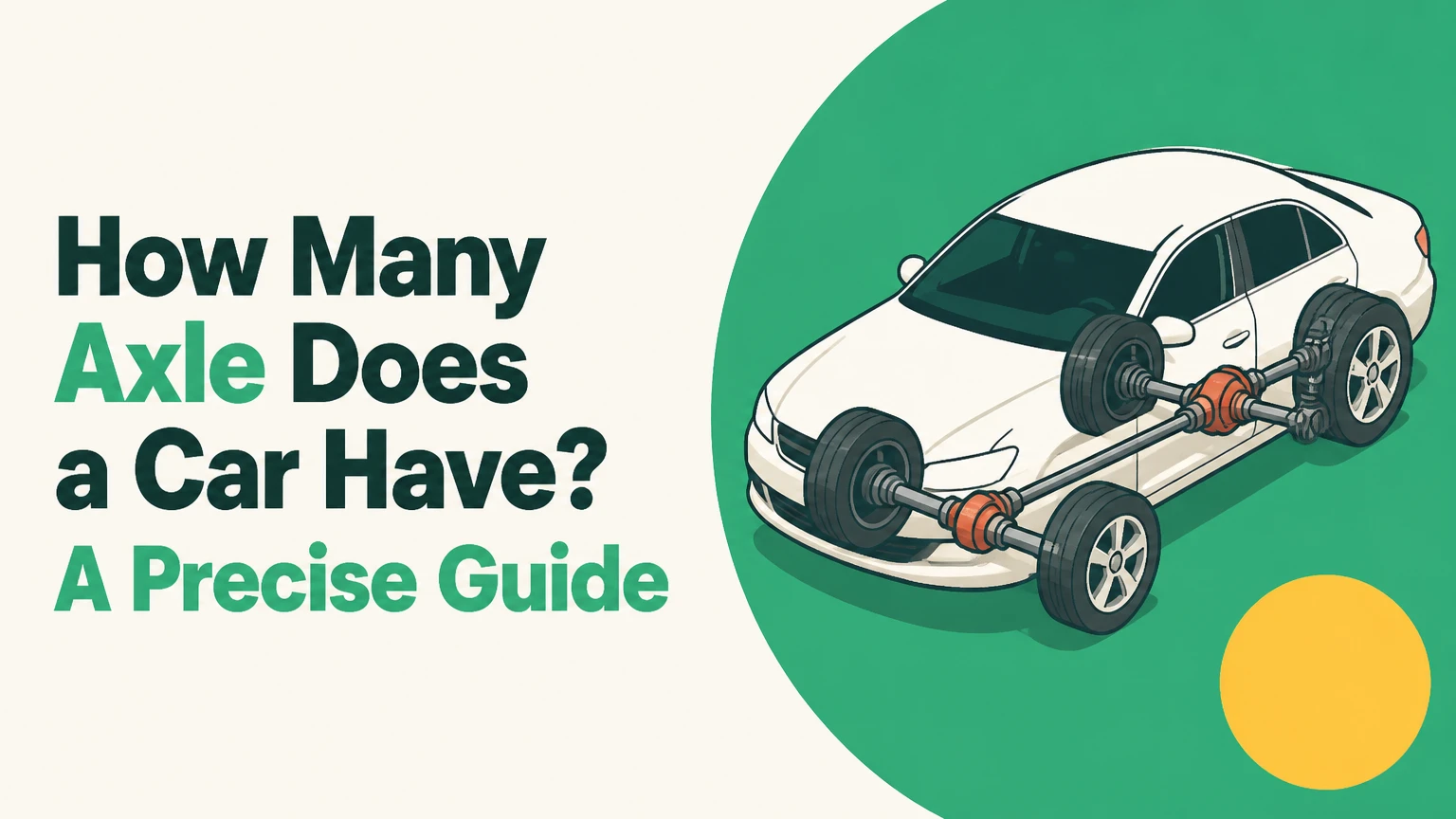
A standard passenger car has two axles, one connecting the front wheel positions and one connecting the rear wheel positions. The axles may use independent half-shafts, CV joints, or electric drive units rather than one solid bar, but a normal four-wheel car still has two axle locations.
Key Facts at a Glance
- A conventional passenger car, sedan, hatchback, coupe, or crossover normally has two axles.
- One front axle location supports the front wheels, and one rear axle location supports the rear wheels.
- A CV axle is usually a powered half-shaft, not the same thing as a complete front or rear axle line.
- Front-wheel-drive cars power the front axle line; rear-wheel-drive cars power the rear axle line.
- All-wheel-drive cars usually deliver torque to both front and rear axle lines.
- Heavy trucks, buses, motorhomes, and tractor-trailers can have three, four, or more axles.
What Is an Axle?
An axle is a vehicle component or axle assembly that locates wheels, carries vehicle loads, and, when driven, transfers torque to the wheels. In everyday automotive language, the word also describes the complete front or rear wheel line, even when the mechanical parts are split between independent suspension components.
The definition requires context. A rigid rear axle on a pickup can be one housing containing a differential and two axle shafts. A modern front-wheel-drive car can have two separate CV axle shafts connected to a transaxle, with no single solid shaft spanning the entire front of the vehicle.
An axle can therefore describe a position, a housing, a shaft, or an assembly. Parts catalogs often use “axle” for a CV axle assembly, while vehicle specifications use “axles” to count front and rear wheel lines.
The Four-Wheel, Two-Axle Rule
Four wheels do not mean four axles. A normal car has two wheel centerlines: the front pair forms one axle location, and the rear pair forms the second. Each wheel can have its own bearing, hub, steering knuckle, and stub shaft without increasing the vehicle’s axle count.
The distinction matters when comparing a repair estimate with a vehicle specification. Replacing the left front CV axle does not mean replacing one of four car axles. It means replacing one powered shaft serving one side of the front axle line.
Axle, Axle Shaft, CV Axle, and Driveshaft
These terms describe related but different parts:
| Term | Typical location | Primary job | Common example |
|---|---|---|---|
| Axle line | Front or rear wheel pair | Defines a wheel centerline | Front axle, rear axle |
| Axle shaft | Differential to wheel hub | Carries torque to one wheel | Rear solid-axle shaft |
| CV axle | Transaxle or differential to driven hub | Transfers torque through suspension movement | Front FWD half-shaft |
| Driveshaft | Transmission to differential | Carries torque between major drivetrain units | RWD propeller shaft |
| Stub axle or stub shaft | Wheel hub or steering knuckle | Supports or locates a wheel end | Front steering knuckle shaft |
A driveshaft is not usually counted as an additional axle. The driveshaft runs lengthwise, while an axle line runs across the vehicle from one side to the other.
How Does an Axle Transfer Power?
A powered axle transfers torque from the transmission or electric drive unit through a differential and axle shafts to the wheel hubs. The basic combustion-vehicle sequence is engine, transmission, final drive, differential, axle shafts, wheel hubs, and tires.
The differential allows the left and right wheels on the same axle line to rotate at different speeds during a turn. The outside wheel travels farther than the inside wheel, so forcing both wheels to spin at exactly the same speed would create tire scrub and driveline stress.
Combustion Vehicle Power Path
- The engine produces rotational power.
- The transmission changes torque and speed.
- The final-drive gears reduce speed and increase wheel torque.
- The differential divides torque between the left and right wheels.
- Axle shafts carry torque to the wheel hubs.
- The tires convert wheel rotation into forward or reverse motion.
A front-wheel-drive transaxle combines the transmission, final drive, and differential in one front-mounted unit. Two CV axle shafts then run from the differential to the front hubs. A rear-wheel-drive car usually sends power through a longitudinal driveshaft to a rear differential.
What Does the Differential Change?
The differential changes how torque reaches the wheels, not how many axles the car has. An open differential normally sends torque through both axle shafts while allowing different wheel speeds, but the wheel with the least available grip can limit useful acceleration.
Limited-slip differentials add clutch packs, helical gears, or other mechanisms to resist excessive speed difference. A locking differential can force both wheels on an axle line to receive drive under selected conditions. Each arrangement remains part of one axle location.
How Many Axle Does a Car Have in Each Drivetrain Layout?
A conventional FWD, RWD, AWD, or four-wheel-drive passenger vehicle normally has two axle locations. Drivetrain layout determines which axle lines receive power, while the suspension design determines whether each axle uses a solid beam or independent components.
| Drivetrain | Powered axle line | Typical axle hardware | Typical vehicle |
|---|---|---|---|
| FWD | Front only | Two front CV axles, rear hubs or stub assemblies | Toyota Corolla |
| RWD | Rear only | Rear differential, two rear axle shafts, front hubs | Mazda MX-5 Miata |
| AWD | Front and rear | Front and rear differentials, four powered half-shafts in many designs | Subaru Outback |
| Part-time 4WD | Rear normally, front when selected | Transfer case, front and rear differentials | Jeep Wrangler |
| Dual-motor EV | Front, rear, or both | One electric drive unit per selected axle line | Tesla Model Y |
The supplied overview’s shorthand, “FWD front live and rear dead,” is useful for basic learning but is technically incomplete. A nondriven rear wheel assembly still carries load and controls wheel position; “dead axle” generally means a nonpowered structural axle, but independent rear suspension may not contain a traditional dead beam axle.
Does Front-Wheel Drive Have Two Axles?
Yes. A front-wheel-drive car has two axle locations even though only the front axle line receives engine torque. The front uses left and right CV axle shafts, while the rear uses wheel hubs, bearings, suspension links, and structural members that support the nondriven wheels.
Front-wheel drive places the engine, transmission, differential, steering, and drive shafts near the front wheels. That arrangement reduces the need for a separate driveshaft to the rear, saves underbody space, and typically lowers manufacturing complexity.
Does Rear-Wheel Drive Have Two Axles?
Yes. A rear-wheel-drive car has a front axle location and a rear axle location, with the rear receiving power through a driveshaft and differential. The front wheels steer and carry load, while the rear axle shafts transmit torque to the drive wheels.
Many RWD sports cars use independent rear suspension, so the rear does not have one rigid axle beam. The car still has one rear axle line, because the term refers to the paired wheel position rather than the presence of a solid housing.
Does AWD Have Two or Four Axles?
Most AWD passenger cars have two axle lines, not four. AWD means the drivetrain can power both the front and rear axle lines; it does not mean that each wheel has a separate axle.
An AWD system may use a center differential, electronically controlled clutch, transfer case, or separate electric motors. A four-wheel-drive truck can use rigid front and rear axles, while an AWD crossover may use four independent CV shafts connected to two differentials.
What Types of Axles Are Used in Cars?
Car axles differ by function, suspension design, and load-bearing method. The most useful categories are live versus nonpowered, solid versus independent, and semi-floating versus full-floating.
Live and Nonpowered Axles
A live axle transmits torque to its wheels and usually contains or connects to a differential. A nonpowered axle carries wheel loads and locates the wheels without receiving propulsion torque.
The term “dead axle” is more common with rigid commercial-vehicle assemblies than with modern passenger-car suspension. A front-wheel-drive car’s rear suspension may have a torsion beam, multilink arrangement, or separate hubs rather than a traditional dead axle housing.
Solid and Independent Axles
A solid axle connects the left and right wheel positions through a rigid housing or beam. When one wheel moves vertically, the housing transfers some movement to the opposite side. Solid axles provide durability and load capacity, which explains their continued use in pickups, off-road vehicles, and heavy trucks.
Independent suspension lets each wheel move with less direct influence on the opposite wheel. Each driven wheel usually needs a separate half-shaft with CV joints. Independent suspension improves ride and wheel control, but it adds joints, boots, bearings, and alignment points.
Semi-Floating and Full-Floating Axles
Semi-floating and full-floating describe how a driven axle shaft carries wheel loads, especially on trucks.
| Axle design | Wheel-load path | Torque path | Common application |
|---|---|---|---|
| Semi-floating | Shaft and bearings share load | Shaft carries drive torque | Light pickups and SUVs |
| Full-floating | Housing and hub bearings carry load | Shaft carries drive torque only | Heavy-duty pickups |
| Three-quarter-floating | Mixed bearing and shaft support | Shaft carries torque | Older specialty trucks |
| Independent half-shaft | Hub bearings and suspension carry load | CV shaft carries torque | Passenger cars and crossovers |
A full-floating design does not make a broken axle shaft safe to drive. The wheel may remain supported by the housing, but the vehicle can lose propulsion, lubricant, or proper shaft retention depending on the failure.
How Can You Count a Vehicle’s Axles?
Count the vehicle’s wheel centerlines from front to rear, not the number of shafts visible underneath. A standard car has one front centerline and one rear centerline, so the result is two axles even when independent suspension divides each side into separate components.
Use this method:
- Stand beside the vehicle and identify each front-to-rear wheel pair.
- Treat wheels aligned across the same lateral position as one axle line.
- Count closely spaced rear wheel pairs separately when each has its own centerline.
- Exclude the driveshaft, transfer case, and individual CV shafts from the count.
- Include lift axles and trailer axles when counting a complete commercial combination.
A dually pickup still generally has two axles if it has one front wheel centerline and one rear wheel centerline. The extra rear tires increase carrying capacity, but they do not automatically create another axle.
How Many Axles Do SUVs, Trucks, Buses, and Trailers Have?
Most SUVs and light-duty pickups have two axles, while larger commercial vehicles use additional axle lines to distribute weight. Vehicle axle count depends on wheelbase, payload, legal axle ratings, maneuverability, and the need to support a trailer or specialized body.
| Vehicle type | Typical axle count | Wheel arrangement | Reason for configuration |
|---|---|---|---|
| Compact car | 2 | One front, one rear | Passenger load and low curb weight |
| Midsize SUV | 2 | One front, one rear | Cargo, towing, and road use |
| Heavy-duty pickup | 2 | Front plus rear, sometimes dual rear tires | Increased payload and towing |
| Transit bus | 2-3 | Front steering plus one or two rear lines | Passenger capacity and floor length |
| Class 8 tractor | 2-3 | One steering plus one or two drive lines | Gross combination weight |
| Semi-trailer | 1-3 | Rear axle group near trailer end | Cargo load distribution |
| Heavy equipment hauler | 4 or more | Multiple closely spaced axle lines | High payload and road limits |
When Does a Truck Have Three or More Axles?
A truck has three or more axles when its chassis includes additional axle lines for payload, traction, or legal weight distribution. Common examples include a three-axle dump truck, a tractor with tandem rear drive axles, and a truck with a steerable or lift axle.
A tandem axle group contains two separate axle lines positioned close together. It should not be mistaken for one unusually wide axle. Each axle has its own wheel centers, suspension, bearings, and load rating.
Does a Trailer Count as an Axle?
A trailer’s axle count is separate from the tow vehicle’s count. A car with two axles towing a single-axle utility trailer is a two-axle car combined with a one-axle trailer, creating three axle lines in the complete vehicle combination.
Regulatory definitions vary by jurisdiction. For registration, tolling, bridge limits, and commercial weight rules, use the relevant state, provincial, or national authority’s definition rather than relying on a general passenger-car explanation.
How Are Electric Vehicle Axles Different?
An electric vehicle still normally has two axle locations, but its propulsion hardware can be arranged differently from a gasoline car. An electric drive unit may combine a motor, reduction gears, and differential into one compact e-axle mounted at the front or rear.
A single-motor EV powers one axle line. A dual-motor EV may power both axle lines, or it may use two motors on one axle in specialized designs. The number of motors does not equal the number of axles.
Electric drive changes maintenance exposure. EVs usually eliminate engine oil, conventional transmissions, and some driveline components, but they still use wheel bearings, half-shafts, CV joints, seals, suspension links, and tires. High instantaneous motor torque can place substantial stress on half-shafts during hard launches.
What Does an Axle Repair Usually Cost?
A typical passenger-car CV axle replacement costs about $300-$800 for one side in the United States, including parts and labor. A mechanic commonly needs 1-2 hours per side, but labor rates, rust, vehicle packaging, genuine versus aftermarket parts, and additional damage can move the estimate substantially.
These are practical ranges, not universal prices. A solid rear axle rebuild, differential repair, or heavy-duty axle replacement is a different job from changing a bolt-in front CV shaft.
| Service | Typical parts cost | Typical labor time | Typical total cost |
|---|---|---|---|
| Front CV axle replacement | $100-$300 | 1-2 hours | $300-$800 |
| CV boot replacement | $30-$100 | 2-4 hours | $200-$600 |
| Wheel bearing replacement | $75-$250 | 1-3 hours | $250-$700 |
| Differential service | $50-$150 | 0.5-1.5 hours | $100-$300 |
| Heavy-duty axle or differential repair | $500-$2,000+ | 4-12 hours | $1,500-$4,000+ |
The 100,000-150,000-mile CV-axle lifespan often quoted by repair businesses is a typical planning range, not a replacement schedule. Road salt, torn boots, lifted suspension, aggressive launches, contaminated lubricant, and repeated curb impacts can shorten service life dramatically.
What Determines the Final Estimate?
The vehicle’s make, model, year, and drivetrain determine parts access and labor time. A transverse FWD car may require intermediate-shaft removal, while a RWD vehicle may need differential disassembly rather than a simple half-shaft replacement.
An estimate should identify the failed part. “Axle problem” might mean a CV joint, wheel bearing, differential bearing, axle seal, bent shaft, or damaged hub. Those repairs have different prices and different safety implications.
What Are the Symptoms of a Failing Axle?
A failing CV axle commonly produces clicking during turns, vibration under acceleration, or grease flung from a torn rubber boot. A bent shaft can create speed-related vibration, but similar symptoms also come from wheel imbalance, tire separation, worn engine mounts, or a damaged wheel bearing.
| Symptom | More likely source | Inspection clue | Driving advice |
|---|---|---|---|
| Clicking on tight turns | Outer CV joint | Noise increases at full steering lock | Schedule prompt inspection |
| Vibration under acceleration | Inner CV joint or axle shaft | Vibration changes with throttle | Avoid high-speed driving |
| Grease on wheel or suspension | Torn CV boot | Split boot or loose clamp | Repair boot or shaft soon |
| Humming that follows road speed | Wheel bearing or tire | Noise changes when gently turning | Inspect before long trips |
| Clunk when selecting drive | Inner joint, mount, or differential | Play during load reversal | Stop if impact is severe |
| Wheel wobble or visible lean | Hub, bearing, suspension, or bent axle | Excessive play with vehicle lifted | Do not drive until checked |
A torn CV boot is an early warning, not proof that the entire axle has failed. If the joint has not ingested dirt and has retained its grease, replacing the boot may be technically possible; many shops replace the complete CV axle because labor, contamination risk, and remanufactured-parts pricing make replacement more predictable.
Can You Drive With a Bad Axle?
Do not continue driving if an axle is broken, the wheel position is unstable, severe vibration occurs, or the vehicle cannot transmit power normally. A minor boot tear may permit a short trip to a repair shop, but a failed CV joint or shaft can leave the car immobile or damage nearby suspension and brake components.
A clicking outer joint may remain drivable for a limited period, but distance and risk are unpredictable. A vibration that rises with speed deserves immediate inspection because a bent shaft, loose wheel, separated tire, or failing bearing can create a more urgent hazard.
What Commonly Gets Misdiagnosed as an Axle Problem?
Tire imbalance, separated tire belts, worn wheel bearings, engine mounts, and transmission mounts can imitate axle symptoms. Diagnosis should compare whether the noise changes with steering angle, vehicle speed, engine speed, throttle position, or road surface.
A practical diagnostic sequence starts with a visual inspection of CV boots, wheel-side grease, bent components, and loose fasteners. The technician then checks wheel and hub play, road-tests the vehicle under acceleration and coast conditions, and confirms whether vibration follows road speed or engine load.
Practitioner Rules That Prevent Wrong Repairs
- A clicking turn noise is not automatically a complete axle diagnosis. Verify the outer joint and inspect boot damage before ordering parts.
- A vibration under power is more informative than a vibration during coasting. Load-sensitive vibration points toward an inner CV joint or driveline component, while speed-only vibration often points toward tires, wheels, or bearings.
- Replace damaged boots early. A boot repair can preserve a sound joint, but delaying after grease loss usually converts a lower-cost protection job into a complete shaft replacement.
- Measure ride height before condemning an axle on a modified vehicle. Lift kits and extreme lowering alter CV-joint angles and can create premature wear without a defective original shaft.
Which Axle Configuration Fits Each Use?
A two-axle FWD car usually suits commuting because it offers compact packaging and predictable operating costs. A two-axle RWD vehicle suits towing, performance driving, and balanced chassis layouts, while AWD or four-wheel drive adds traction hardware for slippery surfaces and off-road use.
| Use case | Suitable layout | Main advantage | Main limitation |
|---|---|---|---|
| Urban commuting | Two-axle FWD | Compact transaxle and efficient packaging | Front tires handle steering and propulsion |
| Snowy paved roads | Two-axle AWD | Torque available at both axle lines | Added weight, service complexity, and tire-matching demands |
| Sports driving | Two-axle RWD | Separates steering from propulsion | Requires careful throttle control on low-grip roads |
| Heavy towing | Two-axle RWD or 4WD truck | Strong rear axle and towing geometry | Higher curb weight and operating cost |
| Rock crawling | Two-axle 4WD with solid axles | Durable low-range traction | Rougher ride and more unsprung mass |
| Very high payload | Three or more axle commercial vehicle | Spreads load across more tires and structures | Larger turning radius and commercial restrictions |
AWD does not guarantee shorter braking distances on ice because braking depends heavily on tires, road friction, speed, and driver input. AWD mainly helps a vehicle accelerate or maintain propulsion when torque demand exceeds the grip available at one axle line.
A two-axle FWD car is not automatically the cheapest vehicle to maintain. Front CV joints, wheel bearings, steering parts, and front tires share high workloads, so service cost depends on design and maintenance history rather than axle count alone.
The Bottom Line
How many axle does a car have? A normal passenger car has two axles, one front and one rear, even when independent suspension divides each axle into separate shafts and joints. FWD powers the front axle line, RWD powers the rear, AWD can power both, and larger trucks or trailers add axle lines for load distribution.
Do not count CV shafts, driveshafts, motors, or wheels as separate axles. Count the front-to-rear wheel centerlines, then diagnose any alleged axle failure by its specific symptom and component.
Frequently Asked Questions
Do four wheels always mean two axles?
Four wheels usually mean two axles when the wheels are arranged as one front pair and one rear pair. A vehicle with unusual tandem wheel lines can have more than two axles, while dual rear tires may still belong to one rear axle. Axle count follows wheel centerlines, not the number of tires.
Are front and rear axles interchangeable?
Front and rear axles are generally not interchangeable because they have different dimensions, suspension connections, steering duties, gear ratios, and brake or hub designs. Even two front axles from different models may differ in spline count, shaft length, CV-joint angle, ABS hardware, and mounting configuration.
Is a CV axle the same as a half-shaft?
A CV axle is a type of half-shaft that uses constant-velocity joints to transmit torque while the suspension moves and, on steered wheels, while the hub changes angle. “Half-shaft” is a broader term, so a rigid rear axle shaft may be a half-shaft without containing CV joints.
Do bigger wheels add axles?
Bigger wheels do not add axles. Wheel diameter changes tire and rim dimensions, while axle count remains based on the number of wheel centerlines. Larger wheels can increase bearing, tire, suspension, and CV-joint loads if the complete wheel-and-tire package is heavier or has a different offset.
How often should a car axle be replaced?
A car axle has no universal replacement interval. Inspect CV boots, joints, seals, bearings, and shafts during routine service, and replace components when damage or measurable wear appears. Many CV axles last roughly 100,000-150,000 miles under typical conditions, but salt, impacts, modifications, and torn boots can shorten that range.
Does an axle affect a car’s alignment?
An axle can affect alignment when it is bent, incorrectly installed, or attached to damaged suspension or hub components. CV-joint wear alone usually causes noise or vibration rather than a direct alignment change. A curb impact can damage the knuckle, control arm, tie rod, wheel, bearing, or axle at the same time, so alignment should follow impact inspection.