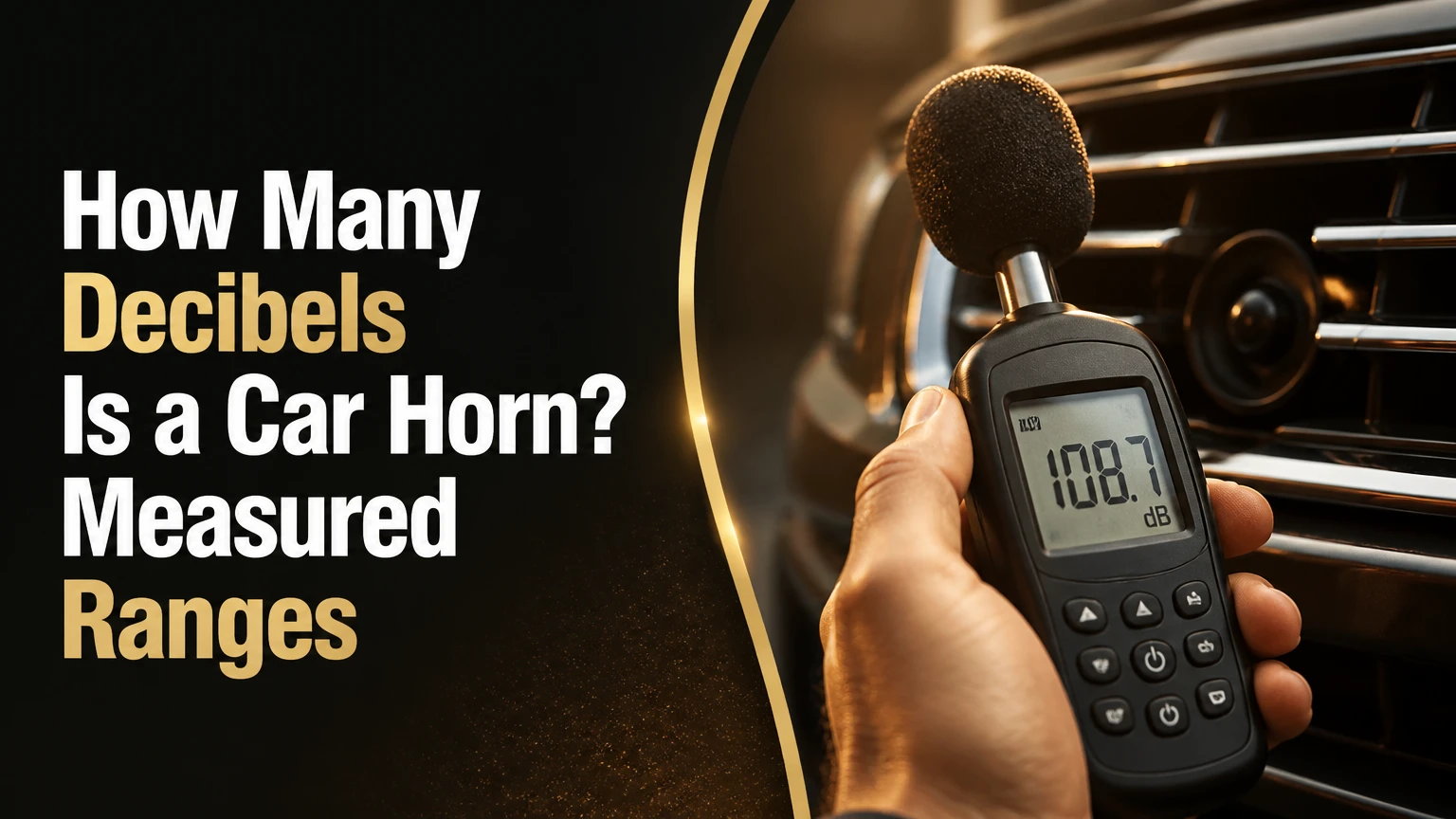
A standard factory car horn typically produces 100-110 dB at approximately 1-2 meters, although the exact result depends on the vehicle, horn design, measurement angle, and sound meter settings. Compact aftermarket electric horns commonly reach 105-115 dB, while pneumatic or train-style systems can exceed 130 dB and may be illegal for road use.
Key Facts at a Glance
- A typical passenger-car horn measures about 100-110 dB at 1-2 meters.
- A 10 dB increase represents 10 times greater acoustic intensity, but perceived loudness is not a precise two-times rule.
- Horn ratings are meaningful only when the distance, weighting, tone, and test environment are known.
- Dual-tone factory horns often combine frequencies near 400 Hz and 500 Hz for better recognition in traffic.
- Compact electric upgrades usually cost $20-$90, while pneumatic train-horn kits commonly cost $200-$800 or more.
- A louder horn does not automatically provide better safety, legality, or audibility inside another vehicle.
How Many Decibels Is a Car Horn?
A normal factory car horn produces roughly 100-110 decibels at 1-2 meters, with some compact disc horns near the lower end and larger snail-style or dual-tone horns near the upper end. Manufacturer specifications can differ because one rating may use dBA, another may use dB, and test distances may not match.
The decibel is a logarithmic unit, so small numerical changes represent large physical changes. A 110 dB reading contains ten times the sound intensity of a 100 dB reading under comparable conditions. Human loudness perception is more complicated: a 10 dB increase is often described as approximately twice as loud, but frequency, duration, background noise, and listener sensitivity change that impression.
A factory horn rating is therefore a useful range, not a universal constant. A horn mounted behind a bumper, aimed sideways, or tested outdoors beside a reflective wall can produce a different reading from the same horn tested in an open acoustic field.
How Is a Car Horn’s Sound Level Measured?
A car horn’s sound level should be measured with a calibrated sound-level meter, at a documented distance and angle, using the correct frequency weighting. A reading is not comparable unless the tester records whether the meter used A-weighting or C-weighting, whether the value was peak or maximum, and whether the microphone faced the horn.
Distance changes the result
In an unobstructed free field, sound pressure generally falls by about 6 dB each time distance doubles. A horn reading of 110 dB at 1 meter could therefore approach 104 dB at 2 meters, although reflections, the vehicle body, pavement, and atmospheric conditions alter the result.
A manufacturer’s “110 dB” label may use a 2-meter test, while a consumer measures at 1 meter. The two numbers should not be treated as direct competitors. The distance must accompany the number.
A-weighting and C-weighting are different
A-weighting, written dBA, reduces the contribution of very low and very high frequencies to approximate human hearing sensitivity. C-weighting, written dBC, is flatter and captures more low-frequency energy, which matters for large pneumatic horns.
A low-frequency train horn may appear less impressive on an A-weighted meter than on a C-weighted meter, even though the horn produces substantial physical pressure. Smartphone applications can help identify a faulty horn or compare installations, but they are not reliable substitutes for a calibrated meter, especially above 100 dB.
| Measurement detail | Typical choice | Why it matters |
|---|---|---|
| Microphone distance | 1 m or 2 m | A 2 m reading can be about 6 dB lower than 1 m |
| Frequency weighting | dBA or dBC | dBC records more low-frequency horn energy |
| Reported value | Maximum or peak | A peak captures short horn transients |
| Microphone angle | 0° on-axis | Directly facing the outlet usually reads highest |
| Test environment | Open area or reflective site | Walls and pavement can raise readings |
Why Does a Car Horn Sound So Loud?
A car horn sounds loud because an electrical or pneumatic actuator converts a small control signal into rapid diaphragm movement and concentrated acoustic output. The horn’s resonator, outlet direction, tone frequency, and short high-power pulse help the warning remain recognizable above engine, tire, and road noise.
How does an electric horn work?
Most factory electric horns use this sequence:
- Pressing the steering-wheel horn pad commands the horn circuit.
- A relay sends battery voltage through a higher-current path.
- Current energizes a coil and creates a magnetic field.
- The magnetic field pulls an armature connected to a metal diaphragm.
- Moving contacts interrupt current and collapse the magnetic field.
- A spring returns the diaphragm and closes the contacts.
- The cycle repeats rapidly, producing pressure waves.
The diaphragm does not simply vibrate continuously like a speaker cone. The contact-breaker mechanism repeatedly energizes and releases the assembly, often producing a fundamental tone in the several-hundred-hertz range. A snail-style horn uses a molded spiral resonator to shape and project that vibration.
Why do many vehicles use two horns?
Many passenger cars use a low-tone and high-tone horn together, commonly near 400 Hz and 500 Hz. The paired frequencies create a distinctive interval that is easier to identify than one narrow buzzing tone, especially when traffic noise masks part of the spectrum.
Two horns also distribute acoustic output across different frequencies. That design improves recognition, but it does not necessarily double the decibel reading. Electrical phase, mounting position, and the test microphone’s location determine how much the outputs reinforce each other.
What Types of Car Horns Produce the Most Sound?
Pneumatic train-style horns produce the highest typical output, often 130-150 dB or more, while compact electric horns usually remain near 100-115 dB. Direct-drive electro-pneumatic units occupy the middle range, commonly around 115-125 dB, but their installation requirements and legal status differ sharply from factory horns.
| Horn type | Typical output at stated test distance | Tone range | Electrical or air requirement | Typical purchase price |
|---|---|---|---|---|
| Factory disc electric | 100-110 dB at 1-2 m | 400-500 Hz | 3-5 A, relay circuit | $15-$30 |
| Snail-shell electric | 100-115 dB at 1-2 m | 400-500 Hz | 5-8 A, relay circuit | $20-$45 |
| Direct-drive air | 115-125 dB at 1-2 m | 530-680 Hz | 15-20 A, heavy relay | $40-$90 |
| Pneumatic train horn | 130-150+ dB at 1-2 m | 150-300 Hz | Compressor, tank, 120-150 psi | $200-$800+ |
The ranges are typical market and manufacturer figures, not a single standardized laboratory comparison. A 115 dB electric horn tested at 1 meter may be quieter at 2 meters than its label suggests, while a low-frequency air horn may sound more penetrating without producing the highest dBA value.
Are air horns louder than electric horns?
Air horns are usually louder and deeper than standard electric horns because compressed air moves a larger diaphragm through a resonating trumpet. The trade-off is physical space, compressor noise, current demand, maintenance, and a greater chance of violating vehicle-equipment rules.
An electric snail horn is usually the practical upgrade for a passenger car. It fits behind many bumpers, uses the existing 12-volt system with a suitable relay, and provides a stronger tone without adding an air tank. A train-horn kit is a specialized system, not a simple plug-in replacement.
What Makes a Car Horn Audible in Traffic?
A car horn’s usefulness depends on more than maximum decibels. Frequency, direction, duration, vehicle insulation, surrounding traffic, and the listener’s location determine whether another driver notices the warning quickly.
A 400-500 Hz dual-tone horn is often easier to recognize than a high-pitched single tone. Low frequencies can pass through some barriers more effectively, but very low-frequency energy can also receive different readings on A-weighted meters. A horn aimed through an open grille usually projects better than one enclosed by foam, plastic, or a blocked bumper cavity.
A short pulse is also more attention-getting than a continuous blast. The warning should communicate urgency without creating unnecessary exposure for pedestrians, cyclists, or nearby workers. More output can become counterproductive when it causes startle reactions or violates local noise rules.
Is a 110 dB Car Horn Dangerous?
A 110 dB car horn can cause harmful exposure when heard at close range, particularly during repeated testing or prolonged activation. A normal brief warning is much shorter than workplace exposure limits, but standing beside a horn outlet while repeatedly sounding it is an avoidable hearing risk.
The National Institute for Occupational Safety and Health states that “Exposure to impulsive or impact noise should not exceed 140 dB peak sound pressure level.” That recommendation addresses peak impulsive noise, not permission to treat every lower reading as harmless. NIOSH also uses an 85 dBA eight-hour recommended exposure limit with a 3 dB exchange rate for occupational noise.
A horn is an impulse-like source, and its risk depends on distance and repetition. During diagnosis, keep the microphone or observer away from the outlet, use short pulses, and wear hearing protection when repeated tests are necessary. Never place an ear next to a horn to determine whether it works.
What Is the Legal Decibel Limit for a Car Horn?
There is no single worldwide legal decibel limit for car horns. Vehicle standards and local traffic laws may specify an audible warning requirement, a measurement method, prohibited tones, or a maximum sound level, so the applicable rule depends on the country, state, province, vehicle class, and inspection authority.
The claim that a 110 dB horn is “street-legal globally” is incorrect. Some jurisdictions regulate horn loudness near a specified test distance; others regulate use, tone, mounting, or whether the device resembles an emergency or railway signal. A train-style horn can be lawful on private property yet prohibited on public roads.
Before installing an aftermarket horn, check the vehicle-equipment regulations and inspection rules where the vehicle is registered. Product labeling alone does not establish compliance. Local authorities may also regulate unnecessary horn use, nighttime noise, and repeated sounding in residential areas.
How Much Does a Car Horn Replacement or Upgrade Cost?
A basic replacement electric horn usually costs $15-$45 for the part and roughly $50-$150 installed, depending on access and labor rates. A direct-drive air horn commonly costs $40-$90, while a complete pneumatic train-horn system can reach $200-$800 or more before custom fabrication.
| Upgrade path | Parts cost | Installation time | Added hardware | Typical practical use |
|---|---|---|---|---|
| OEM-style replacement | $15-$45 | 20-60 minutes | Factory connector or adapter | Restore original warning |
| Twin snail electric | $20-$60 | 45-120 minutes | Relay, bracket, wiring | Stronger passenger-car tone |
| Direct-drive air | $40-$150 | 1-3 hours | 20-30 A relay, heavier cable | Trucks and off-road vehicles |
| Tank-and-trumpet air kit | $200-$800+ | 3-8 hours | Compressor, tank, tubing, fuse | Specialized private or work use |
Access behind the bumper can dominate labor cost. A horn that appears to require one bolt may require grille removal, splash-shield removal, or bumper-panel access. Water protection and wire routing matter more than buying the highest advertised number.
How Do You Install a Louder Electric Car Horn?
Installing a louder electric horn normally takes 45-120 minutes and requires a compatible 12-volt horn, bracket, relay, fuse, wire, terminals, and basic hand tools. The most important success factor is a protected mounting position with a clean electrical ground and adequate current capacity.
- Confirm voltage and polarity. Match the replacement horn to the vehicle’s 12-volt system and verify whether the horn grounds through its bracket or uses a dedicated ground wire.
- Inspect the existing circuit. Check the factory fuse rating, connector condition, relay arrangement, and available mounting space before buying a replacement.
- Mount the horn outlet downward or slightly forward. Avoid an upward-facing trumpet that can collect rainwater, but do not point it directly into a high-speed airflow path.
- Use a relay for increased current. Let the steering-wheel circuit activate the relay, while battery power flows through a separately fused supply wire sized for the horn load.
- Create a low-resistance ground. Remove paint, rust, and undercoating beneath the grounding fastener, then protect the finished connection from corrosion.
- Test briefly. Sound the horn for one-second pulses, check for heat at the fuse and wiring, and confirm that the steering-wheel circuit does not carry the full horn current.
The installation worked when the horn produces a stable tone, the fuse remains cool, the relay clicks once per activation, and the horn does not weaken after several short pulses. A relay cannot compensate for an undersized fuse, poor ground, or blocked acoustic outlet.
What Are the Most Common Car Horn Installation Mistakes?
The most damaging installation mistakes are incorrect orientation, inadequate wiring, poor grounding, blocked sound paths, and failure to check local equipment rules. Each mistake can reduce output or create an electrical fault even when the horn itself is functional.
- Direct-wiring a high-current horn to the factory switch: Use a correctly rated relay and fused battery feed.
- Using the original fuse without checking current draw: A larger horn may require a different circuit design, but never increase fuse size without verifying wire capacity.
- Mounting the trumpet upward: Position the outlet downward or use the manufacturer’s specified angle to limit water entry.
- Grounding through painted or corroded metal: Clean the contact area and verify voltage drop under load.
- Enclosing the horn behind solid plastic or foam: Keep the outlet acoustically open while protecting the unit from direct spray.
- Assuming two horns double loudness: Two tones improve recognition, but output depends on phase, placement, and electrical supply.
A practitioner rule is to measure voltage at the horn while it sounds, not only at the battery. A healthy 12-volt system that drops substantially at the horn points toward wiring, relay, connector, or ground resistance.
Why Is a Car Horn Weak, Silent, or Stuck On?
A silent horn with no relay click usually indicates a fuse, relay, horn-button, clockspring, or control-circuit problem. A relay click without sound more often indicates a failed horn, low voltage, damaged ground, or an open high-current connection.
| Symptom | Likely cause | Diagnostic action | Typical repair |
|---|---|---|---|
| No click and no tone | Fuse, relay, horn pad, clockspring | Check fuse, then test relay control voltage | Replace failed circuit component |
| Click but no tone | Failed horn or poor ground | Apply fused battery power briefly at horn | Replace horn or repair ground |
| Weak or muffled tone | Water, blocked outlet, low voltage | Inspect orientation and measure loaded voltage | Dry, reposition, or replace unit |
| One tone missing | Failed high- or low-tone horn | Disconnect each horn separately | Replace the failed tone unit |
| Horn remains on | Stuck pad, relay contacts, wiring short | Pull fuse immediately, then isolate relay | Repair switch, relay, or harness |
If the horn stays on, pull the horn fuse or disconnect the battery negative terminal when safe to do so. Continuous activation can overheat the horn, drain the battery, and damage wiring. Steering-wheel systems may include an airbag, so clockspring and horn-pad repairs require the vehicle manufacturer’s safety procedure.
Which Car Horn Should You Choose?
The best choice is usually an OEM-style or twin snail-shell electric horn for a passenger car, a direct-drive air horn for a truck with sufficient wiring capacity, and a pneumatic system only for specialized vehicles where local rules and installation space permit it.
| Vehicle or user | Recommended type | Output target | Main requirement | Avoid when |
|---|---|---|---|---|
| Compact commuter car | Twin snail electric | 105-115 dB at 1-2 m | 12 V relay and protected bracket | Space or inspection rules prohibit changes |
| Older vehicle restoring stock function | OEM-style disc | 100-110 dB at 1-2 m | Correct connector and fuse | Original circuit has unresolved faults |
| Highway truck or off-road vehicle | Direct-drive air | 115-125 dB at 1-2 m | Heavy cable, relay, secure mount | Wiring cannot support added load |
| Show, farm, or private-property vehicle | Pneumatic trumpet kit | 130-150+ dB at 1-2 m | Compressor, tank, tubing, legal review | Public-road compliance is uncertain |
For urban commuters
Choose a compact dual-tone electric set that fits the original mounting area and remains close to the factory current demand. The goal is a recognizable warning, not the largest possible peak reading. Confirm that the grille opening does not obstruct the resonator.
For trucks and off-road vehicles
A direct-drive air unit can provide a deeper, more penetrating tone, but the wiring must handle the manufacturer’s current requirement. Use a relay, an appropriately rated fuse, and a short battery feed with protected insulation.
For pneumatic systems
A compressor-and-tank kit requires secure brackets, moisture-resistant tubing, a pressure switch, and a fuse sized for compressor startup current. Such systems are poor choices for a simple daily-driver upgrade because they add failure points, installation time, and regulatory uncertainty.
What Should You Know Before Measuring a Horn?
A horn measurement is useful only when the test conditions are repeatable, and a louder number does not prove a better warning device. Record the distance, microphone angle, weighting, peak or maximum mode, background noise, and whether the vehicle was running.
Test outdoors in an open area, keep people away from the outlet, and use short activations. Do not compare a phone application reading at 30 centimeters with a manufacturer’s calibrated 2-meter result. For a fault diagnosis, voltage drop, continuity, relay operation, and ground quality often matter more than the absolute dB figure.
The honest limitation is simple: consumer measurements cannot certify regulatory compliance. A competent inspection station or acoustical professional may be required when a legal threshold or formal engineering specification applies.
Frequently Asked Questions
Does a car horn damage hearing at close range?
A car horn can expose a nearby listener to a hazardous sound level, especially at roughly 100-110 dB and during repeated testing. Keep ears away from the outlet, use short pulses, and wear hearing protection for extended diagnosis. Risk decreases with distance, but distance does not make repeated high-level exposure automatically safe.
How far away can someone hear a car horn?
A typical 100-110 dB horn can be heard well beyond the immediate vehicle, but no fixed distance guarantees recognition. Traffic noise, wind, buildings, cabin insulation, horn direction, and the listener’s hearing determine the result. A warning horn is designed for nearby road users, not reliable communication over miles.
Do louder horns make driving safer?
A louder horn can improve noticeability in heavy traffic, but excessive output can startle vulnerable road users, damage hearing at close range, and violate local rules. Correct frequency, forward projection, reliable activation, and legal installation often improve practical safety more than choosing the highest advertised decibel rating.
Can I install a train horn on a passenger car?
A train horn can be physically installed on some passenger cars, but public-road legality depends on local vehicle and noise regulations. The system also needs a compressor, tank, tubing, mounting space, high-current protection, and maintenance. Check registration-jurisdiction rules before purchasing because a private-property installation may not be road compliant.
Why does my replacement horn sound different from the original?
Replacement horns can differ in frequency, resonator shape, diaphragm construction, mounting orientation, and electrical supply. A horn may produce its rated tone only when it receives sufficient voltage and has a clean ground. If one of a factory vehicle’s two tone units fails, the remaining horn may sound thin or unusually high-pitched.
The Bottom Line
The answer to how many decibels is a car horn is usually 100-110 dB at 1-2 meters for a standard factory unit. Compact electric upgrades often reach 105-115 dB, direct-drive air horns about 115-125 dB, and pneumatic train-style systems 130-150 dB or more. Compare ratings only when distance and measurement method match, then prioritize safe wiring, correct mounting, hearing protection, and local legal compliance.