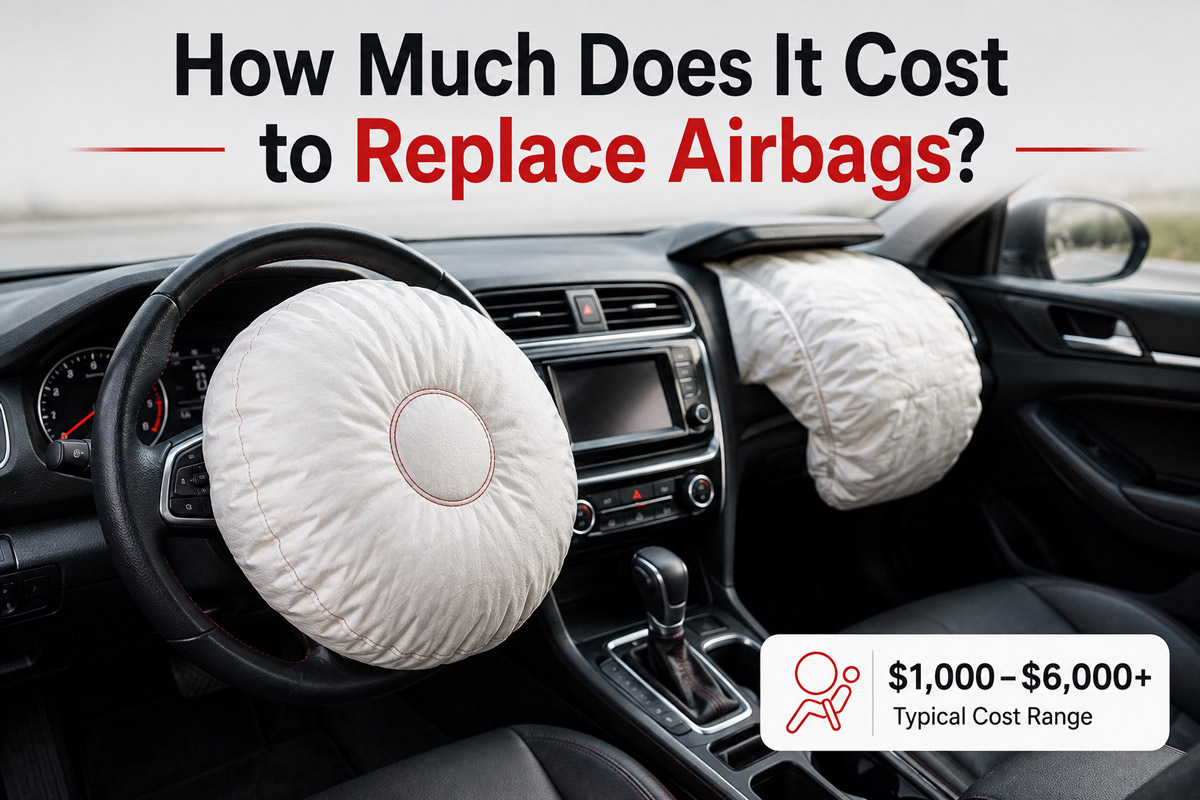
Replacing deployed airbags usually costs $1,000 to $6,000 or more, while repairing a vehicle with several deployed airbags, damaged trim, seat-belt pretensioners, sensors, and an SRS module can exceed $10,000. Use the eight steps below to obtain an accurate estimate. Allow one to five working days; correct VIN-specific diagnosis is the factor that most determines success.
Safety warning: Airbags and seat-belt pretensioners contain pyrotechnic inflators. Do not probe their connectors, measure resistance across inflator terminals, install unknown salvage components, or attempt deployment-system repairs without the vehicle manufacturer’s service information and appropriate SRS training.
Before You Start
Time required
- Initial inspection and diagnostic scan: 30–90 minutes
- Written estimate: same day to 2 working days
- Parts sourcing: 1–10 working days
- Physical repair: 3–15 labor hours
- Typical vehicle downtime: 1–5 working days
- Complex dashboard, curtain-airbag, or parts-delay repairs: one week or longer
Difficulty level
Advanced professional repair.
A vehicle owner can collect estimates, verify part numbers, review insurance coverage, and inspect documentation. Airbag-module installation, restraint wiring diagnosis, module programming, and system verification should be completed by a qualified collision-repair or dealership technician.
Typical cost
- One driver airbag repair: $1,000–$1,500
- One passenger airbag repair: $1,200–$2,000
- One seat-mounted side airbag: $800–$2,000
- One curtain airbag: $1,500–$3,500
- Several deployed restraints: $3,000–$10,000+
- Luxury, performance, or limited-production vehicle: $6,000–$15,000+
These are planning ranges, not flat prices. AutoZone currently places many driver-airbag replacements around $1,000–$1,500 and passenger-airbag repairs around $1,200–$2,000. ConsumerAffairs reports an approximate average of $1,500 per airbag, with substantially higher totals on luxury vehicles.
Information checklist
Collect the following before requesting an estimate:
- The complete 17-character VIN
- Vehicle year, make, model, trim, and production date
- Current mileage
- Photographs of the steering wheel, dashboard, seats, headliner, pillars, and seat belts
- A list of visibly deployed airbags
- Insurance claim number, when applicable
- Police or collision report, when available
- Previous repair invoices
- Recall status
- SRS diagnostic scan report
- Written estimate with individual part numbers
Shop requirements
Choose a facility with:
- An SRS-capable diagnostic platform
- Access to OEM repair procedures
- VIN-specific parts catalog access
- Manufacturer-compatible programming equipment
- Collision-measuring capability when structural damage exists
- Documented post-repair scanning procedures
- A written parts and labor warranty
Phase 1: Establish the Repair Scope
Step 1: Stop Driving and Document the Damage
Park the vehicle and arrange towing when airbags deployed or the SRS warning remains illuminated after a collision.
Photograph every affected interior area before anyone removes trim. Capture the steering wheel, dashboard, front seats, seat belts, headliner, A-, B-, and C-pillars, exterior impact area, and instrument-panel warning lights. Photograph the VIN label on the driver’s door opening as well.
Do not assume that a vehicle is safe because it still starts and moves. NHTSA recommends replacing deployed airbags unless the vehicle is being junked, and restoring any other crash-damaged safety systems.
You’ll know it worked when you have a complete visual record, the vehicle is stored safely, and no one is relying on it for normal transportation.
Common mistake: Continuing to drive because only one airbag deployed. One deployment may be accompanied by activated pretensioners, damaged wiring, stored crash data, or other disabled restraints.
Step 2: Check Recalls and Contact the Insurer
Check the VIN for open safety recalls and notify the insurer before authorizing repairs.
Use the VIN rather than the license plate or model name. A recall repair is normally handled separately from collision damage and may affect which components the manufacturer supplies.
When the deployment followed a covered collision, open the insurance claim before dismantling begins. Ask whether the policy requires a preferred inspection location, photographs, an adjuster’s inspection, or prior authorization.
Collision coverage commonly addresses accident-related vehicle damage, subject to the policy, deductible, exclusions, and total-loss rules. Mechanical faults unrelated to a covered event are generally treated differently.
You’ll know it worked when you have a claim number or written confirmation that the repair will be self-funded, plus the vehicle’s recall status.
Common mistake: Ordering parts before the insurer or repairer documents the vehicle. Premature dismantling can complicate claim review and hide damage needed for a complete estimate.
Step 3: Obtain a VIN-Specific SRS Diagnostic Scan
Have a qualified technician perform a complete pre-repair scan of the Supplemental Restraint System.
The scanner must communicate with the airbag or restraint control module—not merely read generic engine codes. Request a printed or electronic report showing:
- Every current, stored, history, and deployment-related code
- Communication faults
- Driver and passenger inflator-circuit faults
- Side and curtain-airbag faults
- Pretensioner faults
- Occupant-classification faults
- Impact-sensor faults
- Low-voltage or power-supply faults
- Module configuration or VIN errors
A generic OBD-II code reader that only accesses powertrain codes is insufficient.
Do not let anyone test an airbag inflator by placing a standard multimeter directly across its terminals. The manufacturer’s diagnostic procedure may call for approved simulators, breakout equipment, specified test points, and strict depowering instructions.
You’ll know it worked when the repairer can match each visible deployment or warning to a documented code and can explain which additional inspections are required.
Common mistake: Clearing the codes before recording them. Erasing evidence can make diagnosis harder and does not repair an open circuit, deployed component, wiring fault, or locked module.
Step 4: Identify Every Required Restraint Component
Build a VIN-specific replacement list from the scan, physical inspection, and manufacturer’s post-collision instructions.
The estimate may include more than the visible fabric airbags. Inspect or evaluate:
- Driver steering-wheel airbag
- Front passenger dashboard airbag
- Driver and passenger knee airbags
- Seat-mounted torso airbags
- Roof-rail or curtain airbags
- Center airbags
- Inflatable seat belts
- Front and rear seat-belt pretensioners
- Buckle pretensioners
- Seat-belt retractors
- Steering-wheel clockspring
- Impact sensors
- Safing sensor
- SRS control module
- Occupant-classification components
- Seat tracks and seat wiring
- Steering wheel
- Dashboard or instrument panel
- Headliner
- Pillar trim and retaining clips
- Wiring harnesses and connectors
Replacement rules differ by manufacturer, model, impact direction, and deployment pattern. For example, a clockspring should not be described as universally “mandatory” after every driver-airbag deployment. The technician must follow that vehicle’s inspection and replacement criteria.
You’ll know it worked when every estimate line can be connected to an OEM instruction, diagnostic result, visible deployment, or documented physical defect.
Common mistake: Pricing only the airbag module seen hanging from the steering wheel. This creates an artificially low estimate and often produces supplements after dismantling.
Phase 2: Calculate the Real Cost
Step 5: Price the Correct Parts and Labor
Request an itemized estimate containing part numbers, quantities, labor operations, programming, taxes, and sublet work.
Use this formula:
Total repair cost = restraint parts + interior parts + labor + diagnostics + programming + structural repair + taxes and fees
Typical planning ranges include:
The table represents broad U.S. planning ranges. The exact cost changes with the vehicle, labor market, parts source, number of deployment locations, interior color, availability, taxes, and required calibration.
A single airbag cushion or module price is not the same as the complete repair cost. One published estimate places an airbag itself near $500 plus roughly $250 in labor, but that simplified figure excludes many collision-related components that commonly raise the final invoice.
You’ll know it worked when the estimate includes a grand total and every charge is separated into part, quantity, labor time, labor rate, programming, sublet service, tax, and shop fee.
Common mistake: Comparing only the bottom-line totals. One estimate may include pretensioners, scans, trim, and programming while another excludes them.
Step 6: Verify the Source of Every Airbag
Require traceable OEM or manufacturer-approved replacement components with documented part numbers and provenance.
Ask the repairer to state whether each restraint component is:
- New OEM
- Manufacturer-remanufactured
- New aftermarket
- Recycled OEM
- Repaired or reset
Treat unknown inflators, suspiciously cheap online modules, counterfeit labels, and undocumented imported parts as serious safety risks.
NHTSA has warned that dangerous replacement inflators installed after previous crashes have caused deaths and injuries. In January 2026, the agency issued another warning concerning substandard replacement inflators, and in April 2026 it announced a ban on specified defective inflators.
A low-priced part is not a saving when its identity, storage history, crash history, compatibility, or inflator integrity cannot be verified.
You’ll know it worked when the invoice will identify the supplier, manufacturer, part number, condition, and warranty for every restraint component.
Common mistake: Accepting “OEM-style” as meaning OEM. It is a marketing description, not proof that the vehicle manufacturer produced or approved the part.
Step 7: Compare the Repair Cost With the Vehicle’s Value
Compare the complete repair estimate—not merely the airbag subtotal—with the vehicle’s pre-loss actual cash value.
Include:
- Airbags and pretensioners
- Body and paint repair
- Structural measurement and straightening
- Glass
- Cooling-system damage
- Suspension and steering damage
- Dashboard, seats, and trim
- Scanning and programming
- Rental-car expense
- Expected supplements after dismantling
- Salvage value, when used by the insurer
A vehicle can be declared a total loss when repairing it to pre-loss condition costs more than its value. Some jurisdictions or insurers also apply a percentage threshold; Progressive gives 80% as an example of a threshold that may apply in certain states.
Example:
- Pre-loss vehicle value: $9,000
- Visible collision repair: $3,800
- Airbag and restraint repair: $4,200
- Expected supplement: $1,000
- Projected repair total: $9,000
Even though the airbags account for less than half the estimate, the overall claim may reach total-loss territory.
You’ll know it worked when you understand whether repairing, totaling, retaining the salvage, or replacing the vehicle offers the strongest financial and safety outcome.
Common mistake: Spending several thousand dollars on restraints before confirming that the chassis, body structure, and suspension can be restored economically.
Phase 3: Complete and Verify the Repair
Step 8: Authorize a Documented Professional Repair
Authorize the work only after the shop provides a complete repair plan and agrees to post-repair verification.
The repair order should identify:
- Components to be replaced
- Components to be inspected
- OEM procedures being followed
- Required vehicle depowering procedure
- Programming or configuration operations
- Occupant-classification calibration
- Pre-repair and post-repair scans
- Structural or alignment measurements
- Parts source and warranty
- Conditions that may create a supplemental estimate
Do not substitute a generic “disconnect the battery for 15 minutes” instruction for the manufacturer’s procedure. Backup-energy discharge periods, connector locks, fastener torques, module handling, initialization steps, and power-up procedures vary by vehicle.
You’ll know it worked when the completed vehicle has:
- No SRS warning light after the prescribed self-check
- No current restraint-system codes
- Correctly functioning horn and steering-wheel controls
- Correct passenger-airbag status indications
- Properly retracting seat belts
- Secure, correctly fitted trim
- A documented post-repair scan
- Calibration or programming records where required
- A detailed final invoice
Common mistake: Treating an extinguished warning light as the only proof of success. A complete repair also requires correct parts, installation, configuration, calibration, and documented system communication.
Common Mistakes and How to Fix Them
Buying an airbag before checking the VIN
Airbag designs can change by trim level, seat type, production date, steering-wheel option, restraint package, and destination market.
Fix: Use the full 17-character VIN and verify the superseded part number through an OEM catalog before ordering anything.
Assuming every deployed part appears in plain sight
Pretensioners can activate internally without an obvious visual change. Curtain airbags may damage hidden roof clips, brackets, wiring, or headliner components.
Fix: Combine the deployment-code report with a physical inspection and the manufacturer’s post-collision replacement matrix.
Paying to clear crash data without repairing the system
A reset or code-clearing service cannot restore a deployed airbag, fired pretensioner, severed harness, counterfeit inflator, or physically damaged control module.
Fix: Repair every diagnosed fault first. Program, replace, or reset a module only where the vehicle maker’s procedure and applicable rules permit it.
Accepting an estimate that says “airbag kit”
A bundled description can hide unknown part sources, missing pretensioners, incorrect trim, or omitted programming.
Fix: Require individual part numbers, descriptions, quantities, conditions, prices, and warranties.
Reusing damaged trim or one-time fasteners
Airbag doors, pillar clips, seat fasteners, steering-wheel bolts, and headliner retainers may have replacement requirements after deployment or removal.
Fix: Review the OEM procedure for every disturbed component and add all required one-time-use hardware to the estimate.
Skipping the post-repair scan
A warning light may remain off while history, communication, calibration, or intermittent codes still exist.
Fix: Obtain dated pre-repair and post-repair scan reports listing the VIN, modules scanned, codes found, codes resolved, and unresolved conditions.
Cost Variations by Repair Situation
Only the SRS warning light is on
An illuminated airbag light does not necessarily mean an airbag deployed or requires replacement. Possible causes include a clockspring fault, connector problem, seat wiring issue, occupancy sensor, voltage event, impact sensor, control module, or pretensioner circuit.
Diagnosis may cost $100–$250. A minor connector or wiring repair can remain below $500, while a clockspring, control module, seat sensor, or harness repair may cost $500–$2,000 or more.
Do not buy an airbag until a scan identifies the affected circuit.
One frontal airbag deployed
A driver-airbag-only repair often begins around $1,000–$1,500, but the complete invoice may also require a pretensioner, clockspring inspection, steering-wheel components, sensor work, module service, and programming.
A passenger-airbag deployment usually costs more because the instrument panel, dashboard cover, reinforcement, vents, or related trim may require removal or replacement.
Side and curtain airbags deployed
Seat-mounted airbags may require a complete seat-cover assembly, foam, wiring, or seat component rather than only an inflator module.
Curtain airbags can require extensive headliner and pillar-trim removal. Broken clips, roof hardware, wiring, and multirow curtain assemblies frequently push the repair above $1,500–$3,500 per side.
Multiple airbags deployed in a luxury vehicle
Luxury vehicles may combine front, knee, seat, curtain, center, rear-seat, and inflatable-belt systems with expensive leather, dashboard, headliner, and electronic components.
Several deployments can produce a five-figure repair, particularly when parts availability is limited or dashboard and seating assemblies must be replaced. ConsumerAffairs notes that airbag work can exceed $6,000 on high-end vehicles and reach five figures when multiple airbags are involved.
How Long Does Airbag Replacement Take?
A straightforward driver-airbag repair may involve 2–4 labor hours, but that does not represent the entire post-collision process. Diagnosis, insurer approval, parts sourcing, pretensioner replacement, dashboard work, module programming, calibration, and post-repair scanning increase both labor time and vehicle downtime.
Typical timelines are:
Parts availability often controls the calendar more than installation labor. A rare interior color, back-ordered dashboard, seat assembly, or VIN-specific module can delay an otherwise repairable vehicle.
How Much Does Airbag Replacement Cost?
For budgeting purposes, expect approximately:
- $1,000–$2,000 for one commonly available frontal airbag and associated basic labor
- $2,500–$5,000 for two frontal airbags with related restraint components
- $3,000–$10,000+ for several airbags, pretensioners, sensors, module work, and interior trim
- $6,000–$15,000+ for complex luxury-vehicle or multi-airbag repairs
The final cost depends most heavily on:
- Number and type of deployed airbags
- Dashboard, seat, headliner, and pillar damage
- Fired seat-belt pretensioners
- OEM parts prices
- Vehicle-specific programming
- Local labor rates
- Structural collision damage
- Parts availability
- Insurance and total-loss treatment
- Whether unsafe or incorrect previous repairs must be removed
Frequently Asked Questions
Can an airbag be reused after deployment?
No. A deployed airbag module is a one-time pyrotechnic device and must be replaced if the vehicle is repaired. The associated system must also be inspected for fired pretensioners, damaged trim, sensors, wiring, control-module conditions, and manufacturer-specified post-collision replacement items. NHTSA recommends replacing airbags after deployment unless the vehicle will be junked.
Will insurance pay for airbag replacement?
Collision coverage may pay for airbags and related damage when deployment resulted from a covered crash, minus the deductible and subject to the policy. The insurer may instead declare the vehicle a total loss when the complete repair approaches or exceeds its pre-loss value or an applicable statutory threshold.
Can I drive after the airbags deploy?
The vehicle may still move, but it should not be treated as normally roadworthy. Deployed airbags cannot protect occupants in another crash, and associated pretensioners, wiring, steering components, sensors, or structural areas may also be damaged. Arrange inspection and towing rather than relying on the vehicle for routine driving.
Is it legal to install a used airbag?
Rules differ by jurisdiction, and legality does not establish safety or suitability. A recycled component may have an unknown crash, storage, moisture, recall, or handling history. NHTSA has issued urgent warnings about dangerous replacement inflators in previously crashed vehicles. Use traceable parts permitted by the manufacturer, insurer, repairer, and local law.
Can an SRS module simply be reset?
Sometimes a module can be reset or reprogrammed through an approved procedure, while other vehicles require replacement. Resetting the module does not replace deployed airbags or pretensioners and does not repair damaged sensors, connectors, or wiring. The correct decision must come from the VIN-specific OEM procedure and the module’s physical and diagnostic condition.
Does airbag deployment automatically total a car?
No. Deployment alone does not automatically total every vehicle. The insurer compares the full cost of restoring the vehicle with its pre-loss value and any applicable threshold. A valuable newer vehicle may be repaired, while an older low-value vehicle can be totaled after one or two airbags deploy because dashboard and restraint expenses are high.
Final Cost Checklist
Before approving the repair, confirm that the estimate answers all ten questions:
- How many airbags deployed?
- Which pretensioners activated?
- Which sensors require inspection or replacement?
- Does the module require programming, resetting, or replacement?
- Is the clockspring actually damaged or manufacturer-mandated?
- Which dashboard, seat, headliner, or pillar parts are needed?
- Are the replacement airbags traceable?
- Are pre-repair and post-repair scans included?
- Is calibration included where required?
- Does the total repair remain sensible compared with the vehicle’s value?
The reliable answer to how much does it cost to replace airbags is therefore not one universal part price. Budget roughly $1,000–$2,000 for a single straightforward airbag repair and $3,000–$10,000 or more for a multi-component collision repair, then confirm the exact total through a VIN-specific scan, OEM repair plan, itemized parts list, and professional post-repair verification.