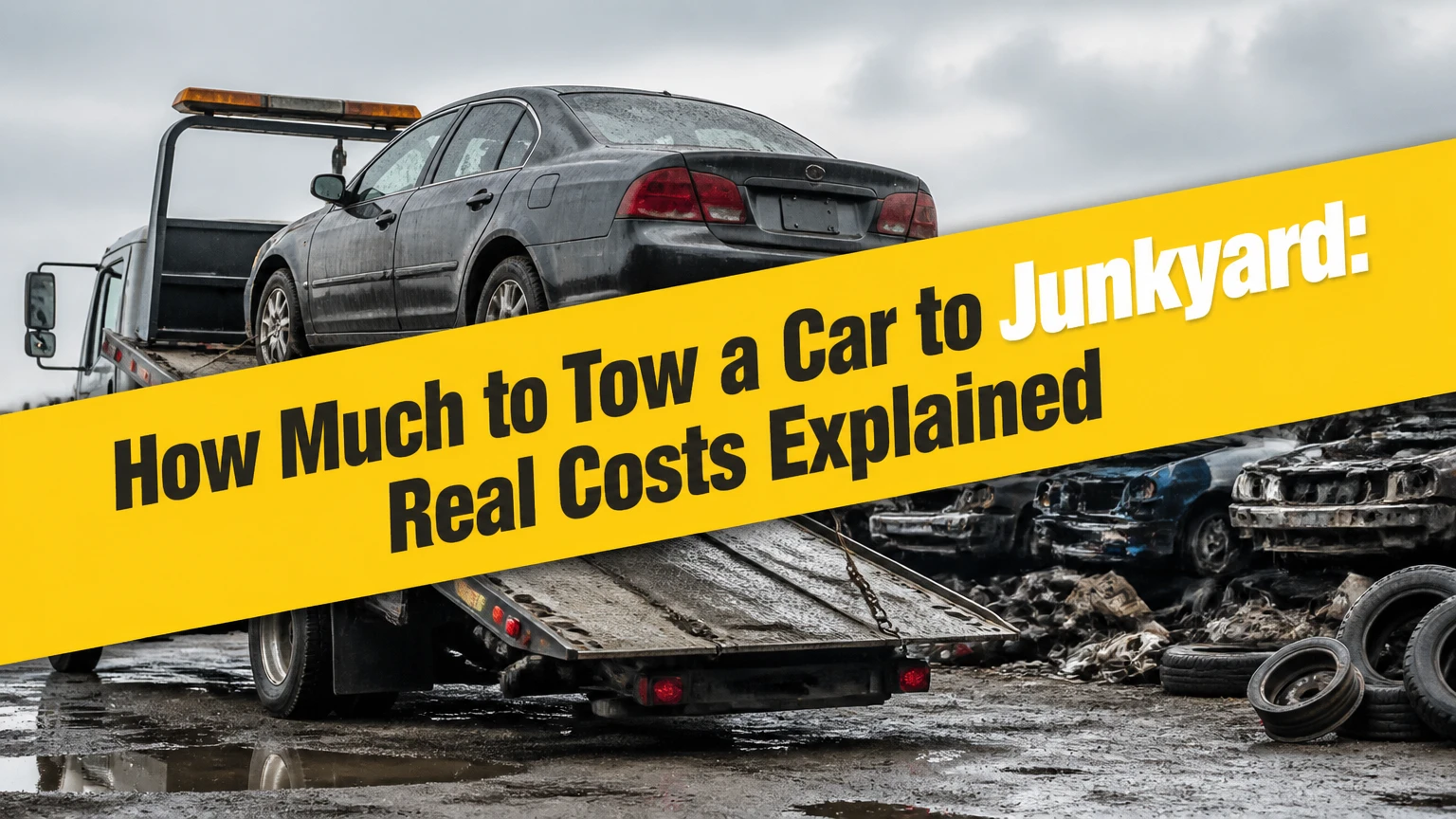
Towing a car to a junkyard usually costs $0 when the salvage buyer arranges pickup, because the buyer deducts transportation from the vehicle’s resale and scrap value. If you hire an independent towing company, a typical local tow costs $75-$200, while long-distance, inaccessible, stripped, or winch-out recoveries can raise the total above $250.
Key Facts at a Glance
- A junkyard or cash-for-cars buyer commonly provides free towing when you accept its vehicle offer.
- An independent local tow commonly costs $75-$125 for hookup plus mileage, producing a typical $75-$200 total.
- Independent towing often adds $3-$7 per mile after an included local distance or base service area.
- Difficult loading, missing wheels, mud, locked steering, and tight access can add $50-$150 or more.
- A vehicle’s advertised payout is not useful unless the quote states the guaranteed net amount after towing and fees.
- Title, lien, plate, insurance, and DMV requirements vary by state, so the transfer sequence matters.
How Much to Tow a Car to Junkyard?
A standard local tow to a junkyard costs about $75-$200 out of pocket, but a salvage buyer normally charges the vehicle owner nothing for pickup. The financial difference comes from ownership: a salvage buyer expects to recover value from parts and scrap, whereas an independent tower earns only from its transport service.
The $0 option is not technically free to the buyer. The salvage company prices the tow into its offer for the vehicle. A complete sedan with a usable engine, catalytic converter, transmission, or high-demand body panels may generate enough downstream revenue to absorb transportation. A stripped shell may still qualify for pickup, but its payout can fall close to zero.
Typical independent towing charges include a hookup or service fee, a mileage allowance, and surcharges for difficult loading. Ask whether the quoted mileage begins at your location or at the tow company’s dispatch yard, because that distinction can change a short-looking quote substantially.
Typical Towing Prices by Situation
| Situation | Typical tow charge | Typical time | Main price driver |
|---|---|---|---|
| Drivable car, local yard | $75-$150 | 20-35 minutes | Hookup and local mileage |
| Non-running car, accessible driveway | $100-$200 | 30-50 minutes | Winch loading and vehicle weight |
| Vehicle 25 miles from yard | $150-$300 | 45-75 minutes | Base fee plus loaded and deadhead miles |
| Missing wheels or locked steering | $175-$350 | 45-90 minutes | Dollies, skates, or extra labor |
| Mud, ditch, or blocked vehicle | $200-$500+ | 1-3 hours | Recovery equipment and extraction time |
These are typical planning ranges, not regulated national prices. Urban competition can lower a local tow, while rural distance, night dispatch, weather, and heavy-duty equipment can raise it.
Why Do Junkyards Often Tow Cars for Free?
Junkyards provide free towing because the vehicle can earn money after pickup through reusable components, metal recycling, auction resale, or parts sales. The yard’s offer is therefore a combined transaction: the buyer acquires the car and assumes the transport cost rather than billing a separate towing invoice.
A vehicle’s value is usually influenced by its weight, model demand, condition, completeness, title status, location, and current commodity prices. A late-model Honda, Toyota, Ford, Chevrolet, or pickup with sought-after components may receive a stronger offer than an older luxury sedan with expensive dismantling requirements.
The “free tow” promise has one important condition: the car generally must be sold to the company arranging the pickup. If you want to keep the vehicle, take it to a particular metal processor, or sell valuable parts separately, you may need to hire and pay an independent hauler.
What Determines the Junk Car Payout?
| Vehicle factor | Higher-value example | Lower-value example | Effect on payout |
|---|---|---|---|
| Completeness | Engine, transmission, wheels installed | Missing drivetrain and wheels | Complete vehicles usually earn more |
| Parts demand | Popular truck or common compact | Obsolete or rare luxury model | Demand affects reusable-parts revenue |
| Catalytic converter | Original converter present | Converter removed or stolen | Missing converter can reduce the offer |
| Title status | Clear title matching seller | Lien, missing title, estate issue | Paperwork delays or blocks purchase |
| Location | Accessible driveway near yard | Remote area requiring long haul | Distance reduces buyer margin |
| Body condition | Minor damage, straight panels | Burned, flooded, crushed shell | Damage changes salvage and handling value |
Which Towing Option Is Cheapest?
The cheapest option is usually a full-service junk-car buyer that gives a written offer with pickup included. Charity donation can also provide no-cost towing, but it produces a tax-related benefit rather than immediate sale proceeds. An independent tow is best when destination control matters more than out-of-pocket cost.
| Disposal method | Owner’s typical cost | Owner receives | Best use |
|---|---|---|---|
| Salvage buyer pickup | $0 | Cash offer, often $200-$1,500+ | Fast disposal with minimum effort |
| Independent tow to chosen yard | $75-$350+ | Separate sale proceeds | Specific destination or negotiated sale |
| Charity vehicle donation | $0 | Donation receipt, possible deduction | Supporting a qualified nonprofit |
| Private parts or vehicle sale | $0 initially | Potentially higher gross proceeds | Complete car or valuable components |
A donation receipt is not the same as cash. The tax treatment depends on whether the organization sells the vehicle, how much it receives, whether you itemize deductions, and the rules in effect for your tax return. The IRS states that a donor must obtain a written acknowledgment from a qualified organization for certain vehicle donations, so retain the receipt and sale documentation.
Selling parts privately can produce more gross revenue, but dismantling creates labor, storage, disposal, and legal obligations. It is usually a poor choice when the car must leave a driveway quickly or contains hazardous fluids.
When Does Paying for Your Own Tow Make Sense?
Pay for an independent tow when the vehicle is worth more at a particular salvage yard than at a free-pickup buyer, when you need to preserve ownership, or when a specialty dismantler has already agreed to purchase it. Compare the net result rather than the quoted sale price.
For example, a yard offers $450 with free pickup. A second facility offers $650, but a $175 tow and $30 administrative fee apply. The second option produces $445, which is slightly worse despite the higher advertised offer.
An independent tow also makes sense for a classic vehicle shell, a project car, or a dismantled vehicle whose parts you have already sold. It is less attractive for a common, low-value car because the transport charge can consume most of the remaining value.
How Do You Calculate the Total Towing Cost?
Calculate the total by adding the base service fee, all mileage charges, loading or recovery labor, equipment fees, storage, tolls, and taxes. Confirm whether the mileage includes the tow truck’s trip to you, the loaded trip to the yard, or both.
A practical estimate is:
Total tow = base fee + mileage charge + difficult-access fee + equipment fee + tolls and taxes
Example: a company charges $95 for hookup, $4 per mile for 20 loaded miles, and $75 for a locked steering wheel. The estimated total is $250 before taxes or tolls.
| Charge component | Typical amount | Question to ask |
|---|---|---|
| Hookup or dispatch | $75-$125 | Is the fee due even if pickup fails? |
| Mileage | $3-$7 per mile | Which miles are billable? |
| Winch or extraction | $50-$150 | Does loading include the first attempt? |
| Dollies or wheel skates | $25-$100 | Is equipment included in the quote? |
| Storage after failed pickup | $25-$75 per day | What triggers storage billing? |
An experienced dispatcher should be able to price the job more accurately when you provide the vehicle’s exact location, weight class, operating condition, wheel status, steering status, and destination address. A photograph of the vehicle and access route often prevents a low initial quote followed by an on-site surcharge.
What Should You Do Before the Junkyard Pickup?
Before pickup, confirm ownership documents, remove personal property, photograph the vehicle, disclose its condition, and obtain the net payout in writing. The driver should not discover missing wheels, a blocked driveway, or an inaccessible parking garage after arriving.
Use this preparation sequence:
- Locate the title. Check that the seller’s name matches the title and resolve active liens before scheduling pickup. A lender’s lien can prevent a legal sale even when the car is physically yours.
- Check local title rules. Some states allow older vehicles to transfer with alternative documents, while others require a duplicate title, bonded title, probate paperwork, or a junking certificate.
- Remove personal belongings. Search the trunk, glove compartment, door pockets, under-seat areas, tool compartments, and sun visors. Recover toll transponders, garage remotes, registration cards, and medical information.
- Photograph the vehicle. Record all sides, the dashboard mileage, the VIN, installed components, and the condition before loading.
- Disclose loading facts. Tell the buyer whether the car rolls, steers, brakes, starts, has keys, has wheels, sits in mud, or occupies a garage.
- Compare written offers. Ask for the exact cash amount after every fee, the pickup date, accepted documents, and payment method.
- Remove plates only when local rules require it. Many jurisdictions require owners to surrender, transfer, or retain plates, but the procedure is not uniform.
- Complete the transfer notice. File the required release-of-liability or notice-of-sale document with the state motor vehicle agency.
- Cancel insurance after the transfer is effective. Coordinate cancellation with plate surrender and ownership transfer so an uninsured registered vehicle does not create a compliance problem.
The best practitioner rule is simple: disclose every obstacle before accepting the offer. A buyer that knows the car is missing wheels can send a truck with skates; a buyer that learns on arrival may revise the price or leave.
What Documents Do Junkyards Require?
Most junkyards request a government-issued photo ID and proof of ownership, usually a title. A lien release, estate authorization, power of attorney, registration record, or duplicate title may be necessary when the title is unavailable or the named owner cannot sign.
| Ownership situation | Common document | Possible complication |
|---|---|---|
| Clear title, owner present | Original title and photo ID | Signature and VIN must match |
| Financed vehicle | Lien release and title | Lender may control transfer |
| Lost title | Duplicate title application | Processing time varies by state |
| Deceased owner | Probate or executor documents | Estate authorization may be required |
| Company-owned vehicle | Title plus business authorization | Driver may lack signing authority |
| Abandoned vehicle | Police or municipal paperwork | Private seller cannot always transfer it |
Do not assume an old registration replaces a title. Some states permit alternative proof for vehicles above a specified age, but the cutoff and paperwork differ by jurisdiction. Call the state DMV or the licensed salvage yard before arranging transportation.
A vehicle identification number can also reveal a title or theft problem. The yard may refuse a vehicle with an altered VIN, unresolved lien, or ownership mismatch, and the tow charge may still be payable if you separately hired the transporter.
How Are Difficult or Non-Running Cars Towed?
Non-running cars are commonly loaded with a winch, wheel dollies, skates, or a flatbed, but the correct equipment depends on wheel movement, steering, ground clearance, and access. A vehicle missing wheels or trapped in a confined garage requires more preparation than a car that rolls freely into a driveway.
Tell the dispatcher these facts:
- The car’s approximate weight and body type, such as sedan, SUV, van, or one-ton truck.
- Whether all four wheels are installed and inflated.
- Whether the steering wheel turns and the transmission can shift into neutral.
- Whether keys are available.
- Whether the car is in a basement, narrow alley, gated lot, mud, snow, or steep driveway.
- Whether overhead clearance limits a flatbed truck.
A flatbed is often safer for a severely damaged, low-clearance, electric, or all-wheel-drive vehicle, but a wheel-lift truck may fit where a flatbed cannot. Underground garages can impose height limits below the truck’s clearance, requiring a smaller recovery vehicle or relocation to a reachable loading point.
What Happens if the Vehicle Is Stripped?
A stripped vehicle can still be collected, but missing engines, transmissions, converters, doors, or wheels reduce its recyclable and resale value. The buyer may also charge for specialized loading if the shell cannot roll or support a normal wheel-lift.
The most damaging mistake is removing parts without comparing their sale value against the buyer’s reduced offer. A $300 privately sold catalytic converter may cause a $500 reduction in the complete-car offer, while removing a low-value stereo may have almost no effect. Ask the buyer for a revised quote before removing anything.
How Can You Avoid a Junkyard Towing Scam?
Avoid a towing scam by obtaining a written net-price guarantee, verifying the company’s identity, confirming payment before release, and refusing unexplained deductions. A legitimate quote should identify the vehicle, pickup address, included towing, required documents, and the amount you will receive.
Use this five-point verification:
- Ask: “What is the exact amount I receive after towing, loading, title, and administrative fees?”
- Request the offer by text or email before the truck arrives.
- Confirm the company name, physical address, phone number, and salvage or dealer license where applicable.
- Ask whether payment is cash, verified company check, or electronic transfer, and when it is delivered.
- Photograph the signed title, bill of sale, VIN, odometer, and truck identification.
Never accept “the office will mail your payment later” unless you have independently verified the company and intentionally accept that risk. A driver’s verbal promise does not protect you from a later deduction.
The second expert rule is to compare net payout, not the headline offer. A $700 offer with a $200 tow deduction is inferior to a $550 offer with guaranteed free pickup.
What Happens During the Pickup?
A normal junk-car pickup takes about 20-45 minutes on site, while difficult recovery can take one to three hours. The driver verifies the vehicle, completes the transfer paperwork, loads the car, and provides payment according to the agreed terms.
The pickup sequence usually includes:
- Vehicle and VIN verification.
- Title, identification, and lien review.
- Odometer and condition confirmation.
- Bill of sale or transfer document signing.
- Payment delivery.
- Winching or loading.
- Receipt and release documentation.
Pickup commonly occurs within 24-48 hours after offer acceptance, with same-day service more available in dense metropolitan areas. Rural areas, weekends, severe weather, oversized vehicles, and title problems can extend the schedule.
Do not sign blank documents. Verify the VIN and buyer name before signing, then keep copies or clear photographs.
What If You Want to Tow the Car to a Specific Junkyard?
Tow the car yourself only after the receiving yard confirms it will accept the vehicle and states its purchase price, paperwork requirements, and unloading procedure. Some facilities buy only complete vehicles, require appointments, or refuse cars containing fluids, batteries, or hazardous materials.
A specific destination may be necessary when:
- The yard specializes in your vehicle’s make.
- You already removed and sold parts.
- A metal recycler quoted a higher weight-based price.
- You need an appraisal or dismantling certificate.
- A charity or insurer requires a designated facility.
Get the receiving facility’s address and hours in writing. A tow truck waiting while a yard refuses the vehicle can produce detention or return-trip charges.
Can You Sell the Car Without a Title?
Sometimes, but the answer depends on state law, vehicle age, ownership records, and the buyer’s license. A salvage yard may accept a duplicate title, old registration, court order, lien release, or estate document, while another yard may reject any vehicle without an original title.
Do not use a title signed by someone who is not the legal owner. Do not alter dates, prices, signatures, or VIN information. Those actions can create fraud and title-branding problems rather than solve a paperwork delay.
Should You Donate, Scrap, or Sell the Car?
Choose a salvage buyer for immediate cash and simple pickup, donate when the nonprofit and tax treatment fit your goals, and use an independent tow when destination control or a specialized sale justifies the cost. The best route depends on net money, speed, paperwork, and the vehicle’s remaining parts value.
| Priority | Recommended route | Expected owner cost | Main trade-off |
|---|---|---|---|
| Highest convenience | Full-service salvage buyer | $0 | Less control over final facility |
| Immediate cash | Local junk-car buyer | $0 | Offer may be below private parts value |
| Tax-supported giving | Qualified charity | $0 | Benefit is delayed and tax-dependent |
| Specific specialist yard | Independent towing | $100-$350 typical | Transport reduces proceeds |
| Maximum parts revenue | Private dismantling | $0 tow initially | Labor, storage, and disposal burden |
A free pickup is not automatically the most profitable choice. Obtain two or three offers, subtract every independent transport cost, and compare the final amount received.
Common Mistakes That Reduce the Final Payout
The most common errors are accepting an incomplete quote, removing valuable parts without recalculating, cancelling insurance before transfer requirements are complete, and ignoring access conditions. Each mistake either reduces the offer or creates avoidable liability.
- Comparing gross offers: Replace a $600 headline quote with a written net quote.
- Hiding missing parts: Disclose the missing converter, engine, transmission, or wheels before pickup.
- Forgetting personal property: Search every compartment before the vehicle leaves.
- Leaving plates attached: Follow local surrender or transfer rules to avoid registration problems.
- Cancelling insurance too early: Coordinate cancellation with the legal transfer and DMV filing.
- Ignoring environmental handling: Do not drain fuel, oil, coolant, refrigerant, or battery chemicals onto the ground.
- Accepting a remote payment promise: Require payment at handoff unless a verified contract says otherwise.
A counterintuitive pricing fact is that a running car is not always worth repairing before sale. A $900 repair can increase a junk offer by only $200 if the yard values the vehicle mainly for weight and parts.
Frequently Asked Questions
How much does it cost to tow a car 20 miles to a junkyard?
A 20-mile independent tow typically costs $150-$300, depending on the base fee, mileage calculation, vehicle condition, and loading equipment. A salvage buyer may still collect the same car at no charge if you accept its purchase offer. Ask whether the 20 miles are loaded miles only or include the truck’s dispatch distance.
Will a junkyard tow a car with no wheels?
Many junkyards will arrange pickup for a car without wheels, but the buyer needs advance notice because skates, dollies, a winch, or a specialized flatbed may be required. The vehicle’s payout can decrease because major missing components reduce parts and scrap value, while loading may add $50-$150 or more.
Can I junk a car with an expired registration?
An expired registration does not automatically prevent disposal, because ownership proof usually matters more than current registration status. The title, VIN, photo ID, lien status, plates, and state transfer rules determine whether the yard can legally purchase the vehicle. Confirm requirements with the yard and DMV before pickup.
Do I need to be present when the junk car is picked up?
You may not need to be present if the buyer accepts signed documents, but an adult representative may need written authorization and identification. Being present reduces disputes about vehicle condition, payment, title signatures, and personal property. Never leave original documents unattended without confirming the company’s procedure.
Is a junkyard tow free if the car is in another city?
A buyer may offer free towing within its service area, but another-city pickup can produce a lower offer, a distance surcharge, or a refusal. Ask for the guaranteed net payout at the exact address. A buyer’s free local pickup policy does not guarantee free regional or interstate transport.
The Bottom Line
The answer to how much to tow a car to junkyard is usually $0 when the junkyard or salvage buyer purchases the vehicle and arranges pickup. Hiring your own tow truck typically costs $75-$200 locally, with distance, missing wheels, difficult access, and recovery equipment pushing the total higher. Compare written net offers, verify title requirements, disclose the vehicle’s condition, complete the transfer paperwork, and secure payment before release.