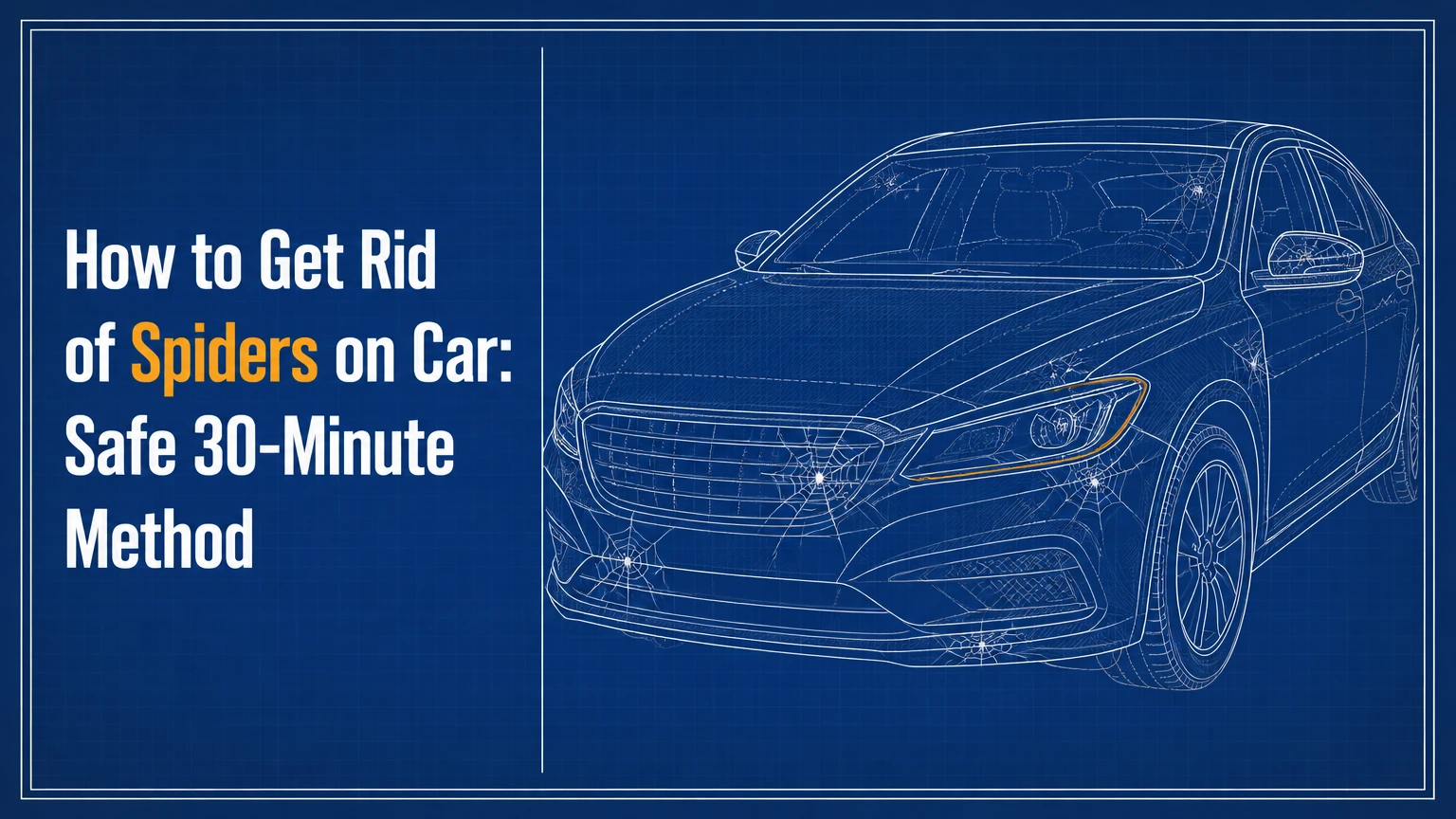
To get rid of spiders on a car, remove the spiders and webs, vacuum egg sacs and prey, wash hidden exterior areas, and correct the conditions attracting insects. A careful cleanup usually takes 30-90 minutes, while repeated sightings require inspection of mirror housings, wheel wells, the windshield cowl, door seals, and the cabin air-intake area.
Key Facts at a Glance
Most vehicle spider sightings involve shelter and available insects, not a permanent infestation inside the dashboard.
Vacuuming and physical web removal are safer first steps than spraying pesticide inside the passenger compartment.
Never use a total-release fogger in a vehicle unless the product label explicitly permits that use.
Peppermint oil and vinegar may discourage some spiders temporarily, but neither reliably kills egg sacs or creates a lasting barrier.
A typical DIY treatment costs $5-$30 and takes 30-90 minutes; professional detailing or pest treatment commonly costs $75-$300.
Repeated spiders usually indicate an untreated hiding place, an insect food source, or a parking location close to lights and vegetation.
Why Do Spiders Enter Cars?
Spiders enter cars for three main reasons: shelter, suitable temperature, and prey. A parked vehicle offers dark cavities behind mirrors, under trim, around the windshield cowl, and near wheel arches; insects attracted by lights, food residue, moisture, or nearby vegetation can then support web-building spiders.
Spiders do not normally colonize a clean, moving passenger compartment in large numbers. They are more likely to remain in a stationary car that is parked outdoors, under trees, beside a lit building, or in a garage containing flies, moths, ants, or other small insects.
Where Are Spiders Usually Hiding?
The most common locations are side-mirror housings, wheel wells, the grille, the engine-bay perimeter, the windshield wiper cowl, trunk hinges, door-jamb seals, and gaps around the cabin air intake. Inside the cabin, inspect seat rails, floor mats, dashboard edges, vents, and the spare-tire compartment.
A web does not prove that spiders are living deep inside the HVAC system. Webs around a vent may originate from the cowl or dashboard edge, while a spider may enter through an open door rather than the ventilation duct.
| Location | What to look for | Safe first action | Typical time |
|---|---|---|---|
| Side mirror | Webs, silk strands, small insects | Soft detailing brush and vacuum | 5-10 minutes |
| Wheel well | Dense webbing, shed skins | Rinse after the car cools | 10-15 minutes |
| Windshield cowl | Webs, leaves, dead insects | Remove debris, vacuum carefully | 10 minutes |
| Passenger cabin | Live spider, egg sac, crumbs | Capture or vacuum, then clean | 10-20 minutes |
| Engine bay | Webs near edges, moths, leaves | Inspect with engine off and cool | 10-15 minutes |
What Should You Do First?
The safest first response is to move the car away from vegetation and bright outdoor lights, close the doors and windows, and remove visible spiders with a vacuum or container. Do not begin by spraying chemicals into vents, upholstery, seat-belt mechanisms, or electrical connectors.
Before cleaning, photograph the spider if identification matters, especially where medically significant species occur. Avoid handling spiders directly because appearance varies by region, and a photograph gives a local extension office or pest professional something useful to assess.
Before You Start
| Requirement | Typical specification |
|---|---|
| Time | 30-90 minutes, plus 1-3 hours for drying |
| Difficulty | Easy for cabin and exterior surfaces; moderate for engine-bay inspection |
| Basic tools | Vacuum with crevice tool, microfiber cloths, soft brush, flashlight |
| Cleaning materials | Car shampoo, 2 buckets, water, interior cleaner, nitrile gloves |
| Optional materials | Plastic container, stiff card, detailing swabs, activated carbon bag |
| DIY cost | Approximately $5-$30 using existing household tools |
| Prerequisite | Park outdoors, switch the engine off, and let hot components cool |
The U.S. Environmental Protection Agency states, “The label is the law.” That rule applies to every pesticide used around a vehicle. A product labeled for outdoor perimeter treatment is not automatically approved for seats, carpets, dashboards, vents, or enclosed cabins.
How Do You Remove Spiders From a Car?
Remove spiders from a car in five stages: isolate the vehicle, remove live spiders and webs, vacuum debris and egg sacs, wash exterior hiding places, and prevent insects from returning. The most important success factor is reaching the actual harboring location rather than repeatedly treating only the visible web.
Step 1: Isolate the Car and Locate Activity
Park the vehicle in a bright, open area away from shrubs, stacked lumber, sheds, and exterior lights. Open the doors and trunk only after checking the door frames, then use a flashlight to inspect mirrors, wheel wells, the cowl, trunk seams, and cabin edges.
Do not place your face near a suspected web. Wear gloves and long sleeves, particularly in regions with black widows, redbacks, funnel-web spiders, or other medically important species.
You will know this step worked when: you can identify whether sightings are concentrated in the cabin, one exterior corner, or several locations.
Common mistake: Cleaning the cabin while leaving the car parked directly beside the hedge or porch light that attracts insects.
Step 2: Remove Live Spiders and Visible Webs
Use a vacuum with a crevice attachment for accessible webs and spiders. For a single visible spider, place a container over it, slide stiff card underneath, and release it outdoors if local safety conditions permit; use the vacuum instead when identification or handling presents a concern.
Brush mirror gaps, cowl edges, door seals, and wheel-well liners with a soft detailing brush. Remove webs before washing because water can spread loose silk into seams without removing the attached anchor points.
You will know this step worked when: no fresh silk remains around the inspected seams, mirror base, or cowl.
Common mistake: Using high-pressure air inside the cabin, which can drive insects, dust, and web fragments deeper behind trim.
Step 3: Vacuum Egg Sacs, Insects, and Interior Debris
Vacuum seat seams, floor-mat edges, under-seat areas, the trunk, spare-tire well, and the base of the windshield. Inspect pale or tan silk bundles carefully. Egg sacs vary by species, and a vacuum may not destroy every viable egg, so seal the vacuum contents in a bag and place it in outdoor waste.
Remove crumbs, spilled drinks, dead insects, leaves, and damp materials. Spider control improves when the food source disappears, although a clean cabin alone will not solve a population living in a mirror housing or wheel well.
You will know this step worked when: the vehicle has no loose food, leaf litter, dead insects, or accessible silk bundles.
Common mistake: Emptying a bagless vacuum inside the garage, which can release live insects or spiders near the vehicle.
Step 4: Wash Exterior Harborages and Dry Them
Wash the exterior with automotive shampoo, paying attention to the grille, mirror undersides, wheel wells, door jambs, trunk seams, and cowl drains. Keep strong household degreasers, undiluted vinegar, bleach, and solvent cleaners away from clear coat, rubber, painted plastic, and headlight lenses.
Rinse wheel wells from a sensible distance, avoid forcing water into electrical connectors, and dry door seals and mirror edges with microfiber cloths. Moisture left in seams can attract insects and create odor, while trapped water can affect sensitive components.
You will know this step worked when: the surfaces are visibly free of silk and debris, and rubber seals are dry rather than glossy with pooled water.
Common mistake: Directing a pressure washer into the side-mirror adjustment gap, door-lock actuator, cowl intake, or engine-bay connector.
Step 5: Reduce Insects and Add Only a Label-Approved Barrier
Clean the windshield, remove dead insects from the grille, replace damp cabin filters when needed, and reduce nearby lighting that attracts moths and flies. If pesticide treatment is necessary, use only a product whose label permits the exact exterior location and application method.
Apply insecticide sparingly to exterior cracks, wheel-well liners, or foundation-like areas only when the label allows vehicle use. Never spray a wet film on steering wheels, pedals, seats, seat belts, air vents, touchscreens, or child-seat contact surfaces.
You will know this step worked when: no new web appears after several days of normal parking, and exterior insect activity has declined.
Common mistake: Assuming a residual spray lasts 60-90 days on every vehicle surface. Sun, rain, washing, abrasion, and the product label determine real persistence.
Which Spider-Removal Method Is Best?
Vacuuming and washing are the best first-line methods for nearly every car because they remove spiders, webs, egg sacs, and prey without leaving chemical residue. Repellents may help around exterior parking points, while pesticides belong only in label-approved areas and professional treatment is appropriate for persistent or medically concerning activity.
| Method | Typical cost | Time to perform | Persistence | Main limitation |
|---|---|---|---|---|
| Vacuum and hand removal | $0-$15 | 20-40 minutes | Immediate removal | Does not treat inaccessible cavities |
| Exterior wash and detailing | $10-$40 DIY | 30-90 minutes | Days to weeks | Must be followed by drying and prevention |
| Essential-oil deterrent | $5-$20 | 10 minutes | Usually hours to several days | Evidence for vehicle use is limited |
| Labeled exterior pesticide | $10-$30 | 10-20 minutes | Label-dependent | Residue, exposure, and material risks |
| Professional detailing | $75-$200 | 2-5 hours | Depends on reinvasion | Does not fix an insect source outdoors |
| Pest professional inspection | $100-$300 typical | Same day to 48 hours | Treatment-dependent | Higher cost and vehicle access may vary |
Do Vinegar or Peppermint Oil Work?
Vinegar and peppermint oil may temporarily discourage spiders from a treated exterior area, but neither should be treated as a proven extermination method. Vinegar can damage or dull some automotive finishes, and essential oils can stain upholstery, soften certain plastics, irritate occupants, or create a slippery residue.
If using a household deterrent, test a hidden, unpainted-compatible area first and keep the liquid away from screens, leather, fabric, steering controls, pedals, vents, and weather seals. A lightly dampened exterior cloth is safer than atomizing oil throughout the cabin, but physical removal remains more dependable.
Should You Use a Bug Bomb in a Car?
Most people should not use a total-release fogger in a car. Foggers can leave pesticide residue across glass, controls, upholstery, and HVAC surfaces, and their propellants create fire and exposure hazards in a small enclosed space.
A fogger also does not remove egg sacs, dead insects, webs, or the reason spiders entered. If a product label specifically permits vehicle use, follow every label instruction for ignition sources, occupancy, dosage, re-entry, and ventilation. Otherwise, choose vacuuming or hire a licensed pest professional.
Does Turning on the Heater Kill Spiders?
Running a car heater for 20-30 minutes is not a reliable spider treatment and can create unnecessary mechanical, fire, and carbon-monoxide risks. Vehicle interiors do not heat uniformly, and dashboard cavities, vents, and mirror housings can remain below the temperature needed to affect spiders or egg sacs.
Do not leave a vehicle running unattended in a garage or closed structure. Use normal climate controls only after removing visible pests, and never rely on heat as a substitute for inspection and cleaning.
How Much Does Spider Treatment for a Car Cost?
A typical DIY spider cleanup costs $5-$30, professional detailing costs about $75-$200, and a pest-control inspection or targeted treatment commonly costs $100-$300. Prices vary by country, vehicle size, infestation location, mobile-service fees, and whether trim or cabin-filter access is required.
| Service or purchase | Typical price, USD | Typical duration | Appropriate use |
|---|---|---|---|
| DIY wash supplies | $5-$20 | 30-60 minutes | Light exterior webbing |
| Interior detail | $75-$150 | 2-4 hours | Cabin debris and odor |
| Full detail | $150-$300 | 4-8 hours | Heavy contamination or neglected vehicle |
| Pest inspection | $100-$200 | 30-90 minutes | Repeated sightings |
| Targeted pest treatment | $150-$400 | 1-3 hours | Persistent exterior harborages |
| Trim or mirror access repair | $100-$500 | 1-4 hours | Webs inside inaccessible cavities |
These are typical North American ranges, not fixed market prices. A professional should explain the exact treatment site, chemical label, ventilation plan, and re-entry interval rather than promising a universal protection period.
Why Do Spiders Keep Coming Back?
Spiders keep returning when the original food source, harbor, or parking condition remains. Common causes include moths around exterior lights, damp leaves in the cowl, insects in a garage, a web-filled mirror cavity, loose weather stripping, and a car that sits under dense vegetation for long periods.
Troubleshooting by Symptom
| Symptom | Likely cause | Corrective action | Expected check |
|---|---|---|---|
| New web in one mirror daily | Protected mirror cavity | Brush, vacuum, inspect access points | No new silk for 7 days |
| Spiders on windshield each morning | Exterior light or nearby plants | Change parking location and clean cowl | Fewer insects overnight |
| Small spiders in cabin | Egg sac or open entry point | Vacuum seams and inspect seals | No juveniles for 14 days |
| Webs near wipers | Leaves and insects in cowl | Clear debris and check drains | Dry, unobstructed cowl |
| Spiders after every wash | Reinfestation from parking site | Move car for one week | Activity declines elsewhere |
| Strong pesticide smell | Overapplication or poor ventilation | Remove occupants, ventilate, follow label | No odor before driving |
A useful practitioner rule is to map sightings for seven days. Record the location, time, weather, and parking position; a repeated single location usually indicates a harbor, while random sightings after outdoor parking more often indicate incidental entry.
What Changes for Mirrors, the Engine Bay, and the Cabin?
The treatment changes with the location because water, chemicals, and access risks differ. Interior sightings call for vacuuming and sanitation, mirror sightings call for careful cavity cleaning, and engine-bay activity requires a cool engine and protection of electrical components.
If Spiders Are in the Side Mirrors
Fold the mirror if the vehicle design permits, use a soft brush to pull webs outward, and vacuum the opening without forcing the nozzle against wiring or the adjustment mechanism. Do not flood the cavity with a hose or pack it with oil-soaked cotton, because retained moisture and residue can damage components or attract dust.
If webs return from the same mirror, ask an automotive technician whether the housing can be safely accessed. A persistent web may reflect a cavity, damaged seal, or parking location rather than a need for repeated pesticide.
If Spiders Are in the Engine Bay
Inspect only when the engine is cold, the ignition is off, and moving parts cannot start. Remove leaves and webs by hand or with a vacuum, keeping the nozzle away from belts, fans, battery terminals, alternators, sensors, and exposed connectors.
Do not spray household insecticide onto a hot engine or electrical assembly. A licensed pest professional can identify a safe exterior treatment, while a mechanic should address damaged seals, nesting material, or signs of rodents.
If Spiders Are Inside the Cabin
Remove child seats, floor mats, cargo, and personal items before vacuuming. Clean spills with an automotive interior product, inspect the cabin air filter if insects are entering through the cowl, and ventilate until surfaces are completely dry.
Never apply essential oils or pesticide to pedals, steering controls, seat belts, airbags, touchscreens, or upholstery without explicit product compatibility and label permission. A slippery pedal or contaminated restraint can create a greater safety problem than the spider.
Which Prevention Measures Actually Help?
The most effective prevention measures are reducing insects, removing vegetation contact, keeping the cowl clean, closing windows when parked, and inspecting webs weekly during warm seasons. Physical exclusion and parking changes generally outperform unverified ultrasonic devices or strong-smelling sprays.
| Prevention measure | Frequency | Cost | Likely benefit |
|---|---|---|---|
| Vacuum cabin and trunk | Every 2-4 weeks | $0-$15 | Removes prey and egg sacs |
| Clear cowl leaves | Monthly in autumn | $0-$10 | Reduces damp insect habitat |
| Wash wheel wells | Every 2-4 weeks outdoors | $5-$20 | Removes webs and debris |
| Park away from shrubs | Every parking event | $0 | Reduces direct entry |
| Reduce nearby white lights | Nightly | $0-$30 | Lowers moth and fly activity |
| Inspect seals and mirror housings | Monthly | $0-$20 | Finds recurring harborages |
Ultrasonic 12-volt repellents are not a dependable primary solution. Claims about continuous spider exclusion vary by device, and a plugged-in unit cannot remove prey, webs, egg sacs, or a physical entry route.
When Should You Call a Professional?
Call a pest professional when spiders appear daily for more than one to two weeks after thorough cleaning, when egg sacs recur, when a suspected medically significant species is present, or when activity involves inaccessible dashboard or structural cavities. Choose a licensed provider who can identify the species and explain every product used.
A professional treatment should specify the application area, active ingredient, vehicle-surface precautions, ventilation requirements, re-entry time, and follow-up policy. Do not accept a blanket promise that one fogging session will eliminate all spiders for three to six months.
The National Pest Management Association commonly emphasizes integrated pest management, which combines sanitation, exclusion, habitat modification, and targeted pesticide use. That framework fits cars well because chemical treatment without food-source removal often produces only temporary improvement.
Common Mistakes and How to Fix Them
- Spraying vinegar on paint or lenses: Wash the area with automotive shampoo, dry it, and inspect for hazing. Use a pH-balanced automotive product instead.
- Applying pesticide inside vents: Stop using the vehicle until the label’s re-entry and ventilation requirements are met. Contact the manufacturer or a professional if residue reached the HVAC system.
- Ignoring the garage: Remove stored cardboard, leaf litter, and insects near the parking space. Change the vehicle’s location for several nights.
- Destroying only the visible web: Inspect a one-meter area around the web, including seams, cowl edges, and nearby debris.
- Using compressed air indiscriminately: Vacuum enclosed cabin areas instead, because air pressure can distribute debris behind trim.
- Driving before surfaces dry: Dry seals, mats, and cleaned controls completely; damp materials encourage odor and insect activity.
FAQ
Can spiders damage a car?
Spiders rarely damage mechanical systems directly, but webs and debris can block small drains, contaminate sensors if sprayed improperly, or create visibility and distraction problems. Rodents, insects, and moisture associated with the same parking environment usually pose greater vehicle risks than the spider itself.
Can spiders lay eggs inside a car?
Yes, a spider can attach an egg sac inside a dark, undisturbed cavity, although many sightings are incidental arrivals. Inspect seat rails, trunk wells, mirror housings, cowl edges, and stored items, then vacuum the area and seal the vacuum contents outdoors.
Is a spider in the car dangerous while driving?
A single spider is usually a distraction risk rather than a mechanical threat. Pull over safely before attempting removal, and do not reach behind the dashboard or under a seat while the vehicle is moving. Seek medical advice after a bite if severe pain, spreading swelling, breathing difficulty, or systemic symptoms develop.
How often should I clean my car to prevent spiders?
Vacuum the cabin and trunk every two to four weeks during warm or wet seasons, and clear leaves from the windshield cowl monthly. Increase inspections when the car is parked beneath trees, beside exterior lights, or near dense vegetation.
Will a car wash remove spiders completely?
A car wash can remove exposed webs, insects, and wheel-well debris, but it may not reach mirror cavities, cowl interiors, door seals, or the passenger compartment. Follow washing with manual inspection, vacuuming, and complete drying.
What is the safest treatment for a car with children or pets?
Use physical removal, vacuuming, washing, and parking changes first. Remove children, pets, toys, food, and car seats during cleaning, and do not apply pesticide or essential oil to contact surfaces unless the product label explicitly permits that application.
The Bottom Line
To get rid of spiders on a car, vacuum the cabin, remove webs and egg sacs, wash the cowl and wheel wells, dry every seam, and reduce the insects attracting them. Use pesticide only on label-approved exterior areas, avoid foggers and improvised heat treatments, and investigate the parking environment when sightings continue.