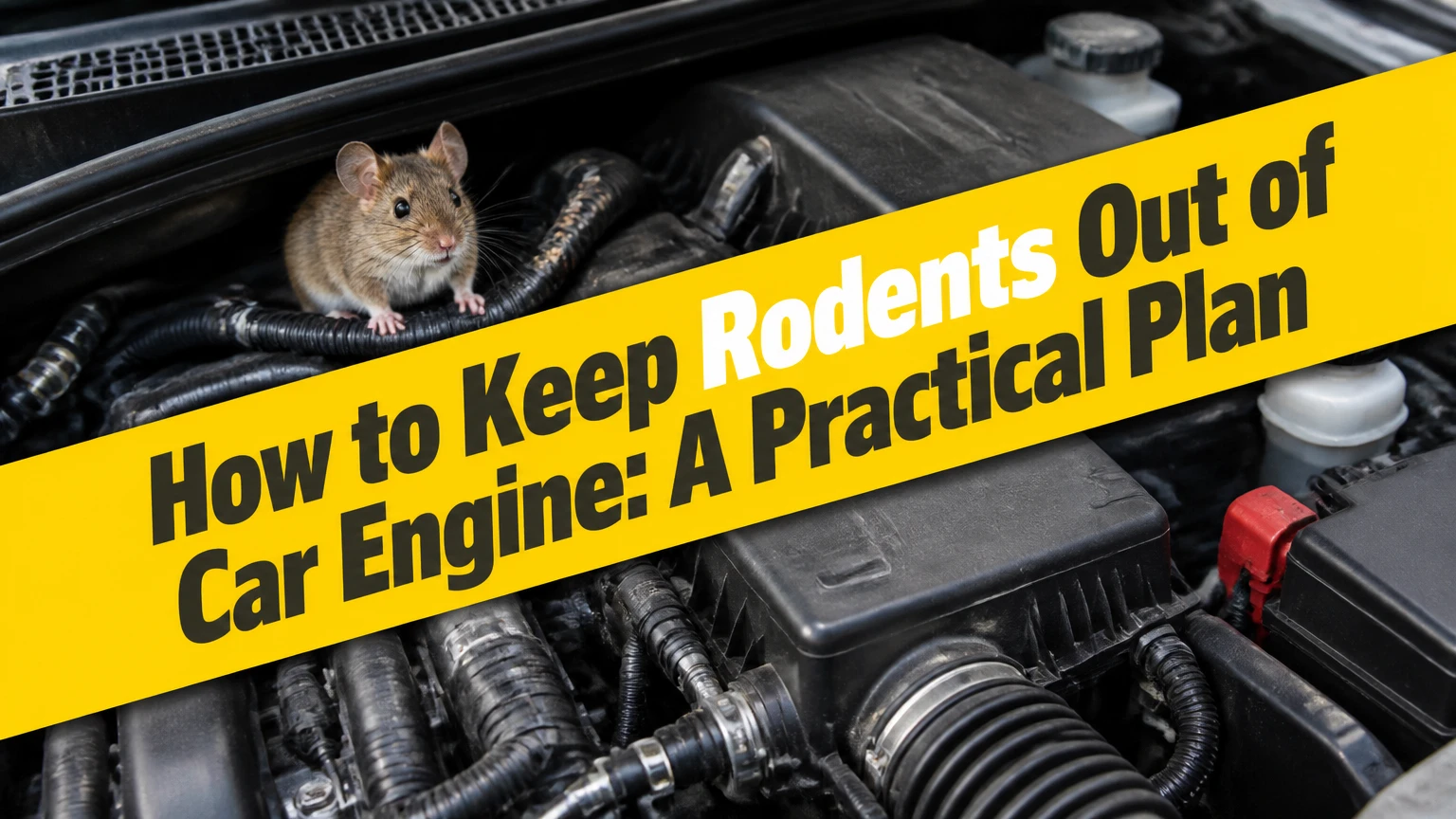
To keep rodents out of a car engine, remove food and nesting access, clean existing scent trails, protect vulnerable wiring, and monitor the vehicle regularly. The most reliable defense combines parking-area control, physical exclusion, and correctly placed deterrents rather than relying on peppermint spray or ultrasound alone.
Key Facts
Rodents enter engine bays mainly for shelter, warmth, nesting material, and nearby food, not because every vehicle’s wiring is proven to taste like food.
A complete inspection, cleaning, exclusion, and monitoring routine usually takes 1-3 hours initially and 5-15 minutes weekly.
Peppermint and other scent products usually require reapplication every 1-2 weeks and lose value after rain, washing, or engine heat.
Snap traps belong around the vehicle or along garage walls, not loose beside belts, fans, exhaust components, or hot manifolds.
Hardware cloth can protect a specific opening, but blocking an air intake, drain, cooling path, or moving component can damage the vehicle.
Typical rodent-related repairs range from about $150 for minor wire repair to more than $5,000 for a major wiring harness, depending on the vehicle.
Why Do Rodents Enter a Car Engine Bay?
Rodents enter engine compartments because the space provides cover from predators, wind, rain, and cold. A recently driven vehicle also retains heat, while parked cars offer protected nesting sites near wiring, insulation, airboxes, and firewall openings.
Mice, rats, chipmunks, and squirrels may use different routes. Mice can pass through openings around 6 mm, roughly 1/4 inch, while larger rats need more space. Squirrels often reach engine bays from nearby trees, fences, or the underside of a vehicle.
The commonly repeated claim that rodents specifically eat soy-based wiring insulation is too broad. Some manufacturers use plant-derived materials in wire insulation, but rodent damage does not prove that soy caused the attack. Shelter, nesting behavior, food contamination, available gnawing surfaces, and local rodent pressure usually matter more than the insulation ingredient.
Rodents also investigate engine bays because they contain low-disturbance cavities. A car that moves only once every few days provides a more stable shelter than one driven several times daily.
What Damage Can Rodents Cause?
Rodents can chew wire insulation, vacuum lines, injector wiring, ignition wiring, plastic clips, hood insulation, air filters, and cabin-filter materials. A nest can obstruct airflow, contaminate surfaces with urine and feces, or create a fire risk if dry material contacts a hot exhaust component.
Typical consequences include:
- Warning lights caused by an open or shorted circuit
- No-start conditions from damaged ignition or sensor wiring
- Blower, lighting, or climate-control faults
- Reduced engine performance from chewed vacuum or intake hoses
- Contaminated cabin air from nesting near the HVAC intake
- Odor and respiratory exposure during cleanup
A vehicle warranty normally covers manufacturing defects, not animal damage. Comprehensive auto insurance may cover rodent damage, but deductibles, exclusions, and claim rules vary by policy and location.
How to Keep Rodents Out of Car Engine Areas
The highest-success approach has seven stages: inspect, make the vehicle safe, clean, remove surrounding attractants, block suitable openings, add targeted deterrents, and monitor. The sequence matters because deterrents applied before cleanup may leave the original scent and nesting material in place.
Before You Start
| Requirement | Typical specification |
|---|---|
| Initial time | 1-3 hours, excluding repairs |
| Weekly follow-up | 5-15 minutes |
| DIY material cost | $25-$120 |
| Required tools | Flashlight, nitrile gloves, mask, inspection mirror, scraper |
| Cleaning supplies | Automotive degreaser, microfiber cloths, disposable bags |
| Exclusion supplies | 1/4-inch galvanized hardware cloth, metal snips, high-temperature ties |
| Safety prerequisite | Engine cold, ignition off, keys away from vehicle |
Do not begin by reaching into a dark engine bay. Rodents may bite, and disturbed nests can contain fleas, mites, or contaminated dust. Wear gloves and a well-fitting mask, and keep children and pets away from droppings.
Step 1: Inspect for Rodent Activity
Look for fresh droppings, shredded paper or insulation, food caches, hair, tracks, grease smears, and chewed plastic. Inspect the battery tray, fuse boxes, air-filter housing, cowl area, firewall, wheel wells, underbody shields, and cabin air-filter compartment.
Use a flashlight and inspection mirror rather than placing your hands behind belts or under covers. Photograph damage before cleaning because the images can help a repair shop and support an insurance claim.
You will know the inspection is complete when you have identified both the entry route and the affected components. A nest without chewed wiring still requires removal and monitoring, because the animal may return to the same protected cavity.
Common mistake: starting the engine to “flush out” an animal. A live rodent can enter a belt path, fan shroud, or hot exhaust area, causing injury or mechanical damage.
Step 2: Isolate Immediate Electrical and Fire Risks
Remove loose nesting material only after confirming that no animal is inside. If wiring is exposed, melted, or severed, do not drive until a technician checks it. A damaged circuit can disable safety systems or short against metal.
For extensive damage, disconnect the negative battery terminal only if the vehicle manufacturer’s procedure permits it. Some vehicles require battery-support equipment or reset procedures after power loss, and hybrids or electric vehicles contain high-voltage systems that owners should not service.
You will know the vehicle is safe to move when no loose material touches hot or moving parts, no fuel or fluid line is damaged, and warning lights have been assessed. A tow is safer than a short drive when the vehicle misfires, smells of fuel, overheats, or shows major electrical faults.
Common mistake: pulling on a partially chewed wire. That can turn a repairable section into a harness replacement.
Step 3: Clean the Engine Bay and Remove Nesting Material
Remove the nest with tools, seal it in a disposable bag, and clean contaminated surfaces using an automotive-safe cleaner. The Centers for Disease Control and Prevention recommends wetting rodent-contaminated material before removal and states, “Do not sweep or vacuum rodent droppings or nesting material.” That precaution reduces contaminated dust.
Avoid spraying fluid directly onto alternators, fuse boxes, connectors, sensors, ignition coils, air-intake openings, or exposed battery terminals. A damp cloth and controlled application are safer than flooding the compartment with a hose.
For feces or urine, follow local health guidance and the cleaner label. Never mix bleach with ammonia, acids, or other cleaners. Enzymatic products can help with odor, but no cleaner guarantees that every territorial scent is removed from porous insulation.
You will know cleaning worked when no droppings, food caches, nesting fibers, or urine odor remain and the compartment is fully dry. Leave the hood open while the engine cools and dries, but close it before leaving the vehicle unattended.
Common mistake: applying peppermint oil to hot surfaces. Oil residues can attract dust, degrade some plastics or rubber, and create a flammable residue near heat sources.
Step 4: Remove Food and Shelter Around the Parking Area
Store birdseed, pet food, livestock feed, and garbage in rigid containers with tight-fitting lids. Remove fallen fruit, spilled seed, cardboard, fabric, and leaf piles within several feet of the parking location.
In a garage, seal wall penetrations, door gaps, utility openings, and foundation cracks with metal mesh, mortar, or rodent-resistant materials. Steel wool alone is not a durable exterior repair because moisture causes corrosion and rodents can pull it apart.
Use snap traps along walls where rodents travel, with the trigger end facing the wall. Place traps in protective boxes where children or pets can reach them. Traps should control the surrounding population, not replace vehicle inspection.
You will know the parking area is improving when bait remains untouched, new droppings stop appearing, and tracking evidence declines for at least 7-14 days. Rodent control often fails when a garage is treated but a neighboring feed source remains accessible.
Common mistake: placing poison beneath the hood. A poisoned animal may die inside the HVAC system, dashboard, or engine compartment, producing odor and creating a difficult removal problem.
Step 5: Block Safe, Specific Entry Points
Use galvanized hardware cloth with openings around 1/4 inch where a vehicle has a known, nonmoving access point. Suitable locations may include a gap in an underbody shield, a large cowl opening, or a storage enclosure, but the correct location depends on the vehicle design.
Do not cover radiator airflow, engine ventilation, exhaust outlets, belt paths, drainage channels, brake components, steering parts, or factory air intakes unless the barrier is engineered for that opening. A blocked intake can cause drivability problems, while loose mesh near a fan can become a mechanical hazard.
Secure mesh with metal fasteners or high-temperature-rated ties, keeping it away from exhaust components. Do not drill into a fuel tank, battery enclosure, high-voltage component, airbag system, or structural member.
You will know exclusion is safe when the barrier cannot contact moving parts, does not reduce airflow, remains secure after a short drive, and leaves all service access points usable.
Common mistake: sealing every visible gap. Cars require designed airflow, drainage, and pressure paths; exclusion should target rodent access, not indiscriminately close the compartment.
Step 6: Protect Vulnerable Wiring
Use rodent-resistant tape containing capsaicin or another bittering agent only on clean, dry, accessible wiring and only according to the product instructions. The tape must not cover connectors that require service, trap moisture against insulation, or touch exhaust parts.
A protective split conduit or professionally installed wire loom can add abrasion resistance, but ordinary plastic conduit is not automatically rodent-proof. If a harness is already damaged, tape is a preventive covering, not an electrical repair.
Ask a technician about replacing severely exposed sections with approved loom, repairing conductors with sealed automotive splices, or installing manufacturer-specific protection. Avoid household electrical tape because engine heat, oil, and water shorten its useful life.
You will know the protection is correctly installed when tape edges are secure, no copper is exposed, connectors remain accessible, and the covering has a safe clearance from heat and movement.
Common mistake: wrapping a harness tightly enough to stress connectors. Protection should shield the cable without bending terminals or preventing inspection.
Step 7: Add a Deterrent and Start a Monitoring Routine
Use a scent product, electronic unit, or physical barrier as a secondary layer after removing the attraction. Scent pouches should be fixed away from belts, fans, exhaust manifolds, and water-sensitive components, while electronic devices must be secured so they cannot fall into moving parts.
For a hardwired 12-volt device, choose a model with an inline fuse and low-voltage cutoff. A cutoff near 11.8-12.0 volts is a typical protective feature, but the vehicle manufacturer’s battery specifications take priority. Battery-operated units avoid parasitic drain but require scheduled battery checks.
Open the hood every 3-7 days during active rodent pressure, then weekly after two weeks without signs. Look for new droppings, disturbed material, fresh gnaw marks, and displaced deterrents.
You will know the defense is holding when two consecutive weekly inspections show no new evidence and the parking-area signs are declining. Continue periodic checks during cold weather, long storage, and nearby construction.
Which Rodent Deterrent Works Best for a Car?
Physical exclusion and surrounding-area control usually provide the most dependable long-term value. Scent products are inexpensive but temporary, electronic devices can supplement the defense, and wiring tape protects a target rather than preventing entry.
| Method | Typical cost | Service interval | Main strength | Main limitation |
|---|---|---|---|---|
| Peppermint or commercial scent spray | $10-$30 | 7-14 days | Five-minute application | Rain and heat reduce residue |
| Scent pouch | $10-$25 | 2-8 weeks | No wiring required | Fire and placement hazards |
| Capsaicin wire tape | $20-$50 per roll | 6-24 months typical | Protects exposed harnesses | Labor-intensive installation |
| Ultrasonic or strobe unit | $25-$80 | Battery check monthly | Adds a noncontact layer | Rodents can habituate or find quiet zones |
| Galvanized hardware cloth | $10-$35 | Inspect quarterly | Blocks a defined opening | Incorrect placement restricts airflow |
| Garage snap traps | $15-$60 for multiple traps | Check daily initially | Reduces local population | Requires safe placement and maintenance |
Ultrasound is not a guaranteed engine-bay solution. Metal, insulation, engine components, and compartment geometry create shaded areas, and evidence for consumer ultrasonic devices varies by pest and environment. A unit should supplement exclusion rather than justify ignoring droppings or food sources.
Scent deterrents also have an honest limitation: they are poor choices for unattended long-term storage unless someone can replace or inspect them. Mothballs are especially unsuitable because they release pesticide vapors, can harm people and pets, and may damage vehicle materials; they are not a safe substitute for exclusion.
What Does Rodent Prevention Cost?
A basic DIY defense typically costs $25-$120 and takes 1-3 hours. Professional inspection, cleaning, or repair adds substantially more when rodents have reached the dashboard, HVAC case, fuse box, or main harness.
| Work or damage level | Typical price range | Typical timeframe | Recommended action |
|---|---|---|---|
| DIY inspection and cleaning | $25-$60 | 1-2 hours | Owner can perform safely |
| Professional inspection | $75-$200 | 30-90 minutes | Use for hidden damage |
| Minor wire repair | $150-$500 | Same day | Automotive electrical technician |
| Multiple harness repairs | $500-$2,000 | 1-3 days | Diagnostic testing required |
| HVAC or dashboard removal | $800-$3,000 | 2-5 days | Specialist evaluation |
| Main harness replacement | $2,000-$5,000+ | 3 days-3 weeks | Confirm parts availability |
These are typical North American ranges, not fixed quotations. Luxury vehicles, hybrids, imported models, labor rates, diagnostic time, and unavailable harnesses can move the final bill well beyond the table.
Insurance treatment differs from warranty treatment. Comprehensive coverage may include animal damage, but a deductible can make a small repair uneconomical; photograph the evidence, avoid discarding damaged parts before approval, and ask the insurer whether teardown requires authorization.
What Should You Do During Storage, Winter, or Rural Parking?
Long-term storage requires stronger physical and environmental control than daily commuting. A parked vehicle beside fields, barns, woodpiles, bird feeders, or dense vegetation faces more pressure than a frequently driven vehicle on a paved urban street.
| Situation | Highest-priority controls | Inspection frequency | Extra precaution |
|---|---|---|---|
| Urban driveway | Remove food, clean bay, inspect cowl | Weekly | Use traps near walls |
| Enclosed garage | Seal gaps, store feed, use traps | Every 3-7 days initially | Keep doors closed |
| Rural property | Hardware cloth, harness protection, perimeter control | Every 2-3 days | Remove vegetation nearby |
| Winter storage | Clean vehicle, dry interior, maintain airflow | Weekly | Do not store food inside |
| RV or seasonal vehicle | Cabin inspection, vents, engine protection | Weekly | Check compartments separately |
Driving the car regularly can make the engine bay less attractive, but movement does not eliminate risk. Rodents may return after the engine cools, and a vehicle parked overnight in the same sheltered location remains exposed.
For storage longer than two weeks, clean the cabin, remove all food and trash, leave no clothing or paper inside, and inspect before each start. A breathable vehicle cover can reduce leaf accumulation, but a cover that reaches the ground may create a protected tunnel for rodents.
How Do You Handle an Existing Nest or Chewed Wire?
Stop and inspect before starting the vehicle when a nest, droppings, or chewed wiring is visible. Remove contamination safely, photograph the damage, and have a technician test affected circuits before applying tape or restarting the engine.
Seek professional help immediately when:
- The check-engine, ABS, airbag, charging, or hybrid-system light appears
- The vehicle cranks but does not start
- Fuel, brake, coolant, or high-voltage wiring appears damaged
- Rodents entered the dashboard or HVAC case
- A burning smell, smoke, misfire, or overheating occurs
- Droppings are extensive or cleanup involves a confined space
A mechanic should test continuity, resistance, ground paths, fuse condition, sensor signals, and network communication where applicable. Modern vehicles can generate multiple unrelated warning codes from one damaged communication wire, so replacing a battery or clearing codes does not solve the underlying problem.
Do not use an ozone generator, strong solvent, or household disinfectant inside the HVAC system without checking material compatibility. Odor treatment cannot replace removal of contaminated insulation or a dead animal.
Common Mistakes That Let Rodents Return
The most common failure is treating the engine bay while leaving the parking area attractive. Rodent prevention fails when food, access, nesting material, and population pressure remain unchanged.
- Relying on one deterrent: Ultrasound, peppermint, or tape alone leaves other access routes open. Combine at least one environmental measure with one physical or targeted protective measure.
- Using loose materials near heat: Mothballs, cloth pouches, paper, and oily cotton can contact hot or moving parts. Secure only purpose-made products in cool, static locations.
- Blocking the wrong opening: Mesh over a radiator, intake, drain, or fan path can create mechanical or thermal problems. Photograph the opening and verify its function first.
- Cleaning with dry methods: Sweeping or vacuuming dry droppings can aerosolize contaminated particles. Wet the material and follow public-health instructions.
- Ignoring the cabin filter: A rodent can enter through the cowl and build a nest in the HVAC intake. Inspect and replace the filter when there is chewing or contamination.
- Failing to check after installation: A deterrent that has fallen onto a belt or lost its battery becomes a hazard or provides no protection. Inspect weekly.
Which Plan Fits Your Vehicle?
A daily commuter generally needs a clean engine bay, sealed garage or driveway food sources, and weekly inspection. Adding a modest scent product or electronic device can help when local rodent activity is visible, but expensive harness wrapping is rarely the first step.
A rural or seasonal-storage owner should prioritize exclusion and population reduction. Protect exposed harnesses, inspect underbody and cowl routes, secure feed, remove vegetation near the parking area, and use enclosed traps around the structure.
A budget-conscious owner can begin with gloves, a flashlight, automotive cleaner, galvanized mesh, and properly placed snap traps for approximately $25-$60. Spend money on professional diagnostics before buying multiple electronic devices if the vehicle already has warning lights or damaged wiring.
An electric-vehicle or hybrid owner should treat the engine compartment as a specialized system. Do not open high-voltage battery compartments or orange cable assemblies, and use a dealer or qualified hybrid technician for any suspected damage.
FAQ
Does driving a car every day keep mice away?
Daily driving may reduce the time available for nesting, but it does not reliably prevent rodents. Mice can enter a vehicle overnight, especially when it is parked near food, vegetation, or a building. Cleaning the bay, removing attractants, and inspecting the cowl and airbox remain necessary.
Will leaving the hood open keep rodents out?
Leaving the hood open may make an engine bay feel less concealed, but it is not a dependable prevention method. The practice also exposes components to rain, debris, and unauthorized access. Use an open hood only during supervised inspection or drying, then close and secure it.
Are car warranties responsible for chewed wires?
Factory warranties generally exclude damage caused by rodents because animal activity is an external event rather than a manufacturing defect. Comprehensive insurance may cover the loss, subject to the policy deductible and exclusions. Ask the insurer before authorizing extensive teardown or harness replacement.
Can I put a mouse trap under the hood?
A loose mouse trap under the hood is usually a poor choice because it can interfere with belts, fans, exhaust components, and service work. Place enclosed snap traps along garage walls or near the vehicle’s parking perimeter, where rodents travel and the traps can be checked safely.
Do dryer sheets or peppermint oil stop rodents?
Dryer sheets and peppermint oil may temporarily change odor, but neither provides dependable exclusion. Heat, weather, evaporation, and habituation reduce their effect. Use commercial scent products only as a secondary layer after removing food, cleaning contamination, and blocking safe entry points.
Are soy-based wires the reason rodents chew car wiring?
Soy-based or plant-derived insulation is not proven to be the universal cause of rodent wiring damage. Rodents chew and investigate many materials, while shelter, nesting opportunity, food scent, and local population pressure usually determine whether a vehicle is attacked. Treat the environment and access route, not only the insulation.
The Bottom Line
To keep rodents out of car engine compartments, begin with inspection and safe wet cleaning, remove food and nesting material from the parking area, block only verified entry points, protect exposed wiring, and monitor at least weekly. The strongest practical defense is layered: environmental control plus physical exclusion, with scent or electronic products used as supporting measures rather than guarantees.