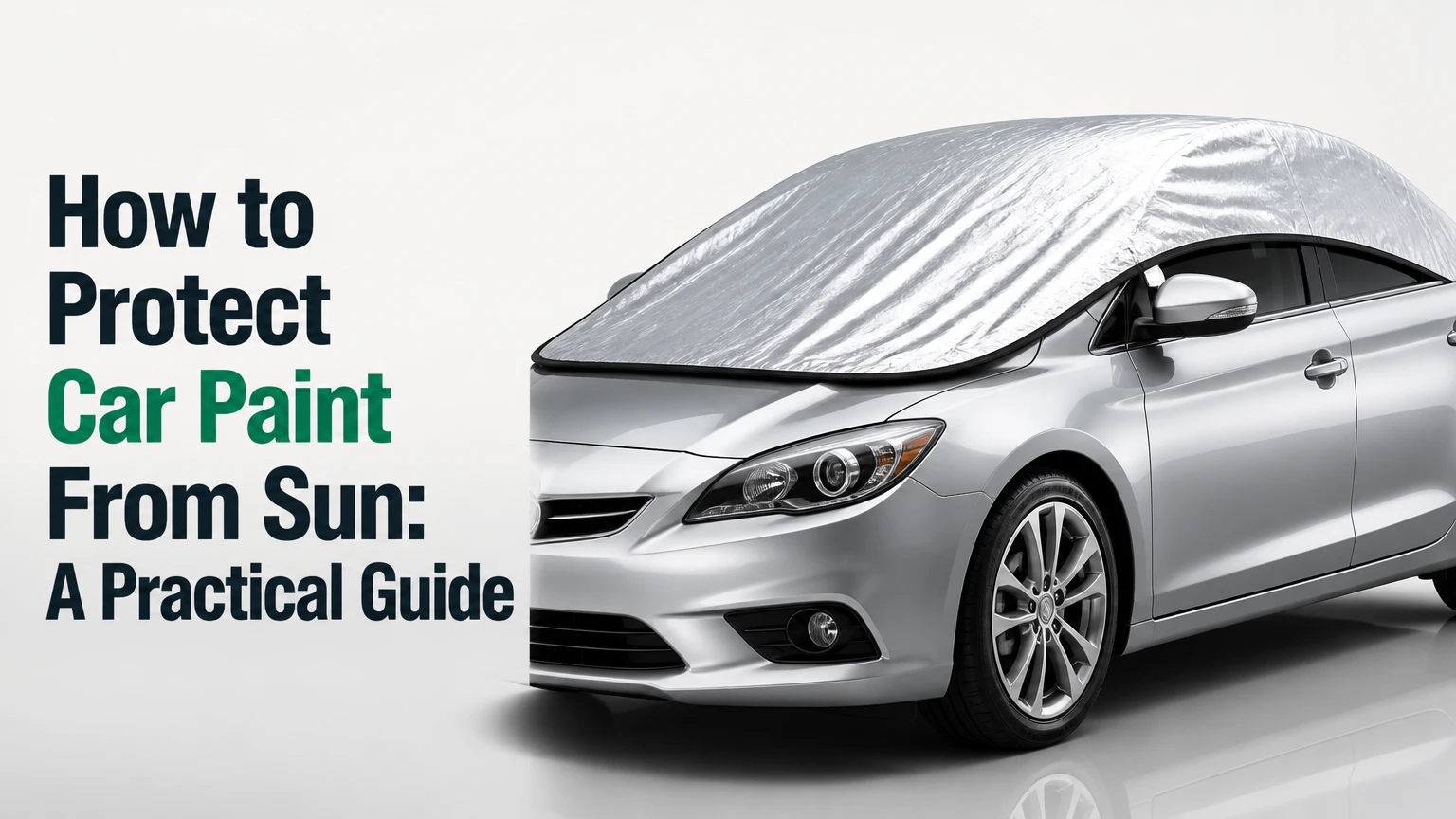
The most effective way to protect car paint from sun is to combine physical shade with a clean, intact protective layer. Park in a garage or under a breathable cover whenever possible, then use a polymer sealant, ceramic coating, or paint protection film according to your exposure, paint condition, budget, and maintenance habits.
Key Facts at a Glance
- Ultraviolet radiation breaks down clear-coat and pigment chemistry, while heat accelerates oxidation and bakes contaminants onto the finish.
- Shade prevents more solar exposure than any liquid product, so parking location should be addressed before wax or coating choice.
- A synthetic polymer sealant typically offers 3-6 months of protection and costs about $20-$50 for consumer product.
- A ceramic coating can last 2-5 years when correctly installed and maintained, but it does not make paint scratch-proof or eliminate washing.
- Paint protection film provides the strongest physical protection against stone chips and can protect exposed paint from UV, with typical professional coverage costing $1,500-$5,000 or more.
- Sun protection cannot repair peeling clear coat; failed clear coat requires sanding, refinishing, or replacement of the affected panel.
Why Sunlight Damages Car Paint
Sunlight damages automotive paint through ultraviolet radiation, infrared heat, repeated temperature changes, and contaminant baking. UV energy can degrade clear-coat resins and pigments, while heat speeds chemical reactions and makes bird droppings, tree sap, hard-water minerals, and bug residue adhere more aggressively.
Modern automotive finishes normally contain a base coat protected by a transparent clear coat. The clear coat takes much of the environmental exposure first. As its resin deteriorates, the finish may lose gloss, fade unevenly, develop a chalky surface, or begin peeling.
The strongest protection is therefore layered. Shade reduces the incoming energy, washing removes reactive contamination, and a sacrificial protectant limits direct contact between the clear coat and the environment.
Does heat alone fade automotive paint?
Heat alone is not usually the primary cause of color fading, but repeated heating accelerates clear-coat aging and contaminant damage. A dark hood can become substantially hotter than surrounding air in direct sun, especially when the vehicle is stationary on asphalt.
Infrared radiation mainly creates thermal stress rather than directly acting like a solvent on pigment. That distinction matters because a ceramic coating may tolerate heat well while still allowing a dirty surface to develop mineral etching. Protection is not a substitute for prompt cleaning.
Which parts of a car need the most protection?
Horizontal panels usually receive the greatest solar and contaminant exposure. The roof, hood, trunk lid, upper doors, mirrors, and spoiler should receive priority, while the front bumper and hood also deserve PPF because they face road debris.
A vehicle parked outside all day may show uneven fading on its upward-facing surfaces. A car that is always parked with one side facing the afternoon sun can also develop side-to-side color variation, particularly if its clear coat is already thin or damaged.
What Is the Best Protection Strategy?
The best strategy is physical shade first, a clean surface second, and a product matched to the paint’s condition and the owner’s maintenance schedule. A garage or carport offers stronger exposure reduction than wax, while sealants, ceramic coatings, and PPF provide progressively greater durability or physical defense.
A practical daily-driver system is simple: park under cover when possible, wash every 1-2 weeks, remove bird droppings promptly, and apply a polymer sealant about twice yearly. Owners who want fewer applications can choose a ceramic coating, but the preparation and maintenance requirements are higher.
No coating blocks all heat. No wax prevents stone chips. PPF protects against impact better than ceramic, but PPF costs more and can still stain, lift, or require replacement.
Product comparison for sun protection
| Protection method | Typical cost | Typical service life | Application time | Best use |
|---|---|---|---|---|
| Carnauba wax | $20-$60 | 4-8 weeks | 45-90 minutes | Warm gloss and low-cost upkeep |
| Polymer sealant | $20-$50 | 3-6 months | 45-90 minutes | Outdoor daily drivers |
| DIY ceramic coating | $50-$150 | 1-3 years | 6-12 hours | Experienced enthusiasts |
| Professional ceramic coating | $500-$2,000 | 2-5 years | 1-3 days | Gloss and reduced maintenance |
| Partial-front PPF | $600-$2,000 | 5-10 years | 1-2 days | Hood, bumper, mirrors, impact zones |
| Full-vehicle PPF | $1,500-$5,000+ | 5-10 years | 2-4 days | High-value or frequently driven vehicles |
These are typical consumer and professional ranges, not fixed prices. Regional labor rates, film brand, paint correction, vehicle size, coverage area, and warranty terms can change the final figure.
Which Paint Protection Product Should You Choose?
Choose a polymer sealant for the best value, ceramic coating for long-term gloss and hydrophobic behavior, and PPF for physical protection on impact-prone panels. Carnauba wax remains useful for appearance, but it is usually the least efficient choice when UV durability and reapplication time matter most.
| Criterion | Carnauba wax | Polymer sealant | Ceramic coating | PPF |
|---|---|---|---|---|
| UV resistance | Low-moderate | High | High-excellent | Very high on covered paint |
| Heat tolerance | Moderate | High | High | High, brand-dependent |
| Scratch resistance | Minimal | Minimal | Light mar resistance | Physical film protection |
| Reapplication interval | 1-2 months | 3-6 months | 1-5 years | 5-10 years |
| DIY difficulty | Low | Low-moderate | Moderate-high | Professional installation |
| Water behavior | Beading | Beading and sheeting | Strong sheeting | Depends on topcoat |
| Typical full-vehicle cost | $20-$60 | $20-$50 | $50-$2,000 | $1,500-$5,000+ |
Is carnauba wax enough for a sunny climate?
Carnauba wax can protect clean paint for several weeks, but it is rarely enough for a vehicle exposed to intense sun every day. Heat, detergents, rainfall, and repeated washing reduce the film, so the owner must inspect and renew it frequently.
Carnauba wax is a sensible choice when the owner values a warm appearance and enjoys monthly detailing. It is a poor fit for a neglected outdoor vehicle, a fleet car, or anyone expecting one application to last through a full summer.
Are synthetic sealants better than wax?
Synthetic polymer sealants generally provide more consistent durability and UV resistance than traditional carnauba wax. Sealants form a more durable polymer film, tolerate temperature changes better, and usually remain effective for several months when applied to properly prepared paint.
Sealant is the strongest budget recommendation for most daily drivers. Apply it to cool paint after decontamination, allow the specified cure period, and avoid stacking it over oily wax unless the product manufacturer explicitly permits that combination.
Is ceramic coating worth the cost?
Ceramic coating is worth the cost when the owner wants multi-year protection, high gloss, easier washing, and is willing to pay for thorough preparation and periodic maintenance. Ceramic coating is not worth it when the vehicle has failing clear coat, receives no regular washing, or may be sold soon.
Automotive ceramic coatings contain reactive silane or siloxane chemistry that bonds to prepared paint and forms a dense, thin protective layer. The layer improves chemical resistance and water behavior, but it does not stop rock chips and does not make a panel immune to swirl marks.
A professional installer should measure paint condition, correct defects where appropriate, control dust and humidity, and inspect the coating for high spots during its early cure. DIY products can work well, but rushed preparation creates visible residue that may require machine polishing.
Does PPF prevent sun fading?
Quality PPF can reduce UV exposure to the paint beneath the film, and it adds a physical barrier against stone chips, abrasion, and some road contamination. It does not prevent fading on uncovered panels, and film quality, installation, cleanliness, and topcoat condition influence long-term performance.
PPF is most cost-effective on the front bumper, partial or full hood, front fenders, mirror caps, rocker panels, and door edges. A ceramic coating can be applied over compatible PPF to improve cleaning and water behavior, but the coating does not replace the film’s impact protection.
How to Protect Car Paint From Sun, Step by Step
The complete process takes about 2-8 hours for a sealant or DIY coating, excluding longer curing periods. Success depends more on surface preparation, shade, temperature, and careful removal than on applying a thick layer of product.
Before You Start
| Requirement | Typical specification |
|---|---|
| Working location | Covered, dust-controlled area at 60-80°F |
| Total active time | 2-4 hours for sealant, 6-12 hours for coating |
| Water supply | 10-15 gallons for a careful hand wash |
| Towels | 8-12 clean, edgeless microfiber towels |
| Washing solution | pH-neutral car shampoo, 1-2 ounces per 4-5 gallons |
| Decontamination | Iron remover and clay mitt or clay bar |
| Surface preparation | Paint cleaner or panel wipe, product-specific |
| Main protectant | Sealant, wax, ceramic coating, or compatible spray product |
Do not begin on hot paint. Avoid applying protectants below the manufacturer’s minimum temperature or during high wind, direct sunlight, rain, or heavy dust.
Step 1: Inspect and Wash the Vehicle
Rinse loose grit from the vehicle, clean the wheels with separate tools, and wash from the roof downward using a clean microfiber mitt. Use two buckets when possible, with one bucket reserved for rinsing the wash mitt.
Use a pH-neutral automotive shampoo for maintenance washing. Dish detergent can remove existing protection and may dry unprotected rubber or trim, although a dedicated strip wash can be appropriate before a new coating when the label permits it.
You will know the wash worked when the surface has no visible road film, greasy residue, or loose grit. A common mistake is washing in direct sun, which leaves mineral deposits before the panel can be dried.
Step 2: Remove Embedded Contamination
Use an iron remover on suitable painted surfaces, rinse according to its instructions, and then clay the lubricated paint to remove bonded particles. Clay only after washing, because dragging a clay bar across loose dirt can create avoidable marring.
Check the paint with a clean plastic bag over your fingertips. Roughness that remains after washing indicates bonded contamination. Aggressive claying is unnecessary and may increase polishing work.
The checkpoint is a smooth surface with no gritty resistance under light finger pressure. The common mistake is using clay without sufficient lubricant or continuing after the clay has become visibly dirty.
Step 3: Correct Oxidation and Defects
Polish oxidized, hazy, or heavily swirled paint before applying a long-term protectant. A mild finishing polish may improve gloss, while deeper oxidation or scratches may require a test spot, a more abrasive compound, and machine polishing.
Paint correction removes a small amount of clear coat, so correction should be proportional to the defect. Do not polish peeling clear coat in an attempt to make it permanent. Clear-coat failure requires professional refinishing.
You will know the correction is adequate when the test area has improved gloss under inspection lighting. The common mistake is chasing every scratch until excessive clear coat is removed.
Step 4: Remove Polishing Oils and Residue
Wipe corrected paint with the panel-preparation product specified by the protectant manufacturer. Isopropyl alcohol dilution varies in suitability, and strong solvent mixtures can affect fresh repaint, trim, or sensitive surfaces, so a branded panel wipe is safer when compatibility is uncertain.
Use a short-pile microfiber towel for the first wipe and a fresh towel for the final inspection. The surface should feel clean rather than oily, with no smears visible under bright, indirect lighting.
The common mistake is assuming that a glossy panel is ready for bonding. Polishing oils can conceal defects and interfere with sealant or coating adhesion.
Step 5: Apply the Protectant in Small Sections
Apply wax or sealant to one panel section at a time, using the manufacturer’s stated amount rather than a thick layer. Thin, even coverage cures more predictably and reduces streaking, high spots, and wasted product.
For a ceramic coating, work roughly 2-by-2-foot sections, watch for the product’s flash behavior, and level residue with two towels if the instructions require it. Flash time changes with temperature, humidity, product formula, and panel size.
You will know the application is controlled when the film wipes clear without oily smears or rainbow-like residue. The common mistake is applying an entire vehicle before checking whether the product has begun to bond.
Step 6: Cure and Protect the Finish
Keep the vehicle dry and away from dust for the exact cure period on the label. Many sealants need several hours before water exposure, while ceramic coatings commonly require an initial dry period of 12-24 hours and a longer period before detergent washing.
Do not place a tight car cover over fresh coating unless the manufacturer approves it. The cover can drag dust across uncured product and imprint the finish.
The checkpoint is a uniformly clear surface with no missed residue or high spots. The common mistake is moving the car into rain, washing too soon, or touching the coating during its early cure.
How Should You Maintain Sun-Protected Paint?
Wash sun-exposed vehicles every 1-2 weeks, remove bird droppings and sap as soon as practical, and inspect the surface before renewing protection. Maintenance preserves the protective layer because dirt, mineral deposits, and alkaline contamination can damage the finish even when a coating remains present.
Use a pH-neutral shampoo, soft wash media, and drying towels that do not drag grit across the paint. Rinse thoroughly, especially in hard-water areas, and dry before mineral-rich droplets evaporate.
| Vehicle situation | Washing interval | Protection check | Recommended action |
|---|---|---|---|
| Garage-kept weekend car | Every 3-4 weeks | Every 2 months | Renew wax or topcoat when behavior declines |
| Outdoor daily driver | Every 1-2 weeks | Monthly | Use sealant twice yearly or coating maintenance spray |
| Coastal vehicle | Every 1-2 weeks | Monthly | Rinse salt and inspect edges, seams, and film |
| Desert vehicle | Weekly in dusty periods | Monthly | Remove dust before waterless or rinseless washing |
| Tree-covered parking | As needed after sap or bird waste | Weekly | Spot-clean contamination immediately |
A loss of water beading does not prove that protection has completely failed. Dirt, oils, mineral scale, and surfactant residue can mask the underlying layer, so clean the surface before deciding to reapply.
What Is the Cheapest Way to Protect a Car Without a Garage?
The cheapest effective strategy is a shaded parking location, a breathable vehicle cover used on a clean car, and a polymer sealant applied two times per year. Parking under a carport or on the shaded side of a building usually reduces exposure without the risks of touching paint with a dusty cover.
A cover works only when it fits correctly, remains secured in wind, and is placed over clean paint. A loose cover can flap against the finish, while a cover installed over dust can create fine scratches.
| Parking method | Typical cost | Paint benefit | Main risk |
|---|---|---|---|
| Garage | $0-$300 monthly | Highest exposure reduction | Limited availability |
| Carport | $0-$200 monthly | Strong UV and heat reduction | Side exposure and weather |
| Breathable fitted cover | $60-$300 | Reduces direct solar exposure | Abrasion over dirty paint |
| Outdoor shade structure | $100-$1,000+ | Good roof-level protection | Wind, installation, local rules |
| Tree shade | $0 | Blocks some sunlight | Sap, bird waste, falling debris |
Window sunshades protect the dashboard and cabin more directly than exterior paint. They do not shield the hood, roof, or sides, so they should not be treated as a paint-protection method.
Common Mistakes and How to Fix Them
Applying protection to hot paint
Hot panels cause wax, sealants, and coatings to flash or dry unevenly. Move the vehicle into shade, let the panels cool, and verify the surface temperature before restarting.
Applying too much product
Thick applications create hazing and difficult removal without producing a proportionally thicker protective film. Remove excess according to the label, then reapply a thin layer if coverage is uncertain.
Sealing contamination under the product
Sap, iron particles, and mineral deposits remain visible or continue reacting beneath protection. Strip or polish the affected area, decontaminate it, and restore the protective layer.
Mixing incompatible layers
Carnauba wax can interfere with a sealant that needs direct paint contact, and some coating toppers are unsuitable over certain films. Follow the product maker’s compatibility instructions and use the simplest stack that meets the goal.
Treating hydrophobic behavior as a protection meter
Water behavior changes because of dirt and mineral residue, not only because a coating has disappeared. Clean and chemically decontaminate the surface before declaring failure.
Polishing a failing clear coat
Polishing can temporarily improve appearance but cannot rebuild delaminated clear coat. Stop when the surface flakes, then obtain a refinishing estimate rather than removing more material.
Can Sun-Damaged Car Paint Be Restored?
Faded but intact paint may improve through washing, chemical decontamination, and controlled polishing, but chalking, peeling, or delaminated clear coat requires refinishing. A simple test is to inspect whether the surface remains smooth and glossy after cleaning; flaking edges indicate a structural finish failure.
Polishing cannot restore missing clear coat. It can remove oxidation from the upper surface, refine scratches, and increase gloss when enough sound material remains.
Paint correction should be followed by a sealant, coating, or compatible protection system. Otherwise, the newly exposed and polished surface remains vulnerable to the same UV and contamination cycle.
Which Protection Plan Fits Your Situation?
Budget daily driver
Choose a polymer sealant after thorough washing and decontamination, then reapply every 4-6 months. Add a fitted breathable cover or use shaded parking when the vehicle remains outside for multiple days.
Enthusiast who enjoys detailing
Choose a DIY ceramic coating after a test spot, paint correction, and careful panel preparation. Reserve a full weekend, control dust and temperature, and inspect every panel during the early cure.
New, valuable, or frequently driven vehicle
Choose PPF on the front bumper, hood, fenders, mirror caps, and rocker panels, then use a compatible ceramic coating or sealant on exposed surfaces. This arrangement addresses both solar exposure and road impact.
Older vehicle with visible oxidation
Assess the clear coat before buying protection. If oxidation is superficial, polish and seal the paint; if clear coat is peeling, budget for body-shop refinishing instead.
FAQ
Does a car cover stop UV damage?
A breathable, correctly fitted car cover blocks much of the direct sunlight reaching exterior paint, but it does not provide the same convenience as a garage. The cover must be placed on clean paint, secured against wind, and removed periodically so trapped moisture and dust do not create new defects.
Should I wax a ceramic-coated car?
Do not automatically apply traditional wax over a ceramic coating. Some waxes contain oils or cleaners that alter water behavior and may complicate maintenance, while manufacturer-approved toppers are designed to bond with the coating and refresh its surface properties.
How long can bird droppings stay on car paint?
Remove bird droppings as soon as practical, preferably within the same day. Heat can dry and harden the material, while its acidic and alkaline components can etch clear coat; soften residue with a wet microfiber towel rather than scraping it dry.
Does car color affect sun damage?
Dark paint usually becomes hotter in direct sunlight, while lighter colors can make fading less visually obvious. Clear-coat quality, pigment stability, parking exposure, contamination, and maintenance generally matter more than color alone when explaining long-term finish condition.
Can window tint protect exterior paint?
Window tint primarily reduces solar energy entering the cabin and protects interior materials from sunlight. It does not cover exterior paint, so tint should be paired with shaded parking, washing, and a paint-protection product when exterior preservation is the goal.
The Bottom Line
The most reliable answer to how to protect car paint from sun is to reduce exposure with shade, keep contamination off the surface, and maintain a protection layer suited to the vehicle. Use a polymer sealant for affordable seasonal protection, ceramic coating for multi-year gloss with disciplined maintenance, and PPF where stone chips and UV exposure justify its higher cost.