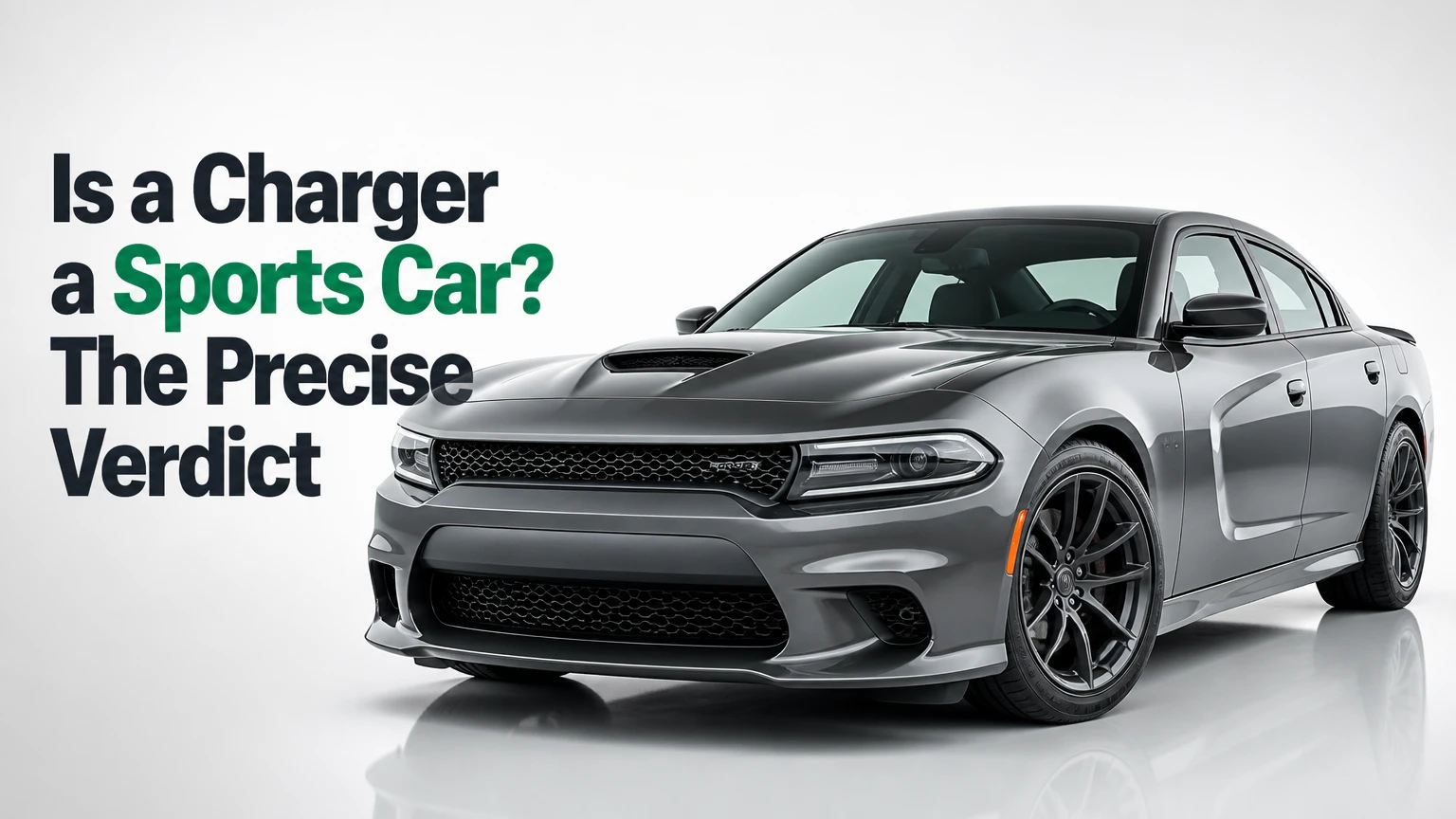
The Dodge Charger is traditionally a muscle car, not a conventional sports car. Its large body, rear-seat practicality, and emphasis on acceleration separate it from lightweight two-seat cars such as the Mazda MX-5 Miata or Porsche 718 Cayman, although modern Charger performance trims and the new Charger Daytona can deliver sports-car-level speed.
Key Facts at a Glance
- The Dodge Charger is generally classified as an American muscle car or performance sedan.
- A sports car prioritizes agility, low mass, steering feedback, and cornering balance more than passenger capacity.
- Classic Chargers from 1966-1978 were primarily two-door muscle coupes with rear-wheel drive and available V8 engines.
- The 2006-2023 Charger was a four-door sedan offered with V6, HEMI V8, rear-wheel-drive, and all-wheel-drive configurations.
- A modern Charger can be exceptionally quick without matching a lightweight sports car’s precision on a technical road.
- The correct answer depends on the model year, trim, body style, and whether acceleration or handling matters most.
Is a Charger a Sports Car by Definition?
The Dodge Charger is a muscle car first, a sports sedan second, and a sports car only in a loose performance sense. The distinction comes from engineering purpose: muscle cars traditionally maximize engine output and straight-line acceleration, while sports cars reduce mass and optimize cornering response, braking control, and driver feedback.
No universal legal rule determines whether a vehicle is a sports car. The U.S. Environmental Protection Agency classifies vehicles primarily by regulatory and fuel-economy categories, not by a single worldwide sports-car definition. Automotive dictionaries and enthusiasts therefore use functional criteria. The Oxford English Dictionary’s short description, “a car designed for high speed and agile handling,” captures why agility matters as much as speed.
The Charger’s architecture explains the usual classification. A four-door sedan with usable rear seats, a substantial trunk, and a curb weight commonly above 4,000 pounds has different priorities from a two-seat roadster weighing near 2,300 pounds. A Charger may outperform some sports cars in a drag race, yet remain less communicative and less nimble through a sequence of tight corners.
What Defines a Sports Car?
A conventional sports car normally combines a low seating position, a compact cabin, a short distance between the driver and the vehicle’s center of mass, and suspension tuning intended for rapid directional changes. Rear-wheel drive is common, but front-wheel-drive and all-wheel-drive sports cars also exist.
Typical reference points include:
| Attribute | Lightweight sports car | Dodge Charger example | Why it matters |
|---|---|---|---|
| Seating | 2-4 seats | 5 seats in the LD sedan | Passenger space adds mass and length |
| Typical curb weight | 2,300-3,500 lb | About 3,900-4,600 lb for many LD trims | More mass increases tire and brake workload |
| Main performance goal | Corner speed and feedback | Acceleration, highway speed, versatility | Purpose changes the driving character |
| Body format | Roadster, coupe, fastback | Sedan, coupe, or fastback depending on generation | Four doors favor everyday use |
| Typical examples | Mazda MX-5, Porsche 718 | Charger R/T, Scat Pack, Hellcat | Badges do not determine vehicle category |
The table describes broad patterns, not mandatory specifications. A Porsche 911 has rear seats and can weigh more than some small roadsters, while a Chevrolet Corvette can be fast in a straight line and highly capable in corners. Categories overlap at the edges.
How Has the Charger’s Identity Changed?
The Charger’s classification changed with its body style and mechanical priorities. The first-generation 1966 Charger was a fastback coupe, the 1968-1970 models became iconic American muscle cars, and the 2006 revival adopted a four-door sedan format that prioritized usable space without abandoning high-output engines.
| Charger era | Body style | Typical powertrain | Broad classification |
|---|---|---|---|
| 1966-1967 | 2-door fastback coupe | V8 and inline-six options | Personal-performance coupe |
| 1968-1970 | 2-door muscle coupe | 318, 383, 440, and HEMI V8 options | Classic muscle car |
| 1971-1978 | 2-door coupe | V8 and six-cylinder options | Personal coupe or muscle-derived coupe |
| 2006-2023 | 4-door sedan | V6, 5.7-liter HEMI, 6.4-liter V8, supercharged V8 | Performance sedan or modern muscle car |
| 2024 onward | 2-door and 4-door configurations by market and model | Battery-electric and turbocharged internal-combustion variants | Electrified muscle-oriented performance car |
The classic Charger’s long hood, rear-wheel-drive layout, and available big-block or HEMI engines made it a muscle-car benchmark. Its purpose was not identical to a lightweight European sports coupe, even when its quarter-mile performance was formidable.
The LD-generation Charger created the most common source of confusion. Dodge offered four doors, rear seats, and a large trunk, then installed engines capable of producing far more acceleration than the body style suggested. That combination makes the Charger a practical muscle sedan rather than a conventional sports car.
Which Charger Models Are Closest to a Sports Car?
The Charger Scat Pack Widebody and Hellcat variants are closest in dynamic capability, but none becomes a traditional lightweight sports car simply because it has more power. The Widebody’s wider tires, adaptive suspension, and larger brakes improve cornering and stopping, while the Hellcat’s supercharged V8 primarily intensifies acceleration.
| Charger version | Engine or propulsion | Approximate output | Dynamic emphasis |
|---|---|---|---|
| Charger SXT or GT | 3.6-liter Pentastar V6 | About 292-300 hp | Daily driving and available AWD |
| Charger R/T | 5.7-liter HEMI V8 | About 370 hp | Muscle-car sound and acceleration |
| Charger Scat Pack | 6.4-liter HEMI V8 | About 485 hp | Strong acceleration and track hardware |
| Charger Hellcat | 6.2-liter supercharged HEMI V8 | About 717 hp | Extreme straight-line performance |
| Charger Hellcat Redeye | 6.2-liter supercharged HEMI V8 | About 797 hp | Maximum power within the LD range |
Power figures vary by year, drivetrain, and market. The specifications above describe common North American LD-generation outputs rather than every production configuration.
The Scat Pack Widebody is the most convincing choice for a driver who wants a Charger on winding roads. Its 305-section rear tires, upgraded Brembo braking equipment, and adaptive damping give the chassis more control than a basic V6 sedan. The added tire grip cannot erase the vehicle’s length or mass.
The Hellcat is a different proposition. Its supercharged V8 can overwhelm the rear tires and demand restraint even when the chassis is pointed straight. A high horsepower figure proves acceleration potential, not sports-car balance.
Is the Charger a Sports Car When It Has Two Doors?
A two-door Charger is more sports-car-like than a four-door sedan because the shorter-access cabin and coupe body reduce practical compromises, but body style alone does not settle the classification. The new two-door Charger Daytona still follows a large, high-performance grand-tourer formula rather than the small, lightweight roadster formula.
A coupe roofline can improve visual proportions and reduce rear-door hardware, yet the vehicle may remain heavy because of its battery, structural reinforcement, sound insulation, and performance equipment. A two-door grand tourer prioritizes high-speed comfort and presence. A sports car prioritizes intimate dimensions and rapid responses.
What About the New Charger Daytona?
The new Dodge Charger Daytona expands the muscle-car formula with battery-electric power and a return to coupe and four-door body configurations. Electric motors provide immediate torque, while all-wheel-drive layouts can distribute power more effectively than a high-output rear-wheel-drive sedan.
Exact equipment, power, battery capacity, and pricing depend on model year and trim. The fundamental classification remains consistent: the Charger Daytona is a large performance vehicle designed for speed, road presence, and usable passenger space, not a minimalist sports car.
Dodge also developed the Fratzonic Chambered Exhaust for Daytona EV models. The system creates an amplified mechanical sound intended to preserve some of the sensory drama associated with combustion-powered muscle cars. The sound system changes the experience, not the vehicle’s mass or fundamental handling physics.
The internal-combustion Charger direction also matters. Turbocharged inline-six engines, often referred to as the Hurricane family, can deliver strong torque with fewer cylinders than the outgoing V8. Turbocharging changes the engine character, but a powerful engine in a large body still aligns more closely with a muscle or grand-touring philosophy.
How Does a Charger Handle?
A Charger handles securely and quickly in performance trims, but its mass produces more body movement, tire load, and braking demand than a lightweight sports car experiences. Adaptive dampers, wide tires, limited-slip differentials, and Brembo brakes compensate for the weight; they do not remove its consequences.
| Handling factor | Charger performance sedan | Lightweight sports car | Practical consequence |
|---|---|---|---|
| Curb weight | Roughly 4,000-4,600 lb in many LD trims | Roughly 2,300-3,500 lb | Charger changes direction with more inertia |
| Rear tire width | Up to about 305 mm on Widebody trims | Commonly 195-295 mm | Charger gains traction but increases replacement cost |
| Brake hardware | Four- or six-piston Brembo systems on performance trims | Vented performance brakes, often smaller | Charger can stop repeatedly, but heat load is higher |
| Wheelbase | About 120 inches for the LD sedan | About 90-108 inches for many sports cars | Longer Charger feels stable but less agile |
| Seating and cargo | Five seats and a full trunk | Often two seats and limited cargo | Charger is easier to use every day |
A short technical road exposes the difference. The Charger arrives with stability and strong traction, but a small sports car usually rotates more readily, needs fewer steering inputs, and communicates front-tire grip earlier. On a fast highway, the Charger’s long wheelbase and substantial power can feel more composed.
A practitioner rule of thumb is useful: every additional 500 pounds increases the energy the brakes and tires must manage at the same speed. Tire compound, alignment, and brake cooling therefore matter more on a heavy Charger than many new owners expect.
Is the Charger Better at Drag Racing?
The Charger is generally better suited to drag racing and high-speed overtaking than to tight autocross or narrow mountain roads. Rear-wheel-drive V8 trims, launch-control systems, performance tires, and high torque give the Charger a clear advantage when acceleration occurs in a straight line.
A typical performance launch involves:
- Selecting the appropriate drive mode.
- Bringing the tires to a suitable operating temperature at a controlled venue.
- Activating launch-control functions according to the owner’s manual.
- Releasing the brake while the vehicle’s computers manage torque and wheel slip.
- Monitoring tire temperature, brake temperature, and drivetrain warnings afterward.
Line Lock can hold the front brakes while the rear tires spin on some high-performance Chargers. That feature belongs on a drag strip or closed course, not a public road. Repeated launches also increase stress on half-shafts, driveshafts, differentials, tires, and transmission components.
The fastest Charger is not automatically the quickest car everywhere. A lightweight sports car can carry more speed into a corner and require less braking before the next straight.
Can a Charger Replace a Sports Car for Daily Use?
A Charger can replace a sports car for daily use when rear-seat access, cargo capacity, highway comfort, and straight-line power matter more than low-speed agility. The Charger cannot fully replace a small sports car for a driver whose priority is steering feel, low consumable costs, or track-day cornering.
| Daily-use criterion | Charger sedan | Mazda MX-5 Miata | Porsche 718 Cayman |
|---|---|---|---|
| Seating | 5 occupants | 2 occupants | 2 occupants |
| Cargo access | Large sedan trunk | Small trunk | Front and rear cargo areas |
| Typical fuel or energy focus | V6, V8, turbo-six, or EV | 4-cylinder gasoline | Turbocharged 4-cylinder or flat-six by trim |
| Highway comfort | Strong at long distances | More road and wind exposure | More focused ride |
| Rear-seat child-seat utility | Available in sedan configuration | Not available | Not available |
| Technical-road agility | Moderate to strong by trim | Very strong at modest speeds | Very strong at higher speeds |
The Charger makes sense for an owner who commutes during the week, carries adults or children, and wants dramatic acceleration without owning a second car. The Miata makes more sense for low-speed enjoyment, narrow roads, and inexpensive track learning.
The honest limitation is important: a Charger is not a sensible substitute for a sports car if the main activity is repeated cornering on a circuit. Consumable costs rise quickly because heavy vehicles use larger tires, larger brake components, and more fuel.
How Much Does a Charger Cost to Buy and Run?
A used modern Charger commonly costs about $15,000-$45,000 for ordinary V6 and R/T examples, while clean Scat Pack and Hellcat cars can range from roughly $40,000 to more than $100,000 depending on mileage, history, specification, and collector demand. New-generation pricing varies by market and equipment.
| Ownership item | Typical Charger range | Main cost driver |
|---|---|---|
| Used V6 or older R/T purchase | $15,000-$45,000 | Year, mileage, accident history |
| Used Scat Pack purchase | $35,000-$70,000 | Widebody equipment and condition |
| Used Hellcat purchase | $45,000-$100,000+ | Mileage, Last Call status, originality |
| Performance tire replacement | About $1,200-$2,500 per set | 20-inch wheels and 305-mm tires |
| High-performance brake service | About $1,000-$3,000 per axle | Rotor, pad, caliper, and labor choice |
| V8 fuel economy | Commonly high teens to low 20s mpg | Driving style, traffic, drivetrain |
These are typical U.S. market ranges, not fixed manufacturer prices. Insurance can be a larger variable than fuel, especially for supercharged trims and younger drivers. A buyer should obtain an insurance quote using the exact vehicle identification number before purchasing.
The cheapest Charger to buy may not be the cheapest to own. A neglected Scat Pack with worn tires, overheated brakes, or modified software can require several thousand dollars in immediate repairs.
Which Cars Should You Compare With a Charger?
The right alternative depends on the desired performance dimension. A Chevrolet Camaro or Ford Mustang offers a closer muscle-car comparison, a BMW M340i offers a sport-sedan comparison, and a Mazda MX-5 or Porsche 718 provides a genuine lightweight-sports-car benchmark.
| Alternative | Approximate role | Main advantage over Charger | Main disadvantage |
|---|---|---|---|
| Ford Mustang GT | 2+2 muscle coupe | Smaller footprint and strong V8 balance | Less rear-seat usability |
| Chevrolet Camaro SS | 2+2 muscle coupe | Sharper cornering focus | Restricted visibility and rear seats |
| BMW M340i | Sport sedan | Refined handling and compact dimensions | Higher complexity and purchase cost |
| Mazda MX-5 Miata | Lightweight roadster | Low mass and communicative handling | Two seats and modest power |
| Porsche 718 Cayman | Mid-engine sports coupe | Excellent balance and steering precision | High purchase and maintenance costs |
The Mustang and Camaro are closer to the Charger’s cultural category, but their shorter bodies can feel more manageable on a winding road. The BMW M340i offers a better comparison for someone who wants four doors and disciplined handling.
The Miata and Cayman answer a different question. They show what “sports car” means when cornering feedback and low mass are the primary design requirements.
What Are the Charger’s Performance Weaknesses?
The Charger’s main weaknesses are weight, braking heat, tire expense, and limited agility on tight roads. High-output trims also magnify driver mistakes because abundant torque can exceed rear-tire grip before the driver has time to correct the slide.
Common Charger Problems During Hard Driving
- Understeer: Entering a corner too quickly overloads the front tires, so the car widens its path. Reduce entry speed, maintain proper tire pressures, and avoid abrupt throttle changes.
- Rear wheelspin: Powerful rear-drive trims can break traction in wet conditions or with worn tires. Keep stability control active on public roads.
- Brake fade: A soft pedal after repeated stops indicates heat saturation. Use suitable high-temperature fluid and track-oriented pads only after confirming compatibility.
- Wheel hop: Repeated axle bouncing during launches can stress suspension and driveline parts. Stop the launch and inspect the vehicle before further hard use.
- Uneven tire wear: Aggressive alignment, heavy cornering, and incorrect pressure can destroy expensive tires quickly. Check tread and pressure before every performance drive.
The most counterintuitive issue is that more grip can expose the next weakness. Wider tires let a Charger enter a corner faster, but the brakes and suspension then have to dissipate more energy, so upgraded tires alone do not create a balanced track car.
The National Highway Traffic Safety Administration advises drivers to maintain control and obey posted limits; launch-control capability does not make public-road acceleration safe. Performance equipment should be used at a sanctioned drag strip, autocross, or road course.
Which Charger Should You Choose?
The best Charger depends on the driver’s purpose, not the maximum horsepower number. A GT suits practical all-weather use, an R/T provides traditional V8 character, a Scat Pack suits occasional performance driving, and a sports car remains better for dedicated cornering.
Choose a Charger GT for Daily Utility
The GT offers a practical entry point with a V6, four doors, and available all-wheel drive on applicable model years. It fits family use, commuting, and winter-weather needs better than a two-seat sports car, while its running costs generally remain below those of V8 and supercharged trims.
Choose a Charger R/T for Muscle-Car Character
The R/T’s 5.7-liter HEMI V8 supplies the sound and torque many buyers associate with a Charger. It is a sensible middle ground for someone who values engine character but does not need Scat Pack braking hardware or Hellcat-level acceleration.
Choose a Scat Pack Widebody for Mixed Road Use
The Scat Pack Widebody is the strongest LD-generation compromise for drivers who want acceleration and improved cornering control. Wide tires and larger brakes help on a road course, although the car still feels substantially heavier than a Mustang, Camaro, or Porsche Cayman.
Choose a Sports Car for Cornering Feedback
Choose a Mazda MX-5, Toyota GR86, Chevrolet Corvette, or Porsche 718 when steering communication, low mass, and corner-exit precision matter more than rear-seat capacity. The Charger cannot replicate that compact, immediate response through equipment upgrades alone.
FAQ
Is a Dodge Charger considered a muscle car?
Yes. The Dodge Charger is widely considered a muscle car because its identity centers on American styling, rear-wheel-drive availability, powerful engines, and straight-line acceleration. The 2006-2023 sedan also qualifies as a performance sedan because it combines muscle-car power with four doors, rear seats, and everyday practicality.
Is a Charger faster than a sports car?
A high-performance Charger can be faster than many sports cars in a straight line. Charger Hellcat variants produce more than 700 horsepower, while lighter sports cars often prioritize corner speed rather than maximum engine output. Acceleration, braking, and lap time measure different kinds of performance.
Is a Charger good for track days?
A Charger Scat Pack Widebody can work well for occasional track days after suitable inspection and preparation. The owner should budget for high-temperature brake fluid, track-capable pads, tire wear, and cooling checks. A lighter sports car usually costs less to operate and feels more agile over a full session.
Is a Charger a sedan or a coupe?
The answer depends on the generation. The 2006-2023 LD Charger is a four-door sedan, while classic Chargers were two-door coupes or fastbacks. The latest Charger range includes coupe and four-door configurations in applicable markets, so the model year must be specified before describing its body style.
Does the Charger handle like a Mustang?
A Charger and Ford Mustang can both be muscle cars, but they do not handle identically. The Mustang is generally smaller and more responsive on technical roads, while the Charger offers a longer wheelbase, greater cabin space, and stronger full-size stability. Trim, tires, suspension, and drivetrain can change the comparison.
Is the new electric Charger a sports car?
The electric Dodge Charger Daytona is better described as an electric muscle car or high-performance grand tourer than a traditional sports car. Instant motor torque can produce rapid acceleration, but the vehicle’s size, battery mass, and four-seat practicality keep its design philosophy closer to the Charger’s muscle-car heritage.
The Bottom Line
The answer to “is a charger a sports car” is usually no: the Dodge Charger is primarily a muscle car, performance sedan, or modern grand tourer. Its V8, turbocharged, and electric versions can deliver sports-car-level acceleration, but a lightweight sports car remains better for cornering agility, steering feedback, and low running costs.